Ideal Gas Law
High-Yield Trend
Questions 6 MCQs
Choose the correct option for graphical representation of Boyle's law, which shows a graph of pressure vs. volume of a gas at different temperatures:
| 1. | |
| 2. | |
| 3. | |
| 4. |
The correct option for the total pressure (in atm) in a mixture of 4 g O2 and 2 g H2 confined in a total volume of one liter at 0C is :
[Given R=0.082 L atm mol-1 K-1, T=273 K]
1. 25.18
2. 26.02
3. 2.518
3. 2.602
(Given R = 0.0831 L bar K-1 mol-1)
1. 4.9
2. 2.5
3. 498.6
4. 49.8
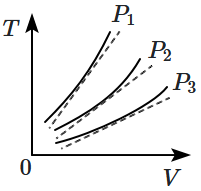
Then the correct relation is:
| 1. | 2. | ||
| 3. | 4. |
1.
2.
3.
4.
Given, and molecular mass of atm pressure
| 1. | 2. | ||
| 3. | 4. |
Preparing Ideal Gas Law for NEET
Ideal Gas Law is a specific sub-topic that frequently appears in the NEET examination. Understanding the underlying principles and practicing targeted questions is key to mastering this concept.
The questions compiled above are previous year questions (PYQs) directly related to Ideal Gas Law. Practicing these specific questions helps you understand the difficulty level and the examiner's approach to this topic.
Topic Frequently Asked Questions
Is Ideal Gas Law a high-weightage topic?
You can refer to the priority and consistency badges at the top of this page. High priority topics should be thoroughly revised multiple times before the exam.
Should I memorize the solutions?
No, it is highly recommended to understand the core concept and methodology behind each solution rather than memorizing them, as exact questions are rarely repeated, but the concepts definitely are.