Prisms
High-Yield Trend
Questions 6 MCQs
A ray of light is incident at an angle of incidence, , on one face of a prism of angle (assumed to be small) and emerges normally from the opposite face. If the refractive index of the prism is the angle of incidence , is nearly equal to:
| 1. | 2. | ||
| 3. | 4. |
The prism will:
| 1. | separate the blue colour part from the red and green colour. |
| 2. | separate all three colours from one another. |
| 3. | not separate the three colours at all. |
| 4. | separate the red colour part from the green and blue colours. |
A thin prism having refracting angle is made of glass of a refractive index . This prism is combined with another thin prism of glass with a refractive index . This combination produces dispersion without deviation. The refracting angle of the second prism should be:
| 1. | 2. | ||
| 3. | 4. |
The refractive index of the material of a prism is and the angle of the prism is One of the two refracting surfaces of the prism is made a mirror inwards with a silver coating. A beam of monochromatic light entering the prism from the other face will retrace its path (after reflection from the silvered surface) if the angle of incidence on the prism is:
| 1. | 2. | ||
| 3. | 4. | zero |
Find the value of the angle of emergence from the prism given below for the incidence ray shown. The refractive index of the glass is .
| 1. | 2. | ||
| 3. | 4. | |
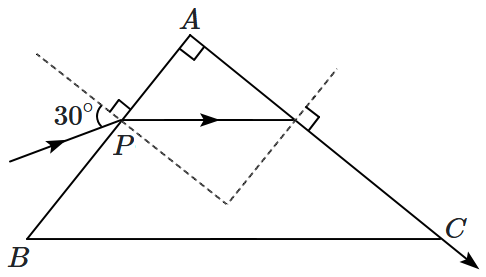
| 1. | 2. | ||
| 3. | 4. |
Preparing Prisms for NEET
Prisms is a specific sub-topic that frequently appears in the NEET examination. Understanding the underlying principles and practicing targeted questions is key to mastering this concept.
The questions compiled above are previous year questions (PYQs) directly related to Prisms. Practicing these specific questions helps you understand the difficulty level and the examiner's approach to this topic.
Topic Frequently Asked Questions
Is Prisms a high-weightage topic?
You can refer to the priority and consistency badges at the top of this page. High priority topics should be thoroughly revised multiple times before the exam.
Should I memorize the solutions?
No, it is highly recommended to understand the core concept and methodology behind each solution rather than memorizing them, as exact questions are rarely repeated, but the concepts definitely are.