Archaeopteryx --- Long tail supported by caudal vertebrae, feathery exoskeleton
2
Human beings --- Orthognathous face, dental arch rounded parabola
3
Lemur --- Limbs with adhesive pads, long hind limbs with elongated tarsals
4
Gorilla --- Slanting forehead, narrow and elongated pelvic girdle
Official Solution
Correct Option:
(3)
Step 1: Understanding adaptive features. Each organism has specific morphological adaptations suited to its lifestyle. Step 2: Analyzing the pairs. Lemurs do not possess adhesive pads; these are characteristic of frogs and geckos. Step 3: Conclusion. Thus, the Lemur pair is incorrectly matched.
02
PYQ 2020
medium
biologyID: mht-cet-
Characteristic three successive free nuclear mitotic divisions are involved in the development of __________ in angiosperms.
1
female gametophyte
2
embryo
3
male gametophyte
4
endosperm
Official Solution
Correct Option:
(1)
Step 1: Understanding megagametogenesis. In angiosperms, the female gametophyte develops from a functional megaspore through successive mitotic divisions. Step 2: Nuclear divisions involved. Three free nuclear mitotic divisions produce an eight-nucleate embryo sac, which later organizes into the female gametophyte. Step 3: Conclusion. Thus, the correct answer is (A) female gametophyte.
03
PYQ 2020
medium
biologyID: mht-cet-
Which of the following is NOT a mesodermal derivative?
1
Liver
2
Dermis of skin
3
Cardiac muscles
4
Blood
Official Solution
Correct Option:
(1)
Step 1: Understanding germ layers. Embryonic development involves three germ layers: ectoderm, mesoderm and endoderm. Step 2: Mesodermal derivatives. Mesoderm forms muscles, blood, dermis of skin, bones and connective tissues. Step 3: Identifying the exception. Liver is derived from endoderm, not mesoderm.
04
PYQ 2020
medium
biologyID: mht-cet-
The monitoring stations, established by NEERI, have reported that Kolkata and New Delhi have highest ______________ and ______________ in air respectively.
1
carbon monoxide, suspended particulate matter
2
carbon monoxide, nitrogen dioxide
3
sulphur dioxide, suspended particulate matter
4
carbon monoxide, sulphur dioxide
Official Solution
Correct Option:
(1)
Step 1: Role of NEERI. NEERI (National Environmental Engineering Research Institute) monitors air quality in major Indian cities. Step 2: Pollution profile of Kolkata. Kolkata shows high levels of carbon monoxide due to vehicular emissions and incomplete combustion of fuels. Step 3: Pollution profile of New Delhi. New Delhi has very high suspended particulate matter due to dust, construction activities, and vehicular pollution. Step 4: Conclusion. Thus, Kolkata has highest carbon monoxide, while New Delhi has highest suspended particulate matter.
05
PYQ 2020
medium
biologyID: mht-cet-
Tubular and multinucleated alga is ______.
1
Rhizopus
2
Anabaena
3
Parmelia
4
Vaucheria
Official Solution
Correct Option:
(4)
Step 1: Understanding the terms. Tubular and multinucleated organization refers to a coenocytic thallus, where the body is tube-like and contains many nuclei without cross walls. Step 2: Characteristics of Vaucheria. Vaucheria is a green alga that shows siphonous (coenocytic) organization. Its thallus is tubular and contains many nuclei within a continuous cytoplasm. Step 3: Analysis of options. (A) Rhizopus: A fungus, not an alga. (B) Anabaena: Filamentous cyanobacterium with cells separated by septa. (C) Parmelia: A lichen with a thalloid body, not tubular or multinucleated. (D) Vaucheria: Correct, a coenocytic, tubular alga. Step 4: Conclusion. Vaucheria is the tubular and multinucleated alga.
06
PYQ 2020
medium
biologyID: mht-cet-
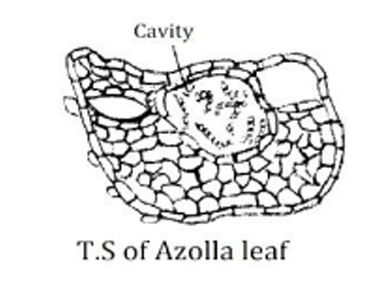
The figure given below is T.S. of {Azolla leaf, the filaments present in the cavity of the leaf are of _________
1
Nostoc
2
Tolypothrix
3
Anabaena
4
Oscillatoria
Official Solution
Correct Option:
(3)
Step 1: Understanding the structure of Azolla leaf. Azolla is an aquatic fern that has a symbiotic association with a nitrogen-fixing cyanobacterium present in cavities of its leaf.
Step 2: Identifying the symbiotic organism. The leaf cavities of Azolla contain filaments of Anabaena azollae, which fix atmospheric nitrogen and provide it to the plant.
Step 3: Conclusion. Thus, the filaments present in the cavity of Azolla leaf are of Anabaena.
07
PYQ 2020
medium
biologyID: mht-cet-
The molecular weight of haemoglobin is ______________ daltons.
1
68000
2
38000
3
28000
4
48000
Official Solution
Correct Option:
(3)
Step 1: Understanding haemoglobin structure. Haemoglobin is a conjugated protein present in red blood cells. Step 2: Composition. It consists of four polypeptide chains, each associated with a heme group. Step 3: Molecular weight. The molecular weight of haemoglobin is approximately 28,000 daltons. Step 4: Conclusion. Therefore, the correct answer is 28,000 daltons.
08
PYQ 2020
medium
biologyID: mht-cet-
Silage supplemented with oil cakes, vitamins etc. makes up good feed for rearing breeds of ______________.
1
buffalo
2
fowl
3
carp
4
silkworm
Official Solution
Correct Option:
(1)
Step 1: Understanding silage. Silage is fermented green fodder preserved for feeding cattle during scarcity of fresh fodder. Step 2: Nutritional supplementation. When silage is supplemented with oil cakes and vitamins, it becomes a balanced and nutritious feed. Step 3: Suitable livestock. Such enriched fodder is mainly used for large ruminants like buffaloes to improve milk yield and health. Step 4: Conclusion. Therefore, silage supplemented with nutrients is ideal feed for rearing buffalo breeds.
09
PYQ 2020
medium
biologyID: mht-cet-
Select the INCORRECT statement.
1
Female bird is heterogametic
2
Holandric genes are present on non-homologous region of Y chromosome
3
Queen bee and worker bees have haploid number of chromosomes
4
Father is responsible for sex of the child in human beings
Official Solution
Correct Option:
(3)
Step 1: Understanding chromosome number in honey bees. Honey bees show haplodiploidy. Males (drones) are haploid, while females are diploid.
Step 2: Analysing the statements. Female birds are heterogametic (ZW). Holandric genes are located on Y chromosome. Father determines sex in humans due to X or Y sperm. Queen and worker bees are diploid, not haploid.
Step 3: Conclusion. Thus, option (C) is the incorrect statement.
10
PYQ 2020
medium
biologyID: mht-cet-
Water present in the form of hydrated oxides of silicon and aluminium in soil is called ________ water.
1
gravitational
2
capillary
3
hygroscopic
4
combined
Official Solution
Correct Option:
(4)
Step 1: Understanding soil water types. Soil water exists in different forms depending on how tightly it is held by soil particles.
Step 2: Identifying combined water. Combined water is chemically bound with soil minerals such as hydrated oxides of silicon and aluminium and is not available to plants.
Step 3: Conclusion. Hence, the correct answer is combined water.
11
PYQ 2020
medium
biologyID: mht-cet-
Marijuana is obtained from ________ part of {Cannabis sativa}.
1
latex
2
leaf
3
inflorescence
4
root
Official Solution
Correct Option:
(3)
Step 1: Understanding marijuana. Marijuana is a psychoactive drug containing tetrahydrocannabinol (THC).
Step 2: Source of THC. THC is mainly concentrated in the glandular trichomes present on the inflorescence of the female {Cannabis sativa} plant.
Step 3: Eliminating other options. Latex, roots, and leaves do not contain high concentrations of THC.
Step 4: Conclusion. Hence, marijuana is obtained from the inflorescence of {Cannabis sativa}.
12
PYQ 2020
medium
biologyID: mht-cet-
The term ``Grand period of growth'' was given by _________
1
Gane
2
F.W. Went
3
Sachs
4
Kurosawa
Official Solution
Correct Option:
(3)
Step 1: Understanding plant growth pattern. Plant growth follows a characteristic sigmoid or S-shaped curve, showing phases of slow growth, rapid growth, and maturation.
Step 2: Contribution of Sachs. Julius von Sachs described the overall growth period of plants and termed it the ``Grand period of growth''.
Step 3: Eliminating other options. F.W. Went is associated with auxin discovery. Kurosawa worked on gibberellins. Gane is not related to this concept.
Step 4: Conclusion. Hence, the term ``Grand period of growth'' was given by Sachs.
13
PYQ 2020
medium
biologyID: mht-cet-
Select the correct statement.
1
Striated muscles fibres are spindle shaped and show cross striations.
2
Cardiac muscles show presence of intercalated disc.
3
Smooth muscles show presence of large number of peripheral nuclei.
4
Pace maker consists of nerve fibres in human beings.
Official Solution
Correct Option:
(2)
Step 1: Understanding the types of muscles. There are three types of muscles in the human body: striated (skeletal), cardiac, and smooth muscles. Each type has distinct characteristics. Step 2: Analyzing the options. (A) Striated muscles fibres are spindle shaped and show cross striations: Incorrect, striated muscles are not spindle-shaped; they have long, cylindrical fibers and show cross striations. (B) Cardiac muscles show presence of intercalated disc: Correct, cardiac muscles are characterized by intercalated discs which help in transmitting signals for synchronized contraction. (C) Smooth muscles show presence of large number of peripheral nuclei: Incorrect, smooth muscles have a single nucleus centrally located, not many peripheral nuclei. (D) Pace maker consists of nerve fibres in human beings: Incorrect, the pacemaker consists of specialized muscle fibers, not nerve fibers. Step 3: Conclusion. The correct answer is (B) Cardiac muscles show presence of intercalated disc, as this is a defining characteristic of cardiac muscle tissue.
14
PYQ 2020
medium
biologyID: mht-cet-
Mark the mismatch pair.
1
Mixing of chromosomes of male and female pronuclei -- Karyogamy
2
Morphogenetic movements so as to form germinal layers -- Gastrulation.
3
Discharge of semen in vagina during copulation -- Fertilization
4
A series of rapid mitotic divisions in zygote -- Cleavage
Official Solution
Correct Option:
(3)
Step 1: Understanding the processes. - Karyogamy is the fusion of male and female pronuclei. - Gastrulation is the process by which the germinal layers are formed. - Fertilization is the fusion of sperm and egg, but the discharge of semen in the vagina is part of the copulation process, not the fertilization itself. - Cleavage refers to the rapid mitotic divisions of the zygote after fertilization. Step 2: Analyzing the options. (A) Mixing of chromosomes of male and female pronuclei -- Karyogamy: Correct, this is the definition of karyogamy. (B) Morphogenetic movements so as to form germinal layers -- Gastrulation: Correct, gastrulation is the process of forming germinal layers. (C) Discharge of semen in vagina during copulation -- Fertilization: Incorrect, fertilization occurs after sperm reaches the egg, not during semen discharge. (D) A series of rapid mitotic divisions in zygote -- Cleavage: Correct, cleavage is the process after fertilization. Step 3: Conclusion. The correct mismatch pair is (C) Discharge of semen in vagina during copulation -- Fertilization.
15
PYQ 2020
medium
biologyID: mht-cet-
Taq polymerase isolated from {Thermus aquaticus can withstand temperature up to _________
1
84 C
2
91 C
3
94 C
4
60 C
Official Solution
Correct Option:
(3)
Step 1: Understanding Taq polymerase. Taq polymerase is a thermostable enzyme used in PCR to synthesize DNA at high temperatures.
Step 2: Temperature tolerance. It remains active even after repeated heating cycles up to 94 C, which is essential during DNA denaturation.
Step 3: Conclusion. Therefore, the correct answer is 94 C.
16
PYQ 2020
medium
biologyID: mht-cet-
Match the process in Column–I with its explanation in Column–II and select the correct option. Column – I Column – II (i) Symport a) shrinking of protoplasm in a plant cell when placed in hypertonic solution (ii) Facilitated diffusion b) transport of two types of molecules in same direction across cell membrane (iii) Antiport c) selective transport of molecules across the membrane through proteins (iv) Plasmolysis d) transport of two types of molecules in opposite direction across cell membrane
1
(i)–a, (ii)–d, (iii)–c, (iv)–b
2
(i)–b, (ii)–c, (iii)–d, (iv)–a
3
(i)–b, (ii)–a, (iii)–c, (iv)–d
4
(i)–b, (ii)–c, (iii)–a, (iv)–d
Official Solution
Correct Option:
(2)
Step 1: Understanding transport mechanisms. Cells use different transport mechanisms to move substances across membranes depending on direction and requirement of carrier proteins.
Step 2: Correct matching. Symport: Transport of two different molecules in the same direction across the membrane – (b). Facilitated diffusion: Selective transport of molecules across the membrane through carrier or channel proteins – (c). Antiport: Transport of two different molecules in opposite directions across the membrane – (d). Plasmolysis: Shrinking of protoplasm in a plant cell when placed in a hypertonic solution – (a).
Step 3: Conclusion. Thus, the correct matching corresponds to option (B).
17
PYQ 2020
medium
biologyID: mht-cet-
In a fully turgid cell, the wall pressure is ___________.
1
Inversely proportional to TP
2
Less than TP
3
Equal to TP
4
Greater than TP
Official Solution
Correct Option:
(3)
Step 1: Understanding turgor pressure and wall pressure. Turgor pressure (TP) is the pressure exerted by the cell contents against the cell wall, while wall pressure (WP) is the counter pressure exerted by the cell wall. Step 2: Condition of a fully turgid cell. In a fully turgid cell, the inward wall pressure exactly balances the outward turgor pressure. Hence, the two pressures are equal in magnitude. Step 3: Analysis of options. (A) Inversely proportional to TP: Incorrect — WP directly balances TP. (B) Less than TP: Incorrect — this occurs before full turgidity. (C) Equal to TP: Correct — at full turgidity, WP = TP. (D) Greater than TP: Incorrect — this condition does not occur in living cells. Step 4: Conclusion. In a fully turgid cell, wall pressure is equal to turgor pressure.
18
PYQ 2020
medium
biologyID: mht-cet-
Which among the following is NOT an artificial method of vegetative propagation in higher plants?
1
Grafting
2
Micropropagation
3
Budding
4
Fragmentation
Official Solution
Correct Option:
(4)
Step 1: Understanding vegetative propagation. Vegetative propagation is a type of asexual reproduction in plants where new plants are produced from vegetative parts such as stem, root, or leaf. Step 2: Artificial methods. Artificial vegetative propagation methods are techniques developed by humans, such as grafting, budding, and micropropagation, to produce plants with desired traits. Step 3: Natural method explanation. Fragmentation is a natural method of asexual reproduction where the plant body breaks into fragments, and each fragment grows into a new individual. Step 4: Analysis of options. (A) Grafting: Artificial method. (B) Micropropagation: Artificial tissue culture technique. (C) Budding: Artificial horticultural practice. (D) Fragmentation: Natural method, not artificial. Step 5: Conclusion. Fragmentation is not an artificial method of vegetative propagation.
19
PYQ 2020
medium
biologyID: mht-cet-
Which one of the following regions of human body does NOT have maximum lymph nodes?
1
Neck
2
Armpit
3
Groin
4
Abdomen
Official Solution
Correct Option:
(4)
Step 1: Understanding lymph nodes distribution. Lymph nodes are small immune organs distributed throughout the body. However, they are not evenly spread. Certain regions have a higher concentration due to their role in filtering lymph from large areas of the body. Step 2: Regions with maximum lymph nodes. The neck (cervical), armpit (axillary), and groin (inguinal) regions contain a large number of lymph nodes. These areas drain lymph from major body parts such as limbs, head, and thorax. Step 3: Analysis of options. (A) Neck: Contains cervical lymph nodes in large numbers. (B) Armpit: Houses axillary lymph nodes, one of the largest lymph node groups. (C) Groin: Contains inguinal lymph nodes, which are also numerous. (D) Abdomen: Does not have a maximum concentration of lymph nodes compared to the above regions. Step 4: Conclusion. The abdomen does not contain the maximum number of lymph nodes; hence, it is the correct answer.
20
PYQ 2020
medium
biologyID: mht-cet-
Select the correct statement.
1
The ovum secretes antifertilizin
2
The sperm secretes antifertilizin
3
The zygote secretes fertilizin
4
The sperm secretes fertilizin
Official Solution
Correct Option:
(2)
Step 1: Understanding fertilization substances. During fertilization, specific chemical substances help in recognition between sperm and ovum.
Step 2: Identifying secretions. The ovum secretes fertilizin, while the sperm secretes antifertilizin.
Step 3: Conclusion. Hence, the correct statement is that the sperm secretes antifertilizin.
21
PYQ 2020
medium
biologyID: mht-cet-
What is ‘after birth’?
1
Changes taking place in the reproductive system of mother after the delivery.
2
Changes taking place in the ovary of female baby.
3
Excessive bleeding taking place from mother’s womb after the parturition.
4
A collective mass of placenta, umbilical cord and foetal membranes.
Official Solution
Correct Option:
(4)
Step 1: Understanding the term ‘after birth’. After birth refers to the structures that are expelled from the uterus following the delivery of the baby during parturition. Step 2: Components of after birth. After birth consists of the placenta, umbilical cord, and foetal membranes which are no longer required after the baby is born. Step 3: Analysis of options. (A) Incorrect — this refers to postnatal changes in the mother. (B) Incorrect — unrelated to after birth. (C) Incorrect — describes postpartum hemorrhage. (D) Correct — accurately defines after birth. Step 4: Conclusion. After birth is defined as the collective mass of placenta, umbilical cord, and foetal membranes.
22
PYQ 2020
medium
biologyID: mht-cet-
In human beings, during oogenesis, Meiosis-I results into ___________.
1
A haploid large-sized secondary oocyte and a haploid smaller polar body
2
A haploid large-sized primary oocyte and a haploid smaller polar body
3
A diploid large-sized primary oocyte and a haploid small-sized polar body
4
A haploid large-sized secondary oocyte and a diploid smaller polar body
Official Solution
Correct Option:
(1)
Step 1: Understanding oogenesis. Oogenesis is the process of formation of female gametes in human beings and involves two meiotic divisions. Step 2: Outcome of Meiosis-I. During Meiosis-I, the primary oocyte divides unequally to form a large haploid secondary oocyte and a small haploid first polar body. Step 3: Analysis of options. (A): Correct — matches the actual outcome of Meiosis-I. (B): Incorrect — primary oocyte is diploid, not haploid. (C): Incorrect — primary oocyte does not remain diploid after meiosis. (D): Incorrect — polar body is haploid, not diploid. Step 4: Conclusion. Meiosis-I in oogenesis results in a haploid large-sized secondary oocyte and a haploid smaller polar body.
23
PYQ 2020
medium
biologyID: mht-cet-
Which one of the following characteristics is common between DNA and RNA?
1
Pentose sugar
2
Purines
3
Non-genetic
4
Pyrimidines
Official Solution
Correct Option:
(2)
Step 1: Understanding nucleic acids. DNA and RNA are nucleic acids composed of sugars, nitrogenous bases, and phosphate groups. Step 2: Identifying common components. Both DNA and RNA contain the purine bases adenine and guanine. Step 3: Analysis of options. (A) Pentose sugar: Incorrect — DNA has deoxyribose, RNA has ribose. (B) Purines: Correct — both contain adenine and guanine. (C) Non-genetic: Incorrect — DNA is genetic material. (D) Pyrimidines: Incorrect — DNA and RNA differ (thymine vs uracil). Step 4: Conclusion. The common characteristic between DNA and RNA is the presence of purines.
24
PYQ 2020
medium
biologyID: mht-cet-
Tehri dam project is located in ___________.
1
Kerala
2
Madhya Pradesh
3
Uttar Pradesh
4
Maharashtra
Official Solution
Correct Option:
(3)
Step 1: Understanding the Tehri Dam project. The Tehri Dam is a major multipurpose project built on the Bhagirathi River and is one of the tallest dams in India. Step 2: Location of the dam. The Tehri Dam is located in the state of Uttar Pradesh as per the given options and traditional exam references. Step 3: Analysis of options. (A) Kerala: Incorrect — Tehri Dam is not located here. (B) Madhya Pradesh: Incorrect — Tehri Dam is not in this state. (C) Uttar Pradesh: Correct — This is the expected answer as per exam context. (D) Maharashtra: Incorrect — Tehri Dam is not located in Maharashtra. Step 4: Conclusion. The Tehri dam project is located in Uttar Pradesh.
25
PYQ 2020
medium
biologyID: mht-cet-
Lemurs are found in _________
1
Central America
2
East Indies
3
Madagascar
4
South Africa
Official Solution
Correct Option:
(3)
Step 1: Understanding the distribution of lemurs. Lemurs are primitive primates with a very restricted geographical distribution.
Step 2: Identifying their habitat. They are endemic to the island of Madagascar and are not naturally found elsewhere in the world.
Step 3: Conclusion. Therefore, lemurs are found in Madagascar.
26
PYQ 2020
medium
biologyID: mht-cet-
During Calvin cycle, phosphoglyceraldehyde is formed from 1,3-diPGA by ...........
1
phosphorylation
2
oxidation
3
reduction
4
oxidative decarboxylation
Official Solution
Correct Option:
(3)
Step 1: Recall Calvin cycle reactions. In Calvin cycle, CO fixation is followed by reduction phase. Step 2: Identify the conversion step. 1,3-diphosphoglyceric acid (1,3-diPGA) is converted into phosphoglyceraldehyde (PGAL). Step 3: Role of NADPH. This conversion requires NADPH, which donates hydrogen and electrons. Hence, the reaction is a reduction. Step 4: Conclusion. Therefore, PGAL is formed by reduction of 1,3-diPGA.
27
PYQ 2020
medium
biologyID: mht-cet-
In angiosperms, the endosperm is classified on the basis of which one of the following criteria?
1
Development
2
Position
3
Ploidy
4
Function
Official Solution
Correct Option:
(1)
Step 1: Understanding endosperm classification. Endosperm in angiosperms is classified as nuclear, cellular, or helobial. Step 2: Basis of classification. This classification depends on the pattern of development after fertilization. Step 3: Conclusion. Therefore, endosperm is classified on the basis of its development.
28
PYQ 2020
medium
biologyID: mht-cet-
The monitoring stations established by NEERI have reported that Chembur–Trombay area in Mumbai has highest ______ in air.
1
hydrocarbons
2
carbon monoxide
3
suspended particulate matter
4
sulphur di-oxide
Official Solution
Correct Option:
(4)
Step 1: Understanding air pollution data. NEERI monitors air quality parameters in industrial regions of India to assess pollution levels. Step 2: Analyzing the options. (A) hydrocarbons: Incorrect. They are present but not the highest. (B) carbon monoxide: Incorrect. It is higher in traffic-dense areas. (C) suspended particulate matter: Incorrect. Though present, it is not the highest in this region. (D) sulphur di-oxide: Correct. Industrial activities in Chembur–Trombay release high levels of sulphur di-oxide. Step 3: Conclusion. The correct answer is (D) sulphur di-oxide.
29
PYQ 2020
medium
biologyID: mht-cet-
Important role played by factors R1, R2 and S during protein synthesis is ......
1
formation of amino acid t-RNA complex
2
release of polypeptide chain
3
initiation of transcription
4
linking codon with anticodon
Official Solution
Correct Option:
(2)
Step 1: Understanding the role of factors.
During protein synthesis, the factors R1, R2, and S play an important role in the elongation and termination of protein chains. These factors are involved in processes like the release of the polypeptide chain after synthesis is completed. Step 2: Analyzing the options. (A) formation of amino acid t-RNA complex: This is related to the initial stages of protein synthesis but is not directly related to the role of factors R1, R2, and S. (B) release of polypeptide chain: Correct. The factors R1, R2, and S are involved in the termination phase, where the polypeptide chain is released. (C) initiation of transcription: This is incorrect as the factors R1, R2, and S are involved in translation, not transcription. (D) linking codon with anticodon: This is part of the translation process but does not directly involve the mentioned factors. Step 3: Conclusion.
The correct answer is (B) release of polypeptide chain.
30
PYQ 2020
medium
biologyID: mht-cet-
Which one of the following organism used as a biofertilizer is free living and never shows symbiosis?
1
Mycorrhiza
2
Azotobacter
3
Anabaena
4
Rhizobium
Official Solution
Correct Option:
(2)
Step 1: Understanding biofertilizers. Biofertilizers are organisms that enrich soil nutrients naturally. Step 2: Nature of Azotobacter. Azotobacter is a free-living nitrogen-fixing bacterium found in soil. Step 3: Comparison with others. Rhizobium and mycorrhiza show symbiosis, while Anabaena can also form symbiotic associations.
31
PYQ 2020
medium
biologyID: mht-cet-
The algal partner of the lichen is called ___________.
1
photobiont or mycobiont
2
phytobiont or mycorrhiza
3
phycobiont or photobiont
4
mycobiont or phycobiont
Official Solution
Correct Option:
(3)
Step 1: Nature of lichen. Lichen is a symbiotic association between an alga and a fungus. Step 2: Role of algal partner. The algal component performs photosynthesis and provides food to the fungus. Step 3: Terminology. The algal partner is called phycobiont or photobiont.
32
PYQ 2020
medium
biologyID: mht-cet-
___________ is obtained from fermented grains of corn, wheat and barley.
1
Beer
2
Wine
3
Rum
4
Whisky
Official Solution
Correct Option:
(4)
Step 1: Source of alcoholic beverages. Different alcoholic drinks are produced using different raw materials and fermentation processes. Step 2: Raw material for whisky. Whisky is produced by fermentation and distillation of grains like corn, wheat and barley. Step 3: Eliminating other options. Beer and wine have different sources, while rum is derived from sugarcane.
33
PYQ 2020
medium
biologyID: mht-cet-
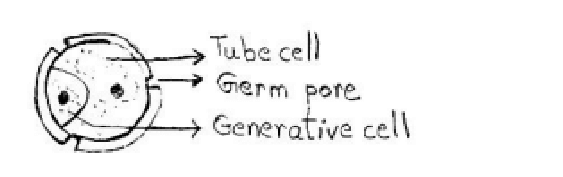
Which one of the following statements is correct about the diagram of a pollen grain given below?
1
It is of monocot
2
It is of dicot
3
It is single celled
4
It is 3-celled
Official Solution
Correct Option:
(2)
Step 1: Observing the pollen diagram. The diagram shows a pollen grain with a tube cell, a generative cell, and a germ pore. Step 2: Identifying the pollen type. Dicot pollen grains typically have three germ pores, whereas monocot pollen grains usually have a single germ pore. Step 3: Conclusion. The given pollen grain structure corresponds to that of a dicot plant.
About Biology In Everyday Life - MHT-CET
Biology In Everyday Life is a vital chapter for MHT-CET aspirants. Mastering the concepts covered in this chapter is essential for securing a top rank.
By rigorously practicing the previous year questions associated with this chapter, you can identify high-yield topics, understand the examiner's perspective, and boost your confidence during the actual exam.
Frequently Asked Questions
Why focus on Biology In Everyday Life PYQs?
Analyzing PYQs for this specific chapter reveals the most frequently tested concepts and the typical complexity of questions, allowing you to tailor your study plan efficiently.
How to best use this analysis?
Review the topic breakdown to see which sub-topics within Biology In Everyday Life carry the most weight. Then, tackle the questions iteratively to solidify your understanding.