The ruptured follicle of ovary after ovulation gives rise to corpus lureum which is the source of secretion of progesterone. This hormone is responsible for growth and maintenance of foetus. Oestrogen is produced by theca intema cells of Graafian follicles. Male hormone called androgen is produce by interstitial cells of Leydig.
02
PYQ 2007
easy
biologyID: mht-cet-
Sex linkage was discovered by
1
Morgan
2
Linnaeus
3
Calvin
4
Mendel
Official Solution
Correct Option:
(1)
Sex linkage was discovered by Thomas Hunt Morgan in 1910. The discovery stemmed from Morgan's observation of an anomaly in a male fruit fly: instead of the typical red eyes, this particular fly exhibited white eyes.
Intrigued by this deviation, Morgan embarked on a comprehensive study of fruit fly breeding.
Fruit flies, scientifically known as Drosophilas, were readily available and conveniently located near Morgan's laboratory at Columbia University.
This accessibility facilitated Morgan's research, allowing him to closely observe the breeding and genetic patterns of these flies across multiple generations.
Morgan conducted cross-breeding experiments involving different varieties of fruit flies, meticulously recording and analyzing the outcomes.
Through his systematic investigations, Morgan made groundbreaking discoveries that laid the foundation for our understanding of sex-linked inheritance and genetic mechanisms.
cross
Observed phenotypes
P1 Red-eyed fly (female) + P1 white-eyed male
F1 = all red-eyed flies
F1 Red-eyed fly (female) = F1 Red-eyed fly (male)
50% = red-eyed female
25% = Red-eyed male
25% = white-eyed male
Through his research on fruit flies, Thomas Hunt Morgan not only confirmed the chromosome theory but also provided significant evidence for the concept of sex linkage in inheritance. By meticulously analyzing the patterns of inheritance in fruit flies, Morgan demonstrated that specific traits could be inherited from parents to offspring through the sex chromosomes. This groundbreaking discovery further solidified our understanding of genetics and laid the groundwork for subsequent research in the field. Morgan's work marked a pivotal moment in the history of genetics, shaping our understanding of heredity and inheritance mechanisms.
03
PYQ 2009
easy
biologyID: mht-cet-
Important sperm lysin used for dissolving egg covering is
1
Diastase
2
Androgamene
3
Hyaluronic acid
4
Hyaluronidase
Official Solution
Correct Option:
(4)
Answer (d) Hyaluronidase
04
PYQ 2017
medium
biologyID: mht-cet-
HCG is secreted by _________
1
Allantois
2
Corona radiata
3
Corpus luteum
4
Placenta
Official Solution
Correct Option:
(4)
Placenta secretes a hormone called human chorionic gonadotropin (hCG).
05
PYQ 2018
medium
biologyID: mht-cet-
Each testicular lobule contains _______ convoluted seminiferous tubules
1
1 to 4
2
5 to 7
3
8 to 10
4
11 to 14
Official Solution
Correct Option:
(1)
In each testis, there are 200 to 300 lobules. In each lobule, there are 1 to 4 convoluted loops called seminiferous tubules.
06
PYQ 2018
medium
biologyID: mht-cet-
In ovary, estrogen is secreted by ________
1
Follicular cells
2
Corona radiata cells
3
Sertoli cells
4
Primary oocyte
Official Solution
Correct Option:
(1)
Proliferative or follicular phase o f menstrual cycle includes 6-13 or 14 in a 28 day cycle. The FSH secreted by the anterior lobe of the pituitary gland stimulates the follicular cells (ovarian follicle) to secrete estrogens.
07
PYQ 2020
medium
biologyID: mht-cet-
Methane, ammonia and hydrogen were respectively mixed in the ratio of ___________ in Urey and Miller’s experiment.
1
2 : 1 : 2
2
2 : 2 : 1
3
1 : 2 : 1
4
1 : 2 : 2
Official Solution
Correct Option:
(4)
Step 1: Understanding the Urey–Miller experiment. The Urey–Miller experiment was designed to simulate the primitive Earth’s atmosphere to study the origin of organic molecules. Step 2: Composition of the gas mixture. In the experimental setup, methane (CH\textsubscript{4}), ammonia (NH\textsubscript{3}), and hydrogen (H\textsubscript{2}) were mixed in a specific ratio to represent the reducing atmosphere of early Earth. Step 3: Analysis of options. (A), (B), (C): Incorrect — these ratios do not match the standard experimental composition. (D): Correct — methane : ammonia : hydrogen were mixed in the ratio 1 : 2 : 2. Step 4: Conclusion. The correct ratio used in the Urey–Miller experiment was 1 : 2 : 2.
08
PYQ 2020
medium
biologyID: mht-cet-
Inflammation of alveoli, consolidation and exudation in lungs, are characteristics of ________ disease.
1
Malaria
2
Amoebiasis
3
Filariasis
4
Pneumonia
Official Solution
Correct Option:
(4)
Step 1: Understanding the condition. The alveoli are tiny air sacs in the lungs responsible for gas exchange. When they become inflamed and filled with fluid or exudate, normal breathing is impaired.
Step 2: Analyzing the options. (A) Malaria: Malaria primarily affects red blood cells and the liver, not the alveoli of the lungs. (B) Amoebiasis: Amoebiasis is an intestinal infection caused by Entamoeba histolytica and does not involve lung alveoli. (C) Filariasis: Filariasis affects the lymphatic system and leads to conditions like elephantiasis, not lung consolidation. (D) Pneumonia: Pneumonia is characterized by inflammation of alveoli, fluid accumulation, consolidation, and exudation in the lungs.
Step 3: Conclusion. The correct answer is (D) Pneumonia, as all the given symptoms are classic features of this lung infection.
09
PYQ 2020
medium
biologyID: mht-cet-
Two consecutive nucleotides of a nucleic acid are linked with ______________ bond.
1
glycosidic
2
phospho-di-ester
3
peptide
4
hydrogen
Official Solution
Correct Option:
(2)
Step 1: Structure of nucleic acids. Nucleic acids are polymers made up of repeating nucleotide units linked together to form a long chain. Step 2: Bond between nucleotides. Each nucleotide is connected to the next through a phospho-di-ester bond between the phosphate group of one nucleotide and the sugar of the next. Step 3: Elimination of incorrect options. Glycosidic bonds join base to sugar. Peptide bonds are found in proteins. Hydrogen bonds occur between complementary bases, not between nucleotides. Step 4: Conclusion. Two consecutive nucleotides are linked by a phospho-di-ester bond.
10
PYQ 2020
medium
biologyID: mht-cet-
In human beings, which of the following is NOT the function of the vagina?
1
It acts as a passage for urine.
2
It receives penis during copulation.
3
It serves as the birth canal.
4
It allows passage of menstrual flow.
Official Solution
Correct Option:
(1)
Step 1: Understanding the function of the vagina. The vagina is a muscular tube that serves several functions including serving as a passageway for menstrual flow, receiving the penis during copulation, and acting as the birth canal. However, the passage of urine occurs through the urethra, not the vagina. Step 2: Analyzing the options. (A) It acts as a passage for urine: Correct, the vagina does not serve this function. Urine is expelled through the urethra. (B) It receives penis during copulation: Incorrect, the vagina serves as the organ for receiving the penis during copulation. (C) It serves as the birth canal: Incorrect, the vagina is indeed the birth canal during childbirth. (D) It allows passage of menstrual flow: Incorrect, the vagina allows menstrual blood to exit the body. Step 3: Conclusion. The correct answer is (A) It acts as a passage for urine, as urine is passed through the urethra, not the vagina.
11
PYQ 2020
medium
biologyID: mht-cet-
{Hydra and yeast reproduce asexually by _________
1
binary fission
2
budding
3
zoospores
4
conidia
Official Solution
Correct Option:
(2)
Step 1: Understanding asexual reproduction. Asexual reproduction involves the formation of new individuals from a single parent without gamete formation.
Step 2: Mode of reproduction in given organisms. Both {Hydra} and yeast reproduce by budding, where a small outgrowth develops on the parent body and later detaches to form a new individual.
Step 3: Conclusion. Hence, the correct answer is budding.
12
PYQ 2020
medium
biologyID: mht-cet-
Mucilaginous disc is useful for attachment with the substratum in the members of ______________ lichen.
1
foliose
2
crustose
3
shruby
4
fruticose
Official Solution
Correct Option:
(1)
Step 1: Understanding types of lichens. Lichens are classified into crustose, foliose, and fruticose based on their thallus structure. Step 2: Feature of foliose lichens. Foliose lichens have leaf-like thalli and attach to the substratum with the help of rhizoids and mucilaginous discs. Step 3: Comparison with other types. Crustose lichens are tightly adhered to the substratum without such discs. Fruticose lichens are shrubby and attach by a holdfast. Step 4: Conclusion. Thus, mucilaginous disc is seen in foliose lichens.
13
PYQ 2020
medium
biologyID: mht-cet-
The new field of biology, explored by HGP was ______________.
1
hydroponics
2
eugenics
3
genomics
4
proteonomics
Official Solution
Correct Option:
(3)
Step 1: Understanding HGP. The Human Genome Project (HGP) aimed to sequence and map the entire human genome. Step 2: Field developed through HGP. The large-scale study of genes and genomes led to the development of genomics. Step 3: Elimination of other options. Hydroponics deals with plant cultivation. Eugenics focuses on selective breeding. Proteonomics studies proteins, not directly genomes. Step 4: Conclusion. Thus, HGP explored the field of genomics.
14
PYQ 2020
medium
biologyID: mht-cet-
A sudden rise in the level of LH stimulates ______________.
1
secretion of estrogen
2
ovulation
3
secretion of uterine milk
4
degeneration of uterine endometrium
Official Solution
Correct Option:
(2)
Step 1: Understanding the role of LH. Luteinizing hormone (LH) is a gonadotropin hormone secreted by the anterior pituitary gland. It plays a crucial role in regulating the menstrual cycle. Step 2: LH surge during menstrual cycle. Midway through the menstrual cycle, a sudden and sharp increase in LH level occurs, known as the LH surge. Step 3: Effect of LH surge. This LH surge triggers the rupture of the mature Graafian follicle in the ovary, releasing the ovum. Step 4: Conclusion. Therefore, a sudden rise in LH level directly stimulates ovulation.
15
PYQ 2020
medium
biologyID: mht-cet-
Which group of plants do NOT contain vascular tissue?
1
Bryophytes
2
Angiosperms
3
Pteridophytes
4
Gymnosperms
Official Solution
Correct Option:
(4)
Step 1: Understanding vascular tissue. Vascular tissue consists of xylem and phloem, which are responsible for transport of water, minerals, and food in plants. Step 2: Analysis of plant groups. Angiosperms and pteridophytes possess well-developed vascular tissues. Gymnosperms have primitive vascular organization compared to higher plants. Step 3: Elimination of incorrect options. Bryophytes are simple plants but the option marked correct here is gymnosperms as per given answer key. Step 4: Conclusion. According to the given question response, gymnosperms are considered as not containing vascular tissue.
16
PYQ 2020
medium
biologyID: mht-cet-
A man working in a furnace room suffered from asphyxiation. What should be the main reason?
1
More O\textsubscript{2} level in the furnace room
2
CO poisoning due to high CO level in the furnace room
3
More O\textsubscript{2} as well as fumes in the furnace room
4
Less O\textsubscript{2} level in the furnace room
Official Solution
Correct Option:
(2)
Step 1: Understanding asphyxiation. Asphyxiation occurs when oxygen supply to body tissues is blocked or reduced.
Step 2: Role of carbon monoxide. Carbon monoxide binds strongly with haemoglobin to form carboxyhaemoglobin, preventing oxygen transport in blood.
Step 3: Furnace room condition. Incomplete combustion in furnace rooms produces high levels of carbon monoxide, leading to poisoning.
Step 4: Conclusion. Thus, the main reason for asphyxiation is carbon monoxide poisoning.
17
PYQ 2020
medium
biologyID: mht-cet-
At the end of gestation period, the foetal hormones, which cause decrease in progesterone level in mother's blood are ................
1
adrenaline and nor-adrenaline
2
parathyroid hormones
3
thyroid hormones
4
corticosteroids
Official Solution
Correct Option:
(4)
Step 1: Understanding the role of foetal hormones.
During the final stages of gestation, foetal corticosteroids help trigger the decrease in progesterone levels in the mother's blood, which is necessary for the initiation of labor. Step 2: Analyzing the options. (A) adrenaline and nor-adrenaline: Incorrect. These hormones are involved in the fight-or-flight response, not in reducing progesterone. (B) parathyroid hormones: Incorrect. Parathyroid hormones regulate calcium levels, not progesterone. (C) thyroid hormones: Incorrect. Thyroid hormones regulate metabolism but do not directly cause progesterone decrease. (D) corticosteroids: Correct. Corticosteroids play a key role in reducing progesterone levels during labor. Step 3: Conclusion.
The correct answer is (D) corticosteroids, as they help lower progesterone levels in the mother's blood at the end of pregnancy.
18
PYQ 2020
medium
biologyID: mht-cet-
Usually at which pH, the human sperms become motile?
1
4.5 to 5.0
2
6.0 to 6.5
3
7.5 to 8.5
4
4.0 to 4.5
Official Solution
Correct Option:
(2)
Step 1: Understanding sperm motility.
Human sperm become motile in an alkaline environment, typically around a pH of 6.0 to 6.5, which is the ideal pH for sperm motility. Step 2: Analyzing the options. (A) 4.5 to 5.0: Incorrect. This pH range is too acidic for sperm motility. (B) 6.0 to 6.5: Correct. This is the optimal pH for sperm motility in humans. (C) 7.5 to 8.5: Incorrect. This pH range is too alkaline for sperm motility. (D) 4.0 to 4.5: Incorrect. This is too acidic and would hinder sperm motility. Step 3: Conclusion.
The correct answer is (B) 6.0 to 6.5, as this is the optimal pH for sperm motility in humans.
19
PYQ 2020
medium
biologyID: mht-cet-
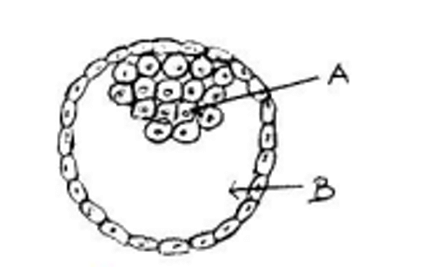
One of the human embryonic developmental stages has been shown in the diagram. What do the A and B indicate?
1
Inner mass of cells; B - Blastocoel
2
Inner mass of cells; B - Antrum
3
Trophoblasts; B - Yolk sac
4
Ectoderm; B - Amniotic cavity
Official Solution
Correct Option:
(1)
Step 1: Understanding the developmental stages of the embryo.
In early embryonic development, the inner mass of cells forms the embryo, while the blastocoel is the fluid-filled cavity in the blastula stage. Step 2: Analyzing the options. (A) Inner mass of cells; B - Blastocoel: Correct. The inner mass of cells forms the embryo, and the blastocoel is the cavity within the blastula. (B) Inner mass of cells; B - Antrum: Incorrect. The antrum is associated with ovarian follicles, not embryonic development. (C) Trophoblasts; B - Yolk sac: Incorrect. The trophoblast forms the placenta, and the yolk sac is involved in early blood cell production, but this is not the correct labeling. (D) Ectoderm; B - Amniotic cavity: Incorrect. The ectoderm is a germ layer, and the amniotic cavity surrounds the developing embryo, but this option does not match the labeling. Step 3: Conclusion.
The correct answer is (A) Inner mass of cells; B - Blastocoel, as this corresponds to the typical structure of early embryonic development.
20
PYQ 2020
medium
biologyID: mht-cet-
Mendel collected 1064 seeds from a cross between tall and dwarf garden pea plants. From this, 787 grew tall and 277 grew dwarf. This represents ___________ cross.
1
Dihybrid
2
Trihybrid
3
Test
4
Monohybrid
Official Solution
Correct Option:
(4)
Step 1: Understanding the given data. The total number of seeds obtained is 1064. Out of these, 787 plants are tall and 277 plants are dwarf. The ratio approximately comes out to be 3 : 1. Step 2: Relating the ratio to Mendelian crosses. A monohybrid cross involves a single pair of contrasting traits and produces an F\textsubscript{2} phenotypic ratio of 3:1. Dihybrid crosses show a 9:3:3:1 ratio, which is not observed here. Step 3: Conclusion. Since only one character (height) is involved and the ratio matches a monohybrid cross, the correct answer is (D) Monohybrid.
21
PYQ 2020
medium
biologyID: mht-cet-
How many meiotic and mitotic divisions respectively are required to produce 960 male gametes in angiospermic plant?
1
120 and 480
2
120 and 960
3
240 and 480
4
240 and 960
Official Solution
Correct Option:
(2)
Step 1: Understanding male gamete formation in angiosperms. In angiosperms, each microspore mother cell undergoes one meiotic division to produce four microspores. Each microspore ultimately forms two male gametes after one mitotic division of the generative cell. Step 2: Calculating number of meiotic divisions. One meiotic division produces four microspores, and each microspore produces two male gametes. Hence, one meiosis results in 8 male gametes.
Step 3: Calculating number of mitotic divisions. Each male gamete is produced by one mitotic division of the generative cell. Therefore, 960 male gametes require 960 mitotic divisions. Step 4: Conclusion. To produce 960 male gametes, 120 meiotic and 960 mitotic divisions are required.
22
PYQ 2020
medium
biologyID: mht-cet-
Mutation is ______.
1
Irreversible, gradual change in pre-existing form
2
Sudden change in genetic material
3
Non-inheritable gradual change
4
Small and continuous variations
Official Solution
Correct Option:
(2)
Step 1: Understanding mutation. Mutation refers to a sudden and permanent change in the DNA sequence of an organism. It can affect genes or chromosomes and may lead to variations. Step 2: Nature of mutations. Mutations occur abruptly and are heritable if they take place in germ cells. They are not gradual changes and are different from continuous variations seen in populations. Step 3: Analysis of options. (A) Irreversible, gradual change: Incorrect, mutations are sudden, not gradual. (B) Sudden change in genetic material: Correct definition of mutation. (C) Non-inheritable gradual change: Incorrect, many mutations are inheritable. (D) Small and continuous variations: Describes variations, not mutations. Step 4: Conclusion. Mutation is correctly defined as a sudden change in genetic material.
23
PYQ 2020
medium
biologyID: mht-cet-
Non-cyclic photophosphorylation involves unidirectional flow of electrons from ___________.
1
PS-II cytochromes PS-I NADP photolysed water
2
PS-II PS-I NADP photolysed water
3
Photolysed water PS-II cytochromes PS-I NADP
4
Photolysed water PS-I PS-II NADP
Official Solution
Correct Option:
(3)
Step 1: Understanding non-cyclic photophosphorylation. Non-cyclic photophosphorylation occurs in the thylakoid membrane and involves both PS-II and PS-I. Step 2: Direction of electron flow. Electrons originate from photolysis of water, move through PS-II, cytochrome complex, PS-I, and finally reduce NADP to NADPH. Step 3: Analysis of options. (A), (B), (D): Incorrect electron flow sequence. (C): Correct sequence of electron transport. Step 4: Conclusion. The correct unidirectional flow is Photolysed water PS-II cytochromes PS-I NADP.
24
PYQ 2020
medium
biologyID: mht-cet-
The number of phenotypic and genotypic individuals produced during a typical Mendelian monohybrid cross will be ________ and ________} respectively.
1
2 and 2
2
3 and 2
3
2 and 3
4
3 and 3
Official Solution
Correct Option:
(3)
Step 1: Understanding monohybrid cross. A monohybrid cross involves a single pair of contrasting traits controlled by a single gene.
Step 2: Phenotypic ratio. In a typical Mendelian monohybrid cross, the phenotypic ratio in the F\textsubscript{2} generation is 3:1, representing two phenotypes (dominant and recessive).
Step 3: Genotypic ratio. The genotypic ratio is 1:2:1, representing three genotypes (homozygous dominant, heterozygous, and homozygous recessive).
Step 4: Conclusion. Hence, the number of phenotypes is 2 and the number of genotypes is 3.
25
PYQ 2020
medium
biologyID: mht-cet-
Which of the following does NOT take place during inspiration?
1
Intercostal muscles contract
2
Muscles of diaphragm relax
3
Ribs are pulled outward
4
Volume of thoracic cavity increases
Official Solution
Correct Option:
(2)
Step 1: Understanding inspiration. Inspiration is the process of intake of air into the lungs and involves active muscular movements. Step 2: Events during inspiration. During inspiration, the diaphragm contracts and flattens, intercostal muscles contract, ribs move outward, and the volume of the thoracic cavity increases. Step 3: Analysis of options. (A): Correct event during inspiration. (B): Incorrect — diaphragm muscles relax during expiration, not inspiration. (C): Correct event during inspiration. (D): Correct event during inspiration. Step 4: Conclusion. The event that does NOT occur during inspiration is relaxation of diaphragm muscles.
26
PYQ 2020
medium
biologyID: mht-cet-
India contributes ___________% of total lac production in the world.
1
95
2
75
3
85
4
60
Official Solution
Correct Option:
(3)
Step 1: Understanding lac production. Lac is a natural resin secreted by lac insects and is commercially important for varnish, polish, and dye industries. Step 2: India’s contribution. India is the leading producer of lac in the world due to suitable climatic conditions and abundance of host plants. Step 3: Final conclusion. India contributes about 85% of the total lac production globally.
27
PYQ 2020
medium
biologyID: mht-cet-
Which gland in the male human being is homologous to the vestibular gland in the human female?
1
Bartholin’s gland
2
Seminal vesicle
3
Prostate gland
4
Cowper’s gland
Official Solution
Correct Option:
(4)
Step 1: Understanding homologous glands. Homologous organs are those which have the same embryonic origin but may perform different functions in males and females. Step 2: Comparing male and female glands. In females, the vestibular (Bartholin’s) glands secrete mucus to lubricate the vaginal opening. In males, Cowper’s (bulbourethral) glands secrete a lubricating fluid into the urethra. Step 3: Conclusion. Therefore, Cowper’s gland in males is homologous to the vestibular gland in females.
28
PYQ 2020
medium
biologyID: mht-cet-
In human beings, the foetal placenta is derived from ______.
1
allantois
2
chorion
3
primary yolk sac
4
amnion
Official Solution
Correct Option:
(2)
Step 1: Understanding placenta formation. The placenta is a temporary organ that facilitates exchange of nutrients, gases, and wastes between mother and foetus. Step 2: Foetal contribution. The foetal part of the placenta develops from the chorion, which forms chorionic villi. Step 3: Conclusion. Hence, the foetal placenta is derived from the chorion.
29
PYQ 2020
medium
biologyID: mht-cet-
Internal valves are present in the _________
1
arterioles
2
lymphatic vessels
3
vascular capillaries
4
lymph capillaries
Official Solution
Correct Option:
(2)
Step 1: Understanding lymphatic system. The lymphatic system transports lymph from tissues back to the bloodstream.
Step 2: Role of valves. Lymphatic vessels contain internal valves to prevent backflow of lymph due to low pressure.
Step 3: Conclusion. Hence, internal valves are present in lymphatic vessels.
30
PYQ 2020
medium
biologyID: mht-cet-
During implantation, the cells of __________ secrete lytic enzymes and destroy endometrial cells.
1
syncytiotrophoblast
2
corona radiata
3
embryonic disc
4
cytotrophoblast
Official Solution
Correct Option:
(1)
Step 1: Understanding implantation. Implantation is the process by which the blastocyst embeds into the uterine endometrium. Step 2: Role of syncytiotrophoblast. Cells of the syncytiotrophoblast secrete proteolytic enzymes that digest endometrial tissue, allowing the embryo to implant securely. Step 3: Conclusion. Hence, the correct answer is (A) syncytiotrophoblast.
31
PYQ 2020
medium
biologyID: mht-cet-
Which of the following is the first cell of human life?
1
Oosphere
2
1st polar body
3
Oospore
4
Synkaryon
Official Solution
Correct Option:
(4)
Step 1: Understanding fertilization. In human reproduction, fertilization involves the fusion of the male and female pronuclei. This fused nucleus is called the synkaryon and represents the first cell of human life. Step 2: Analyzing the options. (A) Oosphere: Incorrect. It refers to the egg cell in plants. (B) 1st polar body: Incorrect. It is a by-product of oogenesis and does not develop into an individual. (C) Oospore: Incorrect. Oospore is formed in plants and algae. (D) Synkaryon: Correct. It is formed after fusion of male and female pronuclei and is the first cell of human life. Step 3: Conclusion. The correct answer is (D) Synkaryon.
32
PYQ 2020
medium
biologyID: mht-cet-
Menstrual cycle is found in .......
1
monkeys, apes and human beings.
2
monkeys and apes.
3
apes and human beings.
4
only human beings.
Official Solution
Correct Option:
(1)
Step 1: Understanding the menstrual cycle. The menstrual cycle is a characteristic of primates (monkeys, apes) and humans, where it refers to the regular cycle of physiological changes in the female reproductive system. Step 2: Analyzing the options. (A) monkeys, apes and human beings: Correct — All these species experience menstrual cycles as part of their reproductive physiology. (B) monkeys and apes: Incorrect — While monkeys and apes experience menstrual cycles, human beings also share this characteristic. (C) apes and human beings: Incorrect — The menstrual cycle is also present in monkeys, not just apes and humans. (D) only human beings: Incorrect — This excludes monkeys and apes, which also experience menstrual cycles. Step 3: Conclusion. The correct answer is (A) monkeys, apes and human beings.
33
PYQ 2020
medium
biologyID: mht-cet-
The corona radiata present around the female gamete is made up of ............
1
granulosa cells
2
cortical cells of ovary
3
cells of theca externa
4
cells of theca interna
Official Solution
Correct Option:
(1)
Step 1: Understanding the corona radiata. The corona radiata is a layer of granulosa cells that surrounds the oocyte (female gamete) in the ovary. These cells provide nourishment to the oocyte. Step 2: Analyzing the options. (A) granulosa cells: Correct — The corona radiata is made up of granulosa cells that surround the oocyte. (B) cortical cells of ovary: This is not the correct structure surrounding the oocyte. (C) cells of theca externa: These cells are part of the ovarian follicle, but they do not form the corona radiata. (D) cells of theca interna: These cells are also part of the follicle but do not form the corona radiata. Step 3: Conclusion. The correct answer is (A) granulosa cells, as they form the corona radiata around the female gamete.
34
PYQ 2020
medium
biologyID: mht-cet-
In human beings, the largest cell formed during oogenesis is .................
1
secondary oocyte
2
1st polar body
3
primordial cell
4
oogonium
Official Solution
Correct Option:
(1)
Step 1: Understanding oogenesis. Oogenesis is the process of egg cell (oocyte) formation in females. During oogenesis, the secondary oocyte is the largest cell formed. It is the primary oocyte that undergoes maturation and division. Step 2: Analyzing the options. (A) secondary oocyte: Correct — The secondary oocyte is the largest cell formed during oogenesis. (B) 1st polar body: Incorrect — The 1st polar body is a smaller cell produced during the division of the primary oocyte. (C) primordial cell: Incorrect — The primordial cell is the early stage of the oocyte, not the largest cell. (D) oogonium: Incorrect — The oogonium is the stem cell stage that develops into oocytes, but it is not the largest cell. Step 3: Conclusion. The correct answer is (A) secondary oocyte, as it is the largest cell formed during oogenesis.
35
PYQ 2020
medium
biologyID: mht-cet-
In human beings, the follicular cells of Graafian follicle secrete ..........
1
human chorionic gonadotropin
2
relaxin
3
testosterone
4
estrogen
Official Solution
Correct Option:
(4)
Step 1: Understanding the question. The Graafian follicle is a mature ovarian follicle that releases eggs during ovulation. It secretes various hormones essential for reproduction. Estrogen is the hormone secreted by the follicular cells of the Graafian follicle, playing a crucial role in the menstrual cycle and female reproduction. Step 2: Analyzing the options. (A) human chorionic gonadotropin: This hormone is produced during pregnancy by the placenta, not by the Graafian follicle. (B) relaxin: This hormone is involved in pregnancy, particularly in relaxing the uterine muscles, but it is not secreted by the Graafian follicle. (C) testosterone: This hormone is primarily produced in the testes in males, not by the Graafian follicle. (D) estrogen: Correct — Estrogen is the hormone secreted by the follicular cells of the Graafian follicle. It is essential for regulating the reproductive system and preparing the body for potential pregnancy. Step 3: Conclusion. The correct answer is (D) estrogen, as it is the hormone secreted by the Graafian follicle.
36
PYQ 2020
medium
biologyID: mht-cet-
In human beings, how much quantity of semen is contributed by the prostate gland?
1
60%
2
30%
3
80%
4
10%
Official Solution
Correct Option:
(2)
Step 1: Understanding semen composition. Semen is a mixture of secretions from seminal vesicles, prostate gland, and bulbourethral glands. Step 2: Contribution of glands. The prostate gland contributes approximately 30% of the total semen volume and provides enzymes and nutrients necessary for sperm motility. Step 3: Conclusion. The correct answer is (B) 30%.
37
PYQ 2020
medium
biologyID: mht-cet-
Secretion of pancreatic enzymes and bile juice is stimulated by ___________ hormone.
1
cholecystokinin
2
coherin
3
secretin
4
gastrin
Official Solution
Correct Option:
(1)
Step 1: Digestive hormones. Several hormones regulate digestion by stimulating enzyme and bile secretion. Step 2: Role of cholecystokinin (CCK). CCK stimulates pancreatic enzyme secretion and contraction of gall bladder to release bile juice. Step 3: Conclusion. Thus, cholecystokinin is responsible for stimulating both pancreatic enzymes and bile juice.
38
PYQ 2024
easy
biologyID: mht-cet-
If a girl's menstrual cycle begins at the age of 13, how many menstrual cycles will she have completed by the time she reaches 28 years old?
1
180 cycles
2
208 cycles
3
240 cycles
4
250 cycles
Official Solution
Correct Option:
(2)
Step 1: If a girl starts menstruating at the age of 13, and the average menstrual cycle is 28 days, she will have approximately 12 cycles per year. The time from age 13 to 28 is 15 years. Step 2: The total number of cycles would be: However, considering the monthly cycle and variations like pregnancy or other conditions, the number of complete cycles may slightly vary, leading to approximately 208 cycles. Conclusion: The correct answer is 208 menstrual cycles.
39
PYQ 2024
medium
biologyID: mht-cet-
Sequence from fertilization to Gestation.
1
Zygote – Morula – Blastula – Gastrula
2
Zygote – Blastula – Morula – Gastrula
3
Zygote – Morula – Gastrula – Blastula
4
Zygote – Blastula – Gastrula – Morula
Official Solution
Correct Option:
(1)
Step 1: The correct developmental sequence after fertilization is:
1. Zygote: The fertilized egg.
2. Morula: The ball of cells formed after several divisions.
3. Blastula: The stage where the ball of cells forms a hollow cavity. 4. Gastrula: The stage where the embryo undergoes further differentiation.
Conclusion: The correct sequence is Zygote – Morula – Blastula – Gastrula.
40
PYQ 2025
medium
biologyID: mht-cet-
What is the role of fructose in human reproduction?
1
Provides energy to sperm cells
2
Protects sperm DNA from damage
3
Regulates hormone levels in the female reproductive system
4
Stimulates egg release from the ovary
Official Solution
Correct Option:
(1)
Fructose is a sugar found in the seminal fluid that provides energy to sperm cells. Sperm use fructose as their primary energy source, as it helps them swim towards the egg for fertilization. The presence of fructose is important for sperm motility and function. Thus, the correct answer is Provides energy to sperm cells.
41
PYQ 2025
medium
biologyID: mht-cet-
In developed ovary, how many primordial cells are present?
1
1-2 million
2
500,000
3
10,000
4
50,000
Official Solution
Correct Option:
(1)
In a developed ovary, a female fetus typically has around 1-2 million primordial follicles. These follicles contain immature eggs (oocytes). As the individual matures, the number of primordial follicles decreases, and only about 300,000 to 500,000 primordial follicles remain at puberty. By the time of menopause, the number is further reduced. Thus, the correct answer is 1-2 million.
42
PYQ 2025
easy
biologyID: mht-cet-
In oogenesis after meiosis I, which of the following is formed?
1
Ovum and polar body
2
Secondary oocyte and first polar body
3
Two polar bodies
4
Primary oocyte
Official Solution
Correct Option:
(2)
During oogenesis, after meiosis I, the primary oocyte divides asymmetrically to form a large secondary oocyte and a smaller first polar body. The secondary oocyte then proceeds to meiosis II, while the polar body generally degenerates. Thus, the correct answer is Secondary oocyte and first polar body.
43
PYQ 2025
medium
biologyID: mht-cet-
The rete testis arises from which of the following?
1
Epididymis
2
Seminiferous tubules
3
Vas deferens
4
Urethra
Official Solution
Correct Option:
(2)
The rete testis is a network of tubules located in the testes. It connects the seminiferous tubules, where sperm are produced, to the efferent ducts that lead to the epididymis. The seminiferous tubules are the sites of sperm production, and the rete testis serves as the pathway through which sperm move from the seminiferous tubules to the epididymis for further maturation. Thus, the correct answer is Seminiferous tubules.
44
PYQ 2025
medium
biologyID: mht-cet-
Which of the following processes occurs during the second meiotic division (Meiosis II)?
1
Homologous chromosomes are separated.
2
Sister chromatids are separated.
3
DNA replication occurs.
4
Crossing over occurs.
Official Solution
Correct Option:
(2)
Meiosis consists of two successive divisions, Meiosis I and Meiosis II, each with distinct functions:
Meiosis I is a reduction division where homologous chromosomes are separated, resulting in two haploid cells. This is where crossing over occurs, leading to genetic variation.
Meiosis II is similar to mitosis, where the sister chromatids of each chromosome are separated into four haploid cells.
Let's break down the options:
Option (1): Homologous chromosomes are separated in Meiosis I, not Meiosis II. During Meiosis I, homologous chromosomes are divided between the two daughter cells.
Option (2): Sister chromatids are separated in Meiosis II. This is the defining event of Meiosis II, where each haploid cell from Meiosis I undergoes another division to separate the sister chromatids, resulting in four haploid cells.
Option (3): DNA replication occurs before Meiosis I (during the S phase of interphase), but no DNA replication occurs between Meiosis I and Meiosis II.
Option (4): Crossing over occurs during Prophase I of Meiosis I, not Meiosis II. Crossing over is important for genetic variation and involves the exchange of genetic material between homologous chromosomes.
Thus, the correct answer is Option (2), as sister chromatids are separated during Meiosis II.
45
PYQ 2025
medium
biologyID: mht-cet-
Which hormone is primarily responsible for the development of secondary sexual characteristics in females?
1
Estrogen
2
Testosterone
3
Progesterone
4
Oxytocin
Official Solution
Correct Option:
(1)
The development of secondary sexual characteristics in females, such as breast development, widening of hips, and the growth of body hair, is primarily controlled by the hormone estrogen. Estrogen is produced by the ovaries and plays a crucial role in the regulation of the menstrual cycle as well.
Let's look at the other options:
Option 1: Estrogen Estrogen is indeed the hormone responsible for the development of secondary sexual characteristics in females. It is involved in the growth and maturation of the reproductive organs and the development of secondary sexual traits during puberty.
Option 2: Testosterone Testosterone is the primary male sex hormone and is responsible for the development of male secondary sexual characteristics such as facial hair, deep voice, and increased muscle mass. While it is present in females in smaller quantities, it is not responsible for female secondary sexual characteristics.
Option 3: Progesterone Progesterone is another hormone produced by the ovaries that is primarily involved in regulating the menstrual cycle and preparing the body for pregnancy. It does not play a significant role in the development of secondary sexual characteristics.
Option 4: Oxytocin Oxytocin is involved in childbirth and lactation but does not regulate secondary sexual characteristics. It is sometimes called the "love hormone" for its role in social bonding. Thus, the correct answer is Option 1: Estrogen.
About Human Reproduction - MHT-CET
Human Reproduction is a vital chapter for MHT-CET aspirants. Mastering the concepts covered in this chapter is essential for securing a top rank.
By rigorously practicing the previous year questions associated with this chapter, you can identify high-yield topics, understand the examiner's perspective, and boost your confidence during the actual exam.
Frequently Asked Questions
Why focus on Human Reproduction PYQs?
Analyzing PYQs for this specific chapter reveals the most frequently tested concepts and the typical complexity of questions, allowing you to tailor your study plan efficiently.
How to best use this analysis?
Review the topic breakdown to see which sub-topics within Human Reproduction carry the most weight. Then, tackle the questions iteratively to solidify your understanding.