A population is a group of all ______________ in a given time.
1
individuals on this planet
2
individuals belonging to same species
3
plants only
4
animals only
Official Solution
Correct Option:
(2)
Step 1: Definition of population. In ecology, a population refers to organisms of the same species living in a specific area at a particular time. Step 2: Key features. All individuals belong to the same species and share resources and habitat. Step 3: Elimination of incorrect options. Population does not include all organisms of the planet or only plants or animals. Step 4: Conclusion. Thus, a population is a group of individuals belonging to the same species.
02
PYQ 2020
medium
biologyID: mht-cet-
Duct of Bellini is formed by joining ___________ collecting ducts.
1
4--5
2
7--8
3
12--14
4
9--11
Official Solution
Correct Option:
(2)
Step 1: Understanding the structure. The duct of Bellini, also known as the papillary duct, is present in the renal medulla of the kidney. It plays an important role in urine transport. Step 2: Formation of duct of Bellini. Several collecting ducts merge together in the renal papilla to form a single large duct called the duct of Bellini. Step 3: Correct anatomical detail. Approximately 7–8 collecting ducts unite to form one duct of Bellini. Step 4: Analysis of options. (A) 4--5: Incorrect. Too few collecting ducts. (B) 7--8: Correct. This is the standard anatomical number. (C) 12--14: Incorrect. Excessively high number. (D) 9--11: Incorrect. Not supported by standard anatomy.
03
PYQ 2020
medium
biologyID: mht-cet-
Identify A and B in the following statement. During vaccine production, toxins are altered to obtain .............. A which acts as an antigen and then mixed with ............ B to improve immune response.
1
A - adjuvant, B - toxoid
2
A - diluent, B - adjuvant
3
A - toxoid, B - adjuvant
4
A - toxoid, B - diluent
Official Solution
Correct Option:
(3)
Step 1: Understanding the components. In vaccine production, toxins (such as tetanus or diphtheria toxin) are altered to become "toxoids," which can no longer cause disease but still stimulate the immune system to generate an immune response. These toxoids are mixed with adjuvants, which enhance the immune response. Step 2: Analyzing the options. (A) A - adjuvant, B - toxoid: Incorrect — Adjuvants enhance immune response, but they are not the altered toxin. The toxoid is the altered toxin, not adjuvant. (B) A - diluent, B - adjuvant: Incorrect — A diluent is used to dilute the vaccine, but it is not the toxin. (C) A - toxoid, B - adjuvant: Correct — Toxoids are the altered toxins, and adjuvants are mixed with them to improve immune response. (D) A - toxoid, B - diluent: Incorrect — A diluent is not involved in enhancing immune response. Step 3: Conclusion. The correct answer is (C) A - toxoid, B - adjuvant, as the altered toxins (toxoid) are mixed with adjuvants to enhance immune response.
04
PYQ 2020
easy
biologyID: mht-cet-
The correct path of transport of urine is ..............
Official Solution
Correct Option:
(1)
05
PYQ 2020
medium
biologyID: mht-cet-
Select the correct match with reference to excretion.
1
Ornithine cycle - uric acid synthesis
2
Camel - uricotelic animal
3
Low threshold substance - glucose
4
High threshold substance - amino acids
Official Solution
Correct Option:
(4)
Step 1: Understanding the question. The question asks for the correct match of terms related to excretion, focusing on the threshold of substances. Step 2: Analyzing the options. (A) Ornithine cycle - uric acid synthesis: The ornithine cycle does not directly correlate with uric acid synthesis; it is involved in the urea cycle. (B) Camel - uricotelic animal: Camels are not uricotelic (excreting uric acid). They are ureotelic, excreting urea to conserve water. (C) Low threshold substance - glucose: This is incorrect because glucose is not a low-threshold substance. Its threshold is typically high. (D) High threshold substance - amino acids: Correct — Amino acids are typically high threshold substances as they are reabsorbed in the kidneys until a certain threshold is surpassed. Step 3: Conclusion. The correct answer is (D) High threshold substance - amino acids, as amino acids are reabsorbed until a certain concentration is reached.
06
PYQ 2020
medium
biologyID: mht-cet-
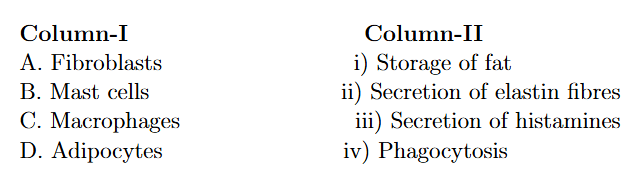
Match the Column-I with Column-II and select the correct option.
1
A-iv, B-i, C-ii, D-iii
2
A-ii, B-iii, C-iv, D-i
3
A-i, B-ii, C-iii, D-iv
4
A-iii, B-ii, C-i, D-iv
Official Solution
Correct Option:
(2)
Step 1: Function of fibroblasts. Fibroblasts are connective tissue cells responsible for the secretion of fibres like collagen and elastin. Step 2: Function of mast cells. Mast cells release histamine and heparin during inflammatory responses. Step 3: Function of macrophages. Macrophages are phagocytic cells involved in engulfing pathogens and debris. Step 4: Function of adipocytes. Adipocytes store fat and help in energy reserve.
07
PYQ 2024
medium
biologyID: mht-cet-
Match the following:
Animal
Excretory Organs
1
1-b, 2-a, 3-d, 4-c
2
1-a, 2-b, 3-c, 4-d
3
1-c, 2-d, 3-a, 4-b
4
1-d, 2-c, 3-b, 4-a
Official Solution
Correct Option:
(1)
In this matching problem, the correct pairings are:
1. Earthworm – Green gland (b)
2. Crustaceans – Metanephridia (a)
3. Insects – Tube feet (d)
4. Echinoderms – Malpighian tubules (c)
08
PYQ 2024
medium
biologyID: mht-cet-
What is the main excretory product in the Animal Kingdom?
1
Ammonia
2
Urea
3
Uric acid
4
Depends on the species
Official Solution
Correct Option:
(4)
Excretory products depend on the species and their environment: Ammonia: Excreted by aquatic animals (ammonotelic) as it requires abundant water. Urea: Excreted by mammals (ureotelic), requiring moderate water. Uric acid: Excreted by birds and reptiles (uricotelic), conserving water.
Adaptations are linked to habitat and water availability. Final Answer:
About Excretory System - MHT-CET
Excretory System is a vital chapter for MHT-CET aspirants. Mastering the concepts covered in this chapter is essential for securing a top rank.
By rigorously practicing the previous year questions associated with this chapter, you can identify high-yield topics, understand the examiner's perspective, and boost your confidence during the actual exam.
Frequently Asked Questions
Why focus on Excretory System PYQs?
Analyzing PYQs for this specific chapter reveals the most frequently tested concepts and the typical complexity of questions, allowing you to tailor your study plan efficiently.
How to best use this analysis?
Review the topic breakdown to see which sub-topics within Excretory System carry the most weight. Then, tackle the questions iteratively to solidify your understanding.