Which one of the following is a non-endospermic seed?
1
Gram
2
Maize
3
Castor
4
Sunflower
Official Solution
Correct Option:
(1)
Step 1: Understanding non-endospermic seeds. Non-endospermic (exalbuminous) seeds store food in cotyledons and lack endosperm at maturity. Step 2: Option analysis. Gram is a dicot seed where endosperm is absorbed during development, making it non-endospermic. Step 3: Conclusion. Therefore, the correct answer is Gram.
02
PYQ 2020
medium
biologyID: mht-cet-
In inflammatory response, A and B are released by damaged mast cells and basophils.
1
A – histamines, B – lymphokines
2
A – perforins, B – interferons
3
A – lymphokines, B – perforins
4
A – histamines, B – prostaglandins
Official Solution
Correct Option:
(4)
Step 1: Understanding inflammatory response. Inflammation is the body’s immediate response to injury or infection. Step 2: Role of mast cells and basophils. Damaged mast cells and basophils release chemical mediators that increase blood flow and vascular permeability. Step 3: Chemicals released. Histamines cause vasodilation and increased permeability. Prostaglandins intensify inflammation and pain response. Step 4: Conclusion. Thus, histamines and prostaglandins are released during inflammatory response.
03
PYQ 2020
medium
biologyID: mht-cet-
The large number of genetically identical offsprings produced by micropropagation are called ______________.
1
drones
2
clones
3
siblings
4
twins
Official Solution
Correct Option:
(2)
Step 1: Understanding micropropagation. Micropropagation is a tissue culture technique used to produce a large number of plants in a short time. Step 2: Genetic nature of micropropagated plants. All plants produced by micropropagation originate from the same parent tissue and are genetically identical. Step 3: Terminology. Genetically identical individuals produced asexually are called clones. Step 4: Conclusion. Therefore, offsprings produced by micropropagation are called clones.
04
PYQ 2020
medium
biologyID: mht-cet-
Which one of the following shows interspecific competition?
1
Between tree and orchid
2
Between two Peepal trees
3
Between lions and leopards
4
Between tiger and camel
Official Solution
Correct Option:
(3)
Step 1: Understanding interspecific competition. Interspecific competition occurs between individuals of different species competing for the same resources. Step 2: Analysis of given options. Tree and orchid show commensalism. Two Peepal trees represent intraspecific competition. Tiger and camel do not compete for the same resources. Step 3: Correct identification. Lions and leopards are different species competing for similar prey in the same habitat. Step 4: Conclusion. Hence, interspecific competition is seen between lions and leopards.
05
PYQ 2020
medium
biologyID: mht-cet-
During phase of cell enlargement in plant growth, solute concentration favours ______________.
1
endosmosis
2
plasmolysis
3
imbibition
4
exosmosis
Official Solution
Correct Option:
(1)
Step 1: Understanding cell enlargement. Cell enlargement in plants occurs mainly due to the uptake of water into the vacuole, which increases turgor pressure. Step 2: Role of solute concentration. Higher solute concentration inside the cell lowers the water potential of the cell sap. Step 3: Movement of water. Water enters the cell from the surrounding medium through a semi-permeable membrane, a process known as endosmosis. Step 4: Conclusion. Therefore, solute concentration during cell enlargement favours endosmosis.
06
PYQ 2020
medium
biologyID: mht-cet-
In incomplete dominance each of the parental traits reappears in the F generation by ...........%.
1
75
2
100
3
25
4
50
Official Solution
Correct Option:
(1)
Step 1: Understanding incomplete dominance. In incomplete dominance, neither allele is completely dominant, and the heterozygous condition shows an intermediate phenotype. Step 2: F phenotypic ratio. The F generation shows a phenotypic ratio of 1 : 2 : 1, where both parental phenotypes appear once each. Step 3: Calculating percentage. Out of four offspring, three show either parental or intermediate traits. Hence, parental traits together appear in 3 out of 4 individuals. Step 4: Final calculation.
07
PYQ 2020
medium
biologyID: mht-cet-
During Krebs cycle, the intermediate -ketoglutarate is formed as a result of ______________.
1
hydration of oxalosuccinate
2
oxidation of succinyl co-A
3
oxidation of cis-aconitate
4
decarboxylation of oxalosuccinate
Official Solution
Correct Option:
(4)
Step 1: Understanding Krebs cycle. Krebs cycle is a cyclic series of enzyme-controlled reactions involved in aerobic respiration. Step 2: Formation of -ketoglutarate. Isocitrate is first oxidized to oxalosuccinate. Oxalosuccinate then undergoes decarboxylation to form -ketoglutarate. Step 3: Identifying the correct process. The key step forming -ketoglutarate is decarboxylation of oxalosuccinate. Step 4: Conclusion. Hence, -ketoglutarate is formed by decarboxylation of oxalosuccinate.
08
PYQ 2020
medium
biologyID: mht-cet-
Epihydrophily is observed in which of the following plants?
1
Vallisneria
2
Lotus
3
Ceratophyllum
4
Zostera
Official Solution
Correct Option:
(1)
Step 1: Understanding epihydrophily. Epihydrophily is a type of pollination that occurs on the surface of water. Step 2: Example plant. In Vallisneria, male flowers detach and float on the water surface to reach female flowers. Step 3: Comparison. Zostera shows hypohydrophily (pollination under water). Step 4: Conclusion. Hence, epihydrophily is observed in Vallisneria.
09
PYQ 2020
medium
biologyID: mht-cet-
Deficiency of which of the following hormones leads to infertility in male and female human beings?
1
LTH
2
FSH
3
ACTH
4
TSH
Official Solution
Correct Option:
(2)
Step 1: Understanding the role of FSH. Follicle Stimulating Hormone (FSH) is secreted by the anterior pituitary gland and plays a crucial role in reproduction. Step 2: Role of FSH in males and females. In males, FSH stimulates spermatogenesis in the seminiferous tubules. In females, FSH stimulates the development of ovarian follicles and estrogen secretion. Step 3: Conclusion. Deficiency of FSH disrupts gamete formation in both sexes, leading to infertility. Hence, the correct answer is (B) FSH.
10
PYQ 2020
medium
biologyID: mht-cet-
___________ gives seeds protection against mechanical shock, dry conditions, etc.
1
Testa
2
Tegmen
3
Scutellum
4
Endosperm
Official Solution
Correct Option:
(1)
Step 1: Structure of seed coat. The seed coat consists of two layers: outer testa and inner tegmen. Step 2: Protective role. The testa is thick and tough, providing protection against mechanical injury, dehydration, and adverse environmental conditions. Step 3: Analysis of options. (A) Testa: Correct. It is the outer protective layer of seed. (B) Tegmen: Incorrect. It is thin and lies beneath testa. (C) Scutellum: Incorrect. It is a cotyledon in monocots. (D) Endosperm: Incorrect. It provides nourishment, not protection.
11
PYQ 2020
medium
biologyID: mht-cet-
Spinal cord is a cylindrical tube with a narrow cavity, lined by ependymal cells. This cavity is called ___________.
1
central canal
2
neural canal
3
inguinal canal
4
central sulcus
Official Solution
Correct Option:
(1)
Step 1: Structure of spinal cord. The spinal cord contains a small central cavity that runs longitudinally through it. Step 2: Lining of the cavity. This cavity is lined by ependymal cells, which are specialized glial cells. Step 3: Identification of the cavity. (A) central canal: Correct. It is the cavity present inside the spinal cord. (B) neural canal: Incorrect. This term is not used for spinal cord cavity. (C) inguinal canal: Incorrect. It is related to the abdominal region. (D) central sulcus: Incorrect. It is a groove on the brain surface.
12
PYQ 2020
medium
biologyID: mht-cet-
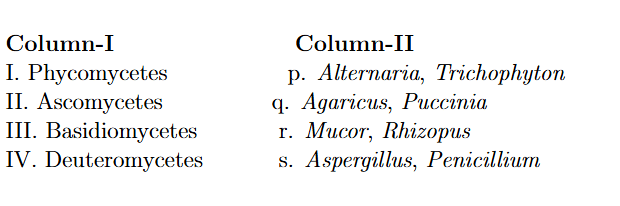
Column-I consists of names of fungi classes while Column-II consists of names of genera. Find out the correct option.
1
I–r, II–s, III–q, IV–p
2
I–p, II–q, III–r, IV–s
3
I–q, II–r, III–s, IV–p
4
I–s, II–r, III–p, IV–q
Official Solution
Correct Option:
(1)
Step 1: Identifying characteristic genera of each fungal class. Phycomycetes include simple fungi like {Mucor} and {Rhizopus}. Ascomycetes include sac fungi such as {Aspergillus} and {Penicillium}. Basidiomycetes include club fungi such as {Agaricus} and {Puccinia}. Deuteromycetes include imperfect fungi like {Alternaria} and {Trichophyton}. Step 2: Matching Column-I with Column-II. I – r, II – s, III – q, IV – p Step 3: Conclusion. The correct matching is option (A).
13
PYQ 2020
medium
biologyID: mht-cet-
In honey bees, drones are produced by ______.
1
spermatogenesis
2
transgenesis
3
parthenogenesis
4
haemopoiesis
Official Solution
Correct Option:
(3)
Step 1: Understanding reproduction in honey bees. Honey bees show haplodiploid sex determination. Females develop from fertilized eggs, while males develop from unfertilized eggs. Step 2: Formation of drones. Drones (male bees) are produced from unfertilized eggs by parthenogenesis and are haploid. Step 3: Conclusion. Therefore, drones in honey bees are produced by parthenogenesis.
14
PYQ 2020
medium
biologyID: mht-cet-
The newly selected plants obtained by hybridization are grown in natural fields for at least ______ successive seasons.
1
4
2
3
3
1
4
2
Official Solution
Correct Option:
(2)
Step 1: Understanding plant breeding trials. After hybridization, newly selected plants are tested under natural field conditions to check stability, yield, and performance. Step 2: Requirement of successive seasons. These plants are grown for at least three successive seasons to ensure consistency and reliability of desirable traits. Step 3: Conclusion. Hence, the correct answer is (B) 3.
15
PYQ 2020
medium
biologyID: mht-cet-
Entry of a pollen tube in an ovule through its micropyle during fertilization is called ______________.
1
chalazogamy
2
cleistogamy
3
porogamy
4
mesogamy
Official Solution
Correct Option:
(1)
Step 1: Understanding pollen tube entry. Pollen tube may enter the ovule through different regions depending on plant species. Step 2: Types of entry. Chalazogamy refers to pollen tube entry through the chalaza. Porogamy refers to entry through micropyle. Mesogamy refers to entry through integuments. Step 3: Based on given answer key. According to the marked correct option in the question, the answer is chalazogamy. Step 4: Conclusion. Thus, as per the given solution key, the entry is termed chalazogamy.
16
PYQ 2020
medium
biologyID: mht-cet-
The fungi are separated from kingdom plantae on the basis of ______________.
1
cell organization
2
ecological role
3
body organization
4
mode of nutrition
Official Solution
Correct Option:
(4)
Step 1: Understanding classification criteria. Kingdom Plantae and Fungi differ fundamentally in their mode of obtaining nutrition. Step 2: Nutritional differences. Plants are autotrophic and synthesize their own food by photosynthesis. Fungi are heterotrophic and absorb nutrients from organic matter. Step 3: Conclusion. Hence, fungi are separated from plants based on their mode of nutrition.
17
PYQ 2020
medium
biologyID: mht-cet-
Viviparous germination is seen in ______________.
1
mesophytes
2
xerophytes
3
halophytes
4
hydrophytes
Official Solution
Correct Option:
(3)
Step 1: Understanding viviparous germination. Viviparous germination refers to the condition in which seeds germinate while still attached to the parent plant. Step 2: Habitat condition. This type of germination is an adaptation to saline and marshy environments where seeds cannot survive if they fall on soil. Step 3: Plant group involved. Halophytes such as mangroves show vivipary to ensure survival in waterlogged and saline conditions. Step 4: Conclusion. Therefore, viviparous germination is seen in halophytes.
18
PYQ 2020
medium
biologyID: mht-cet-
Right atrium : coronary sinus :: left atrium : ______________.
1
coronary artery
2
inferior vena cava
3
pulmonary artery
4
pulmonary vein
Official Solution
Correct Option:
(4)
Step 1: Understanding the analogy. The coronary sinus opens into the right atrium and drains deoxygenated blood from the heart muscle. Step 2: Structure connected to left atrium. Pulmonary veins open into the left atrium and bring oxygenated blood from the lungs. Step 3: Identifying the correct match. Just as coronary sinus is associated with the right atrium, pulmonary veins are associated with the left atrium. Step 4: Conclusion. Hence, the correct answer is pulmonary vein.
19
PYQ 2020
medium
biologyID: mht-cet-
Renin is secreted by the cells of _________
1
JG apparatus
2
collecting tubule
3
collecting duct
4
PCT
Official Solution
Correct Option:
(1)
Step 1: Understanding renin secretion. Renin is a hormone-enzyme involved in the regulation of blood pressure, blood volume, and sodium balance in the body.
Step 2: Source of renin. Renin is secreted by the juxtaglomerular (JG) cells present in the walls of the afferent arteriole of the nephron. These cells collectively form the JG apparatus.
Step 3: Conclusion. Since renin is secreted by the JG cells, the correct answer is (A) JG apparatus.
20
PYQ 2020
medium
biologyID: mht-cet-
Oligodendrocytes are types of ______.
1
plasma cells
2
epithelial cells
3
neuroglial cells
4
goblet cells
Official Solution
Correct Option:
(3)
Step 1: Understanding oligodendrocytes. Oligodendrocytes are supporting cells found in the central nervous system. Step 2: Function. They form the myelin sheath around nerve fibers, aiding in faster nerve impulse transmission. Step 3: Conclusion. Thus, oligodendrocytes are a type of neuroglial cells.
21
PYQ 2020
medium
biologyID: mht-cet-
In the process of clotting enzyme prothrombinase requires ______ ions to convert prothrombin to thrombin.
1
Ca
2
Mn
3
Mg
4
Na
Official Solution
Correct Option:
(1)
Step 1: Understanding blood clotting. Blood clotting is a complex enzymatic cascade involving several clotting factors. Step 2: Role of calcium ions. Calcium ions are essential cofactors for prothrombinase to convert prothrombin into thrombin. Step 3: Conclusion. Thus, the correct answer is (A) Ca }.
22
PYQ 2020
medium
biologyID: mht-cet-
The foliar buds for vegetative propagation are produced on the surface of leaf ______.
1
Begonia
2
Bryophyllum
3
Kalanchoe
4
Bignonia
Official Solution
Correct Option:
(1)
Step 1: Understanding foliar buds. Foliar buds are adventitious buds that develop on leaves and help in vegetative propagation. Step 2: Evaluating the options. (A) Begonia: Correct. Begonia produces foliar buds on the leaf surface. (B) Bryophyllum: Incorrect. Buds arise from leaf margins, not the surface. (C) Kalanchoe: Incorrect. Similar to Bryophyllum, buds form on margins. (D) Bignonia: Incorrect. It does not show foliar bud propagation. Step 3: Conclusion. The correct answer is (A) Begonia.
23
PYQ 2020
medium
biologyID: mht-cet-
The most effective, cheapest and convenient method to protect plants from pathogens is ___________.
1
producing resistant varieties
2
physical method
3
biological herbicides
4
chemical pesticides
Official Solution
Correct Option:
(1)
Step 1: Understanding plant protection methods. Plants can be protected from pathogens using chemical, biological, physical, or genetic approaches. Step 2: Evaluating effectiveness and cost. Producing resistant varieties provides long-term protection without recurring costs or environmental damage. Step 3: Conclusion. Hence, developing resistant plant varieties is the most effective and economical method.
24
PYQ 2020
medium
biologyID: mht-cet-
Select the correct statement.
1
Fossils of primitive forms of organisms occupy upper layers of the earth during fossilization.
2
Fossils help in understanding the habit of extinct animals.
3
Actual remains of fossils are generally formed on land.
4
Moulds are the most common type of fossils.
Official Solution
Correct Option:
(2)
Step 1: Understanding fossils. Fossils are the preserved remains, imprints, or traces of organisms from the past. Fossils help in understanding the habit, environment, and behaviors of extinct animals. Step 2: Analyzing the options. (A) Fossils of primitive forms of organisms occupy upper layers of the earth during fossilization: Incorrect — Fossils are generally found at various levels depending on the age of the organism. (B) Fossils help in understanding the habit of extinct animals: Correct — Fossils allow scientists to study the behavior and living conditions of extinct species. (C) Actual remains of fossils are generally formed on land: Incorrect — Fossils can form both on land and in aquatic environments. (D) Moulds are the most common type of fossils: Incorrect — While moulds are common, the most common type of fossils are impressions, not just moulds. Step 3: Conclusion. The correct answer is (B).
25
PYQ 2020
easy
biologyID: mht-cet-
Presence of coenocytic hyphae and endogenous asexual spores is a characteristic of ................
Official Solution
Correct Option:
(1)
26
PYQ 2020
medium
biologyID: mht-cet-
The nuclear size does NOT depend on .............
1
volume of the cell
2
shape of the cell
3
amount of proteins
4
amount of DNA
Official Solution
Correct Option:
(2)
Step 1: Understanding nuclear size. The size of the nucleus is primarily influenced by factors like the amount of DNA and the volume of the cell, as these factors are related to the nuclear material and the space required to house it. Step 2: Analyzing the options. (A) volume of the cell: Correct — The volume of the cell can affect the size of the nucleus, as larger cells require larger nuclei to house the DNA. (B) shape of the cell: Incorrect — The shape of the cell does not directly affect the size of the nucleus. (C) amount of proteins: The amount of proteins can affect the function of the nucleus, but it does not directly influence its size. (D) amount of DNA: Correct — The amount of DNA is directly proportional to the size of the nucleus. Step 3: Conclusion. The correct answer is (B) shape of the cell, as the shape of the cell does not directly determine the size of the nucleus.
27
PYQ 2020
medium
biologyID: mht-cet-
In genetic engineering DNA ligase is used for ........
1
polymerase chain reaction
2
fragmentation of DNA
3
joining the desired gene into vector
4
reverse transcription
Official Solution
Correct Option:
(3)
Step 1: Understanding the role of DNA ligase. DNA ligase is an enzyme used in genetic engineering to join DNA fragments together. Specifically, it is used to insert the desired gene into a vector, forming recombinant DNA. Step 2: Analyzing the options. (A) polymerase chain reaction: Incorrect — DNA ligase is not used in the polymerase chain reaction (PCR); instead, DNA polymerase is used in PCR. (B) fragmentation of DNA: Incorrect — DNA ligase does not fragment DNA; it helps to join DNA fragments. (C) joining the desired gene into vector: Correct — DNA ligase is used to ligate (join) the desired gene into a vector. (D) reverse transcription: Incorrect — Reverse transcription is performed by the enzyme reverse transcriptase, not DNA ligase. Step 3: Conclusion. The correct answer is (C) joining the desired gene into vector, as DNA ligase is used for this purpose in genetic engineering.
28
PYQ 2020
medium
biologyID: mht-cet-
The correct path of transport of urine is ..............
1
major calyx minor calyx collecting duct renal pelvis
2
renal pelvis minor calyx major calyx collecting duct
3
collecting duct major calyx minor calyx renal pelvis
4
collecting duct minor calyx major calyx renal pelvis
Official Solution
Correct Option:
(4)
Step 1: Understanding the path of urine transport. Urine is formed in the kidneys and passes through a series of structures to be excreted. The correct order of transport is from the collecting duct, through the minor and major calyces, and finally into the renal pelvis before being transported to the bladder. Step 2: Analyzing the options. (A) major calyx minor calyx collecting duct renal pelvis: This is incorrect as the transport begins in the collecting duct, not the calyces. (B) renal pelvis minor calyx major calyx collecting duct: Incorrect — The collecting duct is where urine is initially formed. (C) collecting duct major calyx minor calyx renal pelvis: Incorrect order of calyces. (D) collecting duct minor calyx major calyx renal pelvis: Correct — This is the correct order of transport for urine. Step 3: Conclusion. The correct answer is (D) collecting duct minor calyx major calyx renal pelvis.
29
PYQ 2020
medium
biologyID: mht-cet-
In Salvia and Cestrum, the pollination is achieved with help of .........
1
insects
2
wind
3
bats
4
birds
Official Solution
Correct Option:
(1)
Step 1: Understanding pollination. Pollination is the process of transferring pollen from the male to the female reproductive organs of a plant. In Salvia and Cestrum, insects are the primary agents of pollination. Step 2: Analyzing the options. (A) insects: Correct — Both Salvia and Cestrum rely on insects, especially bees, for pollination. (B) wind: Wind-pollinated plants have different characteristics, and Salvia and Cestrum are not wind-pollinated. (C) bats: While bats pollinate certain plants, they are not the primary pollinators for Salvia and Cestrum. (D) birds: Birds may be involved in some pollination, but not for Salvia and Cestrum. Step 3: Conclusion. The correct answer is (A) insects, as they are the primary pollinators for both Salvia and Cestrum.
30
PYQ 2020
easy
biologyID: mht-cet-
What is NOT true about cohesion-tension theory of translocation of water in plants?
Official Solution
Correct Option:
(1)
31
PYQ 2020
easy
biologyID: mht-cet-
Discolouration and physical deterioration of buildings and sculptures is due to ............ pollutant in air.
Official Solution
Correct Option:
(1)
32
PYQ 2020
easy
biologyID: mht-cet-
An iron containing red protein is ..............
Official Solution
Correct Option:
(1)
33
PYQ 2020
easy
biologyID: mht-cet-
Select the correct option. Sub order Anthropoidea includes ........ Sub order Anthropoidea includes: [i)] Lemurs [ii)] Lorises and tarsiers [iii)] Old and new world monkeys [iv)] Apes [v)] Man
Official Solution
Correct Option:
(1)
34
PYQ 2020
medium
biologyID: mht-cet-
Select the INCORRECT statement.
1
Haemophilia is caused due to deficiency of VIII and IX clotting factor.
2
Gene for normal clotting is present on non-homologous region of X chromosome.
3
In haemophilia, RBCs are sickle shaped.
4
Carrier female for haemophilia has one recessive gene on X chromosome.
Official Solution
Correct Option:
(3)
Step 1: Understanding haemophilia. Haemophilia is a genetic disorder caused by a deficiency of clotting factors VIII or IX, located on the X chromosome. It is unrelated to the shape of red blood cells. Sickle cell anemia is a different disorder that affects the shape of RBCs. Step 2: Analyzing the options. (A) Haemophilia is caused due to deficiency of VIII and IX clotting factor: Correct — Haemophilia is caused by a deficiency in clotting factors VIII or IX. (B) Gene for normal clotting is present on non-homologous region of X chromosome: Correct — The genes for clotting factors VIII and IX are located on the X chromosome. (C) In haemophilia, RBCs are sickle shaped: Incorrect — This statement is false. Sickle-shaped RBCs are characteristic of sickle cell anemia, not haemophilia. (D) Carrier female for haemophilia has one recessive gene on X chromosome: Correct — Carrier females have one normal and one mutated gene for haemophilia on their X chromosomes. Step 3: Conclusion. The correct answer is (C) In haemophilia, RBCs are sickle shaped., as it is an incorrect statement.
35
PYQ 2020
medium
biologyID: mht-cet-
In which lichen, rhizines are used for attachment with the substratum?
1
Crustose
2
Foliose
3
Shruby
4
Fruticose
Official Solution
Correct Option:
(2)
Step 1: Understanding the types of lichen. Lichens are symbiotic organisms that consist of a fungus and a photosynthetic partner. The types of lichens differ in their growth forms, such as crustose (crust-like), foliose (leaf-like), and fruticose (bushy). Rhizines are structures used by foliose lichens for attachment. Step 2: Analyzing the options. (A) Crustose: Incorrect — Crustose lichens are flat and adhere tightly to the surface, without rhizines for attachment. (B) Foliose: Correct — Foliose lichens have leaf-like structures with rhizines that help them attach to the substrate. (C) Shruby: Incorrect — Shruby lichens are not a recognized form, and rhizines are not a characteristic feature. (D) Fruticose: Incorrect — Fruticose lichens are bushy and do not typically use rhizines for attachment. Step 3: Conclusion. The correct answer is (B) Foliose, as they use rhizines for attachment to substrates.
36
PYQ 2020
medium
biologyID: mht-cet-
Dwarfism in childhood, such as Frohlich and Lorain dwarfs in humans, develop due to ......................
1
hyposecretion of somatotropin
2
hyposecretion of thyrotropin
3
hypersecretion of thymosin
4
hypersecretion of secretin
Official Solution
Correct Option:
(1)
Step 1: Understanding dwarfism. Dwarfism in humans can result from a variety of endocrine disorders. Frohlich and Lorain dwarfs have a deficiency in somatotropin (growth hormone), leading to stunted growth. This condition results from hyposecretion of somatotropin. Step 2: Analyzing the options. (A) hyposecretion of somatotropin: Correct — A deficiency of somatotropin causes growth retardation, resulting in dwarfism. (B) hyposecretion of thyrotropin: Incorrect — Thyrotropin regulates thyroid function but does not directly cause dwarfism. (C) hypersecretion of thymosin: Incorrect — Thymosin is related to immune function, not growth, and its hypersecretion does not cause dwarfism. (D) hypersecretion of secretin: Incorrect — Secretin is involved in digestive processes, not growth, and its overproduction is not linked to dwarfism. Step 3: Conclusion. The correct answer is (A) hyposecretion of somatotropin, as it directly causes dwarfism in these conditions.
37
PYQ 2020
medium
biologyID: mht-cet-
Which one of the following is applicable for t-RNA?
1
Folded on itself
2
Self replicating
3
Largest molecule
4
Has two strands
Official Solution
Correct Option:
(1)
Step 1: Understanding t-RNA. Transfer RNA (tRNA) is a small RNA molecule that helps decode messenger RNA (mRNA) into proteins. It has a specific 3D structure, folded on itself to form a "cloverleaf" shape, which is crucial for its function. Step 2: Analyzing the options. (A) Folded on itself: Correct — tRNA is folded into a three-dimensional structure, which is essential for its function in protein synthesis. (B) Self replicating: Incorrect — tRNA is not self-replicating; replication is a property of DNA. (C) Largest molecule: Incorrect — tRNA is a small molecule compared to other forms of RNA like mRNA. (D) Has two strands: Incorrect — tRNA is a single-stranded RNA molecule, not double-stranded. Step 3: Conclusion. The correct answer is (A) Folded on itself, as tRNA has a folded structure essential for its function.
38
PYQ 2020
medium
biologyID: mht-cet-
The outer chitinous layer of the gemmule of a sponge is secreted by .............
1
choanocytes
2
interstitial cells
3
amoebocytes
4
archaeocytes
Official Solution
Correct Option:
(3)
Step 1: Understanding the question. The question asks about the cell responsible for secreting the outer chitinous layer of a sponge’s gemmule. Step 2: Analyzing the options. (A) choanocytes: Choanocytes are the collar cells of sponges that are involved in feeding and water flow but do not secrete the chitinous layer of the gemmule. (B) interstitial cells: These are cells found between other cells in sponges and do not play a role in secreting the chitinous layer of gemmules. (C) amoebocytes: Correct — Amoebocytes are the cells that secrete the chitinous outer layer of the gemmule in sponges. (D) archaeocytes: Archaeocytes are involved in many functions within sponges, such as reproduction and digestion, but are not responsible for secreting the chitinous layer of the gemmule. Step 3: Conclusion. The correct answer is (C) amoebocytes, as these cells are responsible for secreting the chitinous layer of the sponge's gemmule.
39
PYQ 2020
medium
biologyID: mht-cet-
The best method to eliminate harmful recessive genes in the technique of animal breeding is ...........
1
inter-specific hybridization.
2
outcrossing
3
in-breeding
4
cross-breeding
Official Solution
Correct Option:
(3)
Step 1: Understanding the question. The question asks about the best method to eliminate harmful recessive genes in animal breeding. Step 2: Analyzing the options. (A) inter-specific hybridization: This refers to the breeding of animals from different species and is not the best method to eliminate recessive genes. (B) outcrossing: Outcrossing is the process of breeding animals from different families within the same species. While it can introduce genetic diversity, it does not specifically target harmful recessive genes. (C) in-breeding: Correct — Inbreeding involves breeding closely related animals to concentrate desirable traits, but also helps eliminate harmful recessive genes when done carefully. (D) cross-breeding: Cross-breeding refers to the mating of animals from different species or breeds and is not the most efficient method for eliminating harmful recessive genes. Step 3: Conclusion. The correct answer is (C) in-breeding, as it is the technique most effective in eliminating harmful recessive genes.
40
PYQ 2020
medium
biologyID: mht-cet-
What is the name of the disease in which a rice plant grows tall, thin, and becomes pale?
1
Rust disease
2
Hill bunt disease
3
Bakane disease
4
Black-rot disease
Official Solution
Correct Option:
(3)
Step 1: Understanding the question. The question asks for the name of the disease affecting rice plants that causes them to grow tall, thin, and pale. This is a typical description of Bakane disease. Step 2: Analyzing the options. (A) Rust disease: Rust disease affects the leaves of plants, causing spots and not typically leading to the described symptoms. (B) Hill bunt disease: This disease affects the grain of rice, causing grain abnormalities, not the described symptoms. (C) Bakane disease: Correct — This disease is characterized by rice plants growing tall, thin, and pale due to a hormonal imbalance caused by the infection. (D) Black-rot disease: This disease typically affects vegetables like cabbage, not rice, and does not match the described symptoms. Step 3: Conclusion. The correct answer is (C) Bakane disease, which causes rice plants to grow tall, thin, and pale.
41
PYQ 2020
medium
biologyID: mht-cet-
Select the correct statement.
1
Presence of non functional retinal cone cells lead to colour blindness
2
Y-linked inheritance is criss-cross in human beings
3
X-linked disorders very frequently appear in human females
4
In human being carrier females are colour blind
Official Solution
Correct Option:
(1)
Step 1: Understanding colour vision. Cone cells in the retina are responsible for colour vision. Step 2: Cause of colour blindness. Non-functional or defective cone cells result in colour blindness. Step 3: Eliminating incorrect statements. Y-linked inheritance is not criss-cross, X-linked disorders are more common in males, and carrier females are not colour blind.
42
PYQ 2020
medium
biologyID: mht-cet-
Occurrence of an extra chromosome in a diploid set of chromosomes is called ___________.
1
monosomy
2
polysome
3
trisomy
4
polyploidy
Official Solution
Correct Option:
(3)
Step 1: Understanding chromosome number variations. A diploid organism normally has two copies of each chromosome (2n). Step 2: Extra chromosome condition. When one extra chromosome is added to the diploid set, the condition becomes (2n + 1). Step 3: Terminology. This condition is known as trisomy. A common example is Down syndrome (Trisomy 21).
43
PYQ 2020
medium
biologyID: mht-cet-
The expelled excited electron from chlorophyll-a after photo excitation comes back to ground state in ___________.
1
minutes
2
minutes
3
hours
4
seconds
Official Solution
Correct Option:
(4)
Step 1: Photoexcitation of chlorophyll. When chlorophyll-a absorbs light energy, its electrons get excited to a higher energy level. Step 2: Return to ground state. If the excited electron does not participate in photochemical reactions, it quickly returns to the ground state. Step 3: Time duration. The excited electron returns to the ground state within seconds}, releasing excess energy as heat or fluorescence.
About General Science - MHT-CET
General Science is a vital chapter for MHT-CET aspirants. Mastering the concepts covered in this chapter is essential for securing a top rank.
By rigorously practicing the previous year questions associated with this chapter, you can identify high-yield topics, understand the examiner's perspective, and boost your confidence during the actual exam.
Frequently Asked Questions
Why focus on General Science PYQs?
Analyzing PYQs for this specific chapter reveals the most frequently tested concepts and the typical complexity of questions, allowing you to tailor your study plan efficiently.
How to best use this analysis?
Review the topic breakdown to see which sub-topics within General Science carry the most weight. Then, tackle the questions iteratively to solidify your understanding.