Presence of which hormone in urine confirms pregnancy?
1
Oxytocin
2
Progesterone
3
HCG
4
Estrogen
Official Solution
Correct Option: (3)
Step 1: Understanding pregnancy hormones. After fertilization and implantation, the developing embryo releases specific hormones that help maintain pregnancy. These hormones can be detected in blood or urine. Step 2: Role of hCG. Human Chorionic Gonadotropin (hCG) is secreted by the trophoblast cells of the developing embryo soon after implantation. This hormone maintains the corpus luteum and supports progesterone secretion. Step 3: Diagnostic significance. Pregnancy test kits are designed to detect hCG in urine, as its presence is a reliable indicator of pregnancy. Step 4: Analysis of options. (A) Oxytocin: Involved in childbirth and milk ejection. (B) Progesterone: Important for pregnancy maintenance but not used for urine confirmation. (C) HCG: Correct hormone detected in urine during pregnancy. (D) Estrogen: Present in both pregnant and non-pregnant females. Step 5: Conclusion. Presence of hCG in urine confirms pregnancy.
04
PYQ 2020
medium
biologyID: mht-cet-
What will be the genotype of a carrier individual who shows sickle cell anaemic trait?
1
Hb Hb
2
Hb Hb
3
Hb Hb
4
Hb Hb
Official Solution
Correct Option: (2)
Step 1: Understanding sickle cell anaemia. Sickle cell anaemia is a genetic disorder caused by a mutation in the gene coding for haemoglobin.
Step 2: Identifying the carrier genotype. A carrier individual has one normal haemoglobin allele (Hb ) and one sickle allele (Hb ). Such individuals usually do not show severe symptoms.
Step 3: Conclusion. Therefore, the genotype of a carrier individual is Hb Hb }.
05
PYQ 2020
medium
biologyID: mht-cet-
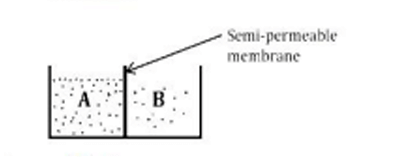
The figure below is showing two chambers A and B having different concentration of solutions separated by a semi-permeable membrane. Identify the correct statement.
1
Movement of solute molecules takes place from chamber 'B' to chamber 'A' till equilibrium.
2
There is no movement of solvent between chamber 'A' and 'B'.
3
Movement of solvent molecules takes place from chamber 'A' to chamber 'B' till equilibrium.
4
Movement of solvent molecules takes place from chamber 'B' to chamber 'A' till equilibrium.
Official Solution
Correct Option: (4)
Step 1: Understanding the principle of osmosis.
Osmosis is the movement of solvent molecules (usually water) across a semi-permeable membrane from an area of lower solute concentration to an area of higher solute concentration. Step 2: Analyzing the options. (A) Movement of solute molecules takes place from chamber 'B' to chamber 'A' till equilibrium: Incorrect. This would not occur in osmosis, where only solvent moves, not solute. (B) There is no movement of solvent between chamber 'A' and 'B': Incorrect. Solvent movement occurs in osmosis. (C) Movement of solvent molecules takes place from chamber 'A' to chamber 'B' till equilibrium: Incorrect. Solvent moves from high to low solute concentration, so it should move from 'B' to 'A'. (D) Movement of solvent molecules takes place from chamber 'B' to chamber 'A' till equilibrium: Correct. This is the correct description of osmosis. Step 3: Conclusion.
The correct answer is (D) Movement of solvent molecules takes place from chamber 'B' to chamber 'A' till equilibrium, as this follows the principle of osmosis.
06
PYQ 2020
medium
biologyID: mht-cet-
The acid which gets accumulated during night in CAM plants is ___________.
1
PEPA
2
Oxaloacetic
3
Pyruvic
4
Malic
Official Solution
Correct Option: (4)
Step 1: Understanding CAM plants. CAM (Crassulacean Acid Metabolism) plants open their stomata at night to reduce water loss and fix carbon dioxide in the dark phase. Step 2: Acid formation at night. During night, CO\textsubscript{2} is fixed into oxaloacetic acid, which is then converted into malic acid and stored in the vacuoles of leaf cells. Step 3: Analysis of options. (A) PEPA: Incorrect — PEPA acts as a CO\textsubscript{2} acceptor, not the stored acid. (B) Oxaloacetic: Incorrect — it is an intermediate, not accumulated. (C) Pyruvic: Incorrect — not involved in CAM acid storage. (D) Malic: Correct — malic acid accumulates during night in CAM plants. Step 4: Conclusion. The acid accumulated during night in CAM plants is malic acid.
07
PYQ 2024
easy
biologyID: mht-cet-
Which of the following best describes the widely accepted root pressure theory in plants?
Official Solution
Correct Option: (1)
08
PYQ 2024
medium
biologyID: mht-cet-
Which scientists are credited with proposing the transpiration pull theory, also known as the cohesion-tension theory?
1
Charles Darwin and Francis Darwin
2
Stephen Hales
3
Henry Dixon and John Joly
4
Ernst Münch
Official Solution
Correct Option: (4)
Step 1: Understanding the transpiration pull theory The transpiration pull theory, also known as the cohesion-tension theory, explains the movement of water from roots to leaves in tall plants. It attributes this upward movement to: Cohesion of water molecules (water-water attraction) Adhesion of water molecules to xylem walls Negative pressure (tension) generated due to transpiration from leaves Step 2: Contribution of Ernst Münch Ernst Münch is credited with proposing the cohesion-tension theory. His work highlighted the role of transpiration in generating a pulling force and the cohesive nature of water in enabling the upward flow through the xylem vessels. Step 3: Elimination of incorrect options (A) Incorrect: Charles Darwin and Francis Darwin contributed to understanding plant tropisms but not the cohesion-tension theory. (B) Incorrect: Stephen Hales made significant contributions to plant physiology, especially in water uptake, but did not propose this theory. (C) Incorrect: Henry Dixon and John Joly are associated with early explanations of water transport but are not credited with the cohesion-tension theory.
09
PYQ 2024
medium
biologyID: mht-cet-
Correct sequence in water absorption by root hairs.
1
Imbibition, diffusion, osmosis.
2
Osmosis, imbibition, diffusion.
3
Diffusion, imbibition, osmosis.
4
Osmosis, diffusion, imbibition.
Official Solution
Correct Option: (1)
Step 1: Understanding the process of water absorption. Water absorption by root hairs occurs in three distinct stages:
Imbibition: This is the initial stage where water is absorbed by hydrophilic substances (e.g., cell wall components like cellulose) through capillary action.
Diffusion: After imbibition, water molecules diffuse from regions of higher concentration (soil solution) to lower concentration (root hair cells).
Osmosis: Finally, water moves through the semipermeable membranes of root hair cells into the root cortex via osmotic gradients.
Step 2: Explanation of the correct sequence. The correct sequence in water absorption is: Imbibition occurs first as the cell walls absorb water. Diffusion facilitates water movement to the root hair cytoplasm. Osmosis enables water transport across membranes into deeper root cells.
Step 3: Explanation of other options. Option (B): Incorrect. Osmosis does not occur first; imbibition precedes it.
Option (C): Incorrect. Diffusion does not occur before imbibition.
Option (D): Incorrect. Osmosis occurs after diffusion, not before.
10
PYQ 2025
easy
biologyID: mht-cet-
Water that except ______ and not is absorbed by plant.
1
transpired.
2
evaporated.
3
absorbed.
4
diffused.
Official Solution
Correct Option: (1)
The correct word to fill in the blank is "transpired". Transpiration is the process by which water is lost from a plant through evaporation from the plant's leaves, primarily through stomata. Water that is transpired is lost into the atmosphere and is not absorbed by the plant. - "Evaporated" could also be associated with water loss but typically refers to the transition of water from a liquid to a gas. - "Absorbed" and "diffused" both suggest processes where water is taken in by the plant, which contradicts the context of the sentence.
Thus, the correct answer is option (A), as it refers specifically to water lost and not absorbed by the plant.
11
PYQ 2025
easy
biologyID: mht-cet-
Which water is absorbed by plants?
Official Solution
Correct Option: (1)
The water absorbed by plants is soil water, which contains dissolved minerals and nutrients essential for plant growth.
Explanation:
Soil water: Soil water is the moisture present in the soil, which plants absorb through their roots. It consists of water from rainfall, irrigation, and the movement of groundwater. Soil water contains essential minerals, ions, and nutrients that are dissolved in it, which plants need for various physiological processes like photosynthesis, cell growth, and nutrient transport.
Absorption process: Water is absorbed by plant roots through a process called osmosis, where water moves from the soil (where the concentration of water is higher) into the root cells (where the concentration of water is lower). This process helps maintain the plant's internal water balance.
Root hairs: Root hairs, which are small extensions of the root epidermal cells, play a crucial role in water absorption by increasing the surface area for absorption.
Additional points:
Water and nutrients: Along with water, essential nutrients such as nitrogen, phosphorus, and potassium are also absorbed from the soil to support plant growth and development.
Capillary action: Once absorbed by the roots, water moves upward through the plant via capillary action in the xylem vessels, reaching the leaves and other parts of the plant for various metabolic activities.
In summary, plants absorb water from the soil, which is vital for their growth, nutrient uptake, and overall physiological functions.