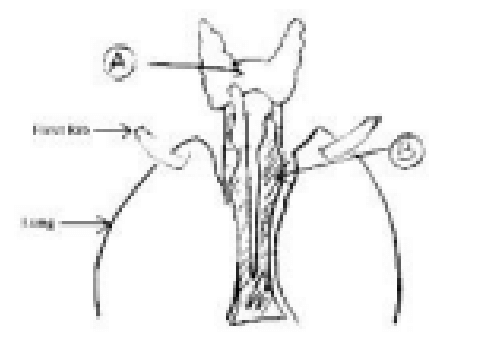
Considering the given diagram, select the correct option with respect to labels ‘A’ and ‘B’.
1
Both ‘A’ and ‘B’ are exocrine glands
2
‘A’ helps to overcome emergency stress situations
3
‘A’ secretes parathormone
4
‘B’ plays role in development of immune system
Official Solution
Correct Option:
(4)
Step 1: Identifying the glands. The diagram shows thymus (B) and adrenal gland (A). Step 2: Function of adrenal gland (A). Adrenal gland helps in stress response by secreting adrenaline, not parathormone. Step 3: Function of thymus (B). Thymus plays a crucial role in the development and maturation of T-lymphocytes and immune system.
02
PYQ 2020
medium
biologyID: mht-cet-
Upper surface of tongue bears many projections called ___________.
1
folia
2
villi
3
papillae
4
cristae
Official Solution
Correct Option:
(3)
Step 1: Structure of tongue. The upper surface of the tongue is rough due to the presence of numerous small projections. Step 2: Function of papillae. Papillae contain taste buds and help in taste sensation and mechanical handling of food. Step 3: Conclusion. Therefore, the projections on the tongue are called papillae.
03
PYQ 2020
medium
biologyID: mht-cet-
Which of the following is NOT a nutrient in the blood plasma?
1
Glycine
2
Creatinine
3
Fatty acid
4
Glucose
Official Solution
Correct Option:
(2)
Step 1: Understanding the blood plasma nutrients. Blood plasma contains nutrients like glucose, fatty acids, and amino acids (such as glycine). Creatinine, however, is a waste product that is produced from muscle metabolism and is excreted by the kidneys, not a nutrient. Step 2: Analyzing the options. (A) Glycine: Incorrect — Glycine is an amino acid, which is a nutrient in the plasma. (B) Creatinine: Correct — Creatinine is a waste product, not a nutrient. (C) Fatty acid: Incorrect — Fatty acids are essential nutrients found in plasma. (D) Glucose: Incorrect — Glucose is an essential energy source in the blood plasma. Step 3: Conclusion. The correct answer is (B) Creatinine, as it is not a nutrient in blood plasma.
04
PYQ 2020
medium
biologyID: mht-cet-
The corpuscles which form maximum number in normal total blood count are .............
1
erythrocytes
2
eosinophils
3
lymphocytes
4
thrombocytes
Official Solution
Correct Option:
(1)
Step 1: Understanding blood components. Erythrocytes, or red blood cells, are the most numerous cells in the blood and are responsible for transporting oxygen. They make up the largest portion of the total blood cell count. Step 2: Analyzing the options. (A) erythrocytes: Correct — Erythrocytes are the most abundant cell type in the blood, making up about 99% of the blood corpuscles. (B) eosinophils: Incorrect — Eosinophils are a type of white blood cell and are much less numerous than erythrocytes. (C) lymphocytes: Incorrect — Lymphocytes are a type of white blood cell, but they are also less numerous than erythrocytes. (D) thrombocytes: Incorrect — Thrombocytes, or platelets, are much less abundant than erythrocytes. Step 3: Conclusion. The correct answer is (A) erythrocytes, as they form the majority of blood cells.
05
PYQ 2020
medium
biologyID: mht-cet-
Which of the following does NOT take place during aerobic cellular respiration?
1
release of energy
2
utilization of O
3
oxidation of food
4
utilization of CO
Official Solution
Correct Option:
(4)
Step 1: Understanding aerobic respiration. Aerobic respiration involves oxidation of food in the presence of oxygen to release energy. Step 2: Role of oxygen and carbon dioxide. Oxygen is utilized, while carbon dioxide is released as a by-product. Step 3: Identifying the incorrect process. Carbon dioxide is not utilized during respiration; hence option (D) is incorrect.
06
PYQ 2024
medium
biologyID: mht-cet-
What is a key concept in Human Physiology?
1
Circulation of blood
2
Neural communication
3
Hormonal regulation
4
All of the above
Official Solution
Correct Option:
(4)
Human Physiology involves multiple interconnected systems: Circulation of blood: The cardiovascular system transports oxygen, nutrients, and waste products. Neural communication: The nervous system controls voluntary and involuntary actions. Hormonal regulation: The endocrine system regulates metabolism, growth, and reproduction.
These systems work in harmony to maintain homeostasis and support life processes. Final Answer:
07
PYQ 2024
medium
biologyID: mht-cet-
An angiotensinogen is secreted by ______?
1
Kidneys
2
Liver
3
Pancreas
4
Lungs
Official Solution
Correct Option:
(2)
Angiotensinogen is a glycoprotein secreted by the liver. It is an essential precursor in the renin-angiotensin system (RAS), which regulates blood pressure and fluid balance. The steps include: Renin, secreted by the kidneys, converts angiotensinogen into angiotensin I. Angiotensin I is further converted to angiotensin II by angiotensin-converting enzyme (ACE) in the lungs. Angiotensin II acts as a potent vasoconstrictor and stimulates the release of aldosterone, enhancing sodium and water retention.
--- Final Answer:
About Human Physiology - MHT-CET
Human Physiology is a vital chapter for MHT-CET aspirants. Mastering the concepts covered in this chapter is essential for securing a top rank.
By rigorously practicing the previous year questions associated with this chapter, you can identify high-yield topics, understand the examiner's perspective, and boost your confidence during the actual exam.
Frequently Asked Questions
Why focus on Human Physiology PYQs?
Analyzing PYQs for this specific chapter reveals the most frequently tested concepts and the typical complexity of questions, allowing you to tailor your study plan efficiently.
How to best use this analysis?
Review the topic breakdown to see which sub-topics within Human Physiology carry the most weight. Then, tackle the questions iteratively to solidify your understanding.