During hypertension, both the systolic and diastolic rate is higher than 120/80. Therefore, the answer is 140/100. Hypertension is high blood pressure. When left untreated it can lead to serious health problems like, cardiovascular disease, eye issues, kidney damage etc. Some of the causes of hypertension are obesity, high salt intake, stress, chronic kidney disease etc.
So, the correct answer is (A) 140/100
02
PYQ 2007
medium
biologyID: mht-cet-
In normal blood pressure of 120/80 mm Hg, the numerator represents
1
Diastole pressure
2
Systole
3
Pulse pressure
4
Cardiac index
Official Solution
Correct Option: (2)
Answer (b) Systole
03
PYQ 2008
medium
biologyID: mht-cet-
Blood group is due to
1
Specific antigen on WBC
2
Specific antibody on WBC
3
Specific antigen on erythrocytes
4
Specific antibody on erythrocytes
Official Solution
Correct Option: (3)
Answer (c) Specific antigen on erythrocytes
04
PYQ 2008
medium
biologyID: mht-cet-
Ridges present in the ventricles are
1
Columnae cameae
2
Papillary muscles
3
Chordae tendineae
4
Musculi pectinati
Official Solution
Correct Option: (1)
Answer (a) Columnae cameae
05
PYQ 2008
medium
biologyID: mht-cet-
Rate of heart beat is reduced by
1
Acetylcholine
2
Adrenaline
3
Calcitonin
4
Thyroxine
Official Solution
Correct Option: (1)
Answer (a) Acetylcholine
06
PYQ 2008
medium
biologyID: mht-cet-
Cell fragments of megakaryocytes yield
1
Erythrocytes
2
Granulocytes
3
Agranulocytes
4
Blood platelets
Official Solution
Correct Option: (4)
Cell fragments of megakaryocytes yield blood platelets.
07
PYQ 2009
easy
biologyID: mht-cet-
Valve present over left auriculo- ventricular opening is
1
Semilunar valve
2
Tricuspid valve
3
Valve of Thebesius
4
Bicuspid valve
Official Solution
Correct Option: (4)
Answer (d) Bicuspid valve
08
PYQ 2009
easy
biologyID: mht-cet-
QRS of ECG depicts
1
Spread of excitation from auricles to ventricles
2
Auricular contraction
3
Ventricular contraction
4
Both B and C
Official Solution
Correct Option: (1)
Answer (a) Spread of excitation from auricles to ventricles
09
PYQ 2009
medium
biologyID: mht-cet-
The opening of inferior vena cava into right auricle is regulated by
1
Semilunar valve
2
Valve of Thebesius
3
Eustachian valve
4
None of the above
Official Solution
Correct Option: (3)
Answer (c) Eustachian valve
10
PYQ 2009
medium
biologyID: mht-cet-
Hypertension is not caused by
1
Anaemia
2
Atherosclerosis
3
Obesity
4
Arteriosclerosis
Official Solution
Correct Option: (1)
Answer (a) Anaemia
11
PYQ 2009
medium
biologyID: mht-cet-
Thromboplastin required for blood clotting at the place of injury is released by
1
Blood platelets
2
Eosinophils
3
Neutrophils
4
Lymphocytes
Official Solution
Correct Option: (1)
Thromboplastin required for blood clotting at the place of injury is released by blood platelets
12
PYQ 2010
easy
biologyID: mht-cet-
What is true ?
1
All arteries carry oxygenated blood
2
All veins carry oxygenated blood
3
All veins cany oxygenated blood except one
4
All arteries carry oxygenated blood except one
Official Solution
Correct Option: (4)
Answer (d) All arteries carry oxygenated blood except one
13
PYQ 2010
medium
biologyID: mht-cet-
Valve surrounding opening of coronary sinus is
1
Thebesius valve
2
Eustachian valve
3
Mitral valve
4
Semilunar valve
Official Solution
Correct Option: (1)
Answer (a) Thebesius valve
14
PYQ 2010
hard
biologyID: mht-cet-
Deposition of cholesterol in walls of arteries is
1
Arteriosclerosis
2
Embolus
3
Atherosclerosis
4
Carditis
Official Solution
Correct Option: (3)
The correct option is(c): Atherosclerosis.
15
PYQ 2010
medium
biologyID: mht-cet-
Differences between systolic and diastolic pressures is
1
Blood pressure
2
Pulse pressure
3
Cardiac output
4
Pulse
Official Solution
Correct Option: (2)
Answer (b) Pulse pressure
16
PYQ 2010
medium
biologyID: mht-cet-
Pulmonary trunk and aorta are attached by
1
Chordae tendineae
2
Ligamentum arteriosus
3
Coronary sulcus
4
Pericardium
Official Solution
Correct Option: (2)
Answer (b) Ligamentum arteriosus
17
PYQ 2017
medium
biologyID: mht-cet-
Atrial systole lasts for _______ in Cardiac Cycle
1
0.1 second
2
0.3 second
3
0.5 second
4
0.7 second
Official Solution
Correct Option: (1)
During atrial systole, the deoxygenated blood from right atrium enters right ventricle and oxygenated blood from left atrium enters the left ventricle through atrioventricular aperture. Atrial systole lasts for 0.1 second.
18
PYQ 2018
medium
biologyID: mht-cet-
In the following diagram of T.S. of Artery, the region marked 'X' is ________
1
Tunica media
2
Tunica externa
3
Tunica interna
4
Tunica albuginea
Official Solution
Correct Option: (3)
X is an endothelium, made up of flattened squamous epithelial cells. Innermost coat of an artery, called tunica interna is made up of elastic membrane and endothelium.
19
PYQ 2020
medium
biologyID: mht-cet-
Spinal cord is enclosed in ________ of vertebral column.
1
neural canal
2
Volkmannβs canal
3
inguinal canal
4
central canal
Official Solution
Correct Option: (1)
Step 1: Understanding vertebral column structure. The vertebral column consists of vertebrae arranged one above the other, forming a protective bony structure.
Step 2: Identifying the enclosing canal. Each vertebra has a vertebral foramen, and together these form the neural canal that encloses and protects the spinal cord.
Step 3: Eliminating incorrect options. Volkmannβs canals are found in bones. The inguinal canal is related to the abdominal region. The central canal is present inside the spinal cord itself.
Step 4: Conclusion. Hence, the spinal cord is enclosed within the neural canal of the vertebral column.
20
PYQ 2020
medium
biologyID: mht-cet-
Eustachian valve guards the opening of ...............
1
coronary sinus
2
coronary artery
3
inferior venacava
4
superior venacava
Official Solution
Correct Option: (3)
Step 1: Understanding the anatomy.
The Eustachian valve is a valve located at the opening of the inferior vena cava into the right atrium. It prevents the backflow of blood into the vena cava. Step 2: Analyzing the options. (A) coronary sinus: Incorrect. The coronary sinus is a vein that returns deoxygenated blood from the heart muscle to the right atrium, but it is not guarded by the Eustachian valve. (B) coronary artery: Incorrect. The coronary artery supplies blood to the heart muscle, but it is not associated with the Eustachian valve. (C) inferior venacava: Correct. The Eustachian valve guards the opening of the inferior vena cava into the right atrium. (D) superior venacava: Incorrect. The superior vena cava does not have an associated Eustachian valve. Step 3: Conclusion.
The correct answer is (C) inferior venacava, as the Eustachian valve guards the opening of the inferior vena cava.
21
PYQ 2020
medium
biologyID: mht-cet-
Match the Column-I with Column-II and select the correct option. Column-I Column-II (a) DNA fragmentation (i) ssDNA gets embedded in nylon membrane (b) Electrophoresis (ii) Sample DNA and probe DNA form double stranded DNA (c) Southern blotting (iii) DNA fragments move to positive pole (d) Hybridization (iv) Fragments of DNA with variable length are formed
1
aβ(iv), bβ(ii), cβ(i), dβ(iii)
2
aβ(iii), bβ(ii), cβ(iv), dβ(i)
3
aβ(i), bβ(ii), cβ(iii), dβ(iv)
4
aβ(iv), bβ(iii), cβ(i), dβ(ii)
Official Solution
Correct Option: (4)
Step 1: Understanding DNA fragmentation. DNA fragmentation involves cutting DNA using restriction enzymes, producing fragments of variable lengths depending on recognition sites. Step 2: Electrophoresis principle. DNA molecules are negatively charged and move towards the positive pole during gel electrophoresis under an electric field. Step 3: Southern blotting process. In Southern blotting, single-stranded DNA fragments are transferred and embedded onto a nylon or nitrocellulose membrane. Step 4: Hybridization step. Hybridization involves the binding of complementary DNA strands where the probe DNA forms double-stranded DNA with the target sequence. Step 5: Conclusion. The correct matching is option (D).
22
PYQ 2020
medium
biologyID: mht-cet-
Generally lower pulse rate is observed in ...............
1
males
2
excitement
3
standing position
4
children
Official Solution
Correct Option: (1)
Step 1: Understanding pulse rate.
In general, males tend to have a lower pulse rate compared to females and children. Factors such as physical activity and excitement can increase pulse rate, but overall, men typically have a lower resting pulse rate. Step 2: Analyzing the options. (A) males: Correct. Males generally have a lower resting pulse rate compared to females and children. (B) excitement: Incorrect. Excitement typically increases pulse rate. (C) standing position: Incorrect. Standing position can sometimes cause a slight increase in pulse rate, especially when changing from a lying down to a standing position. (D) children: Incorrect. Children generally have a higher pulse rate compared to adults. Step 3: Conclusion.
The correct answer is (A) males, as they generally exhibit a lower pulse rate than other groups.
23
PYQ 2020
medium
biologyID: mht-cet-
Lymph contains all of the following components EXCEPT .............
1
platelets
2
lymphocytes
3
antibodies
4
CO2
Official Solution
Correct Option: (1)
Step 1: Understanding the components of lymph.
Lymph is a clear fluid that circulates in the lymphatic system. It contains lymphocytes, antibodies, and CO2, but it does not contain platelets. Platelets are part of blood, not lymph. Step 2: Analyzing the options. (A) platelets: Correct. Platelets are not found in lymph; they are part of blood. (B) lymphocytes: Incorrect. Lymphocytes are a major component of lymph. (C) antibodies: Incorrect. Antibodies are present in lymph and help fight infections. (D) CO2: Incorrect. CO2 is carried by lymph as a waste product of metabolism. Step 3: Conclusion.
The correct answer is (A) platelets, as they are not a component of lymph.
24
PYQ 2020
medium
biologyID: mht-cet-
A single layer of cells that composes epicardium is called ...............
1
endothelium
2
mesothelium
3
ependyma
4
epidermis
Official Solution
Correct Option: (2)
Step 1: Understanding the structure of the epicardium.
The epicardium is the outer layer of the heart wall. It is composed of mesothelium, which is a single layer of flat cells. Step 2: Analyzing the options. (A) endothelium: Incorrect. Endothelium lines blood vessels, not the heart. (B) mesothelium: Correct. Mesothelium is the tissue that forms the epicardium of the heart. (C) ependyma: Incorrect. Ependyma lines the ventricles of the brain and spinal cord, not the heart. (D) epidermis: Incorrect. Epidermis is the outer layer of skin, not related to the heart's epicardium. Step 3: Conclusion.
The correct answer is (B) mesothelium, as it is the tissue layer that forms the epicardium.
25
PYQ 2020
medium
biologyID: mht-cet-
Select the correct match from Column-I with Column-II. Column-I Column-II a) Fibrous pericardium i) Mesothelium b) Lymphocyte ii) Scavenger c) Bundle of His iii) Circular with kidney shaped nucleus d) Erythrocyte iv) Connection with AV node v) Interventricular septum
1
a - v, b - iii, c - iv, d - ii
2
a - v, b - iii, c - ii, d - iv
3
a - v, b - iv, c - iii, d - ii
4
a - iv, b - ii, c - i, d - iii
Official Solution
Correct Option: (1)
Step 1: Understanding the terms in Column-I. - Fibrous pericardium: This is a tough outer layer that covers the heart. It is associated with the interventricular septum. - Lymphocyte: A type of white blood cell with a circular shape and kidney-shaped nucleus. - Bundle of His: A part of the conduction system of the heart that connects to the AV node. - Erythrocyte: Red blood cells responsible for carrying oxygen. They are involved in scavenging. Step 2: Analyzing the options. (A) a - v: Correct, fibrous pericardium is associated with the interventricular septum. (B) b - iii: Correct, lymphocytes have a circular shape with a kidney-shaped nucleus. (C) c - iv: Correct, the Bundle of His is connected with the AV node. (D) d - ii: Correct, erythrocytes function in scavenging. Step 3: Conclusion. The correct matching is a - v, b - iii, c - iv, d - ii.
26
PYQ 2020
medium
biologyID: mht-cet-
Which of the following statements is CORRECT?
1
Louis Pasteur proved the theory of spontaneous generation.
2
Theory of abiogenesis is the oldest theory.
3
Theory of biogenesis satisfactorily explains the continuity of life.
4
Panspermia theory is also called abiogenesis.
Official Solution
Correct Option: (3)
Step 1: Understanding the theories of origin of life. Different theories such as abiogenesis, biogenesis, and panspermia were proposed to explain the origin and continuity of life. Step 2: Evaluating the options. (A) Incorrect β Louis Pasteur disproved spontaneous generation. (B) Incorrect β Abiogenesis is not accepted scientifically today. (C) Correct β Biogenesis states that life arises from pre-existing life, explaining continuity. (D) Incorrect β Panspermia suggests extraterrestrial origin of life, not abiogenesis. Step 3: Conclusion. The statement that correctly explains the continuity of life is (C) Theory of biogenesis satisfactorily explains the continuity of life.
27
PYQ 2020
medium
biologyID: mht-cet-
Column-I contains names of host plants while Column-II contains names of viral diseases. Find the correct option. Column-I Column-II I) Banana p) little leaf II) Sugarcane q) bunchy top III) Papaya r) leaf roll IV) Potato s) grassy shoot V) Brinjal t) leaf curl
1
Iβq, IIβr, IIIβs, IVβt, Vβp
2
Iβq, IIβs, IIIβr, IVβt, Vβp
3
Iβq, IIβs, IIIβt, IVβr, Vβp
4
Iβq, IIβr, IIIβp, IVβs, Vβt
Official Solution
Correct Option: (3)
Step 1: Identifying common viral diseases of crops. Each crop plant is associated with a specific well-known viral disease commonly asked in biology examinations. Step 2: Correct matching. Banana is affected by bunchy top disease. Sugarcane is affected by grassy shoot disease. Papaya is affected by leaf curl disease. Potato is affected by leaf roll disease. Brinjal is affected by little leaf disease. Step 3: Verification of option. Only option (C) correctly matches all host plants with their respective viral diseases. Step 4: Conclusion. Hence, option (C) is the correct answer.
28
PYQ 2020
medium
biologyID: mht-cet-
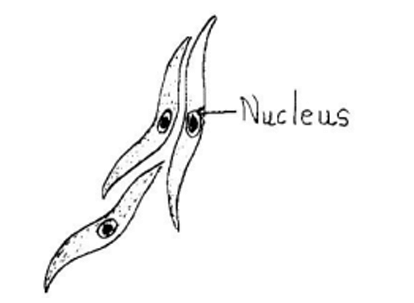
These muscle fibres can be best described as _________
1
striated, voluntary and skeletal
2
unstriated, involuntary and skeletal
3
unstriated, involuntary and visceral
4
striated, voluntary and cardiac
Official Solution
Correct Option: (3)
Step 1: Observing the diagram. The diagram shows spindle-shaped muscle fibres with a single centrally placed nucleus and no visible striations.
Step 2: Identifying muscle type. Such muscle fibres are characteristic of smooth muscles, which lack striations and are involuntary in action.
Step 3: Location of these muscles. Smooth muscles are found in the walls of visceral organs such as the intestine, stomach, and blood vessels.
Step 4: Conclusion. Therefore, these muscle fibres are unstriated, involuntary, and visceral.
29
PYQ 2020
medium
biologyID: mht-cet-
A molecule of chlorophyll which acts as reaction centre in pigment systemβII is _________
1
Pβ650
2
Pβ700
3
Pβ673
4
Pβ680
Official Solution
Correct Option: (4)
Step 1: Understanding pigment systems. Photosynthesis involves two pigment systems: Photosystem I and Photosystem II, each having a specific reaction centre chlorophyll.
Step 2: Identifying reaction centre of PS-II. The reaction centre of Photosystem II absorbs light maximally at 680 nm, hence it is known as Pβ680.
Step 3: Conclusion. Therefore, the correct answer is (D) Pβ680.
30
PYQ 2023
easy
biologyID: mht-cet-
What are the characteristics of capillaries?
Official Solution
Correct Option: (1)
Capillaries are the smallest and most numerous blood vessels in the human body. They have several distinct characteristics that make them unique and vital for various physiological processes. Here are the main characteristics of capillaries:
Size and Structure: Capillaries are tiny vessels with an average diameter of about 5 to 10 micrometers (ΞΌm). They are composed of a single layer of endothelial cells, which form a thin, porous wall. This thin structure allows for efficient exchange of substances between the blood and surrounding tissues.
Microcirculation: Capillaries form an extensive network within tissues, connecting arterioles (small arteries) to venules (small veins). This microcirculation allows for the delivery of oxygen and nutrients to tissues and the removal of waste products.
Permeability: Capillary walls are highly permeable due to their thinness and presence of small gaps or pores between endothelial cells. This allows for the exchange of gases (such as oxygen and carbon dioxide), nutrients, waste products, and other substances between the blood and surrounding tissues.
Surface Area: Capillaries have a large total surface area due to their immense number and extensive branching. This increased surface area enhances the exchange of substances between the blood and tissues.
Slow Blood Flow: Blood flow through capillaries is relatively slow compared to larger blood vessels. This reduced flow velocity facilitates efficient exchange and allows sufficient time for substances to diffuse across the capillary wall.
31
PYQ 2024
medium
biologyID: mht-cet-
Body Fluids and Circulation: The inner surface of the ventricle is thrown into a series of irregular muscular ridges called ______?
1
Chordae tendineae
2
Columnae carneae
3
Papillary muscles
4
Endocardium
Official Solution
Correct Option: (2)
The columnae carneae are muscular ridges found on the inner surface of the ventricles. Their primary functions include: Enhancing the strength and integrity of the ventricular walls. Preventing the walls from sticking together during contraction. Assisting the papillary muscles by anchoring the chordae tendineae, which in turn control valve movement.
These structures play a significant role in the efficient pumping of blood by the heart. --- Final Answer:
32
PYQ 2024
medium
biologyID: mht-cet-
How many heartbeats does a person have in 1 minute on average?
1
50
2
72
3
100
4
120
Official Solution
Correct Option: (2)
The average heart rate of a healthy adult is about 72 beats per minute. It depends on:
Physical activity: Increases during exercise or stress.
Age: Young children have faster heart rates compared to adults.
Health status: Bradycardia and tachycardia are conditions of abnormally slow or fast heart rates.
---
Final Answer:
33
PYQ 2024
medium
biologyID: mht-cet-
Cerebrospinal fluid (CSF) uses were given below. Identify the incorrect use by eliminating it.
1
Cushioning the brain and spinal cord
2
Removing metabolic waste
3
Transporting nutrients to the brain
4
Transmitting nerve impulses
Official Solution
Correct Option: (4)
Evaluating each option: Cushioning the brain and spinal cord: CSF acts as a shock absorber, protecting the central nervous system. Removing metabolic waste: CSF helps in the removal of waste products from the brain. Transporting nutrients to the brain: CSF delivers essential nutrients to neural tissues. Transmitting nerve impulses: Nerve impulses are transmitted by neurons through electrical and chemical signals, not by CSF.
Conclusion: The incorrect use of CSF among the options is transmitting nerve impulses.
34
PYQ 2025
medium
biologyID: mht-cet-
Which of the following acts as hemoglobin (Hb) in the blood buffer system?
1
NaHCOβ
2
HβHb
3
HbCOβ
4
HbCl
Official Solution
Correct Option: (2)
The correct answer is HβHb, which refers to deoxygenated hemoglobin.
Deoxygenated hemoglobin (HβHb) acts as a buffer in the blood buffer system by binding to hydrogen ions (H+) and helping to stabilize the pH of the blood. This occurs because when hemoglobin releases oxygen, it has a higher affinity for hydrogen ions, which allows it to function as a buffer in the tissues, where CO2 is produced during cellular respiration.
In the lungs, when hemoglobin picks up oxygen (forming HbO2), it releases the hydrogen ions, and the pH of the blood is regulated. This dynamic exchange of oxygen and hydrogen ions helps maintain the acid-base balance in the blood, which is essential for proper physiological function.