On reaching the ovary, if pollen tube enters the ovule through integuments, then it is called ______.
1
Chalazogamy
2
Mesogamy
3
Porogamy
4
Siphonogamy
Official Solution
Correct Option: (2)
Step 1: Understanding pollen tube entry. Fertilization in angiosperms depends on the route through which the pollen tube enters the ovule. Different entry routes are named differently. Step 2: Types of pollen tube entry. Porogamy: Entry through the micropyle. Chalazogamy: Entry through the chalaza. Mesogamy: Entry through the integuments or lateral wall of the ovule. Step 3: Analysis of options. (A) Chalazogamy: Entry through chalaza. (B) Mesogamy: Correct, entry through integuments. (C) Porogamy: Entry through micropyle. (D) Siphonogamy: Refers to fertilization through pollen tube, not entry route. Step 4: Conclusion. Entry of pollen tube through integuments is called mesogamy.
02
PYQ 2020
medium
biologyID: mht-cet-
The layer of anther wall, which help in its dehiscence is _________
1
epidermis
2
endothecium
3
tapetum
4
middle layers
Official Solution
Correct Option: (2)
Step 1: Understanding anther structure. The anther wall consists of four layers: epidermis, endothecium, middle layers, and tapetum.
Step 2: Role of endothecium. The endothecium develops fibrous thickenings that generate tension during drying, which leads to anther dehiscence.
Step 3: Eliminating other layers. Epidermis provides protection. Tapetum nourishes developing pollen grains. Middle layers degenerate during development.
Step 4: Conclusion. Therefore, the endothecium is responsible for anther dehiscence.
03
PYQ 2020
medium
biologyID: mht-cet-
The shortest phase of cardiac cycle is _________
1
joint cardiac diastole
2
ventricular systole
3
atrial diastole
4
atrial systole
Official Solution
Correct Option: (4)
Step 1: Understanding phases of cardiac cycle. The cardiac cycle consists of atrial systole, ventricular systole, and joint cardiac diastole, each having a specific duration.
Step 2: Duration comparison. Atrial systole lasts for about 0.1 second, ventricular systole lasts about 0.3 second, and joint cardiac diastole lasts about 0.4 second.
Step 3: Conclusion. Since atrial systole has the shortest duration, the correct answer is atrial systole.
04
PYQ 2020
medium
biologyID: mht-cet-
Match the Column-I with Column-II and select the correct option. Column – I Column – II A. Fibrinogen (i) contractions in female reproductive tract B. Fructose (ii) prevent fungal infection C. Prostaglandins (iii) coagulation of semen D. Lactobacilli in vagina (iv) source of energy
1
A-(ii), B-(iii), C-(iv), D-(i)
2
A-(i), B-(ii), C-(iii), D-(iv)
3
A-(iii), B-(iv), C-(i), D-(ii)
4
A-(iv), B-(i), C-(ii), D-(iii)
Official Solution
Correct Option: (3)
Step 1: Understanding the biological significance of each component. The substances listed in Column-I are associated with reproductive physiology and protective mechanisms. Each has a distinct role either in semen composition or in maintaining reproductive health.
Step 2: Correct matching of Column-I with Column-II. A. Fibrinogen: Fibrinogen is responsible for the coagulation of semen after ejaculation, which helps retain sperms inside the female reproductive tract. Hence, A is matched with (iii). B. Fructose: Fructose serves as the primary source of energy for sperms, supporting their motility. Hence, B is matched with (iv). C. Prostaglandins: Prostaglandins stimulate contractions in the female reproductive tract, aiding sperm transport towards the ovum. Hence, C is matched with (i). D. Lactobacilli in vagina: Lactobacilli help maintain an acidic environment in the vagina and thereby prevent fungal infection. Hence, D is matched with (ii).
Step 3: Final conclusion. The correct matching is A-(iii), B-(iv), C-(i), and D-(ii), which corresponds to option (C).
05
PYQ 2020
medium
biologyID: mht-cet-
After birth, infant receives antibodies IgA through colostrum from mother. This is an example of ______________ immunity.
1
natural acquired active
2
innate (natural)
3
artificial acquired passive
4
natural acquired passive
Official Solution
Correct Option: (4)
Step 1: Understanding antibody transfer. Colostrum is the first milk produced by the mother and is rich in antibodies, especially IgA. Step 2: Nature of immunity. The infant does not produce these antibodies; instead, they are transferred directly from the mother. Step 3: Classification of immunity. Since antibodies are received naturally and passively, this immunity is termed natural acquired passive immunity. Step 4: Conclusion. Thus, IgA transfer through colostrum is an example of natural acquired passive immunity.
06
PYQ 2020
medium
biologyID: mht-cet-
In Kalanchoe, vegetative reproduction takes place by ...........
1
root tuber
2
stem tuber
3
floral buds
4
epiphyllous buds
Official Solution
Correct Option: (4)
Step 1: Understanding vegetative reproduction in Kalanchoe.
In Kalanchoe, vegetative reproduction occurs through epiphyllous buds, which form on the leaves. These buds can develop into new plants when they fall off and take root. Step 2: Analyzing the options. (A) root tuber: Incorrect. Root tubers are used in vegetative reproduction in some plants but not in Kalanchoe. (B) stem tuber: Incorrect. Stem tubers are not involved in Kalanchoe's vegetative reproduction. (C) floral buds: Incorrect. Floral buds produce flowers, not new plants through vegetative reproduction. (D) epiphyllous buds: Correct. Kalanchoe uses epiphyllous buds for vegetative reproduction, which develop on its leaves. Step 3: Conclusion.
The correct answer is (D) epiphyllous buds, as this is the method of vegetative reproduction in Kalanchoe.
07
PYQ 2020
medium
biologyID: mht-cet-
Which one of the following groups of drugs is called cannabinoids?
1
Marijuana, hashish, charas
2
Morphine, heroin, LSD
3
Heroin, hashish, cocaine
4
Barbiturates, amphetamines, benzodiazepines
Official Solution
Correct Option: (1)
Step 1: Understanding cannabinoids. Cannabinoids are a group of drugs that are obtained from the plant Cannabis sativa. These substances mainly affect the central nervous system and produce hallucinogenic effects. Step 2: Analyzing the options. (A) Marijuana, hashish, charas: Correct — All these are products derived from the Cannabis plant and are classified as cannabinoids. (B) Morphine, heroin, LSD: Incorrect — Morphine and heroin are opioids, while LSD is a hallucinogen. (C) Heroin, hashish, cocaine: Incorrect — Heroin is an opioid and cocaine is a stimulant, so this group is mixed. (D) Barbiturates, amphetamines, benzodiazepines: Incorrect — These are synthetic drugs used as sedatives or stimulants, not cannabinoids. Step 3: Conclusion. The correct group of drugs classified as cannabinoids is (A) Marijuana, hashish, charas.
08
PYQ 2020
medium
biologyID: mht-cet-
Mark the CORRECT sequence of phase in menstrual cycle.
Step 1: Understanding the menstrual cycle. The menstrual cycle is a monthly reproductive cycle in human females that prepares the uterus for possible pregnancy. It is regulated by hormones such as estrogen and progesterone. Step 2: Correct order of phases. The cycle begins with the menstrual phase, during which shedding of the uterine lining occurs. This is followed by the proliferative phase, where the endometrium regenerates under the influence of estrogen. Next is the ovulatory phase, marked by the release of an ovum from the ovary. Finally, the luteal phase occurs, where the corpus luteum secretes progesterone to maintain the endometrium. Step 3: Analysis of options. Only option (B) correctly represents the natural physiological sequence of menstrual cycle phases. Step 4: Conclusion. The correct sequence of phases in the menstrual cycle is option (B).
09
PYQ 2020
medium
biologyID: mht-cet-
Which one of the following is enriched with calcium?
1
Spinach
2
Carrot
3
Pumpkin
4
Mustard
Official Solution
Correct Option: (1)
Step 1: Understanding nutrient enrichment. Calcium is an essential mineral required for strong bones and teeth. Green leafy vegetables are generally rich sources of calcium. Step 2: Nutritional value of spinach. Spinach is a green leafy vegetable that contains a high amount of calcium along with iron and vitamins, making it nutritionally superior in terms of mineral content. Step 3: Analysis of options. (A) Spinach: Correct, as it is a well-known calcium-rich vegetable. (B) Carrot: Rich in vitamin A but not particularly high in calcium. (C) Pumpkin: Contains vitamins but has low calcium content. (D) Mustard: Seeds contain oils, but leaves are less commonly noted for calcium enrichment compared to spinach. Step 4: Conclusion. Spinach is enriched with calcium and hence is the correct answer.
10
PYQ 2020
medium
biologyID: mht-cet-
Primary lesions called chancre are formed at the site of infection by ___________.
1
Diplococcus pneumoniae
2
Treponema pallidum
3
Salmonella typhi
4
Wuchereria bancrofti
Official Solution
Correct Option: (2)
Step 1: Understanding chancre. A chancre is a painless ulcer that appears at the site of infection during the primary stage of syphilis. Step 2: Causative organism. Syphilis is a sexually transmitted disease caused by the spirochaete bacterium Treponema pallidum. Step 3: Analysis of options. (A) Diplococcus pneumoniae: Causes pneumonia. (B) Treponema pallidum: Correct — causes syphilis and primary chancre. (C) Salmonella typhi: Causes typhoid fever. (D) Wuchereria bancrofti: Causes filariasis. Step 4: Conclusion. Primary lesions called chancre are formed due to infection by Treponema pallidum.
11
PYQ 2020
medium
biologyID: mht-cet-
Select the INCORRECT statement.
1
Hisardale is an example of cross-breeding experiment.
2
Genetic mother in MOET technique serves for multiple ovulation.
3
{Apis mellifera} and {Apis florea} are domesticated species of honey bee.
4
Layers management includes processes like culling and debeaking.
Official Solution
Correct Option: (3)
Step 1: Understanding domestication of honey bees. Only a few species of honey bees are domesticated for commercial honey production and pollination.
Step 2: Analyzing each option. (A) Hisardale is a sheep breed developed through cross-breeding, so this statement is correct. (B) In MOET (Multiple Ovulation and Embryo Transfer) technique, the genetic mother is hormonally stimulated for multiple ovulation, hence correct. (C) {Apis mellifera} is domesticated, but {Apis florea} is a wild species and not domesticated, making this statement incorrect. (D) Culling and debeaking are standard practices in layers management, so this statement is correct.
Step 3: Conclusion. Thus, option (C) is the incorrect statement.
12
PYQ 2020
medium
biologyID: mht-cet-
Degradation of haemoglobin occurs in the ___________.
1
Liver
2
Heart
3
Bone marrow
4
Kidney
Official Solution
Correct Option: (1)
Step 1: Understanding haemoglobin breakdown. Haemoglobin from worn-out red blood cells is broken down into heme and globin components. This process mainly occurs in organs rich in macrophages. Step 2: Role of the liver. The liver plays a key role in haemoglobin degradation. Heme is converted into biliverdin and then bilirubin, which is processed and excreted in bile. Step 3: Analysis of options. (A) Liver: Correct — primary site of haemoglobin degradation. (B) Heart: Incorrect — no role in haemoglobin breakdown. (C) Bone marrow: Incorrect — mainly involved in RBC formation. (D) Kidney: Incorrect — involved in excretion, not degradation. Step 4: Conclusion. Degradation of haemoglobin occurs mainly in the liver.
13
PYQ 2020
medium
biologyID: mht-cet-
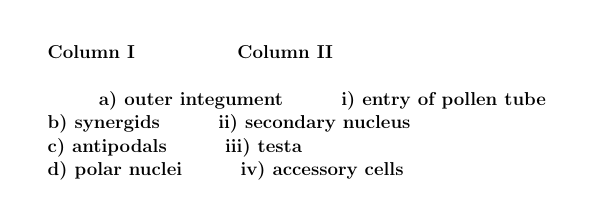
Match Column - I with Column - II and select the correct option.
1
a-ii, b-i, c-iv, d-iii
2
a-iii, b-i, c-iv, d-ii
3
a-iii, b-ii, c-iv, d-i
4
a-i, b-ii, c-iii, d-iv
Official Solution
Correct Option: (2)
Step 1: Analyzing the columns. - Outer integument refers to the protective layers, which is linked to the testa (iii).
- Synergids are specialized cells that assist in fertilization, and they are related to entry of pollen tube (i).
- Antipodals are cells located opposite the egg, related to accessory cells (iv).
- Polar nuclei are involved in secondary nucleus formation (ii). Step 2: Conclusion. Thus, the correct match is a-iii, b-i, c-iv, d-ii.
14
PYQ 2020
medium
biologyID: mht-cet-
The boll worms attack ......
1
maize
2
rice
3
okra
4
cotton
Official Solution
Correct Option: (4)
Step 1: Understanding boll worms.
Boll worms are a major pest for cotton plants, causing significant damage to the cotton crop by feeding on the plant's bolls. Step 2: Analyzing the options. (A) maize: This is incorrect, as boll worms do not primarily attack maize. (B) rice: This is incorrect, as boll worms do not primarily attack rice crops. (C) okra: This is incorrect, as boll worms do not primarily attack okra. (D) cotton: Correct. Boll worms are known to attack cotton plants. Step 3: Conclusion.
The correct answer is (D) cotton.
15
PYQ 2020
medium
biologyID: mht-cet-
Which of the following is NOT the significance of vegetative propagation?
1
Variations are caused, which help in evolution
2
The yield of plant can be increased by grafting
3
Production of clones of economically useful and rare plants
4
Easy and cheaper method of multiplication
Official Solution
Correct Option: (1)
Step 1: Understanding vegetative propagation.
Vegetative propagation is a form of asexual reproduction where new plants are produced from vegetative parts such as roots, stems, or leaves. This method does not typically cause variations, as the offspring are genetically identical to the parent plant. Step 2: Analyzing the options. (A) Variations are caused, which help in evolution: This is incorrect. Vegetative propagation produces clones, which do not involve genetic variation. (B) The yield of plant can be increased by grafting: This is correct. Grafting is a form of vegetative propagation that increases yield. (C) Production of clones of economically useful and rare plants: This is correct. Vegetative propagation is often used to propagate valuable plants. (D) Easy and cheaper method of multiplication: This is correct. Vegetative propagation is generally cheaper and quicker than seed propagation. Step 3: Conclusion.
The correct answer is (A) Variations are caused, which help in evolution.
16
PYQ 2020
medium
biologyID: mht-cet-
A flower with five stamens bearing dithecous anthers has produced total 2560 male gametes. What would be the number of pollen mother cells per microsporangium in this flower?
1
128
2
64
3
32
4
16
Official Solution
Correct Option: (4)
Step 1: Understanding the formation of pollen. In flowers, each pollen mother cell undergoes meiosis to produce four pollen grains (male gametes). Since the total number of male gametes is 2560, and each pollen mother cell produces four male gametes, the number of pollen mother cells can be found by dividing 2560 by 4. Step 2: Calculation. Since there are five stamens, the number of pollen mother cells per stamen is 640/5 = 128. However, the question asks for the number of pollen mother cells per microsporangium, which corresponds to 16 for each stamen's microsporangium. Step 3: Conclusion. The correct answer is (D) 16.
17
PYQ 2020
medium
biologyID: mht-cet-
Small inconspicuous flowers without bright colours but with versatile and exposed anthers are characteristic of ...................
1
ornithophily
2
entomophily
3
anemophily
4
chiropterophily
Official Solution
Correct Option: (3)
Step 1: Understanding the types of pollination. Anemophily refers to pollination by wind, and such flowers are typically small, inconspicuous, and do not require bright colors. They have exposed anthers that release pollen into the air. Step 2: Analyzing the options. (A) ornithophily: Incorrect — Ornithophily refers to pollination by birds, which usually involves brightly colored flowers. (B) entomophily: Incorrect — Entomophily refers to pollination by insects, which typically involves brightly colored flowers. (C) anemophily: Correct — Anemophily is wind pollination, which matches the description of flowers with exposed anthers. (D) chiropterophily: Incorrect — Chiropterophily refers to pollination by bats, which also involves different flower characteristics. Step 3: Conclusion. The correct answer is (C) anemophily, as it refers to wind pollination with small, inconspicuous flowers.
18
PYQ 2020
medium
biologyID: mht-cet-
In a pregnant woman, ___________ is the major source of progesterone during the first trimester.
1
corpus callosum
2
corpus albicans
3
placenta
4
corpus luteum
Official Solution
Correct Option: (4)
Step 1: Role of progesterone. Progesterone is essential for maintaining pregnancy by preparing the uterine lining for implantation. Step 2: Hormone source during early pregnancy. During the first trimester, progesterone is secreted mainly by the corpus luteum. Step 3: Change in later stages. After the first trimester, the placenta takes over progesterone production.
19
PYQ 2024
medium
biologyID: mht-cet-
Two pollen grains consist of:
1
One vegetative and one male gamete
2
Two male gametes
3
One vegetative cell and one generative cell
4
One generative cell and one male gamete
Official Solution
Correct Option: (3)
Step 1: Pollen grains consist of two main cells: the vegetative cell, which controls the growth of the pollen tube, and the generative cell, which divides to form two male gametes.
Step 2:
- (A) One vegetative and one male gamete: Incorrect, as the male gametes are formed from the generative cell. - (B) Two male gametes: Incorrect, because the generative cell divides into two male gametes after the pollen tube formation. - (D) One generative cell and one male gamete: Incorrect, since the generative cell gives rise to two male gametes. Conclusion: Pollen grains consist of one vegetative cell and one generative cell, making the correct answer.
20
PYQ 2024
medium
biologyID: mht-cet-
Match the following:
Column – I
Column – II
1
1-b, 2-a, 3-c
2
1-a, 2-b, 3-c
3
1-c, 2-b, 3-a
4
1-c, 2-a, 3-b
Official Solution
Correct Option: (1)
Step 1: Understanding the types of cuttings used for plant propagation: - Stem cutting: A method used to propagate plants like blackberry (Column II - a). - Leaf cutting: A method commonly used for plants like rose (Column II - b).
- Root cutting: A technique used for plants like sansevieria (Column II - c).