KCET SERIES
Biology

Anatomy Of Flowering Plants

11 previous year questions.

Volume: 11 Ques
Yield: Medium

High-Yield Trend

1
2026
1
2024
2
2021
1
2020
1
2016
2
2013
1
2011
1
2010
1
2008

Chapter Questions
11 MCQs

01
PYQ 2008
medium
biology ID: kcet-200
Intercalary meristem is a derivative of
1
Promeristem
2
Lateral meristem
3
Secondary meristem
4
Primary meristem
02
PYQ 2010
medium
biology ID: kcet-201
Which one of the following pairs is an example for lateral meristem?
1
Interfascicular cambium and phellem
2
Procambium and phelloderm
3
Phellogen and fascicular cambium
4
Phellogen and phelloderm
03
PYQ 2011
medium
biology ID: kcet-201
Casparian strips are present in the.......... of the root.
1
epiblema
2
cortex
3
pericycle
4
endodermis
04
PYQ 2013
medium
biology ID: kcet-201
Cork cambium of dicot stem originates from
1
Dedifferentiated parenchyma cells of cortex
2
Dedifferentiated collenchyma cells of cortex
3
Parenchyma cells of medullary rays
4
Parenchyma cells of pericycle
05
PYQ 2013
medium
biology ID: kcet-201
Which of the following tissue is not a component of a complex tissues ?
1
Parenchyma
2
Collenchyma
3
Sclerenchyma
4
Tracheids
06
PYQ 2016
medium
biology ID: kcet-201
In plants, lateral roots arise from
1
epidermis
2
hypoderinis
3
endodermis
4
pericycle
07
PYQ 2020
medium
biology ID: kcet-202
Identify the incorrect statement.
1
Heart wood does not conduct water but gives mechanical support
2
Sapwood is involved in conduction of water and minerals from root to leaf
3
Sapwood is the innermost secondary xylem and is lighter in colour
4
Due to deposition of tannins, resins, oils etc., heart wood is dark in colour
08
PYQ 2021
medium
biology ID: kcet-202
Identify the incorrect statement.
1
Heart wood does not conduct water but gives mechanical support
2
Sapwood is involved in conduction of water and minerals from root to leaf
3
Sapwood is the innermost secondary xylem and is lighter in colour
4
Due to deposition of tannins, resins, oils etc., heart wood is dark in colour
09
PYQ 2021
medium
biology ID: kcet-202

In the given diagram identify the parts labelled as a,b,c and d.
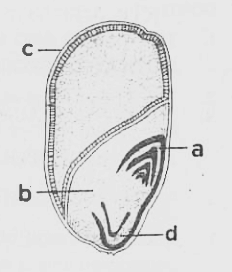
identify the parts labelled as a,b,c and d
1

a → Coleoptile, b → Scutellum, c → Coleorhiza, d → Pericarp

2

a → Coleoptile, b → Scutellum, c → Pericarp, d → Coleorhiza

3
a →Pericarp, b → Coleorhiza, c → Scutellum, d → Coleoptile
4
a →Coleorhiza, b → Coleoptile, c → Scutellum, d → Pericarp
10
PYQ 2024
medium
biology ID: kcet-202
When a flower has both stamens and carpels, it is described as:
1
Asexual
2
Unisexual
3
Bisexual
4
Dioecious
11
PYQ 2026
medium
biology ID: kcet-202
The large empty colourless cells seen on the upper epidermis in grasses which facilitate the curling of leaves to minimise water loss are ________
1
Guard cells
2
Bulliform cells
3
Subsidiary cells
4
Mesophyll cells

About Anatomy Of Flowering Plants - KCET

Anatomy Of Flowering Plants is a vital chapter for KCET aspirants. Mastering the concepts covered in this chapter is essential for securing a top rank.

By rigorously practicing the previous year questions associated with this chapter, you can identify high-yield topics, understand the examiner's perspective, and boost your confidence during the actual exam.

Frequently Asked Questions

Why focus on Anatomy Of Flowering Plants PYQs?

Analyzing PYQs for this specific chapter reveals the most frequently tested concepts and the typical complexity of questions, allowing you to tailor your study plan efficiently.

How to best use this analysis?

Review the topic breakdown to see which sub-topics within Anatomy Of Flowering Plants carry the most weight. Then, tackle the questions iteratively to solidify your understanding.