With respect to Inbreeding, which among the following is not true ?
1
It helps to evolve a pure line in an animal.
2
Inbreeding decreases homozygosity.
3
It helps in accumulation of superior genes.
4
It helps in elimination of less desirable genes.
Official Solution
Correct Option:
(2)
Step 1: What is Inbreeding? Inbreeding refers to the mating of closely related individuals, which increases the chance of offspring inheriting identical genes from both parents.
Step 2: Inbreeding and Homozygosity Inbreeding typically increases homozygosity, not decreases it. Since closely related individuals are likely to share similar genes, their offspring have a higher chance of inheriting two identical copies of the same gene (homozygosity).
Step 3: Conclusion The statement "Inbreeding decreases homozygosity" is incorrect because inbreeding tends to increase homozygosity.
The correct answer is (B) : Inbreeding decreases homozygosity.
02
PYQ 2026
medium
biologyID: kcet-202
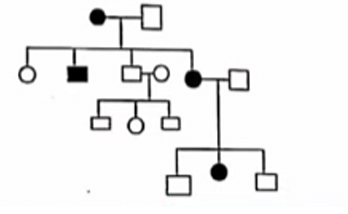
In a practical examination, the below given pedigree chart was given as spotter for identification.
1
Autosomal recessive
2
Autosomal dominant
3
Sex-linked dominant
4
Sex-linked recessive
Official Solution
Correct Option:
(2)
Step 1: Understanding the Concept: Pedigree analysis is a tool used to track the inheritance pattern of a specific genetic trait through generations in a family. Step 2: Key Formula or Approach: Analyze the inheritance from affected parents to their offspring to deduce if the trait is dominant or recessive, and whether it is autosomal or sex-linked. Step 3: Detailed Explanation:
Looking at the chart, in the first generation, both the father and the mother are affected (shaded).
They have some children who are completely unaffected (unshaded).
This is the hallmark of a dominant trait. If the trait were recessive, both affected parents would have the genotype "aa", meaning they could only produce "aa" (affected) children. Since they produce unaffected offspring, both parents must be heterozygous carriers of a dominant trait (Aa Aa), capable of producing "aa" (unaffected) children.
Next, we determine if it is autosomal or sex-linked.
If it were an X-linked dominant trait, an affected father ( ) would pass his affected chromosome to ALL his daughters, making them 100% affected.
However, the chart clearly shows the affected father has an unaffected daughter. This explicitly rules out X-linked dominant inheritance.
Therefore, the inheritance pattern must be Autosomal dominant. Step 4: Final Answer: The correct identification is Autosomal dominant.
About Population Genetics - KCET
Population Genetics is a vital chapter for KCET aspirants. Mastering the concepts covered in this chapter is essential for securing a top rank.
By rigorously practicing the previous year questions associated with this chapter, you can identify high-yield topics, understand the examiner's perspective, and boost your confidence during the actual exam.
Frequently Asked Questions
Why focus on Population Genetics PYQs?
Analyzing PYQs for this specific chapter reveals the most frequently tested concepts and the typical complexity of questions, allowing you to tailor your study plan efficiently.
How to best use this analysis?
Review the topic breakdown to see which sub-topics within Population Genetics carry the most weight. Then, tackle the questions iteratively to solidify your understanding.