Match the digestive glands given in Column-I with their respective enzymes given in Column-II and choose the correct combination from the given options.
Column-I
Column-II
1
Pancreas
p
Pepsin
2
Gastric glands
q
Enterokinase
3
Small intestine
r
Ptyalin
4
Salivary glands
s
Trypsin
Choose the correct options :
1
(I)-(p). (2)-(q). (3)-(r), (4)-(s)
2
(I)-(s), (2)-(p). (3)-(q). (4)-(r)
3
(I)-(r), (2)-(q), (3)-(p). (4)-(s)
4
(I)-(q), (2)-(s), (3)-(r), (4)-(p)
Official Solution
Correct Option: (2)
1. Pancreas: Produces Trypsin (s) (secreted as trypsinogen and activated by enterokinase)
2. Gastric glands: Secrete Pepsin (p) (secreted as pepsinogen and activated by HCl)
3. Small intestine: Produces Enterokinase (q) (which activates trypsinogen)
4. Salivary glands: Secrete Ptyalin (r) (salivary amylase that breaks down starch)
The correct matching is therefore: (1)-(s), (2)-(p), (3)-(q), (4)-(r)
Thus, the correct option is (B) (1) - (s), (2) - (p), (3) - (q), (4) - (r).
02
PYQ 2022
medium
biologyID: kcet-202
Enzyme involved in crossing over
1
Lygase
2
Recombinase
3
Polymerase
4
Endonuclease
Official Solution
Correct Option: (2)
The correct answer is:
Option 2: Recombinase
Explanation:
Recombinase enzymes play a crucial role in the process of crossing over during meiosis. These enzymes facilitate the recombination of genetic material between homologous chromosomes by enabling the exchange of DNA segments.
Recombinase is involved in creating Holliday junctions, which are key intermediates in genetic recombination.
The other options are incorrect because:
Ligase (Option 1) is involved in joining DNA fragments but is not specifically involved in crossing over.
Polymerase (Option 3) synthesizes DNA but does not directly participate in the crossing-over process.
Endonuclease (Option 4) makes cuts in DNA, but it does not directly regulate the exchange of genetic material during crossing over.
Thus, recombinase is the enzyme involved in the crossing-over process.
03
PYQ 2022
medium
biologyID: kcet-202
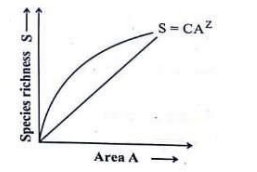
The given graph represents
1
Species area relationship
2
Enzyme activity
3
Growth of organisms
4
Population growth
Official Solution
Correct Option: (1)
Yes, the given graph likely represents the Species-Area Relationship, which describes how the number of species (species richness) increases with the area of a habitat.
Key Points about the Species-Area Relationship:
Proposed by Alexander von Humboldt
Expressed mathematically as:
S=CAZ
where:
S = Species richness
A = Area
C = Constant
Z = Slope of the line (varies between 0.1 and 0.2 for smaller areas and higher for larger areas like continents)
The relationship follows a logarithmic form, meaning that as area increases, species richness increases at a decreasing rate.
This concept is important in ecology, conservation biology, and island biogeography, helping predict species loss due to habitat destruction.
04
PYQ 2022
medium
biologyID: kcet-202
The term "Molecular Scissors" refers to
1
Taq polymerase
2
Polymerase-I
3
Polymerase-II
4
Restriction enzyme
Official Solution
Correct Option: (4)
Restriction enzymes, also known as restriction endonucleases, are enzymes that recognize specific DNA sequences and cleave the DNA at or near those recognition sites. They are often referred to as "molecular scissors" because of their ability to cut DNA molecules at specific points.
Restriction enzymes are produced by bacteria as a defense mechanism against invading viral DNA. These enzymes recognize and bind to specific DNA sequences, called restriction sites, and then cleave the DNA at those sites. The resulting DNA fragments can be used in various molecular biology techniques such as DNA cloning, gene mapping, and genetic engineering.
The discovery and application of restriction enzymes have revolutionized molecular biology and have been instrumental in many areas of genetic research. They allow scientists to manipulate and analyze DNA molecules with precision, making them essential tools in molecular biology laboratories.
05
PYQ 2022
medium
biologyID: kcet-202
Enzyme which is useful to remove the oily stains in laundry?
1
Lipase
2
Renin
3
Protease
4
Amylase
Official Solution
Correct Option: (1)
Lactic Acid Bacteria (LAB), including species such as Lactobacillus and Bifidobacterium, play a crucial role in the fermentation process of curd/yogurt. During fermentation, these bacteria produce enzymes that help convert lactose (milk sugar) into lactic acid. This process of acidification gives curd its characteristic tangy taste and thick texture.
Apart from lactic acid production, LAB can also synthesize certain vitamins, including Vitamin B12. Vitamin B12 is a complex and important nutrient that is naturally produced by certain bacteria and archaea. In the case of curd fermentation, specific strains of LAB can contribute to the production of Vitamin B12, increasing its levels in the final product.
It's important to note that the Vitamin B12 content in curd can vary depending on the specific bacterial strains used for fermentation, the processing methods, and the initial ingredients. Nonetheless, LAB fermentation can potentially increase the Vitamin B12 content in curd.
06
PYQ 2025
medium
biologyID: kcet-202
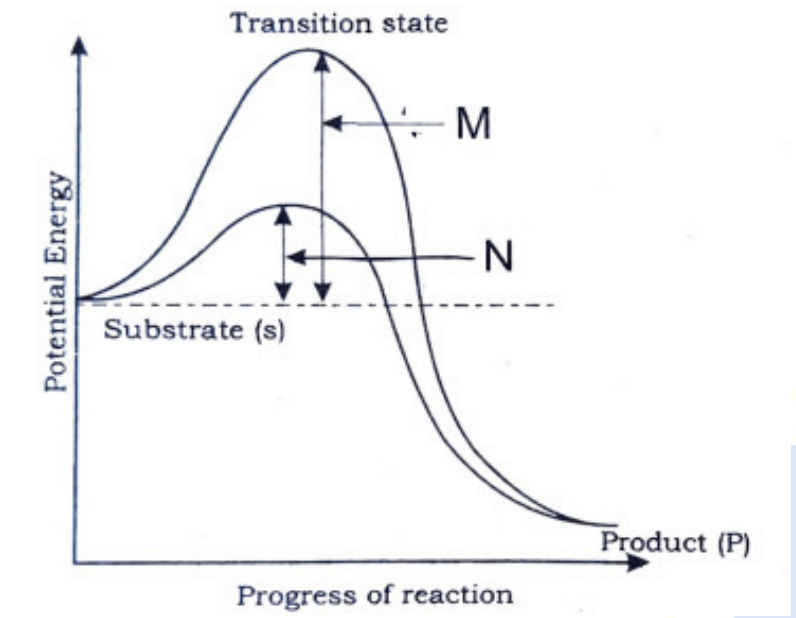
The graph showing the concept of activation energy of enzyme is given below. Observe the graph and choose the correct option for M and N.
1
M-High temperature, High activation energy, N-Low temperature, Low activation energy
2
M-High substrate, High activation energy, N-Low substrate, Low activation energy
3
M-Activation energy without enzyme, N-Activation energy with enzyme
4
M-Activation energy with enzyme, N-Activation energy without enzyme
Official Solution
Correct Option: (3)
Graph Analysis: The graph depicts two energy curves. The higher curve (M) represents the energy barrier without a catalyst (enzyme), while the lower curve (N) shows a reduced energy barrier with an enzyme.
Activation Energy Concept: Activation energy is the energy required to reach the transition state. Enzymes lower this energy, as shown by the difference between M and N.
Option Analysis:
(1) M-High temperature, High activation energy, N-Low temperature, Low activation energy: Temperature affects reaction rate, not directly the activation energy curves shown. Incorrect.
(2) M-High substrate, High activation energy, N-Low substrate, Low activation energy: Substrate concentration influences rate, not the energy barrier itself. Incorrect.
(3) M-Activation energy without enzyme, N-Activation energy with enzyme: Matches the graph, where M is the higher barrier (no enzyme) and N is the lower barrier (with enzyme). Correct.
(4) M-Activation energy with enzyme, N-Activation energy without enzyme: Reverses the graph interpretation. Incorrect.
Conclusion: The correct option is (3), as M represents the activation energy without an enzyme, and N represents the reduced activation energy with an enzyme.
07
PYQ 2026
medium
biologyID: kcet-202
The following statements are the steps in the catalytic action of an enzyme. Arrange them in correct sequence.
a) The active site of the enzyme, now in close proximity of the substrate, breaks the chemical bonds of the substrate and the new enzyme product complex is formed.
b) The substrate binds tightly to the enzyme, inducing a change in the active site of the enzyme.
c) The enzyme releases the products of the reaction and the free enzyme is ready to bind to another molecule of the substrate.
d) The substrate binds to the active site of the enzyme.
1
c, a, b, d
2
d, b, a, c
3
a, b, c, d
4
d, c, b, a
Official Solution
Correct Option: (2)
Step 1: Understanding the Concept: The catalytic cycle of an enzyme action follows a specific sequential pathway described by the induced-fit model. Step 2: Key Formula or Approach: Map the biological events from initial contact (substrate binding) to final release (product separation) in a chronological order. Step 3: Detailed Explanation: The first step is the binding of the substrate to the active site of the enzyme (statement d).
This binding induces a conformational change in the enzyme, making it fit more tightly around the substrate (statement b).
The active site, now in close proximity to the substrate, breaks the chemical bonds of the substrate to form the enzyme-product complex (statement a).
Finally, the enzyme releases the products of the reaction, and the free enzyme is ready to bind to another substrate molecule (statement c).
Thus, the correct sequence is d b a c. Step 4: Final Answer: The correct sequence matches option (2).