To match Column I with Column II, let's analyze each pair:
Pituitary gland: This gland is often referred to as the "master gland" because it regulates other endocrine glands. Disorders associated with it include:
Diabetes insipidus: A condition characterized by excessive thirst and urination, resulting from insufficient antidiuretic hormone (ADH) production.
Thyroid gland: This gland produces hormones that regulate metabolism. Disorders include:
Grave's disease: An autoimmune disorder leading to hyperthyroidism, causing symptoms like weight loss and rapid heartbeat.
Adrenal gland: These glands produce hormones like cortisol and adrenaline. Disorders include.
Addison's disease: A disorder resulting from insufficient production of adrenal hormones, leading to fatigue and muscle weakness.
Pancreas: This organ produces insulin and glucagon to regulate blood sugar. Disorders include:
Diabetes mellitus: A condition characterized by high blood sugar levels due to insulin resistance or deficiency.
Correct Matching :
a. Pituitary gland → iii. Diabetes insipidus
b. Thyroid gland → i. Grave's disease
c. Adrenal gland → iv. Addison's disease
d. Pancreas → ii. Diabetes mellitus
The correct answer is (D) : i-s, ii-r, iii-p, iv-q.
02
PYQ 2022
medium
biologyID: kcet-202
ADA deficiency can be cured by
1
Heart Transplantation
2
Bone-marrow Transplantation
3
Liver Transplantation
4
Kidney Transplantation
Official Solution
Correct Option: (2)
Yes, Adenosine Deaminase (ADA) deficiency can be treated by bone marrow transplantation (Option 2).
However, other possible treatments include:
Enzyme Replacement Therapy (ERT): Injecting ADA enzyme into the patient.
Gene Therapy: Introducing a functional ADA gene into the patient's cells using a viral vector.
Bone marrow transplantation is a potential permanent cure if a suitable donor is available.
03
PYQ 2023
medium
biologyID: kcet-202
Which of the following statements is correct?
1
Female carrier for haemophilia may transmit the disease to sons.
2
Thalassemia is a qualitative problem.
3
Change in whole set of chromosomes is called aneuploidy
4
Sickle cell anaemia is a quantitative problem.
Official Solution
Correct Option: (1)
Haemophilia is an X-linked recessive disorder. A female carrier (with one normal X chromosome and one X chromosome carrying the defective gene) has a 50% chance of transmitting the defective X chromosome to her sons. Since sons inherit the Y chromosome from their fathers, they can only inherit the X chromosome from their mother. Therefore, a female carrier can pass on the disease to her sons.
The correct answer is (A) : Female carrier for haemophilia may transmit the disease to sons.
04
PYQ 2024
medium
biologyID: kcet-202
Find the incorrect statement among the following: n(A) In sex-linked recessive traits, the gene is transmitted from an unaffected carrier female to some of the male progeny. n(B) Accumulation of phenylpyruvic acid in the brain results in mental retardation. n(C) Individuals affected by Down’s Syndrome will have congenital heart defects and are more intelligent. n(D) Turner’s Syndrome is caused due to the absence of one X chromosome.
1
In sex-linked recessive traits, the gene is transmitted from an unaffected carrier female to some of the male progeny.
2
Accumulation of phenylpyruvic acid in the brain results in mental retardation.
3
Individuals affected by Down’s Syndrome will have congenital heart defects and are more intelligent.
4
Turner’s Syndrome is caused due to the absence of one X chromosome.
Official Solution
Correct Option: (3)
The incorrect statement is: Individuals affected by Down's Syndrome will have congenital heart defect and are more intelligent.
(A) Sex-linked inheritance - Correct: Carrier females (XHXh) can transmit recessive traits (e.g., hemophilia) to male offspring (XhY).
(B) Phenylpyruvic acid accumulation - Correct: This is characteristic of phenylketonuria (PKU), causing intellectual disability if untreated.
(C) Down's Syndrome description - Incorrect: While congenital heart defects occur in ~50% cases, individuals typically have mild to moderate intellectual disability (not increased intelligence).
(D) Turner's Syndrome - Correct: 45,X karyotype (missing one X chromosome) causes this condition.
The incorrect statement is (C), as it contains a factual error regarding cognitive abilities in Down's Syndrome (Trisomy 21).
05
PYQ 2026
medium
biologyID: kcet-202
Thalassemia and Sickle cell anaemia are due to a problem in globin molecule synthesis. Select the correct statement.
1
Sickle cell anaemia is due to a quantitative problem of globin molecule.
2
Both are due to qualitative defects in globin chain synthesis.
3
Both are due to quantitative defects in globin chain synthesis.
4
Thalassemia is due to less synthesis of globin molecules.
Official Solution
Correct Option: (4)
Step 1: Understanding the Concept: Both Thalassemia and Sickle Cell Anaemia are genetic disorders affecting the hemoglobin molecule, but their fundamental molecular mechanisms differ entirely. Step 2: Key Formula or Approach: Distinguish between a "quantitative" defect (amount produced) and a "qualitative" defect (structure produced) for both diseases. Step 3: Detailed Explanation: Thalassemia is a genetic disorder resulting in a significantly reduced rate of synthesis of one of the globin chains ( or ).
Because it fundamentally affects the amount or quantity of globin synthesized, Thalassemia is defined strictly as a quantitative problem.
Conversely, Sickle cell anaemia is caused by a point mutation that produces a structurally abnormal, but normally quantified, globin chain (valine instead of glutamic acid).
Because it affects the structural quality and function of the hemoglobin molecule rather than its quantity, Sickle cell anaemia is defined as a qualitative problem.
Looking at the options, statement (4) correctly states that Thalassemia is due to "less synthesis" (which is a quantitative issue). Step 4: Final Answer: The correct statement is (4).
06
PYQ 2026
easy
biologyID: kcet-202
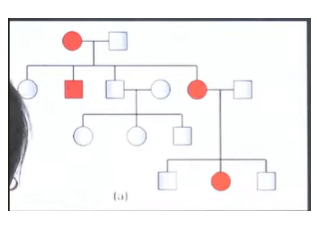
In the following pedigree chart, the mutant trait is shaded black. The gene responsible for the trait is:
Official Solution
Correct Option: (1)
07
PYQ 2026
medium
biologyID: kcet-202
Match the column I with column II. Column-I: (A) Autosomal trisomy, (B) Allosomal trisomy, (C) Allosomal Monosomy, (D) Cystic fibrosis Column-II: (i) Turner's Syndrome, (ii) Mendelian disorder, (iii) Klinefelter's Syndrome, (iv) Down's Syndrome
1
(A)-(i); (B)-(ii); (C)-(iii); (D)-(iv)
2
(A)-(i); (B)-(ii); (C)-(iv); (D)-(iii)
3
(A)-(iv); (B)-(iii); (C)-(ii); (D)-(i)
4
(A)-(iv); (B)-(iii); (C)-(i); (D)-(ii)
Official Solution
Correct Option: (4)
Step 1: Understanding the Concept:
Genetic disorders are classified as Chromosomal disorders (caused by changes in number or structure of chromosomes) or Mendelian disorders (caused by mutation in a single gene). Chromosomal disorders involve Aneuploidy, such as trisomy (extra chromosome) or monosomy (missing chromosome). Step 2: Detailed Explanation:
1. Autosomal trisomy: This involves an extra copy of a non-sex chromosome. Down's Syndrome is trisomy of the 21st chromosome.
2. Allosomal trisomy: This involves an extra sex (allosome) chromosome. Klinefelter's Syndrome involves a genotype of XXY.
3. Allosomal Monosomy: This involves a missing sex chromosome. Turner's Syndrome involves a genotype of XO.
4. Mendelian disorder: These follow Mendelian inheritance patterns. Cystic fibrosis is an autosomal recessive Mendelian disorder. Step 3: Final Answer
The correct matching sequence is (A)-(iv); (B)-(iii); (C)-(i); (D)-(ii).