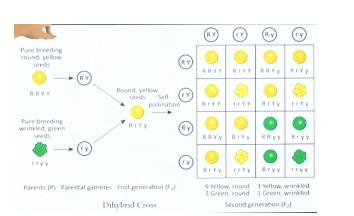
In dihybrid cross, when F1 plants (RrYy) are self hybridised, the ratio of segregation of yellow and green in F2 is :
1
0.04306713
2
3:01
3
9:3:3:1
4
1:1:1:1
Official Solution
Correct Option:
(2)
In dihybrid cross, when F1 plants (RrYy) are self hybridised, 12 yellow and 4 green seeds are produced. Therefore the ratio of segregation of yellow and green in F2 is 3:1
02
PYQ 2026
medium
biologyID: kcet-202
In dihybrid cross, when plants (Rr Yy) are self hybridized, the ratio of segregation of yellow and green in is
1
1:2:1
2
3:1
3
9:3:3:1
4
1:1:1:1
Official Solution
Correct Option:
(2)
Step 1: Understanding the Concept:
In a dihybrid cross, we track two pairs of contrasting traits. However, according to Mendel's Law of Independent Assortment, the inheritance of one pair of characters is independent of the other. This means we can analyze each trait (seed color and seed shape) as a separate monohybrid cross. Step 2: Detailed Explanation:
1. The genotype is . Selfing this gives .
2. To find the ratio for yellow vs. green seeds, we only look at the part of the cross.
3. A cross of results in: - (Yellow) - (Yellow) - (Yellow) - (Green)
4. Counting the phenotypes, we see 3 Yellow seeds for every 1 Green seed.
5. Even though the overall dihybrid phenotypic ratio is 9:3:3:1, if we isolate just one trait (seed color), it still follows the monohybrid segregation ratio of 3:1. Step 3: Final Answer
The ratio of segregation of yellow and green in is 3:1.
About Dihybrid Cross - KCET
Dihybrid Cross is a vital chapter for KCET aspirants. Mastering the concepts covered in this chapter is essential for securing a top rank.
By rigorously practicing the previous year questions associated with this chapter, you can identify high-yield topics, understand the examiner's perspective, and boost your confidence during the actual exam.
Frequently Asked Questions
Why focus on Dihybrid Cross PYQs?
Analyzing PYQs for this specific chapter reveals the most frequently tested concepts and the typical complexity of questions, allowing you to tailor your study plan efficiently.
How to best use this analysis?
Review the topic breakdown to see which sub-topics within Dihybrid Cross carry the most weight. Then, tackle the questions iteratively to solidify your understanding.