Compare the statements A and B. Statement A : When the urine moves through the descending limb, it becomes hypertonic and as it passes through the ascending limb of Henle's loop, it becomes hypotonic. Statement B : The descending limb is permeable to sodium ions, while the ascending limb is impermeable to sodium ions.
1
Statement A is wrong and B is correct.
2
Statement A is correct and B is wrong
3
Both statements A and B are correct.
4
Both statements A and B are wrong
Official Solution
Correct Option: (2)
When the urine moves through the descending limb, it becomes hypertonic and as it passes through the ascending limb of the loop of Henle, it becomes hypotonic because the descending limb is permeable to water and impermeable to sodium ions, while the ascending limb is impermeable to water and permeable to sodium ions.
02
PYQ 2011
easy
biologyID: kcet-201
Effective filtration pressure in glomerulus is caused due to...................
1
powerful pumping action of the heart
2
secretion of adrenalin
3
Afferent arteriole is slightly larger than efferent arteriole
4
Vacuum develops in proximal convoluted tubule and sucks the blood
Official Solution
Correct Option: (3)
Glomerulus is a capillary network within the Bowman?s capsules. Blood enters glomerular capillaries through afferent arterioles and leaves through efferent arterioles. The diameter of afferent arteriole is much more than that of efferent arteriole. This increases the volume of blood in glomerulus and increases the filtration rate
03
PYQ 2015
medium
biologyID: kcet-201
A fall in glomerular filtration rate activates
1
adrenal medulla to release adrenaline
2
juxta glomerular cells to release renin
3
posterior pituitary to release vasopressin
4
adrenal cortex to release aldosterone
Official Solution
Correct Option: (2)
The kidneys have built-in mechanisms for the regulation of glomerular filtration rate. One such efficient mechanism is carried out by juxtaglomerular apparatus (JGA). JGA is a special sensitive region formed by cellular modifications in the distal convoluted tubule and the afferent arteriole at the location of their contact. A fall in GFR can activate the JG cells to release renin which can stimulate the glomerular blood flow and thereby the GFR come back to normal
04
PYQ 2016
medium
biologyID: kcet-201
Facultative absorption of water from primary urine is influenced by the hormone
1
Androgens
2
Epinephrine
3
Vasopressin
4
Thyroxine
Official Solution
Correct Option: (3)
Vasopressin or Pitressin or Antidiuretic hormone (ADH) increases the reabsorption of water in the distal convoluted tubule and collecting ducts of the kidneys
05
PYQ 2026
medium
biologyID: kcet-202
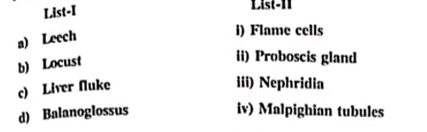
Match the animals given in List-I with their excretory organs in List-II.
1
a - ii, b - i, c - iv, d - iii
2
a - i, b - ii, c - iii, d - iv
3
a - iii, b - iv, c - i, d - ii
4
a - iv, b - iii, c - ii, d - i
Official Solution
Correct Option: (3)
Step 1: Understanding the Concept: Different animal phyla have evolved specialized anatomical structures to carry out osmoregulation and excretion of nitrogenous wastes. Step 2: Key Formula or Approach: Identify the biological phylum/class of each animal and match it to its characteristic excretory organ. Step 3: Detailed Explanation:
(a) Leech: Belongs to Phylum Annelida. Annelids primarily excrete through coiled tubular structures called Nephridia (iii).
(b) Locust: An insect belonging to Phylum Arthropoda. Insects excrete predominantly via numerous fine tubules called Malpighian tubules (iv) which empty into the gut.
(c) Liver fluke: A flatworm belonging to Phylum Platyhelminthes. Flatworms utilize specialized ciliated protonephridia known as Flame cells (i) for osmoregulation and excretion.
(d) Balanoglossus: An acorn worm belonging to Phylum Hemichordata. They possess a specialized excretory structure located in the proboscis, simply called the Proboscis gland (ii).
Matching them up yields: a-iii, b-iv, c-i, d-ii. Step 4: Final Answer: The correct matching corresponds to option (3).