Phenol can be converted to o-hydroxybenzaldehyde by
1
Kolbes reaction
2
Reimer-Tiemann reaction
3
Wurtz reaction
4
Cannizaro reaction
Official Solution
Correct Option: (2)
Treatment of phenol with chloroform in presence of aqueous or at followed by hydrolysis gives o-hydroxybenzaldehyde (salicylaldehyde) as the major product. This reaction is called Reimer-Tiemann reaction.
02
PYQ 2014
medium
chemistryID: keam-201
Williamson?? synthesis of preparing dimethyl ether is a/an
1
electrophilic substitution
2
reaction
3
electrophilic addition
4
reaction
Official Solution
Correct Option: (4)
(alkoxide ion reacts with primary alkyl halide in a single step to form ether)
03
PYQ 2021
medium
chemistryID: keam-202
Isopropylbenzene (cumene) is oxidized in the presence of air to give compound 'X which on hydrolysis in the presence of acids gives compounds 'Y' and 'Z. Compounds 'X', 'Y' and 'Z' are respectively
1
benzyl alcohol, benzaldehyde, ethanol
2
cumene hydroperoxide, phenol, acetone
3
cumene hydroperoxide, benzaldehyde, acetone
4
cumene hydroperoxide, phenol, acetaldehyde
5
cumerc hydroperoxide, benzaldehyde, acetaldehyde
Official Solution
Correct Option: (2)
Isopropylbenzene (cumene) is oxidized in the presence of air to form cumene hydroperoxide (X).
On acidic hydrolysis, cumene hydroperoxide breaks down to give:
Phenol (Y)
Acetone (Z)
This reaction is important in industry for the commercial production of phenol and acetone.
Compounds 'A', 'B' and 'C' have the same molecular formula C_7H_8O. Compound 'A' and 'B' liberate hydrogen gas with sodium metal. When treated with sodium hydroxide, compound 'B' alone dissolves. Compound 'C' is inert towards both sodium metal and sodium hydroxide. Compounds 'A', 'B' and 'C" are respectively
1
Cresol, benzyl alcohol and anisole
2
Benzyl alcohol, cresol and anisole
3
Benzyl alcohol, anisole and cresol
4
Cresol, anisole and benzyl alcohol
5
Anisole, cresol and benzyl alcohol
Official Solution
Correct Option: (5)
We are given three compounds A, B, and C with the molecular formula . Let's analyze their behavior to identify each compound:
Compound A and Compound B liberate hydrogen gas with sodium metal: This means both compounds contain a hydroxyl group (–OH), indicating they are either alcohols or phenols.
Compound B dissolves in sodium hydroxide: This is a property of phenols, which form phenoxide ions in basic solutions. So, B is a phenol.
Compound C is inert to both sodium metal and sodium hydroxide: This suggests it is neither an alcohol nor a phenol. It is likely an ether, which generally does not react with either.
Now, considering the molecular formula :
Compound A is likely benzyl alcohol – reacts with sodium but not with NaOH like phenol.
Compound B is likely cresol (a methylphenol) – reacts with both sodium and NaOH.
Compound C is likely anisole (methoxybenzene) – an ether that is unreactive in both tests.
Correct Answer:
Correct Answer: (E) Anisole, cresol and benzyl alcohol
05
PYQ 2021
medium
chemistryID: keam-202
Compound 'A' is obtained by the reaction of benzyl chloride with magnesium metal in dry ether followed by treatment with water. What is the compound 'A"?
1
Toluene
2
Benzyl alcohol
3
Phenol
4
Benzene
5
Benzaldehyde
Official Solution
Correct Option: (2)
When benzyl chloride (C₆H₅CH₂Cl) reacts with magnesium metal in dry ether, it forms a Grignard reagent known as benzylmagnesium chloride (C₆H₅CH₂MgCl).
Upon treatment with water, this Grignard reagent undergoes hydrolysis to form benzyl alcohol (C₆H₅CH₂OH), which is the product 'A'.
Correct Answer:
Correct Answer: (B) Benzyl alcohol
06
PYQ 2022
medium
chemistryID: keam-202
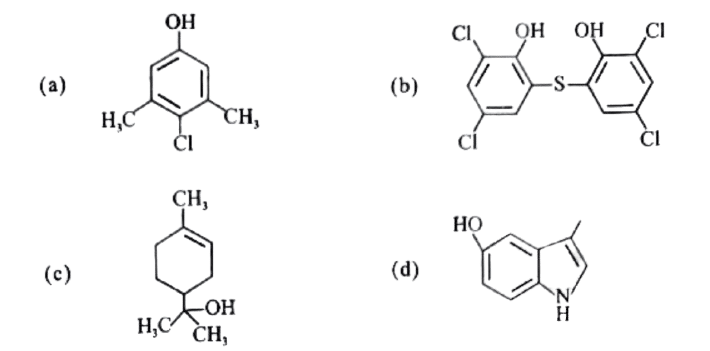
From the following, choose the correct structures of chloroxylenol and terpineol, which are the constituents of "Dettol"
1
a and b
2
b and c
3
a and d
4
a and c
5
b and d
Official Solution
Correct Option: (4)
Chloroxylenol: This compound is a chlorinated derivative of phenol. It is commonly used as a disinfectant and antiseptic. The structure of chloroxylenol has a benzene ring with a hydroxyl group (-OH) and a chlorine atom (Cl) attached to it. In option (a), we can see a phenol ring with a chlorine atom attached to the ring at position 4 and a methyl group attached to position 2, which matches the structure of chloroxylenol.
Terpineol: Terpineol is a monoterpene alcohol found in many essential oils. It has a hydroxyl group (-OH) attached to a six-membered cyclohexene ring. The structure in option (c) corresponds to terpineol, as it is a six-membered ring with a hydroxyl group and two methyl groups, which is characteristic of terpineol. Thus, the correct answer is (D), which corresponds to structures (a) and (c).
Both are constituents of Dettol, where chloroxylenol is a primary active ingredient and terpineol is used for its fragrance and mild antiseptic properties.
Therefore, the correct answer is (D), which includes structures (a) and (c).
07
PYQ 2022
medium
chemistryID: keam-202
Choose the correct order of acidity of the following phenols: (I) m-nitrophenol (II) p-cresol (III) p-nitrophenol (IV) phenol
1
(III) > (I) > (IV) > (II)
2
(II) > (IV) > (III) > (I)
3
(I) > (II) > (III) > (IV)
4
(IV) > (II) > (III) > (I)
5
(III) > (II) > (I) > (IV)
Official Solution
Correct Option: (1)
The acidity of phenols is influenced by substituents that either stabilize or destabilize the phenoxide ion.
p-Nitrophenol (III) is the most acidic due to the electron-withdrawing nitro group at the para position, which stabilizes the phenoxide ion through resonance.
m-Nitrophenol (I) is less acidic than p-nitrophenol, but more acidic than phenol due to the electron-withdrawing nitro group, albeit in the meta position, which has less resonance effect.
Phenol (IV) is more acidic than p-cresol (II) because the hydroxyl group in phenol is a stronger electron-withdrawing group compared to the methyl group in p-cresol.
p-Cresol (II) is the least acidic because the methyl group is an electron-donating group, which destabilizes the phenoxide ion.\\
The correct option is (A) : (III) > (I) > (IV) > (II)
08
PYQ 2022
medium
chemistryID: keam-202
Resorcinol is
1
Benzene-1,3-diol
2
Benzene-1,4-diol
3
Benzene-1,2-diol
4
3-Methylphenol
5
4-Methylphenol
Official Solution
Correct Option: (1)
Resorcinol is a chemical compound consisting of a benzene ring with two hydroxyl groups (-OH) attached to the ring. The positions of the hydroxyl groups determine its name. In the case of resorcinol, the hydroxyl groups are attached to the 1st and 3rd positions on the benzene ring. This gives the compound the name Benzene-1, 3-diol.
The correct option is (A) : Benzene-1,3-diol
09
PYQ 2022
hard
chemistryID: keam-202
Which of the following aryl chlorides on warming with water forms the corresponding phenol?
1
4-Methylchlorobenzene
2
4-Nitrochlorobenzene
3
2, 4, 6-Trinitrochlorobenzene
4
2-Nitrochlorobenzene
5
2, 4-Dinitrochlorobenzene
Official Solution
Correct Option: (3)
When 2, 4, 6-Trinitrochlorobenzene is warmed with water, the chlorine atom is replaced by the hydroxyl group, forming the corresponding phenol. This is because the nitro groups present at the ortho and para positions to the chlorine atom increase the electrophilicity of the carbon attached to the chlorine, making it easier for the nucleophilic substitution to occur with water, leading to phenol formation.
The correct option is (C) : 2, 4, 6-Trinitrochlorobenzene
10
PYQ 2025
medium
chemistryID: keam-202
The order of acidity of the following compounds is: (i) o-Nitrophenol (ii) Phenol (iii) o-Cresol (iv) Ethanol
1
(i) < (iii) < (ii) < (iv)
2
(iii) < (i) < (ii) < (iv)
3
(i) < (ii) < (iii) < (iv)
4
(iv) < (iii) < (ii) < (i)
5
(iii) < (ii) < (i) < (iv)
Official Solution
Correct Option: (3)
The acidity of a compound depends on the electronic effects of substituents attached to the aromatic ring (for phenols and derivatives) and the stability of the conjugate base formed after losing a proton. - o-Nitrophenol (i): The nitro group is an electron-withdrawing group (via both inductive and resonance effects), which increases the acidity of phenol. The ortho position further stabilizes the conjugate base, making it the most acidic among these compounds. - Phenol (ii): Phenol itself is less acidic than o-nitrophenol, as there are no additional electron-withdrawing groups. The hydroxyl group can donate electrons via resonance, making the conjugate base less stable compared to o-nitrophenol. - o-Cresol (iii): The methyl group is an electron-donating group via inductive effects, which makes the conjugate base less stable and reduces the acidity of o-cresol. - Ethanol (iv): Ethanol has a hydroxyl group, but it is not attached to an aromatic ring, and the lack of any additional electron-withdrawing groups makes it the least acidic. Thus, the correct order of acidity is (i) < (ii) < (iii) < (iv).
11
PYQ 2025
medium
chemistryID: keam-202
Acetanilide is prepared by reacting -------and-------.
1
Aniline and acetic acid
2
Aniline and acetic anhydride
3
Acetone and aniline
4
Aniline and acetic chloride
Official Solution
Correct Option: (2)
Acetanilide is a compound formed by the reaction of aniline with acetic anhydride. The reaction is an example of acetylation, where an acetyl group -COCH from acetic anhydride attaches to the nitrogen of the aniline molecule. The general reaction for the preparation of acetanilide is: Thus, the correct answer is Aniline and acetic anhydride.
12
PYQ 2025
medium
chemistryID: keam-202
The IUPAC name of phenyl isopentyl ether is
1
3-Methylbutoxybenzene
2
2-Methylbutoxybenzene
3
2-Methylphenoxybutane
4
4-Methylbutoxybenzene
5
1-Methylbutoxybenzene
Official Solution
Correct Option: (1)
Concept:
Name as alkoxybenzene. Step 1: Structure.
Isopentyl → 3-methylbutyl group.
13
PYQ 2025
medium
chemistryID: keam-202
Phenol on treatment with chloroform in the presence of NaOH, a -CHO group is introduced at ortho position of benzene ring. The reaction is known as
1
Kolbe's reaction
2
Reimer-Tiemann reaction
3
Gattermann-Koch reaction
4
Stephen reaction
5
Sandmeyer reaction
Official Solution
Correct Option: (2)
Concept:
Formylation of phenol using CHCl /NaOH. Step 1: Reaction.
Which of the following compound is used for the manufacture of phenol in large scale?
1
Chlorobenzene
2
Benzene
3
Aniline
4
Cumene
5
Cyclohexane
Official Solution
Correct Option: (4)
Concept:
Phenol is industrially prepared by Cumene process. Step 1: Identify process.
Step 2: Select correct compound.
Cumene is used as starting material.
17
PYQ 2025
medium
chemistryID: keam-202
The major product obtained in the dehydration of ethanol in the presence of at 413 K is
1
Ethanoic acid
2
Ethanal
3
Ethyne
4
Ethoxyethane
5
Ethane
Official Solution
Correct Option: (4)
Step 1: Understanding the Concept:
Dehydration of alcohols with H2SO4 gives different products depending on temperature. Step 2: Detailed Explanation:
At 413 K (140°C), intermolecular dehydration occurs:
Product is diethyl ether (ethoxyethane).
At 443 K (170°C), intramolecular dehydration gives ethene. Step 3: Final Answer:
The major product at 413 K is ethoxyethane.
18
PYQ 2025
medium
chemistryID: keam-202
1
2-Ethoxy-3-methylpentane
2
2-Ethoxy-4-methylpentane
3
1-Ethoxy-2-methylpentane
4
2-Ethoxy-2-methylpentane
5
5-Ethoxy-3-methylpentane
Official Solution
Correct Option: (1)
Step 1: Understanding the Concept:
Williamson ether synthesis: Alkoxide ion reacts with alkyl halide to form an ether. The alkoxide is from the alcohol, halide provides the other alkyl group. Step 2: Detailed Explanation:
The alkoxide is .
This is the sodium salt of 3-methylpentan-2-ol.
The alkyl halide is (bromoethane).
The product: .
Longest chain: pentane. O is at C2, methyl at C3. Name: 2-Ethoxy-3-methylpentane. Step 3: Final Answer:
The product is 2-Ethoxy-3-methylpentane.
19
PYQ 2025
medium
chemistryID: keam-202
Which of the following compound has the highest boiling point?
1
n-Butane
2
Propan-1-ol
3
Methoxy methane
4
Propanal
5
Acetone
Official Solution
Correct Option: (2)
Step 1: Understanding the Concept:
Boiling point depends on intermolecular forces: Hydrogen bonding Dipole-dipole London dispersion. Step 2: Detailed Explanation:
Propan-1-ol (CH3CH2CH2OH): Exhibits strong intermolecular hydrogen bonding → highest BP (~97°C).
Propanal (CH3CH2CHO): Dipole-dipole → BP ~49°C.
Acetone (CH3COCH3): Dipole-dipole → BP ~56°C.
Methoxy methane (CH3OCH3): Weak dipole → BP ~-24°C.
n-Butane (C4H10): Only London forces → BP ~-0.5°C. Step 3: Final Answer:
Propan-1-ol has the highest boiling point.
20
PYQ 2025
medium
chemistryID: keam-202
Which of the following acid is highly acidic?
1
Fluoroacetic acid
2
Formic acid
3
Dichloroacetic acid
4
Benzoic acid
5
Acetic acid.
Official Solution
Correct Option: (3)
Step 1: Understanding the Concept:
Acidity of carboxylic acids is increased by electron-withdrawing groups (-I effect) which stabilize the carboxylate anion. Step 2: Detailed Explanation:
Dichloroacetic acid (Cl2CHCOOH) has two Cl atoms (strong -I effect) → most acidic.
Fluoroacetic acid: One F atom, but F has less -I effect than Cl? Actually F has stronger -I, but here Cl2CH vs FCH2 — two Cl vs one F makes Cl2CHCOOH more acidic.
Formic acid (HCOOH) is more acidic than acetic acid (CH3COOH) due to +I effect of CH3.
Benzoic acid (C6H5COOH) is weaker than formic due to resonance but stronger than acetic.
Order: Dichloroacetic Fluoroacetic Formic Benzoic Acetic. Step 3: Final Answer:
Dichloroacetic acid is the most acidic.
21
PYQ 2025
medium
chemistryID: keam-202
Phenetole is
1
Ethoxybenzene
2
Methoxyethane
3
Methoxybenzene
4
1-Methoxypropane
5
2-Methoxypropane
Official Solution
Correct Option: (1)
Step 1: Understanding the Concept:
Phenetole is a common name for a simple ether. Step 2: Detailed Explanation:
Phenetole is ethyl phenyl ether. Its IUPAC name is ethoxybenzene. The "phen" refers to the phenyl group (C H -), and "etole" refers to the ethyl group (-OCH CH ).
Anisole is methoxybenzene.
Ethoxyethane is diethyl ether. Step 3: Final Answer:
Phenetole is ethoxybenzene.
22
PYQ 2025
medium
chemistryID: keam-202
Acetone can be converted into 2-methylpropan-2-ol using
1
Pd H
2
B H H O , NaOH
3
CH MgI H O
4
LiAlH
5
NaBH
Official Solution
Correct Option: (3)
Step 1: Understanding the Concept:
This is a reaction of a carbonyl compound with a Grignard reagent to form a tertiary alcohol. Step 2: Detailed Explanation:
Acetone is (CH ) C=O. 2-methylpropan-2-ol is (CH ) C-OH, a tertiary alcohol with three methyl groups attached to the carbinol carbon.
To convert acetone to this alcohol, we need to add one more methyl group. This can be achieved by reacting acetone with methylmagnesium iodide (CH MgI), followed by hydrolysis (H O). The Grignard reagent attacks the carbonyl carbon, and after work-up, we get the tertiary alcohol.
Reducing agents like LiAlH or NaBH would give isopropyl alcohol, not the tertiary alcohol. Step 3: Final Answer:
The correct reagent is CH MgI H O.
23
PYQ 2025
medium
chemistryID: keam-202
Which of the following is the weakest acid?
1
Phenol
2
p-Nitrophenol
3
p-Cresol
4
Ethanol
5
m-Cresol
Official Solution
Correct Option: (4)
Step 1: Understanding the Concept:
Acidity depends on the stability of the conjugate base. Phenols are more acidic than alcohols due to resonance stabilization of the phenoxide ion. Step 2: Detailed Explanation:
Alcohols (like ethanol) are neutral or very weakly acidic (pKa ≈ 16). Phenols are more acidic (pKa ≈ 10). The presence of electron-withdrawing groups (like -NO2 at p-position) increases the acidity of phenol. Electron-donating groups (like -CH3 at p- or m-position) decrease the acidity of phenol. However, all phenols are still much stronger acids than ethanol. Therefore, ethanol is the weakest acid among the given options. Step 3: Final Answer:
Ethanol is the weakest acid.
24
PYQ 2025
medium
chemistryID: keam-202
Lucas reagent is
1
Con. HNO + ZnCl
2
Con. HCl + ZnCl
3
Con. H SO + ZnCl
4
Acetic acid + ZnCl
5
Oleium + ZnCl
Official Solution
Correct Option: (2)
Step 1: Understanding the Concept: Lucas reagent is a chemical test used to distinguish between primary, secondary, and tertiary alcohols. Step 2: Detailed Explanation: Lucas reagent is a solution of anhydrous zinc chloride (ZnCl2) in concentrated hydrochloric acid (HCl). It reacts with alcohols to form alkyl chlorides. The rate of reaction is: tertiary > secondary > primary. Tertiary alcohols react immediately, secondary alcohols react within a few minutes, and primary alcohols react very slowly or not at all at room temperature. Step 3: Final Answer: Lucas reagent is conc. HCl + ZnCl2.
25
PYQ 2026
medium
chemistryID: keam-202
IUPAC name of is
1
3-Ethylheptane-4,6-diol
2
3-Ethylheptan-4,6-diol
3
5,5-Diethylpentane-2,4-diol
4
5-Ethylpentane-2,4-diol
5
2-Ethylheptane-4,6-diol
Official Solution
Correct Option: (4)
Concept: • Choose longest chain containing -OH groups Step 1: Identify parent chain
Pentane chain containing both -OH groups Step 2: Numbering
OH at 2 and 4 Step 3: Substituent
Ethyl at C-5 Final Name:
5-Ethylpentane-2,4-diol Final Conclusion:
Option (D)
26
PYQ 2026
easy
chemistryID: keam-202
Which one of the following alcohols reacts instantaneously with Lucas reagent?
1
2
3
4
5
Official Solution
Correct Option: (2)
Step 1: Understanding the Question: The Lucas test (conc. ) is used to distinguish between , , and alcohols. The speed of reaction depends on the stability of the carbocation intermediate. Step 2: Detailed Explanation: The reactivity order towards Lucas reagent is: Tertiary ( ) Secondary ( ) Primary ( ). - Tertiary alcohols react instantaneously to produce turbidity (alkyl chloride). - Secondary alcohols react within 5-10 minutes. - Primary alcohols do not react at room temperature. Analyzing the options: (A) 2-methylpropan-1-ol: Primary alcohol. (B) 2-methylpropan-2-ol (tert-butyl alcohol): Tertiary alcohol. (C) Butan-1-ol: Primary alcohol. (D) Butan-2-ol: Secondary alcohol. Since option (B) is a tertiary alcohol, it reacts immediately. Step 3: Final Answer: The alcohol that reacts instantaneously is 2-methylpropan-2-ol.
27
PYQ 2026
medium
chemistryID: keam-202
The major products formed by heating with HI are
Official Solution
Correct Option: (1)
Step 1: Understanding the Concept:
The reaction involves the cleavage of an ether by a strong acid (Hydrogen Iodide, HI). Ethers are cleaved by strong acids via nucleophilic substitution mechanisms ( or ). The products depend on the stability of the possible carbocation intermediates and steric hindrance. Step 2: Key Formula or Approach:
1. Protonate the ether oxygen to form an oxonium ion.
2. Determine which carbon-oxygen bond is more susceptible to cleavage by the nucleophile ( ). Step 3: Detailed Explanation:
The reactant is benzyl phenyl ether:
Step 1: Protonation by HI:
Step 2: Cleavage. We must decide which bond breaks.
- Bond A: Between Oxygen and the Phenyl ring ( ). This bond is very strong and possesses partial double-bond character due to the resonance delocalization of oxygen's lone pair into the benzene ring. Furthermore, an attack on an hybridized aryl carbon is extremely difficult.
- Bond B: Between Oxygen and the Benzyl group ( ). This bond is weaker. Cleavage here can proceed rapidly via an mechanism because it leads to the formation of a resonance-stabilized benzyl carbocation ( ). Even if following , the benzyl position is reactive.
Because Bond B is much weaker and its cleavage path is highly favorable, the iodide ion ( ) attacks the benzylic carbon.
The bond breaks, yielding:
1. Benzyl iodide:
2. Phenol:
Phenol does not react further with HI under normal conditions because its bond is too strong to be cleaved by halide ions. Step 4: Final Answer:
The major products are Benzyl iodide and Phenol.
28
PYQ 2026
medium
chemistryID: keam-202
Reaction of butanone with methylmagnesium bromide followed by hydrolysis gives:
1
2-methyl-2-butanol
2
2-butanol
3
3-methyl-2-butanol
4
2,2-dimethyl-1-butanol
5
2-pentanol
Official Solution
Correct Option: (1)
Step 1: Understanding the Concept
This is a nucleophilic addition reaction of a Grignard reagent ( ) to a ketone. Grignard reagents react with ketones to produce tertiary ( ) alcohols after acidic hydrolysis. Step 2: Key Formula or Approach
1.
2. Step 3: Detailed Explanation
1. Butanone (Ethyl methyl ketone) has the structure: .
2. Methylmagnesium bromide ( ) provides a nucleophilic methyl group ( ).
3. The attacks the carbonyl carbon of butanone. The oxygen becomes .
4. Upon hydrolysis ( ), the group is converted to an group.
5. The resulting structure is .
6. Following IUPAC rules, the longest chain has 4 carbons with a methyl and hydroxyl group at the 2nd position: 2-methyl-2-butanol. Step 4: Final Answer
The product is 2-methyl-2-butanol.