In which reaction is Benzyl chloride converted to Benzaldehyde?
1
Gatterman Koch reaction
2
Stephan’s reaction
3
Etard reaction
4
Rosemend reduction
Official Solution
Correct Option:
(3)
The Etard reaction is a process in organic chemistry in which benzyl chloride is converted into benzaldehyde in the presence of chromium compounds (such as chromium trioxide or dichromate) and a suitable solvent. This is a well-known method for the oxidation of benzyl chloride to benzaldehyde. Thus, the correct answer is .
02
PYQ 2026
medium
chemistryID: keam-202
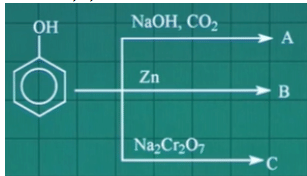
Find A, B, C
1
A
2
B
3
C
4
D
5
E
Official Solution
Correct Option:
(1)
Step 1: Understanding the Concept:
This problem requires knowledge of the standard chemical reactions of phenol. Phenol undergoes characteristic substitution and oxidation/reduction reactions depending on the reagents used. Step 2: Key Formula or Approach:
The approach involves identifying the specific name reaction or standard transformation for each of the three pathways provided in the reaction scheme. Step 3: Detailed Explanation:
Let's analyze the three distinct reactions of phenol: Reaction 1: Formation of A
- This specific combination of reagents corresponds to the Kolbe's reaction (or Kolbe-Schmitt reaction).
- Phenol reacts with sodium hydroxide to form sodium phenoxide, which is even more reactive towards electrophilic aromatic substitution.
- It then reacts with the weak electrophile, carbon dioxide ( ), under pressure and heat.
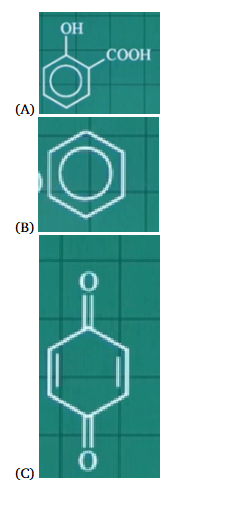
- Acidification yields the final main product, which is 2-hydroxybenzoic acid, commonly known as Salicylic acid.
- This matches Structure A in the options. Reaction 2: Formation of B
- When phenol is heated with zinc dust, it undergoes a reduction reaction.
- The zinc acts as a reducing agent, abstracting the oxygen from the phenol to form zinc oxide ( ), while the aromatic ring is reduced to Benzene ( ).
- This matches Structure B in the options. Reaction 3: Formation of C
- Sodium dichromate ( ) in acidic medium is a strong oxidizing agent.
- Phenol is easily oxidized by chromic acid. The oxidation disrupts the aromaticity to produce a conjugated diketone.
- The product is cyclohexa-2,5-diene-1,4-dione, which is universally known as p-Benzoquinone.
- This matches Structure C in the options. Step 4: Final Answer:
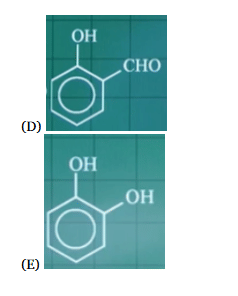
By systematically solving the reactions, we find that A is Salicylic acid, B is Benzene, and C is p-Benzoquinone, which correspond precisely to the provided options A, B, and C.
03
PYQ 2026
easy
chemistryID: keam-202
What is the IUPAC name of Mesityl oxide?
Official Solution
Correct Option:
(1)
04
PYQ 2026
medium
chemistryID: keam-202
Reagent used to convert decanol to decanoic acid
1
Tollen's reagent
2
Jones reagent
3
Grignard reagent
4
Fehling's reagent
5
DIBAC H
Official Solution
Correct Option:
(2)
Step 1: Understanding the Concept:
The oxidation of a primary alcohol to a carboxylic acid requires the use of a strong oxidizing agent. Mild oxidizing agents will stop at the aldehyde stage. Step 2: Key Formula or Approach:
The approach is to identify the functional group transformation (primary alcohol to carboxylic acid) and select the corresponding strong oxidizing agent from the given options. Step 3: Detailed Explanation:
Decanol is a primary alcohol with a 10-carbon chain.
To convert it into decanoic acid, complete oxidation must occur.
Jones reagent, which is a mixture of chromium trioxide ( ) in aqueous sulfuric acid and acetone, is a strong oxidizing agent.
It oxidizes primary alcohols first to aldehydes, and then rapidly further to carboxylic acids.
Tollen's reagent and Fehling's reagent are mild oxidizing agents that only oxidize aldehydes to carboxylic acids, but do not oxidize alcohols.
Grignard reagents are used for nucleophilic addition to carbonyls, not for oxidation.
DIBAC H is a reducing agent, typically used to reduce esters or nitriles to aldehydes.
Therefore, Jones reagent is the correct choice. Step 4: Final Answer:
The correct reagent is Jones reagent.
About Organic Reactions - KEAM
Organic Reactions is a vital chapter for KEAM aspirants. Mastering the concepts covered in this chapter is essential for securing a top rank.
By rigorously practicing the previous year questions associated with this chapter, you can identify high-yield topics, understand the examiner's perspective, and boost your confidence during the actual exam.
Frequently Asked Questions
Why focus on Organic Reactions PYQs?
Analyzing PYQs for this specific chapter reveals the most frequently tested concepts and the typical complexity of questions, allowing you to tailor your study plan efficiently.
How to best use this analysis?
Review the topic breakdown to see which sub-topics within Organic Reactions carry the most weight. Then, tackle the questions iteratively to solidify your understanding.