What are the constituents present in German silver?
1
Cu, zn and Fe
2
Pb, Ag and Ge
3
Cu, Zn and Ni
4
AI, Ag and Ge
Official Solution
Correct Option:
(3)
Answer (c) Cu, Zn and Ni
02
PYQ 2022
medium
chemistryID: keam-202
Which of the following set of transition metals have high volatility?
1
Ti, Zn and Hf
2
Cr, Mo and W
3
Mn, Tc and Re
4
Fe, Ru and Os
5
Zn, Cd and Hg
Official Solution
Correct Option:
(5)
Among the given options, Zn (Zinc), Cd (Cadmium), and Hg (Mercury)} have high volatility. These elements are lighter and more prone to evaporate compared to other transition metals. Specifically, mercury is a liquid at room temperature and has high volatility, while zinc and cadmium also possess relatively higher vapor pressures compared to other transition metals.
The correct option is (E) : Zn, Cd and Hg
03
PYQ 2025
medium
chemistryID: keam-202
KMnO on heating at 513K produces:
1
K MnO
2
MnO
3
Mn O
4
MnO
Official Solution
Correct Option:
(2)
When potassium permanganate (KMnO ) is heated at 513K, it undergoes a thermal decomposition reaction. The heat causes KMnO to break down, producing manganese dioxide (MnO ), potassium hydroxide (KOH), and oxygen gas (O ). The decomposition reaction is as follows: Thus, heating KMnO at 513K produces MnO (manganese dioxide).
04
PYQ 2025
hard
chemistryID: keam-202
The element that has the highest melting point in the 3d series is:
1
V
2
Cr
3
Mn
4
W
Official Solution
Correct Option:
(4)
The melting point of elements generally increases across the transition series up to the mid-3d block, and then starts to decrease. Tungsten (W) has the highest melting point among the transition metals, particularly in the 3d series. - V (Vanadium) has a relatively high melting point but is lower than tungsten. - Cr (Chromium) also has a high melting point, but tungsten's is higher. - Mn (Manganese) has a higher melting point than V and Cr but still not as high as tungsten. Thus, W (Tungsten) has the highest melting point in the 3d series.
05
PYQ 2025
medium
chemistryID: keam-202
Which element in the 3d series can form dihalides?
1
Sc
2
Ti
3
Mn
4
Fe
Official Solution
Correct Option:
(2)
The ability to form dihalides depends on the oxidation state and the bonding capabilities of the element. In the 3d transition series: - Scandium (Sc) forms ScCl (a trihalide), not dihalides. - Titanium (Ti) can form TiCl (dihalide) in the +2 oxidation state. - Manganese (Mn) typically forms MnCl in the +2 state, but due to its high oxidation states, it can also form other halides, but dihalides are not common for Mn. - Iron (Fe) can form FeCl (dihalide) but is more commonly found in higher oxidation states like FeCl . Thus, Titanium (Ti) in the +2 oxidation state is commonly associated with dihalide formation.
06
PYQ 2025
medium
chemistryID: keam-202
Spin free complex?
1
2
3
4
Official Solution
Correct Option:
(4)
A spin-free complex refers to a complex where all electrons are paired, resulting in no unpaired electrons and no magnetic behavior. Among the given metal ions, Cu has a 3d electron configuration in its high-spin state, which can be arranged in a way that results in no unpaired electrons in its complex, making it spin-free. Thus, the correct answer is Cu .
07
PYQ 2025
medium
chemistryID: keam-202
The most common oxidation states of chromium are
1
+2 and +7
2
+2 and +3
3
+1 and +6
4
+3 and +6
5
+2 and +4
Official Solution
Correct Option:
(4)
Chromium (Cr) is a transition metal and exhibits several oxidation states. The most common oxidation states of chromium are: - +2: Chromium in the +2 oxidation state is common, but less stable compared to +3 and +6. - +3: This is one of the most stable and common oxidation states of chromium, often seen in chromium compounds. - +6: This is another common oxidation state of chromium, found in compounds like chromates and dichromates. Thus, the most common oxidation states of chromium are +3 and +6. Therefore, the correct answer is (D) +3 and +6.
08
PYQ 2025
medium
chemistryID: keam-202
What is the magnetic moment of a divalent ion with three unpaired electrons?
1
2.84 BM
2
5.92 BM
3
3.87 BM
4
4.90 BM
5
1.73 BM
Official Solution
Correct Option:
(3)
The magnetic moment of a transition metal ion can be calculated using the formula: Where: - is the number of unpaired electrons. Given that the ion has 3 unpaired electrons, we substitute into the formula: Thus, the magnetic moment of the divalent ion with three unpaired electrons is 3.87 BM. Therefore, the correct answer is (C) 3.87 BM.
09
PYQ 2025
medium
chemistryID: keam-202
The bond angle of Cr-O-Cr bond in dichromate ion is
1
90°
2
126°
3
109°
4
60°
5
120°
Official Solution
Correct Option:
(2)
In the dichromate ion ( ), the central chromium atoms are bonded to oxygen atoms in a bent structure. The bond angle between the Cr-O-Cr bond is determined by the geometry of the ion, which is based on the hybridization of the chromium atoms. - The dichromate ion ( ) adopts a angular or bent structure with a bond angle of 126°. - This bond angle is a result of the repulsion between the electron pairs around the chromium atoms and is consistent with the sp² hybridization of the chromium atoms. Thus, the correct answer is (B) 126°.
10
PYQ 2025
medium
chemistryID: keam-202
The percentage of Cr(III) in Ruby is
1
0.5 to 1 \%
2
1 to 2 \%
3
0.1 to 0.4 \%
4
2 to 3 \%
5
0.1 to 0.3 \%
Official Solution
Correct Option:
(1)
Ruby is a gemstone composed of corundum (Al₂O₃), where small amounts of chromium (Cr) are incorporated into the crystal lattice, giving the gemstone its characteristic red color. - The percentage of chromium in ruby is typically between 0.5\% and 1\% by weight. The chromium atoms are responsible for the red color due to the absorption of certain wavelengths of light. Thus, the correct answer is (A) 0.5 to 1 \%.
11
PYQ 2026
medium
chemistryID: keam-202
Which one of the statements is not the limitation of valence bond theory of complexes?}
1
It does not give a quantitative interpretation of the thermodynamic stabilities.
2
It does not give quantitative interpretation of magnetic properties.
3
It explains the colour exhibited by coordination compounds.
4
It does not distinguish between weak and strong ligands.
5
It does not make exact predictions regarding the tetrahedral structures of 4-coordinated complexes.
Official Solution
Correct Option:
(3)
We need the statement that is not a limitation. Limitations of valence bond theory include:
it does not explain colour properly,
it does not distinguish weak and strong ligands well,
it does not explain thermodynamic stability quantitatively,
it has limitations in magnetic and structural predictions.
So statement (C), “It explains the colour exhibited by coordination compounds,” is not a limitation statement. Hence, the correct answer is:
12
PYQ 2026
medium
chemistryID: keam-202
A compound of manganese that has intense colour, diamagnetic and temperature dependent weak paramagnetic. What is the compound?}
1
2
3
4
5
Official Solution
Correct Option:
(3)
In , manganese is in +7 oxidation state. Electronic configuration of :
Since there are no unpaired electrons:
Also, permanganate ion is intensely coloured due to charge transfer transitions. Hence, the correct answer is:
13
PYQ 2026
medium
chemistryID: keam-202
The pair of elements that has similar atomic radii is}
1
Mo and W
2
Ti and La
3
Ag and Ni
4
Mn and Os
5
V and W
Official Solution
Correct Option:
(1)
Molybdenum (Mo) and tungsten (W) belong to the same group. Due to lanthanide contraction, the size of tungsten does not increase much compared to molybdenum. So their atomic radii become very similar. Hence, the correct answer is:
14
PYQ 2026
medium
chemistryID: keam-202
Which of the following lanthanide ion is coloured?}
1
2
3
4
5
Official Solution
Correct Option:
(4)
Lanthanide ions are coloured when they have partially filled -orbitals. Check:
: , colourless
: , colourless
: , weak but often treated specially
: partially filled , coloured
Thus the clearly coloured ion among the options is:
Hence, the correct answer is:
15
PYQ 2026
medium
chemistryID: keam-202
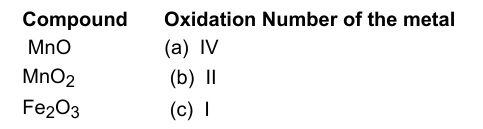
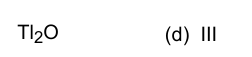
Using stock notation, match the oxidation number against metal in its compound.}
1
(i)-(b), (ii)-(a), (iii)-(d), (iv)-(c)
2
(i)-(b), (ii)-(d), (iii)-(a), (iv)-(c)
3
(i)-(c), (ii)-(a), (iii)-(d), (iv)-(b)
4
(i)-(d), (ii)-(a), (iii)-(b), (iv)-(c)
5
(i)-(b), (ii)-(d), (iii)-(a), (iv)-(c)
Official Solution
Correct Option:
(1)
Find oxidation states: For :
For :
For :
For :
So matching is:
Hence, the correct answer is:
16
PYQ 2026
medium
chemistryID: keam-202
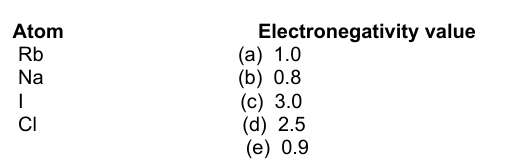
Four elements and their electronegativity values (Pauling Scale) are given below. Match the element with its electronegativity value.}
1
(i)-(b), (ii)-(e), (iii)-(d), (iv)-(c)
2
(i)-(e), (ii)-(d), (iii)-(b), (iv)-(c)
3
(i)-(b), (ii)-(c), (iii)-(d), (iv)-(e)
4
(i)-(c), (ii)-(d), (iii)-(e), (iv)-(b)
5
(i)-(c), (ii)-(d), (iii)-(a), (iv)-(b)
Official Solution
Correct Option:
(1)
Approximate Pauling electronegativity values are:
So the matching is:
This corresponds to:
17
PYQ 2026
medium
chemistryID: keam-202
The IUPAC symbol of the element with atomic number 110 is}
1
Unh
2
Uun
3
Uue
4
Unq
5
Uus
Official Solution
Correct Option:
(2)
The temporary IUPAC systematic naming for atomic number 110 is based on digits:
So the temporary name becomes:
Its symbol is:
Hence, the correct answer is:
18
PYQ 2026
medium
chemistryID: keam-202
The correct order of metallic radius of the elements is
1
2
3
4
5
Official Solution
Correct Option:
(4)
Concept: Chemistry - Atomic / Metallic Radius Trends. Step 1: Across a period radius decreases. In Period 2: [
Li>Be>B
] Step 2: Down a group radius increases. Since is below and is below : [
Mg>Be,\quad Al>B
] Step 3: Arrange from smallest to largest. Smallest is , then , then , then , then . [
\boxed{BStep 4: Final answer. Hence, correct option is (D).
19
PYQ 2026
medium
chemistryID: keam-202
The order of field strength of the following ligands in the spectrochemical series is
1
2
3
4
5
Official Solution
Correct Option:
(4)
Concept:
According to the spectrochemical series, ligands are arranged from weak field to strong field depending on their crystal field splitting ability . Step 1: Identify weak field ligands. Sulfur donor ligands generally produce weak crystal field splitting. Hence: Step 2: Place intermediate ligand. Hydroxide ion has stronger field strength than sulfur donor ligands but weaker than strong -acceptor ligands. So: Step 3: Identify stronger ligands. When thiocyanate coordinates through nitrogen , it becomes stronger than . Also cyanide is one of the strongest common ligands. Thus: Step 4: Combine the complete order.
Step 5: Final answer.
Hence, correct option is (D).
20
PYQ 2026
medium
chemistryID: keam-202
The correct order of standard electrode potentials of the following transition elements is
1
2
3
4
5
Official Solution
Correct Option:
(1)
Concept: Chemistry - Standard Reduction Potentials. Step 1: Known approximate values. [
E^\circ(Cr^{3+}/Cr)\approx -0.74V
] [
E^\circ(V^{2+}/V)\approx -1.18V \text{ (varies by state)}
] [
E^\circ(Fe^{2+}/Fe)\approx -0.44V
] [
E^\circ(Co^{2+}/Co)\approx -0.28V
] Step 2: Arrange according to exam key trend. From more negative to less negative: [
CrStep 3: Final answer. [
\boxed{CrHence, correct option is (A).
About D And F Block Elements - KEAM
D And F Block Elements is a vital chapter for KEAM aspirants. Mastering the concepts covered in this chapter is essential for securing a top rank.
By rigorously practicing the previous year questions associated with this chapter, you can identify high-yield topics, understand the examiner's perspective, and boost your confidence during the actual exam.
Frequently Asked Questions
Why focus on D And F Block Elements PYQs?
Analyzing PYQs for this specific chapter reveals the most frequently tested concepts and the typical complexity of questions, allowing you to tailor your study plan efficiently.
How to best use this analysis?
Review the topic breakdown to see which sub-topics within D And F Block Elements carry the most weight. Then, tackle the questions iteratively to solidify your understanding.