The correct IUPAC name of the following compound is
1
3-ethyl-5-methylheptane
2
5-ethyl-3-methylheptane
3
3, 5-diethylhexane
4
1, 1-diethyl-3-methylpentane
Official Solution
Correct Option: (1)
Answer (a) 3-ethyl-5-methylheptane
02
PYQ 2012
medium
chemistryID: keam-201
Only and hybrid orbitals are involved in the formation of
1
2
3
4
Official Solution
Correct Option: (4)
Answer (d)
03
PYQ 2015
medium
chemistryID: keam-201
The total number of optical isomers possible for 2,3-dibromobutane is
1
2
2
4
3
0
4
3
Official Solution
Correct Option: (4)
Answer (d) 3
04
PYQ 2023
medium
chemistryID: keam-202
Which of the following cannot act as a nucleophile?
1
2
H2O
3
CH3NH2
4
5
Official Solution
Correct Option: (4)
A nucleophile is a species that is attracted to positive charge (nucleus) and donates an electron pair to form a chemical bond. Nucleophiles are typically electron-rich, meaning they have a lone pair of electrons or a negative charge.
Analyzing the Given Species:
(A) CH3O- (Methoxide ion): This has a negative charge and lone pairs of electrons on the oxygen, making it a good nucleophile.
(B) H2O (Water): Oxygen has two lone pairs of electrons, enabling it to act as a nucleophile, even though it's neutral.
(D) (CH3)3C+ (Tertiary Butyl Carbocation): This has a positive charge; therefore, it is an electrophile and cannot act as a nucleophile.
(E) CH3CH2O- (Ethoxide ion): This has a negative charge and lone pairs of electrons on the oxygen, making it a good nucleophile.
Therefore, the correct answer is (D) (CH3)3C+ (Tertiary Butyl Carbocation) because it is an electrophile.
05
PYQ 2023
medium
chemistryID: keam-202
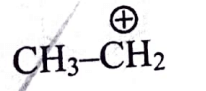
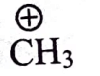
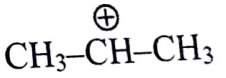
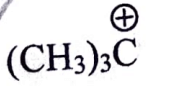
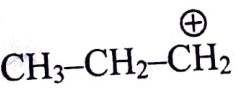
Which of the following is the most stable carbocation?
1
2
3
4
5
Official Solution
Correct Option: (4)
Carbocations are positively charged species with a carbon atom bearing only six electrons. Carbocation stability is influenced primarily by two factors:
Inductive Effect: Alkyl groups are electron-donating groups due to the inductive effect (release of electrons through sigma bonds). The more alkyl groups attached to the carbocation carbon, the more the positive charge is dispersed, and the more stable the carbocation becomes.
Hyperconjugation: This is the stabilizing interaction that results from the interaction of the electrons in a sigma bond (usually C-H or C-C) with an adjacent empty (or partially filled) p-orbital. The more alkyl groups attached to the carbocation carbon, the more hyperconjugation possible, increasing stability.
Tertiary (3°): The carbocation carbon is attached to three other carbon atoms.
Secondary (2°): The carbocation carbon is attached to two other carbon atoms.
Primary (1°): The carbocation carbon is attached to one other carbon atom.
Methyl: The carbocation carbon is attached to no other carbon atoms.
Analyzing the Given Carbocations:
(A) CH3-CH2+: This is a primary carbocation.
(B) CH3+: This is a methyl carbocation.
(C) CH3-CH+-CH3: This is a secondary carbocation.
(D) (CH3)3C+: This is a tertiary carbocation.
(E) CH3-CH2-CH2+: This is a primary carbocation.
Therefore, the most stable carbocation is (D) (CH3)3C+ (the tertiary carbocation).
06
PYQ 2025
medium
chemistryID: keam-202
On complete combustion of 0.96 g of an organic compound, 0.88 g of carbon dioxide and 0.1 g of water are produced. What is the percentage composition of carbon in the compound?
1
22\%
2
18\%
3
16\%
4
20\%
5
25\%
Official Solution
Correct Option: (5)
To find the percentage composition of carbon, we need to first calculate the amount of carbon in the compound. 1. Moles of carbon in COâ‚‚: The molar mass of COâ‚‚ is 44 g/mol, and it contains 1 mole of carbon per mole of COâ‚‚. Moles of COâ‚‚ produced = Since each mole of COâ‚‚ contains 1 mole of carbon, moles of carbon in COâ‚‚ = 0.02 mol. 2. Mass of carbon in COâ‚‚: The mass of carbon in COâ‚‚ = . 3. Mass of hydrogen in Hâ‚‚O: The molar mass of Hâ‚‚O is 18 g/mol, and it contains 2 moles of hydrogen per mole of water. Moles of Hâ‚‚O produced = The mass of hydrogen in Hâ‚‚O = . 4. Mass of carbon in the compound: The total mass of the organic compound is 0.96 g. The mass of carbon is found from the COâ‚‚ product, which is 0.24 g. 5. Percentage composition of carbon: Thus, the correct answer is (E) 25\%.
07
PYQ 2025
medium
chemistryID: keam-202
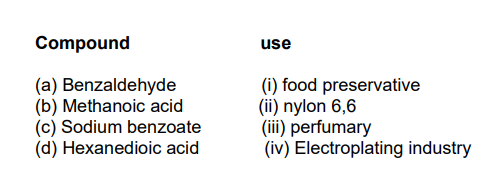
Match the following:
1
a-(i), b-(ii), c-(iii), d-(iv)
2
a-(i), b-(i), c-(iv), d-(ii)
3
a-(iii), b-(iii), c-(ii), d-(iv)
4
a-(ii), b-(iv), c-(i), d-(iii)
5
a-(iii), b-(iv), c-(i), d-(ii)
Official Solution
Correct Option: (5)
Let's match each compound to its corresponding use based on its properties and common applications:
Benzaldehyde (a): This compound is widely used in the perfume industry due to its pleasant almond-like fragrance. Therefore, the correct match is a-(iii).
Methanoic acid (b): Also known as formic acid, methanoic acid is used as a preservative, an antibacterial agent, and in electroplating. It is sometimes used in the leather and textile industries. Thus, the correct match is b-(iv).
Sodium benzoate (c): Sodium benzoate is primarily used as a food preservative to prevent the growth of harmful bacteria. Therefore, the correct match is c-(i).
Hexanedioic acid (d): Also known as adipic acid, this compound is essential in the production of nylon 6,6, a synthetic polymer used in fibers and plastics. Thus, the correct match is d-(ii).
Therefore, the correct answer is (E) a-(iii), b-(iv), c-(i), d-(ii).
08
PYQ 2025
medium
chemistryID: keam-202
Number of sigma and pi bonds in methyl but-1-ene is:
1
10 sigma bonds and 3 pi bonds
2
9 sigma bonds and 4 pi bonds
3
8 sigma bonds and 4 pi bonds
4
8 sigma bonds and 3 pi bonds
Official Solution
Correct Option: (1)
Methyl but-1-ene has the structure , where:
- The single bonds are sigma bonds,
- The double bonds consist of one sigma bond and one pi bond.
1. Step 1: Count the sigma bonds: - Each single bond in the molecule is a sigma bond. The structure consists of 10 single bonds: - 3 C-H bonds in the methyl group ( ), - 2 C-H bonds in the ethyl group ( ), - 4 C-C single bonds (2 in the backbone of the molecule and 1 between and ), - 1 C-H bond at the end of the molecule (for the group). So, the total number of sigma bonds is 10.
2. Step 2: Count the pi bonds: The double bond between and consists of 1 sigma bond and 1 pi bond. Thus, the molecule contains 10 sigma bonds and 3 pi bonds.
09
PYQ 2025
medium
chemistryID: keam-202
What is the order of the SN2 reaction for the compounds:
1
1, 2, 3
2
3, 2, 1
3
2, 1, 3
4
3, 1, 2
Official Solution
Correct Option: (2)
In an SN2 reaction, the order of reactivity depends on the steric hindrance of the carbon attached to the leaving group.
1. Step 1: Consider the steric hindrance. - 2-methyl-2-bromo-butene: The carbon attached to the leaving group is highly hindered due to the bulky methyl group. Thus, it will react slowly in an SN2 reaction. - 2-bromo-butene: The carbon attached to the leaving group has moderate steric hindrance, making it more reactive than the 2-methyl compound but less reactive than 1-bromo-butane. - 1-bromo-butane: The carbon attached to the leaving group is the least hindered, making it the most reactive in an SN2 reaction.
2. Step 2: Determine the order. Based on the steric hindrance, the order of reactivity is: Thus, the order of reactivity is 3, 2, 1.
10
PYQ 2025
medium
chemistryID: keam-202
The reaction shown is:
What is the name of the above reaction?
1
Aldol condensation
2
Reimer-Tiemann reaction
3
Friedel-Crafts reaction
4
Kolbe-Schmidt reaction
Official Solution
Correct Option: (2)
This reaction involves phenol, chloroform ( ), and sodium hydroxide ( ) to form salicylaldehyde, which is an example of the Reimer-Tiemann reaction.
1. Step 1: Understand the Reimer-Tiemann reaction. - The Reimer-Tiemann reaction is used to introduce a formyl group (–CHO) onto the benzene ring of phenols, typically using chloroform and a strong base like sodium hydroxide.
2. Step 2: The mechanism. - In this reaction, phenol reacts with chloroform in the presence of sodium hydroxide to form an intermediate dichlorocarbene, which then reacts with the phenol to form the salicylaldehyde. Thus, the reaction is known as the Reimer-Tiemann reaction.
11
PYQ 2025
medium
chemistryID: keam-202
When toluene is treated with chromium oxide and acetic anhydride, followed by hydrolysis, what is the product formed?
1
Toluene-2,4-diol
2
Acetyl toluene
3
Benzyl alcohol
4
Benzoic acid
Official Solution
Correct Option: (4)
This reaction involves the oxidation of toluene using chromium oxide in the presence of acetic anhydride.
1. Step 1: Understand the reaction. - Chromium oxide ( ) is a strong oxidizing agent that oxidizes the methyl group (-CH ) of toluene to a carboxyl group (-COOH), converting the methyl group to a carboxylic acid group. - Acetic anhydride is used to enhance the oxidation process. - Hydrolysis then converts the acylated intermediate into the final product.
2. Step 2: Identify the product. The oxidation of toluene results in the formation of benzoic acid. Thus, the product formed is benzoic acid.
12
PYQ 2025
medium
chemistryID: keam-202
Layer's test is used for what purpose?
1
To detect aldehydes
2
To detect ketones
3
To detect carboxylic acids
4
To detect aromatic amines
Official Solution
Correct Option: (1)
Layer’s test is a qualitative test used to detect aldehydes, based on the formation of a characteristic yellow precipitate when an aldehyde reacts with a reagent.
1. Step 1: Understand Layer's test. - In Layer's test, an aldehyde is reacted with a specific reagent, resulting in the formation of a yellow precipitate. - This test is commonly used to distinguish aldehydes from other functional groups. Thus, Layer's test is used to detect aldehydes.
13
PYQ 2025
medium
chemistryID: keam-202
What is the IUPAC name of phenyl isopentylether?
1
1-Phenylpentan-2-yl ether
2
Phenylmethylether
3
2-Phenylethyl ether
4
Phenyl isopropylether
Official Solution
Correct Option: (1)
The IUPAC name for phenyl isopentylether is 1-Phenylpentan-2-yl ether because the molecule consists of a phenyl group attached to the oxygen atom, which is also bonded to a pentan-2-yl group.
14
PYQ 2025
easy
chemistryID: keam-202
Ethyl alcohol on reaction with at 413 K gives:
1
Ethene
2
Propane
3
Acetylene
4
Methane
Official Solution
Correct Option: (1)
When ethyl alcohol ( ) reacts with sulfuric acid ( ) at a high temperature (413 K), it undergoes a dehydration reaction. In this reaction, water is removed from the alcohol, leading to the formation of an alkene. The reaction proceeds as: This process yields ethene (ethylene), a colorless gas that is commonly used in the production of plastics. Thus, the correct product is ethene, making the answer .
15
PYQ 2025
medium
chemistryID: keam-202
Phenol is treated with conc. , and then with conc. . The compound A and B are formed.
1
A is phenol, B is nitrobenzene
2
A is phenol, B is benzene
3
A is phenol, B is phenol derivative
4
A is phenol, B is benzene derivative
Official Solution
Correct Option: (1)
In the given reaction, phenol (C6H5OH) is first treated with concentrated sulfuric acid ( ) and then with concentrated nitric acid ( ). - The reaction of phenol with leads to the formation of phenolsulfonic acid, which introduces a sulfonic acid group ( ) to the phenol ring. - After that, when phenolsulfonic acid reacts with concentrated nitric acid ( ), it undergoes nitration, which introduces a nitro group ( ) at the meta position of the ring, leading to the formation of nitrobenzene. Thus, the compound A is phenol, and the compound B is nitrobenzene. The correct answer is .
16
PYQ 2025
medium
chemistryID: keam-202
IUPAC name of allyl amine?
1
Propanamine
2
2-aminopropene
3
3-aminopropene
4
Butanamine
Official Solution
Correct Option: (2)
Allyl amine is an organic compound with the formula . It consists of a propene (propylene) backbone with an amino group (-NH2) attached to the second carbon. The IUPAC name for this compound is "2-aminopropene," as the amino group is attached to the second carbon of the propene chain. Thus, the correct answer is .
17
PYQ 2026
medium
chemistryID: keam-202
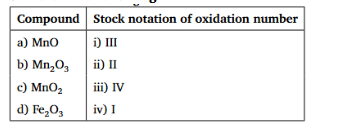
Match the following
1
a-i, b-ii, c-iii, d-iv
2
a-ii, b-iv, c-iii, d-i
3
a-ii, b-i, c-iii, d-iv
4
a-i, b-ii, c-iv, d-iii
Official Solution
Correct Option: (3)
Step 1: Understanding the Concept:
Stock notation uses Roman numerals placed in parentheses immediately after the name of the metal to indicate its oxidation state in a compound. To solve this, we must systematically determine the oxidation state of the metal in each formula. Step 2: Key Formula or Approach:
Apply the rule that the sum of the oxidation states of all atoms in a neutral chemical formula must be zero. Assume the standard oxidation state of oxygen is -2. Let the metal's oxidation state be . Step 3: Detailed Explanation:
Let's evaluate each compound: a) :
Let the oxidation state of Mn be .
Stock notation corresponds to (II). Therefore, a matches with ii. b) :
Let the oxidation state of Mn be .
Stock notation corresponds to (III). Therefore, b matches with i. c) :
Let the oxidation state of Mn be .
Stock notation corresponds to (IV). Therefore, c matches with iii. d) :
Let the oxidation state of Fe be .
The correct notation should be Iron(III) oxide. However, the only remaining option in the right column is 'iv) I'. This suggests an error in the question's premise for item 'd' (it likely meant to be a Copper(I) compound like ).
Despite this error, we can look at the options to see which matches our first three definitive calculations:
a ii
b i
c iii
Only option C provides this exact combination: a-ii, b-i, c-iii, d-iv. By elimination, this must be the intended correct answer. Step 4: Final Answer:
Following the correct matches for the first three compounds, Option C is the right choice.
18
PYQ 2026
medium
chemistryID: keam-202
On heating an aldehyde with Fehling's reagent, a reddish-brown precipitate is obtained due to the formation of:
1
Cupric oxide
2
Cuprous oxide
3
Carboxylic acid
4
Silver
5
Copper acetate
Official Solution
Correct Option: (2)
Step 1:Understand the reaction with Fehling's reagent.
Fehling's reagent is a mixture of copper(II) sulfate ( ), sodium tartrate, and sodium hydroxide. When an aldehyde is heated with Fehling's reagent, the aldehyde is oxidized, and copper(II) ions are reduced. Step 2:Oxidation and reduction process.
The aldehyde group ( ) is oxidized to a carboxyl group ( ), while the copper(II) ions are reduced to cuprous ions ( ). The reaction can be represented as:
The reddish-brown precipitate is cuprous oxide ( ). Step 3:Conclusion.
Thus, the reddish-brown precipitate formed when an aldehyde is heated with Fehling's reagent is cuprous oxide.
19
PYQ 2026
easy
chemistryID: keam-202
Compound 'A' is obtained by the reaction of benzyl chloride with magnesium metal in dry ether followed by treatment with water. What is the compound 'A'?
1
Toluene
2
Benzyl alcohol
3
Phenol
4
Benzene
5
Benzaldehyde
Official Solution
Correct Option: (1)
Step 1: Understand the reaction mechanism.
The reaction described is known as the Wurtz-Fittig reaction, which involves the reaction of an alkyl halide (benzyl chloride) with magnesium metal in dry ether to form a Grignard reagent, followed by hydrolysis with water. Step 2: Formation of the Grignard reagent.
Benzyl chloride ( ) reacts with magnesium metal in dry ether, forming the Grignard reagent:
This is a benzyl magnesium chloride. Step 3: Reaction with water.
When the Grignard reagent ( ) is treated with water, the magnesium halide is hydrolyzed, resulting in the formation of toluene (methylbenzene):
The product formed is toluene. Step 4: Conclusion.
Therefore, the compound 'A' is toluene.
20
PYQ 2026
medium
chemistryID: keam-202
The major product obtained in the dehydration of ethanol in the presence of at 413 K is:
1
Ethanoic acid
2
Ethanal
3
Ethyne
4
Ethane
5
Ethoxyethane
Official Solution
Correct Option: (3)
Step 1: Understand the process of dehydration of ethanol.
Dehydration of ethanol involves the removal of a water molecule from ethanol (C H OH) to form an alkene. The reaction is catalyzed by sulfuric acid ( ) and is typically carried out at a temperature of 413 K (around 140°C). Step 2: Mechanism of the reaction.
At 413 K, ethanol undergoes elimination to form ethene (C H ) as the major product. The reaction proceeds through the formation of a carbocation intermediate in the presence of the strong acid . The overall reaction is:
This forms ethene (ethene is commonly known as ethylene, which is a gas). Step 3: Identification of the product.
Since the question specifies the reaction conditions, which are typical for ethanol dehydration, the major product is ethyne (C H ) after the complete dehydration process, though sometimes, under the specified conditions (with high concentration sulfuric acid and elevated temperature), the final product formed is ethene, which will yield the product .
21
PYQ 2026
medium
chemistryID: keam-202
Which of the following compounds has the highest boiling point?
1
n-Butane
2
Propan-1-ol
3
Methoxy methane
4
Propanal
5
Acetone
Official Solution
Correct Option: (2)
Step 1: Understand the relationship between boiling points and intermolecular forces.
The boiling point of a compound is influenced by the strength of its intermolecular forces. Compounds with stronger intermolecular forces (such as hydrogen bonding) tend to have higher boiling points. The main types of intermolecular forces are:
- London dispersion forces (found in non-polar molecules),
- Dipole-dipole interactions,
- Hydrogen bonding (found in molecules with -OH or -NH groups).
Step 2: Examine the compounds. - n-Butane: A simple alkane, it only experiences London dispersion forces. Alkanes generally have low boiling points.
- Propan-1-ol: An alcohol with a hydroxyl (-OH) group. The -OH group allows hydrogen bonding, which significantly increases its boiling point compared to non-polar molecules.
- Methoxy methane: An ether with no hydrogen bonding. It only experiences dipole-dipole interactions and London dispersion forces.
- Propanal: An aldehyde with a polar carbonyl group (C=O). It experiences dipole-dipole interactions but does not have hydrogen bonding.
- Acetone: A ketone, also with a polar carbonyl group (C=O). Like propanal, it has dipole-dipole interactions but lacks hydrogen bonding.
Step 3: Compare the boiling points.
Among the given compounds, propan-1-ol has the highest boiling point due to the presence of hydrogen bonding, which significantly increases the boiling point compared to other compounds that only have dipole-dipole interactions or dispersion forces. Step 4: Final Answer.
Therefore, the compound with the highest boiling point is propan-1-ol.
22
PYQ 2026
medium
chemistryID: keam-202
One mole of an alkene on ozonolysis gives a mixture of one mole pentan-3-one and one mole methanal. The alkene is (2024)
1
3-ethylbut-1-ene
2
2-methylpent-1-ene
3
2-ethylbut-1-ene
4
4-methylpent-2-ene
5
4-methylpent-1-ene
Official Solution
Correct Option: (3)
Step 1: Understanding the Concept:
Ozonolysis is a reaction where the double bond ( ) of an alkene is cleaved and replaced by two carbonyl ( ) groups. To find the original alkene, we can "reverse" the process by removing the oxygen atoms from the products and joining the carbon atoms with a double bond. Step 2: Key Formula or Approach:
1. Draw the structures of the products.
2. Align the carbonyl groups ( ) facing each other.
3. Remove the Oxygens and join the Carbons: . Step 3: Detailed Explanation:
1. Product 1: Pentan-3-one ( ).
2. Product 2: Methanal ( or ).
3. Aligning the groups:
4. Joining the carbons results in:
5. The IUPAC name for this structure is 2-ethylbut-1-ene. (Chain: with an ethyl group at position 2). Step 4: Final Answer:
The alkene is 2-ethylbut-1-ene.
23
PYQ 2026
medium
chemistryID: keam-202
CH₃CH₂Br → (aq. KOH) → A → (PCl₅) → B Final product B:
1
CH₃CH₂OH
2
CH₃CH₂Cl
3
CH₃CH₂Br
4
CH₃CHO
5
CH₃CH₂COOH
Official Solution
Correct Option: (2)
Step 1: Understanding the Concept:
This is a two-step organic transformation involving nucleophilic substitution. Aqueous KOH converts alkyl halides to alcohols, and PCl₅ converts alcohols to alkyl chlorides. Step 2: Key Formula or Approach:
1.
2. Step 3: Detailed Explanation:
1. Step 1: Ethyl bromide ( ) reacts with aqueous KOH. The hydroxyl group (OH⁻) replaces the bromine atom. Product A is Ethanol.
2. Step 2: Ethanol reacts with . The OH group is replaced by a Chlorine atom. Product B is Ethyl chloride (Chloroethane). Step 4: Final Answer:
The final product B is CH₃CH₂Cl.
24
PYQ 2026
medium
chemistryID: keam-202
The products obtained by the ozonolysis of 2-methylbut-1-ene are:
1
Propanone and ethanal
2
Propanone and methanal
3
Butanone and methanal
4
Ethanal and propanal
5
Butanone and methanol
Official Solution
Correct Option: (2)
Step 1: Understand the process of ozonolysis.
Ozonolysis is the reaction of an alkene with ozone (O ) that leads to the cleavage of the double bond, forming two carbonyl compounds. Ozonolysis of alkenes typically results in the formation of aldehydes, ketones, or a combination of both, depending on the structure of the alkene. Step 2: Analyze the structure of 2-methylbut-1-ene.
2-Methylbut-1-ene is an alkene with the structure:
It has a double bond between carbon atoms 1 and 2, and a methyl group attached to carbon 2. Step 3: Apply ozonolysis to 2-methylbut-1-ene.
The ozonolysis of 2-methylbut-1-ene involves breaking the carbon-carbon double bond between C1 and C2. The reaction produces two carbonyl compounds:
- The cleavage of the double bond forms two products: 1. A compound where the C1 carbon forms a carbonyl group (propanone, also known as acetone). 2. A compound where the C2 carbon forms a carbonyl group (methanal, also known as formaldehyde).
Step 4: Final Answer.
Therefore, the products of the ozonolysis of 2-methylbut-1-ene are propanone and methanal.
25
PYQ 2026
medium
chemistryID: keam-202
2-methyl propene is obtained as product when sodium methoxide reacts with
1
2-chloropropane
2
Isobutyl bromide
3
tert-butyl bromide
4
n-butyl bromide
5
sec-butyl bromide
Official Solution
Correct Option: (3)
The reaction involves the elimination of a halide ion ( ) from a substrate in the presence of sodium methoxide (NaOCH₃), which results in the formation of an alkene. Step 1: Mechanism of reaction.
Sodium methoxide is a strong base and will dehydrohalogenate alkyl halides. The base will abstract a hydrogen atom from a carbon adjacent to the carbon bearing the halogen, leading to the formation of a double bond and expulsion of the halide ion. Step 2: Reaction with tert-butyl bromide.
When sodium methoxide reacts with tert-butyl bromide, the result is the elimination of hydrogen from the carbon adjacent to the one with the bromine, resulting in the formation of 2-methylpropene. Step 3: Conclusion.
Therefore, the correct answer is (C) tert-butyl bromide, as it leads to the formation of 2-methylpropene under elimination conditions. Final Answer:} (C) tert-butyl bromide
26
PYQ 2026
medium
chemistryID: keam-202
Find the alkene which gives 2 mol of acetone by ozonolysis.
Official Solution
Correct Option: (1)
Step 1: Understand the reaction. Ozonolysis is a reaction in which an alkene undergoes cleavage in the presence of ozone (O ) to form two carbonyl compounds. The type of products formed depends on the structure of the alkene. For ozonolysis of an alkene to produce 2 moles of acetone, the alkene must have a structure that leads to the formation of acetone (CH COCH ) upon cleavage. Step 2: Identify the alkene. The ozonolysis of the following alkene:
(propen) would produce acetone as one of the products. In this case, the reaction occurs as follows:
The double bond in propene breaks, and two molecules of acetone (CH COCH ) are produced. Step 3: Conclusion. Thus, the alkene that gives 2 moles of acetone by ozonolysis is:
27
PYQ 2026
medium
chemistryID: keam-202
Benzene diazonium salt in the presence of Cu/HBr will give bromobenzene (C H Br) and release nitrogen gas (N ). This reaction is known as:
Official Solution
Correct Option: (1)
The reaction described is known as the Sandmeyer Reaction. In the Sandmeyer reaction, a benzene diazonium salt reacts with copper(I) halides (such as CuBr or CuCl) in the presence of HBr or HCl to substitute the diazonium group with a halide, producing an aromatic halide and releasing nitrogen gas. Step 1: Write the general equation for the Sandmeyer Reaction. The general reaction for the Sandmeyer reaction is:
In this case, the diazonium salt (C H N ^+Cl^-) reacts with CuBr and HBr to produce bromobenzene and nitrogen gas. Step 2: Conclusion. Thus, the reaction where benzene diazonium salt in the presence of Cu/HBr gives bromobenzene and releases nitrogen gas is known as the Sandmeyer Reaction.
28
PYQ 2026
medium
chemistryID: keam-202
Which aldehyde does not give Fehling test?
1
Methanal
2
Propanal
3
Ethanal
4
Butanal
5
Phenylmethanal
Official Solution
Correct Option: (5)
Fehling's test is used to distinguish between aldehydes and ketones. Aldehydes generally react with Fehling's solution (a mixture of copper sulfate, sodium potassium tartrate, and sodium hydroxide), reducing the blue copper(II) ion to red copper(I) oxide, while ketones do not undergo this reaction. Step 1: Fehling's test principle.
Fehling's test involves the reduction of Cu²⁺ ions to Cu₂O (copper(I) oxide) in the presence of aldehydes. Most aldehydes, except aromatic aldehydes, give a positive result, while ketones and aromatic aldehydes generally do not. Step 2: Explanation of options.
- Methanal (formaldehyde) is an aldehyde and gives a positive Fehling's test.
- Propanal and Butanal are also aldehydes and give a positive test.
- Ethanal (acetaldehyde) also reacts positively with Fehling's solution.
- Phenylmethanal (benzaldehyde) is an aromatic aldehyde, and aromatic aldehydes generally do not react with Fehling's solution.
Step 3: Conclusion.
Thus, the correct answer is (E) Phenylmethanal, as it does not give a positive Fehling's test. Final Answer:} (E) Phenylmethanal
29
PYQ 2026
medium
chemistryID: keam-202
What is the name of the element which is known as Eka-Aluminium?
Official Solution
Correct Option: (1)
The element known as Eka-Aluminium is Gallium (Ga). Explanation: - The term "Eka-Aluminium" was coined by the famous chemist Dmitri Mendeleev, who predicted the existence and properties of several elements before they were discovered.
- Mendeleev left gaps in his periodic table for undiscovered elements. For the element below aluminium, he predicted a metal with properties similar to aluminium.
- Later, this element was discovered and named Gallium. Gallium shares many similarities with aluminium, such as being a soft metal, and it was the first element to be predicted and then discovered based on Mendeleev’s predictions. Thus, the element known as Eka-Aluminium is:
30
PYQ 2026
medium
chemistryID: keam-202
When CO is reacted with at 573 K, methanol is formed. Which is the catalyst used in this process?
1
Pd-BaSO₄
2
Ni-CrO₃
3
ZnO - Cr₂O₃
4
Pt-BaSO₄
5
CuO - Cr₂O₃
Official Solution
Correct Option: (3)
The process of producing methanol from CO and is known as the catalytic hydrogenation of carbon monoxide. This process typically uses a catalyst consisting of zinc oxide (ZnO) and chromium oxide (Cr₂O₃). Step 1: Catalytic reaction.
In this reaction, a mixture of carbon monoxide and hydrogen undergoes a reaction in the presence of a catalyst at high pressure and moderate temperature (573 K). The catalyst helps in the formation of methanol: Step 2: Catalyst used.
ZnO - Cr₂O₃ is the typical catalyst used in this reaction. This combination of catalysts helps facilitate the conversion of CO and into methanol at the given conditions. Step 3: Conclusion.
Thus, the correct answer is (C) ZnO - Cr₂O₃, as this is the catalyst used in the production of methanol from CO and at 573 K. Final Answer:} (C) ZnO - Cr₂O₃
31
PYQ 2026
medium
chemistryID: keam-202
Which of these have the least bond length (in pm)?
1
2
3
4
HF
5
Official Solution
Correct Option: (4)
The bond length of a molecule is influenced by the atomic size of the atoms involved in the bond. Generally, as the atomic size decreases, the bond length also decreases, provided the atoms are of the same period. Step 1: Bond length comparison.
- has a bond length of approximately 121 pm.
- has a bond length of approximately 198 pm.
- has a bond length of approximately 228 pm.
- HF has a bond length of approximately 92 pm, which is the shortest among the listed options.
- has a bond length of approximately 142 pm.
Step 2: Conclusion.
Among the given options, HF (hydrogen fluoride) has the shortest bond length of about 92 pm, making it the correct answer. Final Answer:} (D) HF
32
PYQ 2026
medium
chemistryID: keam-202
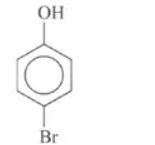
Which reagent gives as major product from phenol
1
2
3
Bromine water
4
5
Official Solution
Correct Option: (1)
Step 1: Understanding the reaction. When phenol reacts with bromine, substitution occurs at the ortho and para positions of the benzene ring due to the activating effect of the hydroxyl group. The reagent that gives the major product with phenol is typically bromine in a non-polar solvent, which prevents multiple substitutions and allows for substitution at the most reactive sites.
Step 2: Analysis of the options. - (A) at 273 K: Correct. In the presence of carbon disulfide ( ) and bromine at 273 K, the reaction leads to a major substitution at the para position, giving the para-bromophenol as the major product. This reaction is common for phenol bromination.
- (B) : Incorrect. Heating bromine with phenol leads to a more complicated reaction with multiple substitutions, resulting in the formation of a mixture of products rather than a major one.
- (C) Bromine water: Incorrect. Bromine water reacts with phenol, but it leads to a series of products, including polybrominated phenols, with no clear major product.
- (D) at 273 K: Incorrect. Although CCl4 is a non-polar solvent, it does not work as efficiently in this reaction as CS2, resulting in a mixture of products.
- (E) : Incorrect. Acetone is polar, and the reaction does not efficiently lead to a major product.
Step 3: Conclusion. The correct reagent to give the major product of bromophenol is in at 273 K.
Final Answer:
33
PYQ 2026
medium
chemistryID: keam-202
Hinsberg reagent is
1
p-toluene sulphonyl chloride
2
Benzene sulphonyl chloride
3
Phthalimide and KOH
4
Anhydrous ZnCl and conc HCl
5
Benzoyl chloride and NaOH
Official Solution
Correct Option: (3)
Step 1: Understanding Hinsberg reagent. Hinsberg reagent is used in the detection of primary and secondary amines. It reacts with amines to form a sulfonamide derivative. The correct reagent for this test is a combination of Phthalimide and KOH. Step 2: Explanation of options. \begin{itemize} \item (A) p-toluene sulphonyl chloride: Incorrect. This is a sulfonyl chloride derivative, but it is not the Hinsberg reagent. \item (B) Benzene sulphonyl chloride: Incorrect. Similar to (A), this compound does not react with amines in the way Hinsberg reagent does. \item (C) Phthalimide and KOH: Correct. Phthalimide and KOH form the Hinsberg reagent, which is used to distinguish primary, secondary, and tertiary amines. \item (D) Anhydrous ZnCl and conc HCl: Incorrect. This combination is used for other reactions such as the Friedel-Crafts alkylation, not for the Hinsberg test. \item (E) Benzoyl chloride and NaOH: Incorrect. This combination is used for other reactions but not for the Hinsberg reagent test.
\end{itemize} Step 3: Conclusion. Therefore, the correct answer is (C) Phthalimide and KOH, which forms the Hinsberg reagent. Final Answer: Phthalimide and KOH.
34
PYQ 2026
medium
chemistryID: keam-202
If ‘m’ is the molality, ‘M’ is the molarity, ‘d’ is the density in g/cm and ‘M ’ is the molarity of solute. What is the relation between them?
Official Solution
Correct Option: (1)
Step 1: Define the terms.
- Molality (m) is defined as the number of moles of solute per kilogram of solvent: - Molarity (M) is defined as the number of moles of solute per liter of solution: - Density (D) is the mass per unit volume of the solution in g/cm . Step 2: Relate molality and molarity.
To derive a relation between molality and molarity, we use the following:
- The mass of the solution = volume of the solution density (in grams).
- The moles of solute are the same for both molality and molarity. Let be the volume of the solution and be the molarity of the solute, then: By using the above formula, the relation between molality (m), molarity (M), and density (D) is established.
35
PYQ 2026
medium
chemistryID: keam-202
Which of the following has highest pKa value?
1
CH COOH
2
F-CH -COOH
3
CN-CH -COOH
4
Cl-CH -COOH
5
NO -CH -COOH
Official Solution
Correct Option: (1)
Step 1: Understanding pKa value. pKa is a measure of the acidity of a compound, with a lower pKa indicating a stronger acid. The presence of electron-withdrawing groups (EWGs) typically lowers the pKa, making the acid stronger. Step 2: Analysis of the options. \begin{itemize} \item (A) CH COOH: This is acetic acid, which is a weak acid. It has the highest pKa among the given options, indicating that it is the weakest acid. \item (B) F-CH -COOH: The presence of the electronegative fluorine atom withdraws electron density from the carboxyl group, making it a stronger acid and lowering its pKa value. \item (C) CN-CH -COOH: The nitrile group (CN) is an electron-withdrawing group, which lowers the pKa further, making this compound a stronger acid. \item (D) Cl-CH -COOH: Chlorine is also an electron-withdrawing group, but it is less effective than fluorine or nitrile groups in lowering the pKa. \item (E) NO -CH -COOH: The nitro group (NO ) is a very strong electron-withdrawing group, which significantly lowers the pKa value, making this the strongest acid.
\end{itemize} Step 3: Conclusion. Therefore, the compound with the highest pKa value is acetic acid (CH COOH), as it has the weakest electron-withdrawing effect and is the least acidic. Final Answer: CH COOH.
36
PYQ 2026
medium
chemistryID: keam-202
Two solutions that are isotonic have same ......
1
Same boiling point
2
Same freezing point
3
Same vapour pressure
4
Same osmotic pressure
5
Same solubilities
Official Solution
Correct Option: (4)
Isotonic solutions are solutions that have the same osmotic pressure. This means that when two solutions are isotonic, they exert the same pressure on a semipermeable membrane, as they contain the same concentration of solute particles. Step 1: Definition of isotonic solutions.
Isotonic solutions have equal osmotic pressure, and this is the defining characteristic of isotonicity. Osmotic pressure is related to the concentration of solute particles, and when two solutions are isotonic, they have the same concentration of solute. Step 2: Explanation of other options.
- Same boiling point and same freezing point: These are related to the colligative properties of the solutions, but isotonicity specifically refers to osmotic pressure, not these properties.
- Same vapor pressure: While vapor pressure is also a colligative property, it is not directly related to isotonicity.
Step 3: Conclusion.
Thus, the correct answer is (D) Same osmotic pressure, as isotonic solutions must have the same osmotic pressure. Final Answer:} (D) Same osmotic pressure
37
PYQ 2026
medium
chemistryID: keam-202
Arrange the following amines in the decreasing order of their basic strength : Aniline (I), Benzylamine (II), p-toluidine (III)
1
I>II>III
2
III>II>I
3
II>I>III
4
III>I>II
5
II>III>I
Official Solution
Correct Option: (5)
Step 1: Understanding the Concept:
The basic strength of an amine depends on the availability of the lone pair of electrons on the Nitrogen atom for donation to a proton ( ). Factors that increase electron density on Nitrogen (like or effects) increase basicity, while factors that decrease it (like resonance or effects) decrease basicity. Step 2: Detailed Explanation:
1. Benzylamine (II): In , the lone pair on Nitrogen is localized (it is not in resonance with the benzene ring) because of the group. It behaves like an aliphatic amine, making it the strongest base among the three.
2. Aniline (I): In , the lone pair on Nitrogen is delocalized into the benzene ring through resonance. This significantly reduces the electron density on Nitrogen, making it a very weak base.
3. p-toluidine (III): This is aniline with a methyl group ( ) at the para position. The group has a effect and hyperconjugation, which pushes electron density toward the ring and Nitrogen. While the lone pair is still delocalized (like aniline), it is more available than in pure aniline. Step 3: Comparing the three:
- II (Localized lone pair) is strongest.
- III (Delocalized lone pair + electron-donating group) is stronger than Aniline.
- I (Delocalized lone pair) is the weakest.
Order: II>III>I. Step 4: Final Answer:
The decreasing order of basic strength is II>III>I.
38
PYQ 2026
medium
chemistryID: keam-202
Correct order of acidic strength:
1
Phenol>Ethanol>Acetic acid
2
Acetic acid>Phenol>Ethanol
3
Ethanol>Phenol>Acetic acid
4
Phenol>Acetic acid>Ethanol
5
Acetic acid>Ethanol>Phenol
Official Solution
Correct Option: (2)
Step 1: Understanding the Concept:
Acidic strength depends on the stability of the conjugate base formed after losing a proton ( ). The more stable the conjugate base, the stronger the acid. Step 2: Detailed Explanation:
1. Acetic Acid ( ): Forms the acetate ion ( ). The negative charge is delocalized over two highly electronegative oxygen atoms through resonance. This is very stable, making it the strongest acid in this group.
2. Phenol ( ): Forms the phenoxide ion ( ). The negative charge is delocalized over the benzene ring. While resonance occurs, the charge resides on carbon atoms (less electronegative than oxygen), so it is less stable than the acetate ion.
3. Ethanol ( ): Forms the ethoxide ion ( ). There is no resonance stabilization. In fact, the ethyl group has an (inductive) effect, which pushes electron density toward the oxygen, making the negative charge \textit{less} stable. Step 3: Final Answer:
The correct order of acidic strength is Acetic acid>Phenol>Ethanol.