The electric potential at a point on the axial line of an electric dipole is:
1
maximum
2
minimum
3
zero
4
none of these
Official Solution
Correct Option:
(1)
Step 1: Concept
Potential . Step 2: Analysis
On the axial line, or , so . Step 3: Conclusion
This yields the maximum magnitude of potential for a given distance. Final Answer: (A)
02
PYQ 2008
medium
physicsID: met-2008
Work done to rotate a dipole from to is . The work required to rotate it to is:
1
2W
2
4W
3
W
4
3W
Official Solution
Correct Option:
(2)
Step 1: Concept
Work . Step 2: Analysis
Case 1: . Thus, .
Case 2: . Step 3: Conclusion
. Final Answer: (B)
03
PYQ 2009
medium
physicsID: met-2009
The characteristic not related to alkali metal is
1
high ionisation energy
2
their ions are isoelectronic with noble gases
3
low melting point
4
low electronegativity
Official Solution
Correct Option:
(1)
Step 1: Properties of Group 1
Alkali metals are the most electropositive elements in their respective periods. Step 2: Analysis
They have the largest atomic radii and effectively shield their valence electrons. Step 3: Ionization Energy
Because they lose their valence electron easily, they possess the minimum (low) ionization energy in their period, not high. Step 4: Verification
Options (b), (c), and (d) are true characteristics of alkali metals. Final Answer: (a)
04
PYQ 2009
medium
physicsID: met-2009
A compound of 'A' and 'B' crystallises in a cubic lattice in which 'A' atoms occupy the lattice points at the corners of the cube. The 'B' atoms occupy the centre of each face of the cube. The probable empirical formula of the compound is
1
2
3
AB
4
Official Solution
Correct Option:
(4)
Step 1: Calculate Atoms of 'A'
Atoms at corners are shared by 8 unit cells. Number of A atoms . Step 2: Calculate Atoms of 'B'
Atoms at face centers are shared by 2 unit cells. There are 6 faces. Number of B atoms . Step 3: Empirical Formula
The ratio of A:B is 1:3, leading to the formula . Final Answer: (d)
05
PYQ 2010
medium
physicsID: met-2010
The force of interaction between two charges and is 12 N. If charge is added to each of the charges, then the new force of interaction is
1
2
Zero
3
30 N
4
Official Solution
Correct Option:
(2)
Step 1: Analysis
When is added to ( ), the new charge becomes . Step 2: Calculation
According to Coulomb's Law, force is proportional to the product of charges ( ). Step 3: Conclusion
Since one of the charges is now zero, the force becomes zero. Final Answer: (b)
06
PYQ 2011
medium
physicsID: met-2011
In Millikanâs oil drop experiment, an oil drop carrying a charge is held stationary by a potential difference 2400 V between the plates. To keep a drop of half the radius stationary, the potential difference had to be made 600 V. What is the charge on the second drop?
1
2
3
4
Official Solution
Correct Option:
(2)
Step 1: Use the relation between radius and electric force. The force on an oil drop is given by:
where is the potential difference, is the charge, and is the distance between the plates. The force on the drop is also related to the radius by:
Since the radius is halved, the new force will be of the original force. Step 2: Relate the new potential difference. The new potential difference is proportional to the change in force:
Thus, the charge on the second drop is .
07
PYQ 2011
medium
physicsID: met-2011
In Millikanâs oil drop experiment, a charged drop of mass is stationary between its plates. The distance between its plates is 0.9 cm, and the potential difference is 2000 V. The number of electrons in the drop is:
1
500
2
50
3
5
4
10
Official Solution
Correct Option:
(2)
Step 1: Calculate the electric force. The force acting on the oil drop is the electric force, given by:
where is the charge on the drop, and is the electric field between the plates. The electric field is:
where is the potential difference and is the distance between the plates. Substituting the given values:
Step 2: Set up the balance of forces. The oil drop is stationary, so the electric force is balanced by the gravitational force:
The gravitational force is . Thus:
Solving for :
Step 3: Find the number of electrons. The charge on a single electron is . The number of electrons is:
08
PYQ 2011
medium
physicsID: met-2011
In a neon discharge tube, ions move to the right each second while electrons move to the left per second, electrons charge is . The current in the discharge tube is:
1
1 A, towards right
2
0.66 A, towards right
3
0.66 A, towards left
4
zero
Official Solution
Correct Option:
(2)
Step 1: Calculate the current. The current due to ions is given by:
where, , . Hence:
Similarly, the current due to electrons:
Since electrons move to the left, their current will be considered negative. Adding the ion and electron currents:
Thus, the current is towards the right. Step 2: Conclusion. The current in the discharge tube is , towards the right, which is option (2).
09
PYQ 2013
medium
physicsID: met-2013
For a body moving with relativistic speed if the velocity is doubled, then
1
its linear momentum is doubled
2
its linear momentum will be less than double
3
its linear momentum will be more than double
4
its linear momentum remains unchanged
Official Solution
Correct Option:
(3)
Step 1: Understanding the Concept:
Relativistic momentum . Step 2: Detailed Explanation:
When is doubled, denominator becomes smaller than .
So increases by factor more than 2. At non-relativistic speeds, . At relativistic speeds, increases faster than . Step 3: Final Answer:
Thus, momentum becomes more than double.
10
PYQ 2013
medium
physicsID: met-2013
An elevator car whose floor to ceiling distance is starts ascending with a constant acceleration of . after a bolt begins to fall from the ceiling of the car. The free fall time of the bolt is
1
2
3
4
Official Solution
Correct Option:
(4)
Step 1: Understanding the Concept:
Relative acceleration of bolt w.r.t. elevator = (since elevator accelerates upward). Step 2: Detailed Explanation:
Elevator acceleration upward. Bolt accelerates downward with .
Relative acceleration = .
Initial relative velocity = 0. Distance = .
Using :
. Step 3: Final Answer:
Thus, time = .
11
PYQ 2013
medium
physicsID: met-2013
The energy supplied to Kolkata by the state electricity board during an average November week day was 40 GWh. If this energy could be obtained by the conservation of matter, how much mass would have to be annihilated?
1
1.6 g
2
2.2 g
3
4.0 g
4
1.6 kg
Official Solution
Correct Option:
(1)
Step 1: Understanding the Concept:
Einstein's mass-energy equivalence: . GWh = J = J. Step 2: Detailed Explanation:
kg = 1.6 g. Step 3: Final Answer:
Thus, mass annihilated = 1.6 g.
12
PYQ 2014
medium
physicsID: met-2014
Three infinite charged sheets are placed parallel. Find electric field at point .
1
2
3
4
Official Solution
Correct Option:
(3)
Concept:
Electric field due to infinite sheet:
Direction:
• Away from
• Towards Step 1: Identify sheets
Top:
Middle:
Bottom: Step 2: Field contributions at
From : downward
From : upward
From : upward
Step 3: Net field Conclusion:
13
PYQ 2020
medium
physicsID: met-2020
A comb is run through wet hair on a rainy day, then:
1
it will attract large number of small bits of paper
2
it will not go through the hair
3
it will not attract small bits of paper
4
None of the above
Official Solution
Correct Option:
(3)
Concept:
Charging by friction produces static electricity. Moisture (humidity) allows charges to leak away. Step 1: Effect of wet hair and rain.
Water conducts electricity and prevents charge accumulation. Step 2: Conclusion.
No static charge develops, so no attraction occurs.
14
PYQ 2021
medium
physicsID: met-2021
A charge of moves at 30 rev/s in a circle of diameter 80 cm. The current linked with the circuit is :
1
0.02 A
2
20 A
3
0.60 A
4
60 A
Official Solution
Correct Option:
(3)
Concept:
Current:
Step 1: Given values.
Step 2: Calculate current.
15
PYQ 2021
medium
physicsID: met-2021
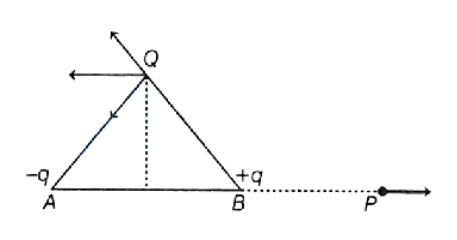
Due to the dipole shown in figure, the electric intensity will be parallel to the dipole axis at the point :
1
Q
2
P
3
both P and Q
4
neither P nor Q
Official Solution
Correct Option:
(3)
Concept:
Electric field of dipole:
• On axial line → along dipole axis
• On equatorial line → opposite to dipole axis Step 1: Point P.
P lies on axial line field along axis. Step 2: Point Q.
At symmetric point, perpendicular components cancel, leaving resultant along axis. Step 3: Conclusion.
16
PYQ 2021
medium
physicsID: met-2021
If an electron has an initial velocity in a direction different from that of an electric field, the path of the electron is :
1
a straight line
2
a circle
3
an ellipse
4
a parabola
Official Solution
Correct Option:
(4)
Concept:
Electric force:
gives constant acceleration. Step 1: Motion analysis.
Acceleration is along electric field, while initial velocity is at an angle. Step 2: Trajectory.
Motion is analogous to projectile motion.
17
PYQ 2022
medium
physicsID: met-2022
The potential at a point at a distance from the centre of an electric dipole is proportional to
1
2
3
4
Official Solution
Correct Option:
(2)
Concept:
Electric potential due to a dipole:
Step 1: Observe dependence on distance.
Step 2: Conclusion.
Thus, potential varies inversely with square of distance.
18
PYQ 2024
medium
physicsID: met-2024
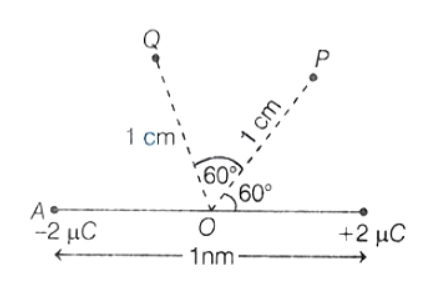
An electric dipole shown in the figure. Work done to move a charge particle of from point Q to P is , then the value of is:
Official Solution
Correct Option:
(1)
Concept:
Work done in moving charge:
Potential due to dipole:
Step 1:Given data
•
•
• Step 2:Potential difference
Step 3:Substitute values
From dipole: Using values from figure and : Conclusion
About Electric Charges And Fields - MET
Electric Charges And Fields is a vital chapter for MET aspirants. Mastering the concepts covered in this chapter is essential for securing a top rank.
By rigorously practicing the previous year questions associated with this chapter, you can identify high-yield topics, understand the examiner's perspective, and boost your confidence during the actual exam.
Frequently Asked Questions
Why focus on Electric Charges And Fields PYQs?
Analyzing PYQs for this specific chapter reveals the most frequently tested concepts and the typical complexity of questions, allowing you to tailor your study plan efficiently.
How to best use this analysis?
Review the topic breakdown to see which sub-topics within Electric Charges And Fields carry the most weight. Then, tackle the questions iteratively to solidify your understanding.