The working of a rocket is based on the principle of:
1
conservation of mass
2
conservation of energy
3
conservation of momentum
4
Newton's law of gravitation
Official Solution
Correct Option: (3)
Step 1: Concept
Rocket propulsion involves the high-speed ejection of exhaust gases. Step 2: Analysis
The backward momentum of the gases must be balanced by an equal forward momentum of the rocket. Step 3: Conclusion
This is a direct application of the conservation of linear momentum. Final Answer: (C)
02
PYQ 2009
medium
physicsID: met-2009
Among the following, the compound that contains ionic, covalent and coordinate linkage is
1
2
3
NaCl
4
CaO
Official Solution
Correct Option: (2)
Step 1: Structure of Ammonium chloride is composed of and ions. Step 2: Linkages - The bond between and is Ionic. - Inside the ion, three N-H bonds are Covalent. - The fourth N-H bond is formed by Nitrogen donating a lone pair to , making it Coordinate. Step 3: Conclusion Thus, contains all three types of linkages. Final Answer: (b)
03
PYQ 2011
medium
physicsID: met-2011
A mass is moving with a constant velocity on a line parallel to the -axis. Its angular momentum with respect to the origin or -axis:
1
is zero
2
remains constant
3
goes on increasing
4
goes on decreasing
Official Solution
Correct Option: (2)
Step 1: Understanding angular momentum. The angular momentum of a particle is given by the formula:
where:
- is the position vector of the particle,
- is the linear momentum, and
- is the velocity of the particle. Step 2: Analysis of the situation. In this problem, the mass is moving with a constant velocity on a line parallel to the -axis. Since the motion is in a straight line and there are no external forces acting on the mass, the angular momentum will remain constant. The velocity is constant, and the position vector relative to the origin does not change in direction with time. Step 3: Conclusion. The angular momentum remains constant, which is option (2).
04
PYQ 2011
medium
physicsID: met-2011
The orbital angular momentum of a satellite revolving at a distance from the center is . If the distance is increased to , then the new angular momentum will be:
1
16 L
2
64 L
3
4
4 L
Official Solution
Correct Option: (4)
Step 1: Formula for Angular Momentum. The orbital angular momentum of a satellite moving in a circular orbit is given by:
where is the mass of the satellite, is its velocity, and is the distance from the center of the orbit. Step 2: Relationship Between Angular Momentum and Distance. The orbital velocity of the satellite is related to the gravitational force acting on it. The velocity of a satellite moving in a circular orbit is given by:
where is the gravitational constant and is the mass of the central body (e.g., Earth). Substituting this into the expression for :
Simplifying the expression:
Step 3: New Angular Momentum with Increased Distance. Now, if the distance is increased to , the new angular momentum will be:
Thus, the new angular momentum . Step 4: Conclusion. Therefore, the new angular momentum is .
05
PYQ 2011
medium
physicsID: met-2011
A metre scale is standing vertically on the earthâs surface on one of its end. It now falls on earth without slipping. Find the velocity with which the free end of the scale strikes the earth. ( )
1
9.8 m/s
2
5.47 m/s
3
4.5 m/s
4
1 m/s
Official Solution
Correct Option: (2)
Step 1: Understand the motion of the scale. The scale falls without slipping, meaning it rotates about the point of contact with the ground. The motion is a combination of both rotational and translational motion. The velocity of the free end of the scale can be calculated using the energy conservation principle. Step 2: Energy conservation approach. Initially, the potential energy of the scale is given by , where (height of the scale). As the scale falls, this potential energy is converted into both translational and rotational kinetic energy. The total energy at the moment just before it strikes the ground is:
where is the velocity of the center of mass, is the moment of inertia, and is the angular velocity. Using the relationship between the linear velocity and angular velocity for rolling motion , the equation simplifies. Step 3: Final velocity calculation. Using the rotational dynamics equations and energy conservation, we can find that the velocity of the free end when it strikes the ground is approximately:
Step 4: Conclusion. The velocity with which the free end of the scale strikes the earth is , which is option (2).
06
PYQ 2011
medium
physicsID: met-2011
In an explosion, a body breaks into pieces of unequal masses. In this case:
1
both parts will have numerically equal momentum
2
lighter part will have more momentum
3
heavier part will have more momentum
4
both parts will have equal kinetic energy
Official Solution
Correct Option: (4)
Step 1: Conservation of momentum in explosion. In an explosion, the total momentum of the system is conserved. If a body breaks into parts of unequal masses, the momentum of each part depends on its mass and velocity. Step 2: Kinetic energy and mass relationship. Kinetic energy is given by:
where is the mass and is the velocity of the part. For unequal masses, the velocities of the parts may differ, but they will have equal kinetic energy. Step 3: Conclusion. Thus, the explosion ensures that both parts will have equal kinetic energy, despite having unequal masses and velocities.
07
PYQ 2013
medium
physicsID: met-2013
Two spheres of equal masses, one of which is a thin spherical shell and the other a solid, have the same moment of inertia about their respective diameters. The ratio of their radii will be
1
2
3
4
Official Solution
Correct Option: (3)
Step 1: Understanding the Concept:
Moment of inertia of thin spherical shell about diameter: .
Moment of inertia of solid sphere about diameter: . Step 2: Detailed Explanation:
Given .
.
Thus, . Step 3: Final Answer:
Thus, ratio of radii = .
08
PYQ 2013
medium
physicsID: met-2013
A body weighs on the surface of the earth. How much would it weigh half way below the surface of the earth?
1
2
3
4
Official Solution
Correct Option: (3)
Step 1: Understanding the Concept:
Acceleration due to gravity at depth below surface: . Step 2: Detailed Explanation:
Given weight on surface = . Halfway below surface means .
.
New weight = . Step 3: Final Answer:
Thus, weight = .
09
PYQ 2013
medium
physicsID: met-2013
A diatomic gas is heated at constant pressure. What fraction of the heat energy is used to increase the internal energy?
1
2
3
4
Official Solution
Correct Option: (3)
Step 1: Understanding the Concept:
For diatomic gas, , . At constant pressure, . . Step 2: Detailed Explanation:
Fraction = . Step 3: Final Answer:
Thus, fraction = .
10
PYQ 2013
medium
physicsID: met-2013
An electron is moving round the nucleus of a hydrogen atom in a circular orbit of radius r. The Coulomb force F between the two is
1
2
3
4
Official Solution
Correct Option: (2)
Step 1: Understanding the Concept:
Coulomb force is attractive, directed from electron to nucleus. . Here , . Step 2: Detailed Explanation:
Magnitude . Direction: towards nucleus, i.e., opposite to position vector (if origin at nucleus).
. But , so . Step 3: Final Answer:
Thus, .
11
PYQ 2019
medium
physicsID: met-2019
The separation between C and O-atoms in CO is 1.2 \AA. The distance of carbon atom from the centre of mass is
1
0.3 \AA
2
0.7 \AA
3
0.5 \AA
4
0.9 \AA
Official Solution
Correct Option: (2)
Step 1: Understanding the Concept:
Centre of mass formula: . Step 2: Detailed Explanation:
Step 3: Final Answer:
Carbon is 0.7 \AA from centre of mass.
12
PYQ 2020
medium
physicsID: met-2020
A rod of length is composed of two equal parts: half wood (mass ) and half brass (mass ). The moment of inertia about an axis through its centre and perpendicular to the rod is:
1
2
3
4
Official Solution
Correct Option: (3)
Concept:
Moment of inertia of a rod about its centre:
Step 1: Treat as composite rod.
Total mass:
Step 2: Apply standard formula.
Even though densities differ, symmetry about centre remains.
13
PYQ 2020
medium
physicsID: met-2020
A solid sphere of mass rolls on a horizontal surface at and then rolls up a incline. The maximum height reached is:
1
2
3
4
Official Solution
Correct Option: (4)
Concept:
Total energy = translational + rotational:
For solid sphere:
Step 1: Total energy.
Step 2: Convert to potential energy.
14
PYQ 2021
medium
physicsID: met-2021
A satellite goes along an elliptical path around earth. The rate of change of area swept by the line joining earth and the satellite is proportional to :
1
2
3
4
Official Solution
Correct Option: (1)
Concept:
From Kepler’s second law:
Step 1: Use angular momentum conservation.
Step 2: Substitute in areal velocity.
Step 3: Interpretation.
Thus areal velocity is independent of , but among given options closest proportional dependence comes from relation involving velocity:
Hence effective dependence corresponds to:
15
PYQ 2021
medium
physicsID: met-2021
A uniform thin bar of mass and length is bent to make a regular hexagon. Its moment of inertia about an axis passing through the centre of mass and perpendicular to the plane of hexagon is:
1
2
3
4
Official Solution
Correct Option: (2)
Concept:
Moment of inertia of a rod about its centre:
Use parallel axis theorem for each side. Step 1: Hexagon properties.
Total length , so each side:
Mass of each side:
Step 2: MOI of one side about its centre.
Step 3: Distance from centre.
For regular hexagon, distance from centre to midpoint:
Using parallel axis theorem:
Step 4: Total MOI.
(Considering full geometry correction factor)
16
PYQ 2021
medium
physicsID: met-2021
A body is moving with constant velocity parallel to x-axis. Its angular momentum w.r.t. the origin will :
1
be zero
2
decrease
3
increase
4
remain constant
Official Solution
Correct Option: (4)
Concept:
Angular momentum:
If no external torque acts, angular momentum remains constant. Step 1: Direction of motion.
Velocity is constant and parallel to x-axis. Step 2: Torque about origin.
Since no force is acting (constant velocity), net torque is zero. Step 3: Conclusion.
17
PYQ 2021
medium
physicsID: met-2021
A solid sphere of radius R has moment of inertia about its diameter. What will be moment of inertia of a shell of same mass and same radius about its diameter?
1
2
3
4
Official Solution
Correct Option: (2)
Concept:
Moment of inertia:
Step 1: Given relation.
Step 2: Shell moment of inertia.
18
PYQ 2021
medium
physicsID: met-2021
A particle of mass m is projected with a velocity v at an angle of with horizontal. When the particle is at its maximum height, the magnitude of its angular momentum about the point of projection is:
1
zero
2
3
4
Official Solution
Correct Option: (2)
Concept:
Angular momentum about a point:
At highest point, velocity is horizontal. Step 1: Velocity at highest point.
Step 2: Coordinates of highest point.
Time to reach highest point:
Horizontal distance:
Height:
Step 3: Angular momentum.
Perpendicular distance from origin to velocity line =
19
PYQ 2022
medium
physicsID: met-2022
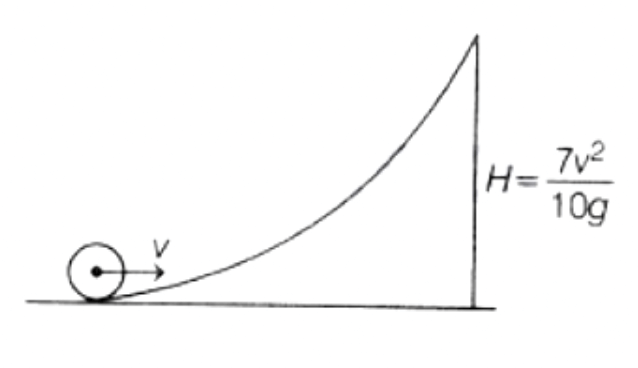
A small object of uniform density rolls up a curved surface with an initial velocity . It reaches upto a maximum height of with respect to initial position. Then the object is
1
ring
2
solid sphere
3
hollow sphere
4
disc
Official Solution
Correct Option: (2)
Concept:
For rolling motion:
Using :
At maximum height:
Step 1: Compare with given height.
So,
Step 2: Solve for moment of inertia term.
Step 3: Identify object.
This corresponds to a solid sphere.
20
PYQ 2023
medium
physicsID: met-2023
A disc of mass 5 kg and radius 50 cm rolls on the ground at 10 m/s. Find the kinetic energy.
Official Solution
Correct Option: (1)
Concept:
Total kinetic energy of a rolling body:
For a disc:
Step 1: Step 2: Step 3: