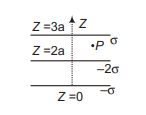
A circular disc of radius is cut from a disc of radius . Find MOI of remaining part about .
1
2
3
4
Official Solution
Correct Option:
(1)
Concept:
MOI of remaining = MOI of full disc - MOI of removed part. Step 1: Full disc
Step 2: Small disc mass
MOI about its centre:
Step 3: Shift to centre
Distance = Step 4: Remaining MOI
Scaling gives:
Conclusion:
02
PYQ 2014
medium
physicsID: met-2014
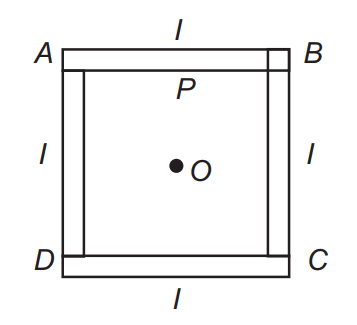
Four thin rods of same mass and length form a square. Find moment of inertia about axis through centre and perpendicular to plane.
1
2
3
4
Official Solution
Correct Option:
(1)
Concept:
Use parallel axis theorem. Step 1: MOI of one rod about its centre
Step 2: Shift to square centre
Distance = Step 3: Total for 4 rods Conclusion:
03
PYQ 2014
medium
physicsID: met-2014
A wheel rotates at and stops in . Find work done if .
1
2
3
4
Official Solution
Correct Option:
(3)
Concept:
Work done = change in rotational KE. Step 1: Initial KE
Step 2: Final KE = 0 But opposing torque energy dissipated:
Conclusion:
04
PYQ 2014
medium
physicsID: met-2014
A solid sphere (radius ) recast into disc. MOI about edge remains same. Find disc radius.
1
2
3
4
Official Solution
Correct Option:
(1)
Concept:
Use parallel axis theorem. Step 1: Sphere MOI
Step 2: Disc MOI about edge
Step 3: Equate Conclusion:
05
PYQ 2015
medium
physicsID: met-2015
A solid cylinder is rolling down on an inclined plane of angle . The coefficient of static friction between the plane and the cylinder is . The condition for the cylinder not to slip is
1
2
3
4
Official Solution
Correct Option:
(3)
Step 1: Understanding the Concept:
For rolling without slipping, friction must be sufficient to provide the necessary torque for angular acceleration.
Step 3: Final Answer:
Condition for no slipping: .
06
PYQ 2019
medium
physicsID: met-2019
An inclined plane makes an angle 30° with horizontal. A solid sphere rolling down this inclined plane has a linear acceleration of
1
2
3
4
Official Solution
Correct Option:
(1)
Step 1: Understanding the Concept:
For rolling: . Step 2: Detailed Explanation:
For solid sphere,
Step 3: Final Answer:
Acceleration is .
About Rotational Motion - MET
Rotational Motion is a vital chapter for MET aspirants. Mastering the concepts covered in this chapter is essential for securing a top rank.
By rigorously practicing the previous year questions associated with this chapter, you can identify high-yield topics, understand the examiner's perspective, and boost your confidence during the actual exam.
Frequently Asked Questions
Why focus on Rotational Motion PYQs?
Analyzing PYQs for this specific chapter reveals the most frequently tested concepts and the typical complexity of questions, allowing you to tailor your study plan efficiently.
How to best use this analysis?
Review the topic breakdown to see which sub-topics within Rotational Motion carry the most weight. Then, tackle the questions iteratively to solidify your understanding.