A glass flask having mass 390 g and an interior volume of 500 floats on water when it is less than half filled with water. The density of material of the flask is
1
0.8 g/cc
2
2.8 g/cc
3
1.8 g/cc
4
0.28 g/cc
Official Solution
Correct Option:
(2)
Step 1: Analysis
When half filled, it floats fully submerged: Mass of flask + mass of water in it = Total displacement weight.
(outer volume). Step 2: Material Volume
Volume of material = Outer volume - Inner volume = . Step 3: Density
Density . Final Answer: (B)
02
PYQ 2015
medium
physicsID: met-2015
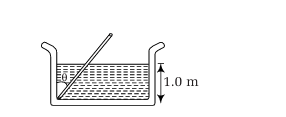
A uniform rod of length 2 m, specific gravity 0.5 and mass 2 kg is hinged at one end to the bottom of a tank of water (specific gravity = 1.0) filled upto a height of 1 m as shown in the figure. Taking the case , the force exerted by the hinge on the rod is
1
10.2 N upwards
2
4.2 N downwards
3
8.3 N downwards
4
6.2 N upwards
Official Solution
Correct Option:
(3)
Step 1: Understanding the Concept:
Take torques about the hinge. The length submerged is . Upthrust acts at mid-point of submerged length. Weight acts at centre of rod.
Step 2: Detailed Explanation:
From torque balance: . Solving gives . At : Upthrust N. Weight N. Vertical equilibrium: N. Negative means downward.
Hinge force N downwards.
Step 3: Final Answer:
Force exerted by hinge N downwards.
03
PYQ 2015
medium
physicsID: met-2015
A small block of wood of specific gravity 0.5 is submerged at a depth of 1.2 m in a vessel filled with water. The vessel is accelerated upwards with an acceleration . Time taken by the block to reach the surface, if it is released with zero initial velocity is
1
0.6 s
2
0.4 s
3
1.2 s
4
1 s
Official Solution
Correct Option:
(2)
Step 1: Understanding the Concept:
In an accelerating vessel, the effective gravity is . Upthrust , weight . Net upward acceleration of block relative to vessel.
Step 2: Detailed Explanation:
Block acceleration in ground frame:
Relative acceleration m/s . Wait, relative to vessel: . Hmm, let me redo: net acc of block (upward) in ground frame. Relative to vessel (acc upward): . Using : s.
Step 3: Final Answer:
Time s.
About Hydrostatics - MET
Hydrostatics is a vital chapter for MET aspirants. Mastering the concepts covered in this chapter is essential for securing a top rank.
By rigorously practicing the previous year questions associated with this chapter, you can identify high-yield topics, understand the examiner's perspective, and boost your confidence during the actual exam.
Frequently Asked Questions
Why focus on Hydrostatics PYQs?
Analyzing PYQs for this specific chapter reveals the most frequently tested concepts and the typical complexity of questions, allowing you to tailor your study plan efficiently.
How to best use this analysis?
Review the topic breakdown to see which sub-topics within Hydrostatics carry the most weight. Then, tackle the questions iteratively to solidify your understanding.