From Kepler's third law, the square of the period of revolution ( ) is proportional to the cube of the semi-major axis ( ). If a planet has , then:
1
2
3
4
Official Solution
Correct Option:
(2)
Step 1: Concept
Kepler's Third Law: . Step 2: Analysis
.
Given , then .
. Step 3: Conclusion
Therefore, . Final Answer: (B)
02
PYQ 2008
medium
physicsID: met-2008
The time period of a satellite of earth is 5 hours. If the separation between the earth and the satellite is increased to 4 times the previous value, the new time period will become:
1
10 hours
2
80 hours
3
40 hours
4
20 hours
Official Solution
Correct Option:
(3)
Step 1: Concept
According to Kepler's Third Law, . Step 2: Analysis
. Given and hours.
. Step 3: Conclusion
The new time period hours. Final Answer: (C)
03
PYQ 2008
medium
physicsID: met-2008
If the length of a simple pendulum is increased by 44%, the percentage increase in its time period is:
1
10%
2
20%
3
44%
4
33%
Official Solution
Correct Option:
(2)
Step 1: Concept
Time period . Step 2: Analysis
New length .
New time period . Step 3: Conclusion
Percentage increase . Final Answer: (B)
04
PYQ 2009
medium
physicsID: met-2009
The rms velocity of molecules of a gas of density and pressure is
1
2
3
4
Official Solution
Correct Option:
(1)
Step 1: Formula
The root mean square velocity is . Step 2: Substitution
. Step 3: Calculation
. Final Answer: (a)
05
PYQ 2009
medium
physicsID: met-2009
The condensation polymer among the following is
1
rubber
2
protein
3
PVC
4
polyethene
Official Solution
Correct Option:
(2)
Step 1: Definition
Condensation polymers are formed by the combination of monomers with the elimination of small molecules like water, methyl alcohol, etc. Step 2: Analysis
- Rubber, PVC, and polyethene are addition polymers.
- Proteins are natural polymers formed by the condensation of -amino acids. Step 3: Conclusion
During the formation of proteins, amino acids link together via peptide bonds ( ) with the release of water molecules. Final Answer: (b)
06
PYQ 2009
medium
physicsID: met-2009
The one which decreases with dilution is
1
molar conductance
2
conductance
3
specific conductance
4
equivalent conductance
Official Solution
Correct Option:
(3)
Step 1: Definition of Specific Conductance
Specific conductance ( ) is the conductance of 1 cc of solution. Step 2: Effect of Dilution
Upon dilution, the total volume increases, which means the number of ions per cc (unit volume) decreases. Step 3: Conclusion
Because there are fewer ions available to carry current in a given unit volume, the specific conductance decreases with dilution. Final Answer: (c)
07
PYQ 2010
medium
physicsID: met-2010
A bullet comes out of the barrel of gun of length 2 m with a speed 80 m/s. The average acceleration of the bullet is
The acceleration of a particle performing SHM is at a distance of 3 cm from the mean position. Its time period is:
1
0.5 s
2
1.0 s
3
2.0 s
4
3.14 s
Official Solution
Correct Option:
(4)
Step 1: Acceleration in SHM. In simple harmonic motion (SHM), the acceleration is related to the displacement from the mean position by the equation:
where is the angular frequency and is the displacement. Step 2: Use the given data. We are given:
-
- Substitute these values into the SHM equation:
Step 3: Solve for angular frequency . Rearranging the equation:
Step 4: Calculate the time period. The time period of the particle is related to the angular frequency by the formula:
Substitute :
Thus, the time period is approximately . Step 5: Conclusion. Therefore, the time period is .
09
PYQ 2011
medium
physicsID: met-2011
Escape velocity from earth's surface is 11 km/s. If the radius of a planet is double that of earth and the density is the same as that of earth, then the escape velocity from this planet will be:
1
5.5 km/s
2
11 km/s
3
16.5 km/s
4
22 km/s
Official Solution
Correct Option:
(4)
Step 1: Formula for Escape Velocity. The escape velocity is given by the formula:
where:
- is the gravitational constant,
- is the mass of the planet, and
- is the radius of the planet. Step 2: Understand the Given Data. We are told that:
- The radius of the new planet is double that of Earth, so .
- The density of the new planet is the same as Earth, meaning the mass of the new planet will be 8 times the mass of Earth. This is because the mass of a planet depends on its volume, and volume scales with the cube of the radius. Therefore, if the radius is doubled, the volume (and thus the mass) increases by a factor of . Step 3: Relation for New Planet. The escape velocity depends on both the mass and the radius of the planet. The formula for the escape velocity can be written for the new planet as:
Substitute and into the equation:
Step 4: Simplifying the Expression. Now simplify the expression:
Step 5: Compare with Escape Velocity from Earth. We know that the escape velocity from Earth is:
Thus, we can write:
Step 6: Conclusion. Therefore, the escape velocity from the new planet is .
10
PYQ 2013
medium
physicsID: met-2013
The moment of inertia of a disc of mass and radius about an axis, which is tangential to the circumference of the disc and parallel to its diameter is
1
2
3
4
Official Solution
Correct Option:
(3)
Step 1: Understanding the Concept:
Use parallel axis theorem: . For disc about diameter, . Step 2: Detailed Explanation:
Axis is tangential to circumference and parallel to diameter. Distance from centre to tangent = .
. Step 3: Final Answer:
Thus, .
11
PYQ 2013
medium
physicsID: met-2013
Escape velocity at surface of earth is . Escape velocity from a planet whose mass is the same as that of earth and radius that of earth, is
1
2
3
4
Official Solution
Correct Option:
(3)
Step 1: Understanding the Concept:
Escape velocity . Step 2: Detailed Explanation:
For earth: .
For planet: , .
. Step 3: Final Answer:
Thus, escape velocity = .
12
PYQ 2014
medium
physicsID: met-2014
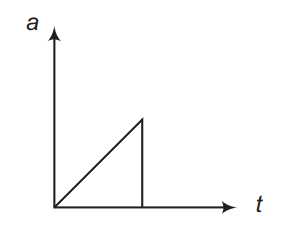
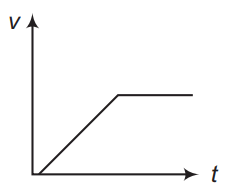
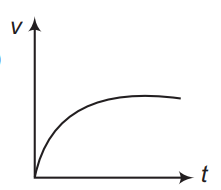
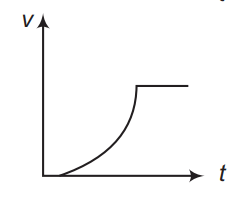
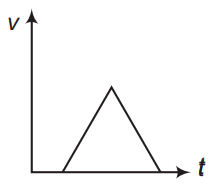
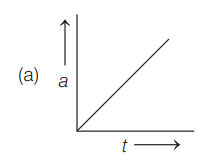
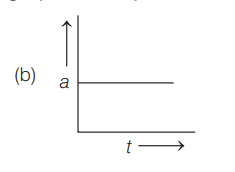
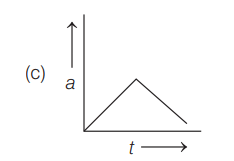
The acceleration-time graph of a body is shown below. The most probable velocity-time graph of the body is
1
2
3
4
Official Solution
Correct Option:
(3)
Concept: Step 1: Analyze acceleration graph.
Acceleration increases linearly with time, then becomes zero. Step 2: Effect on velocity.
• Increasing acceleration velocity curve is concave upward (curved increase)
• Constant zero acceleration velocity becomes constant (horizontal line) Step 3: Match with options.
Only option (C) shows:
• Initially curved increase
• Then constant velocity Conclusion:
13
PYQ 2014
medium
physicsID: met-2014
A body starts from origin and moves along x-axis with velocity . What is the acceleration at distance 2 m from origin?
1
2
3
4
Official Solution
Correct Option:
(2)
Step 1: Find position.
Step 2: Use .
Let :
Step 3: Find acceleration. Conclusion:
14
PYQ 2015
medium
physicsID: met-2015
A juggler keeps on moving four balls in air throwing the balls after regular intervals. When one ball leaves his hand (speed = ), the position of other balls (height in metre) will be (take )
1
10, 20, 10
2
15, 20, 15
3
5, 15, 20
4
5, 10, 20
Official Solution
Correct Option:
(2)
Step 1: Understanding the Concept:
Time of flight for one ball: . Balls are thrown at regular intervals of 1 second. Step 2: Detailed Explanation:
At , one ball is thrown; previous balls have been in air for 1 s, 2 s, and 3 s. Height formula: . For : . For : . For : . Heights are: 15 m, 20 m, 15 m. Step 3: Final Answer:
15
PYQ 2020
medium
physicsID: met-2020
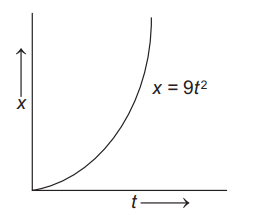
The displacement-time graph of a particle moving along a straight line is shown in the figure. The acceleration-time graph of this particle is:
1
Increasing linearly with time
2
Constant acceleration
undefined
3
First increases then decreases
undefined
4
Increasing non-linearly with time
Official Solution
Correct Option:
(2)
Concept:
Acceleration is the second derivative of displacement:
Step 1: Given equation from graph.
From the graph:
Step 2: Find velocity.
Step 3: Find acceleration.
Step 4: Conclusion.
Acceleration is constant with time.
16
PYQ 2021
medium
physicsID: met-2021
Imagine a light planet revolving around a very massive star in a circular orbit of radius R with a period of revolution T. If the gravitational force of attraction between the planet and the star is proportional to , then is proportional to :
1
2
3
4
Official Solution
Correct Option:
(2)
Concept:
Centripetal force:
Also:
Step 1: Force relation.
Step 2: Substitute velocity.
Step 3: Solve relation.
17
PYQ 2021
medium
physicsID: met-2021
A point initially at rest moves along x-axis. Its acceleration varies with time as . If it starts from origin, the distance covered in 2 s is:
1
20 m
2
18 m
3
16 m
4
25 m
Official Solution
Correct Option:
(2)
Concept:
Acceleration is the derivative of velocity:
Position is obtained by integrating velocity. Step 1: Find velocity.
Since initially at rest at :
Step 2: Find displacement.
At , Step 3: Distance in 2 s.
18
PYQ 2021
medium
physicsID: met-2021
The displacement of an oscillating particle is given by . The dimensional formula for is:
1
2
3
4
Official Solution
Correct Option:
(2)
Concept:
The argument of a trigonometric function must be dimensionless. Hence,
Also, displacement has dimension of length. Step 1: Dimension of .
Since , and sine is dimensionless:
Step 2: Dimension of .
From dimensionless:
Step 3: Dimension of and .
From and dimensionless:
Step 4: Dimension of .
Since options match closest to frequency-type dimension:
19
PYQ 2022
medium
physicsID: met-2022
If the radius of a planet is three times the radius of the earth. Both have same mass-densities. and are the escape velocities of the planet and the earth respectively, then
1
2
3
4
Official Solution
Correct Option:
(2)
Concept:
Escape velocity:
For same density:
Step 1: Relate mass and radius.
Step 2: Use escape velocity formula.
Step 3: Final relation.
20
PYQ 2023
medium
physicsID: met-2023
The acceleration due to gravity becomes at a height equal to:
1
2
3
4
Official Solution
Correct Option:
(1)
Concept:
For small heights ,
Step 1: Apply condition Step 2: SimplifyConclusion
21
PYQ 2023
medium
physicsID: met-2023
Two stones having different masses and are projected at angles and with same velocity from the same point. The ratio of their maximum heights is:
1
2
3
4
Official Solution
Correct Option:
(4)
Concept:
Maximum height of projectile:
Step 1: Heights of two projectiles:
Step 2: Using identity:
Step 3: Ratio:
22
PYQ 2024
medium
physicsID: met-2024
Two points move in the same straight line starting at the same moment from the same point. One moves with velocity and the other with acceleration . The greatest distance between them is:
Motion In A Straight Line is a vital chapter for MET aspirants. Mastering the concepts covered in this chapter is essential for securing a top rank.
By rigorously practicing the previous year questions associated with this chapter, you can identify high-yield topics, understand the examiner's perspective, and boost your confidence during the actual exam.
Frequently Asked Questions
Why focus on Motion In A Straight Line PYQs?
Analyzing PYQs for this specific chapter reveals the most frequently tested concepts and the typical complexity of questions, allowing you to tailor your study plan efficiently.
How to best use this analysis?
Review the topic breakdown to see which sub-topics within Motion In A Straight Line carry the most weight. Then, tackle the questions iteratively to solidify your understanding.
 undefined
 undefined