The process by which a heavy nucleus splits into two lighter nuclei is called:
1
fusion
2
fission
3
-decay
4
chain reaction
Official Solution
Correct Option:
(2)
Step 1: Concept
Nuclear reactions involve changes in the nucleus of an atom. Step 2: Analysis
Fission specifically refers to the division of a heavy nucleus (like Uranium) into smaller nuclei with the release of energy. Step 3: Conclusion
This process is called nuclear fission. Final Answer: (B)
02
PYQ 2008
medium
physicsID: met-2008
A radioactive nucleus emits 3 -particles and 2 -particles. The ratio of the initial atomic number to the final atomic number is:
1
2
3
4
Official Solution
Correct Option:
(1)
Step 1: Concept
Each -emission reduces by
2. Each -emission increases by 1. Step 2: Analysis
Total change in .
Final atomic number . Step 3: Conclusion
The ratio is . Final Answer: (A)
03
PYQ 2008
medium
physicsID: met-2008
A nuclear reaction is given by . This reaction represents:
1
fission
2
-decay
3
-decay
4
fusion
Official Solution
Correct Option:
(2)
Step 1: Concept
-decay involves the emission of an electron (or positron) from the nucleus. Step 2: Analysis
In the given reaction, the atomic number increases by 1 ( ) while the mass number remains constant, accompanied by an electron ( ) and an antineutrino ( ). Step 3: Conclusion
This is the characteristic equation for negative beta ( ) decay. Final Answer: (B)
04
PYQ 2009
medium
physicsID: met-2009
A body of mass x kg is moving with a velocity of . Its de-Broglie wavelength is m. Hence, x is ( Js)
1
0.1 kg
2
0.25 kg
3
0.15 kg
4
0.2 kg
Official Solution
Correct Option:
(1)
Step 1: Formula
Use the de-Broglie wavelength formula: . Step 2: Rearrangement
. Step 3: Substitution
. Step 4: Calculation
kg. Final Answer: (a)
05
PYQ 2009
medium
physicsID: met-2009
The compound which forms acetaldehyde when heated with dilute NaOH, is
1
1, 1-dichloroethane
2
1, 1, 1-trichloroethane
3
1-chloroethane
4
1, 2-dichloroethane
Official Solution
Correct Option:
(1)
Step 1: Nucleophilic Substitution
Heating 1,1-dichloroethane with dilute NaOH replaces both chlorine atoms with hydroxyl (-OH) groups. Step 2: Unstable Intermediate
The resulting gem-diol (two -OH groups on the same carbon) is highly unstable. Step 3: Dehydration
The unstable gem-diol immediately loses a water molecule to form acetaldehyde ( ). Final Answer: (a)
06
PYQ 2009
medium
physicsID: met-2009
The carbon-carbon bond length in benzene is
1
in between and
2
same as in
3
in between and
4
in between and
Official Solution
Correct Option:
(1)
Step 1: Comparison Values
The bond length of C-C in (ethane) is 1.54 Å and in (ethene) is 1.34 Å. Step 2: Resonance Effect
In benzene, the electrons are delocalized, making all C-C bonds equivalent. Step 3: Result
The actual carbon-carbon bond length in benzene is 1.39 Å, which lies between the single and double bond lengths. Final Answer: (a)
07
PYQ 2010
medium
physicsID: met-2010
In the reaction , identify .
1
2
3
He
4
Ar
Official Solution
Correct Option:
(1)
Step 1: Concept
In a nuclear reaction, the sum of atomic numbers (Z) and mass numbers (A) must be conserved on both sides. Step 2: Analysis
Atomic number: . Thus, the atomic number of X is 8. Step 3: Conclusion
The element with atomic number 8 is Oxygen. Final Answer: (a)
08
PYQ 2011
medium
physicsID: met-2011
The half-life of the isotope is 15 h. How much time does it take for of a sample of this isotope to decay?
1
75 h
2
65 h
3
55 h
4
45 h
Official Solution
Correct Option:
(2)
Step 1: Understand the decay process. The decay of radioactive isotopes follows the formula:
where:
- is the amount of the isotope remaining at time ,
- is the initial amount of the isotope,
- is the half-life of the isotope, and
- is the time elapsed. Step 2: Calculate the time for decay. We are asked to find the time it takes for of the sample to decay, which means that of the sample remains. Therefore, we set:
Taking the natural logarithm of both sides:
Substitute :
Step 3: Conclusion. The time for of the sample to decay is 65 h, which is option (2).
09
PYQ 2011
medium
physicsID: met-2011
As a result of radioactive decay, is converted into . The particles emitted during this decay are:
1
a proton and a neutron
2
a proton and two -particles
3
an -particle and a -particle
4
two -particles and a proton
Official Solution
Correct Option:
(3)
Step 1: Understand the decay process. When Uranium-238 ( ) undergoes radioactive decay, it transforms into Protactinium-234 ( ) through a two-step process. The decay of involves the emission of an -particle, followed by the emission of a -particle. Step 2: Explanation of emissions. - The first step involves the emission of an -particle, which is a helium nucleus ( ), causing a decrease in the atomic number by 2 and the mass number by 4.
- The second step involves the emission of a -particle, which is an electron, resulting in the conversion of a neutron into a proton. Step 3: Conclusion. Thus, the correct emission products in this case are an -particle and a -particle.
10
PYQ 2013
medium
physicsID: met-2013
The correct relation between and in a transistor is
1
2
3
4
Official Solution
Correct Option:
(2)
Step 1: Understanding the Concept:
, , and . Step 2: Detailed Explanation:
. Step 3: Final Answer:
Thus, .
11
PYQ 2013
medium
physicsID: met-2013
A red flower kept in green light will appear
1
red
2
yellow
3
black
4
white
Official Solution
Correct Option:
(3)
Step 1: Understanding the Concept:
A red flower reflects red light and absorbs other colours. Green light contains no red component. Step 2: Detailed Explanation:
Red flower appears red because it reflects red wavelength. When illuminated with green light, it absorbs green light (no red to reflect). Thus, it appears black (no light reflected). Step 3: Final Answer:
Thus, the flower appears black.
12
PYQ 2015
medium
physicsID: met-2015
Order of magnitude of density of uranium nucleus is kg
1
kg/m
2
kg/m
3
kg/m
4
kg/m
Official Solution
Correct Option:
(2)
Step 1: Understanding the Concept:
Nuclear radius follows where m, and mass .
Step 2: Detailed Explanation:
This is independent of (all nuclei have approximately the same density).
Step 3: Final Answer:
Nuclear density kg/m .
13
PYQ 2015
medium
physicsID: met-2015
A neutron moving with a speed makes a head on collision with a hydrogen atom in ground state kept at rest. The minimum kinetic energy of neutron for which inelastic collision will take place is
1
10.2 eV
2
20.4 eV
3
12.1 eV
4
16.8 eV
Official Solution
Correct Option:
(2)
Step 1: Understanding the Concept:
For inelastic collision with hydrogen atom: neutron must supply at least excitation energy (10.2 eV). In lab frame, not all KE is available for excitation. Step 2: Detailed Explanation:
Using conservation of momentum and energy. Masses are equal (neutron proton). Condition: . Threshold condition: . Therefore: . Step 3: Final Answer:
Minimum kinetic energy eV.
14
PYQ 2015
medium
physicsID: met-2015
In a nuclear reactor, undergoes fission liberating 200 MeV of energy. The reactor has a 10% efficiency and produces 1000 MW power. If the reactor is to function for 10 yr, then find the total mass of uranium required.
1
2
3
4
Official Solution
Correct Option:
(4)
Step 1: Understanding the Concept:
Energy produced = Power × Time. Efficiency = Output/Input. Step 2: Detailed Explanation:
Output energy = .
Input energy = .
Energy per fission = .
Number of fissions = .
Mass of U = .
Closest is . Step 3: Final Answer:
15
PYQ 2016
medium
physicsID: met-2016
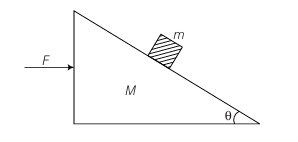
A mass m is placed on a wedge (triangular block) of mass M. The wedge moves on a smooth horizontal surface. What should be the force F applied on the wedge to the right, so that m remains stationary with respect to wedge? (Ignore any friction)
1
2
3
4
Official Solution
Correct Option:
(3)
Step 1: For m to remain stationary relative to wedge, acceleration of wedge = acceleration of m horizontally. Step 2: For m: , . So . Step 3: For system: .
16
PYQ 2016
medium
physicsID: met-2016
Two sources give an interference pattern observed on a screen distance D away. The fringe width is 2W. If D is doubled, the fringe width will:
1
become W/2
2
remains the same
3
become W
4
become 4W
Official Solution
Correct Option:
(4)
Step 1: Fringe width . Step 2: If D is doubled, becomes (since original ).
17
PYQ 2016
medium
physicsID: met-2016
Nuclear reactor in which U-235 is used as fuel uses 2 kg of U-235 in 30 days. Then, power output of the reactor will be (given energy released per fission = 185 MeV):
1
43.5 MW
2
58.5 MW
3
69.6 MW
4
73.1 MW
Official Solution
Correct Option:
(2)
Step 1: Number of atoms in 2 kg: . Step 2: Energy = J. Power = MW.
18
PYQ 2018
medium
physicsID: met-2018
The mass defect in a particular nuclear reaction is . The amount of energy liberated in kilowatt-hours is (velocity of light ).
1
2
3
4
Official Solution
Correct Option:
(4)
Step 1: Understanding the Concept:
, and kWh = J. Step 2: Detailed Explanation:
J. kWh = J. So kWh. Step 3: Final Answer:
The energy liberated is kWh.
19
PYQ 2018
medium
physicsID: met-2018
The binding energy per nucleon is maximum in the case of
1
2
3
4
Official Solution
Correct Option:
(2)
Step 1: Understanding the Concept:
Binding energy per nucleon is a measure of nuclear stability. Step 2: Detailed Explanation:
The binding energy per nucleon is maximum for iron (Fe-56), which is the most stable nucleus. Step 3: Final Answer:
The correct answer is Iron-56.
20
PYQ 2019
medium
physicsID: met-2019
The nuclear reaction (mass of deuteron = 2.0141 amu and of He = 4.0024 amu) is
1
fusion reaction releasing 24 MeV energy
2
fusion reaction absorbing 24 MeV energy
3
fission reaction releasing 0.0258 MeV energy
4
fission reaction absorbing 0.0258 MeV energy
Official Solution
Correct Option:
(1)
Step 1: Understanding the Concept:
Mass defect releases energy via . Step 2: Detailed Explanation:
Energy =
This is fusion (light nuclei combining). Step 3: Final Answer:
Fusion reaction releasing 24 MeV.
21
PYQ 2019
medium
physicsID: met-2019
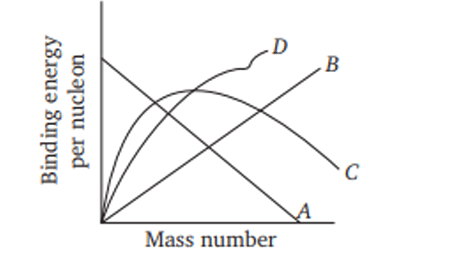
Binding energy per nucleon plot against the mass number for stable nuclei is shown in the figure. Which curve is correct?
1
A
2
B
3
C
4
D
Official Solution
Correct Option:
(3)
Step 1: Understanding the Concept:
Binding energy per nucleon increases to a peak then decreases. Step 2: Detailed Explanation:
B.E./nucleon rises sharply, peaks at Fe (A=56), then slowly decreases. Curve C shows this. Step 3: Final Answer:
Curve C is correct.
22
PYQ 2020
medium
physicsID: met-2020
The mass number of an atom is 15 and its atomic number is 7. Now, this atom absorbs an -particle and emits a proton. What will be the mass number of changed atom?
1
16
2
18
3
17
4
15
Official Solution
Correct Option:
(2)
Concept: • -particle: adds mass number 4
• Proton emission: reduces mass number by 1 Step 1: Initial mass number.
Step 2: After absorbing -particle.
Step 3: After emitting proton.
About Nuclear Physics - MET
Nuclear Physics is a vital chapter for MET aspirants. Mastering the concepts covered in this chapter is essential for securing a top rank.
By rigorously practicing the previous year questions associated with this chapter, you can identify high-yield topics, understand the examiner's perspective, and boost your confidence during the actual exam.
Frequently Asked Questions
Why focus on Nuclear Physics PYQs?
Analyzing PYQs for this specific chapter reveals the most frequently tested concepts and the typical complexity of questions, allowing you to tailor your study plan efficiently.
How to best use this analysis?
Review the topic breakdown to see which sub-topics within Nuclear Physics carry the most weight. Then, tackle the questions iteratively to solidify your understanding.