Pressure-volume relation: jar A has ; jar B has . Find ratio of number of molecules.
1
2
3
4
Official Solution
Correct Option:
(4)
Concept: Step 1: Jar A
Step 2: Jar B
Step 3: Ratio Conclusion:
02
PYQ 2014
medium
physicsID: met-2014
Two identical vessels contain gases at . One heated to . Find pressure and number of moles .
1
2
3
4
Official Solution
Correct Option:
(2)
Step 1: Initial moles in each vessel
Step 2: After heating one vessel
Step 3: Total moles conserved
Step 4: Moles in heated vessel Conclusion:
03
PYQ 2014
medium
physicsID: met-2014
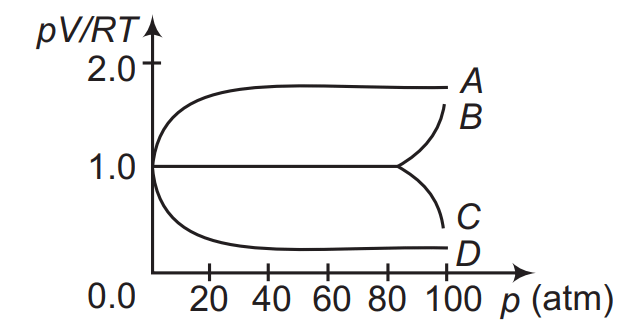
For a real gas, variation of with pressure is shown. Identify correct curve.
1
Curve A
2
Curve B
3
Curve C
4
Curve D
Official Solution
Correct Option:
(2)
Concept:
is called compressibility factor. Step 1: Ideal gas
Step 2: Real gas behavior
• At low pressure: intermolecular attraction dominates
• At high pressure: repulsion dominates Step 3: Graph nature
Curve dips below 1 and then rises above 1. Conclusion:
04
PYQ 2020
medium
physicsID: met-2020
Two identical containers A and B with frictionless pistons contain the same ideal gas at the same temperature and volume . The masses are and . On isothermal expansion to , pressure changes are and respectively. The relation between masses is:
1
2
3
4
Official Solution
Correct Option:
(3)
Concept:
For isothermal process:
Step 1: Pressure change relation.
Thus:
Step 2: Use given data.
For A:
For B:
05
PYQ 2020
medium
physicsID: met-2020
During an experiment, an ideal gas is found to obey an additional law . The gas is initially at temperature and volume . The temperature of the gas when it expands to a volume is:
Two identical cylinders contain helium at 2.5 atm and argon at 1 atm respectively. If both the gases are filled in one of the cylinders, the pressure would be:
1
3.5 atm
2
1.50 atm
3
1.75 atm
4
1 atm
Official Solution
Correct Option:
(1)
Concept:
Using ideal gas law:
Step 1: Initial moles.
For identical cylinders (same ):
Step 2: Total moles.
Step 3: Final pressure.
Now gases are in one cylinder (volume ):
About Gas Laws - MET
Gas Laws is a vital chapter for MET aspirants. Mastering the concepts covered in this chapter is essential for securing a top rank.
By rigorously practicing the previous year questions associated with this chapter, you can identify high-yield topics, understand the examiner's perspective, and boost your confidence during the actual exam.
Frequently Asked Questions
Why focus on Gas Laws PYQs?
Analyzing PYQs for this specific chapter reveals the most frequently tested concepts and the typical complexity of questions, allowing you to tailor your study plan efficiently.
How to best use this analysis?
Review the topic breakdown to see which sub-topics within Gas Laws carry the most weight. Then, tackle the questions iteratively to solidify your understanding.