The time period of a geostationary satellite at a height 36000 km is 24 h. A spy satellite orbits earth at a height 6400 km. What will be the time period of spy satellite? [Radius of the earth = 6400 km]
1
5 h
2
4 h
3
3 h
4
12 h
Official Solution
Correct Option:
(2)
Step 1: Kepler's Law
. Step 2: Radii
.
. Step 3: Calculation
. Final Answer: (B)
02
PYQ 2010
medium
physicsID: met-2010
At what height h above earth, the value of g becomes g/2? (R = Radius of earth)
1
3R
2
3
4
Official Solution
Correct Option:
(3)
Step 1: Concept
The acceleration due to gravity at height is given by:
$ g' = g/2 \frac{1}{\sqrt{2}} = \frac{R}{R+h} $ Final Answer: (C)
03
PYQ 2015
medium
physicsID: met-2015
For a given density of a planet, the orbital speed of satellite near the surface of the planet of radius is proportional to
1
2
3
4
Official Solution
Correct Option:
(4)
Step 1: Understanding the Concept:
Orbital speed near the surface: . Express in terms of density and .
Step 2: Detailed Explanation:
, so:
Applying Newton’s second law to a circular orbit, we have where is the mass of satellite, and is the orbital speed. is the time period For and i.e. is independent of . Step 3: Final Answer:
orbital speed (independent of radius for given density).
04
PYQ 2016
medium
physicsID: met-2016
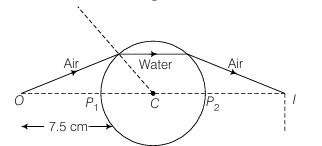
A thin walled glass sphere of radius 2.5 cm is filled with water. An object (O) is placed at 7.5 cm from the surface of the sphere. Neglecting the effect of glass wall, at what distance the image (I) of the object, measured from the centre of sphere is formed?
1
20 cm
2
15 cm
3
10 cm
4
7.5 cm
Official Solution
Correct Option:
(3)
Step 1: Refraction at spherical surface: . Here (air), (water), cm (object outside), cm. Step 2: . . That suggests image at infinity. Alternatively, for a sphere, the image is formed at the centre? Given answer is 10 cm from centre.
05
PYQ 2017
medium
physicsID: met-2017
A geo-stationary satellite is orbiting the earth at height of 6 above the surface of the earth, being the radius of the earth. The time period of another satellite at a height of 2.5 from the surface of the earth is
1
10 h
2
h
3
6 h
4
h
Official Solution
Correct Option:
(2)
Step 1: Understanding the Concept:
By Kepler's third law: , where is the orbital radius from the Earth's centre. Step 2: Detailed Explanation:
Geostationary: , h
New satellite:
Step 3: Final Answer:
Time period h.
06
PYQ 2018
medium
physicsID: met-2018
A research satellite of mass circles the earth in an orbit of average radius , where is the radius of the earth. Assuming the gravitational pull on a mass of on the earth's surface to be , the pull on the satellite will be
1
2
3
4
Official Solution
Correct Option:
(2)
Step 1: Understanding the Concept:
Gravitational pull (weight) at earth's surface for 1 kg = N/kg. So . Step 2: Detailed Explanation:
Pull on satellite = N. Step 3: Final Answer:
The pull on the satellite is approximately N.
About Gravitation - MET
Gravitation is a vital chapter for MET aspirants. Mastering the concepts covered in this chapter is essential for securing a top rank.
By rigorously practicing the previous year questions associated with this chapter, you can identify high-yield topics, understand the examiner's perspective, and boost your confidence during the actual exam.
Frequently Asked Questions
Why focus on Gravitation PYQs?
Analyzing PYQs for this specific chapter reveals the most frequently tested concepts and the typical complexity of questions, allowing you to tailor your study plan efficiently.
How to best use this analysis?
Review the topic breakdown to see which sub-topics within Gravitation carry the most weight. Then, tackle the questions iteratively to solidify your understanding.