Two bodies A and B having temperatures and are radiating heat to the surrounding. The surrounding temperature is . The ratio of rates of heat radiation of A to that of B is
1
0.52
2
0.31
3
0.81
4
0.42
Official Solution
Correct Option:
(1)
Step 1: Concept
According to Stefan-Boltzmann law, the net loss of energy of a body by radiation is . Step 2: Conversion
Convert temperatures to Kelvin:
.
.
. Step 3: Calculation
. Final Answer: (A)
02
PYQ 2010
medium
physicsID: met-2010
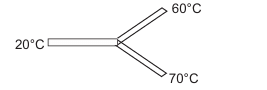
Three identical thermal conductors are connected as shown in figure. Considering no heat loss due to radiation, temperature at the junction will be
r
1
2
3
4
Official Solution
Correct Option:
(3)
Step 1: Concept
In equilibrium, the rate of flow of heat entering the junction equals the rate of flow of heat leaving it. Step 2: Equation
$ $ Final Answer: (C)
03
PYQ 2015
medium
physicsID: met-2015
When a copper sphere is heated, percentage change is
1
maximum in radius
2
maximum in volume
3
maximum in density
4
equal in radius, volume and density
Official Solution
Correct Option:
(2)
Step 1: Understanding the Concept:
The three coefficients of thermal expansion are related: , where , , are linear, area, and volume expansion coefficients.
Step 2: Detailed Explanation:
Percentage change in radius . Percentage change in volume . Percentage change in density in magnitude. Volume change is radius change, and is numerically the largest positive change.
Step 3: Final Answer:
Percentage change is maximum in volume.
04
PYQ 2019
medium
physicsID: met-2019
If the density of earth is doubled keeping its radius constant, then acceleration due to gravity g is
1
20 m/s
2
10 m/s
3
5 m/s
4
2.5 m/s
Official Solution
Correct Option:
(1)
Step 1: Understanding the Concept:
, so when R constant. Step 2: Detailed Explanation:
density
New Step 3: Final Answer:
New g is .
05
PYQ 2019
medium
physicsID: met-2019
A ball is dropped from top of a tower of 100 m height. Simultaneously another ball was thrown upward from bottom of the tower with a speed of 50 m/s. They will cross each other after (g = 10 m/s )
1
1 s
2
2 s
3
3 s
4
4 s
Official Solution
Correct Option:
(2)
Step 1: Understanding the Concept:
Sum of distances covered equals tower height. Step 2: Detailed Explanation:
Let time = t
,
Step 3: Final Answer:
They cross after 2 seconds.
06
PYQ 2019
medium
physicsID: met-2019
Which is different from others in units?
1
Phase difference
2
Mechanical equivalent
3
Loudness of sound
4
Poisson's ratio
Official Solution
Correct Option:
(4)
Step 1: Understanding the Concept:
Identify which quantity is dimensionless. Step 2: Detailed Explanation:
Poisson's ratio = lateral strain/longitudinal strain, hence dimensionless. Phase difference, mechanical equivalent, loudness have units. Step 3: Final Answer:
Poisson's ratio has no unit.
07
PYQ 2019
medium
physicsID: met-2019
The driver of a car moving towards a rocket launching pad with a speed of 6 m/s observes that the rocket is moving with speed of 10 m/s. The upward speed of the rocket as seen by the stationary observer is
1
4 m/s
2
6 m/s
3
8 m/s
4
11 m/s
Official Solution
Correct Option:
(3)
Step 1: Understanding the Concept:
Relative velocity is vector difference. Step 2: Detailed Explanation:
Step 3: Final Answer:
Upward speed is 8 m/s.
08
PYQ 2019
medium
physicsID: met-2019
A satellite revolves very near to the earth surface. Its speed should be around
1
5 km/s
2
8 km/s
3
2 km/s
4
11 km/s
Official Solution
Correct Option:
(2)
Step 1: Understanding the Concept:
Orbital speed for a near-Earth satellite is the first cosmic velocity. Step 2: Detailed Explanation:
Orbital speed ≈ 7.9 km/s, rounded ≈ 8 km/s. Step 3: Final Answer:
Speed is about 8 km/s.
09
PYQ 2019
medium
physicsID: met-2019
Continuous emission spectrum is produced by
1
incandescent electric lamp
2
mercury vapour lamp
3
sodium vapour lamp
4
polyatomic substances
Official Solution
Correct Option:
(1)
Step 1: Understanding the Concept:
Different sources produce different spectra types. Step 2: Detailed Explanation:
Incandescent lamp produces continuous spectrum. Mercury and sodium lamps give line spectra. Polyatomic substances give band spectra. Step 3: Final Answer:
Incandescent electric lamp produces continuous emission spectrum.
About Thermal Properties Of Matter - MET
Thermal Properties Of Matter is a vital chapter for MET aspirants. Mastering the concepts covered in this chapter is essential for securing a top rank.
By rigorously practicing the previous year questions associated with this chapter, you can identify high-yield topics, understand the examiner's perspective, and boost your confidence during the actual exam.
Frequently Asked Questions
Why focus on Thermal Properties Of Matter PYQs?
Analyzing PYQs for this specific chapter reveals the most frequently tested concepts and the typical complexity of questions, allowing you to tailor your study plan efficiently.
How to best use this analysis?
Review the topic breakdown to see which sub-topics within Thermal Properties Of Matter carry the most weight. Then, tackle the questions iteratively to solidify your understanding.