Step 1: Concept
According to Lens Maker's Formula, . Step 2: Analysis
Refractive index ( ) is higher for shorter wavelengths (Cauchy's equation). Violet light has the shortest wavelength in the visible spectrum, so it has the highest . Step 3: Conclusion
Since is inversely proportional to , the focal length is minimum for violet light. Final Answer: (B)
02
PYQ 2008
medium
physicsID: met-2008
A convex lens of focal length 20 cm is in contact with a concave lens of focal length 40 cm. The power of the combination is:
Refraction, Dispersion and Total Internal Reflection
4
Scattering only
Official Solution
Correct Option: (3)
Step 1: Concept
Rainbow formation involves multiple optical phenomena within water droplets. Step 2: Analysis
Sunlight enters the drop (refraction), splits into colors (dispersion), reflects off the back (TIR), and exits (refraction). Step 3: Conclusion
All three processes are essential for the observer to see a rainbow. Final Answer: (C)
04
PYQ 2009
medium
physicsID: met-2009
The IUPAC name of ion is
1
penta ammine nitrito cobalt (IV) ion
2
penta ammine nitrito cobalt (III) ion
3
penta ammine nitro cobalt (III) ion
4
penta ammine nitro cobalt (IV) ion
Official Solution
Correct Option: (2)
Step 1: Identify Ligands
The complex contains five ammine ( ) ligands and one nitrito ( ) ligand. Step 2: Determine Oxidation State
Let oxidation state of be : . Step 3: Naming
Name ligands alphabetically (ammine before nitrito). The nitrite ligand is bonded through Oxygen, so it is called "nitrito".
The full name is: penta ammine nitrito cobalt (III) ion. Final Answer: (b)
05
PYQ 2009
medium
physicsID: met-2009
The oxidation state of Fe in the brown ring complex: is
1
+3
2
0
3
+2
4
+1
Official Solution
Correct Option: (4)
Step 1: Complex Charge
The complex dissociates as and . Step 2: Ligand Nature
In this specific complex, the nitric oxide ( ) ligand exists in the form of the nitrosyl ion ( ). Water is neutral ( ). Step 3: Calculation
Let oxidation state of be : . Final Answer: (d)
06
PYQ 2009
medium
physicsID: met-2009
If is defined by , then the range of is contained in the interval
1
[1, 12]
2
[12, 34]
3
[35, 50]
4
[-12, 12]
Official Solution
Correct Option: (2)
Step 1: Differentiation
. Step 2: Analysis of Monotonicity
Setting gives , which has no real roots. This means is strictly increasing for all real . Step 3: Calculating Endpoints
At , .
At , . Step 4: Range
Since the function is strictly increasing, the range is . Final Answer: (b)
07
PYQ 2011
medium
physicsID: met-2011
A thin prism of angle 4ΓΒ° and refractive index 1.54ΓΒ° is combined with another thin prism of refractive index 1.72 to produce dispersion without deviation. The angle of is
1
4ΓΒ°
2
5.33ΓΒ°
3
2.6ΓΒ°
4
3ΓΒ°
Official Solution
Correct Option: (4)
Step 1: Understanding the dispersion condition. When two prisms are combined to produce dispersion without deviation, the total deviation produced by both prisms must cancel each other out. This means that the deviation produced by the first prism ( ) is exactly balanced by the deviation produced by the second prism ( ). The deviation for a prism is given by:
where is the refractive index of the prism, and is the angle of the prism. Step 2: Setting up the equation. For no deviation, the deviations must cancel out:
Substituting the given values:
Step 3: Conclusion. Thus, the angle of is 3ΓΒ°. Therefore, the correct answer is (4).
08
PYQ 2011
medium
physicsID: met-2011
A fish at a depth of 12 cm in water is viewed by an observer on the bank of a lake. To what height the image of this fish is raised? (Refractive index of lake water )
1
9 cm
2
12 cm
3
3.8 cm
4
3 cm
Official Solution
Correct Option: (4)
Step 1: Understand the refraction of light in water. The apparent depth of an object submerged in water is given by the formula:
where:
- is the actual depth of the object,
- is the refractive index of the water. Step 2: Apply the formula. Given that the actual depth and the refractive index of the water is , we substitute these values into the formula:
Step 3: Simplify the expression. Simplifying the expression:
Thus, the apparent depth (the height the image is raised) is .
09
PYQ 2013
medium
physicsID: met-2013
The plano-convex lens of focal length and are placed together to form a double convex lens, the final focal length will be
1
2
3
4
Official Solution
Correct Option: (1)
Step 1: Understanding the Concept:
For lenses in contact, . Step 2: Detailed Explanation:
Given , .
. Step 3: Final Answer:
Thus, focal length = .
10
PYQ 2013
medium
physicsID: met-2013
Simple pendulum of length has a maximum angular displacement . The maximum kinetic energy of the bob is
1
2
3
4
Official Solution
Correct Option: (1)
Step 1: Understanding the Concept:
At maximum displacement, KE = 0, PE = maximum. At mean position, KE = maximum, PE = 0. By energy conservation, maximum KE = loss in PE. Step 2: Detailed Explanation:
Height gained by bob at angular displacement : .
Loss in PE = . This equals maximum KE. Step 3: Final Answer:
Thus, maximum KE = .
11
PYQ 2014
medium
physicsID: met-2014
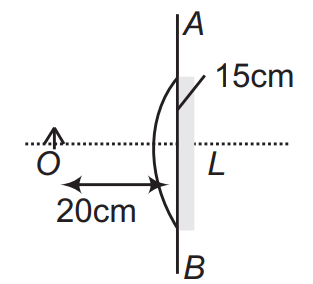
Object at 20 cm from plano-convex lens (f = 15 cm), plane surface silvered. Find image position.
1
60 cm left of AB
2
30 cm left of AB
3
12 cm left of AB
4
60 cm right of AB
Official Solution
Correct Option: (3)
Concept:
Light passes twice through lens due to reflection. Step 1: First refraction
Step 2: Reflection at plane mirror
Image forms at same distance:
Step 3: Second refraction
Now object for lens is at : Image on left side. Conclusion:
12
PYQ 2014
medium
physicsID: met-2014
A biconvex lens forms circular image of sun of radius . Find relation with focal length .
Graph of image position vs object position for convex lens is given. Find focal length.
1
cm
2
cm
3
cm
4
cm
Official Solution
Correct Option: (4)
Concept:
Graph asymptotes:
Step 1: From graph
Asymptotes at:
But given scaling shows:
Step 2: Error estimation
Graph uncertainty Conclusion:
14
PYQ 2015
medium
physicsID: met-2015
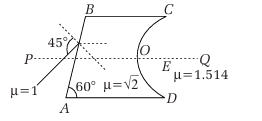
Figure shows an irregular block of material of refractive index . A ray of light strikes the face AB as shown in figure. After refraction, it is incident on a spherical surface CD of radius of curvature 0.4 m and enters a medium of refractive index 1.514 to meet PQ at E. Find the distance OE upto two places of decimal.
1
7 m
2
7.29 m
3
6.06 m
4
8.55 m
Official Solution
Correct Option: (3)
Step 1: Understanding the Concept:
Apply Snell's law at face AB and then the refraction formula at spherical surface CD: .
Step 2: Detailed Explanation:
At AB: . The refracted ray inside the block becomes parallel to AD (travels horizontally). At spherical surface CD: object at , , , m:
Step 3: Final Answer:
Distance OE m.
15
PYQ 2016
medium
physicsID: met-2016
A ray of light is travelling through a medium of refractive index with respect to air. When it is incident on the surface making an angle with the surface, which of the following will take place?
1
Angle of refraction will be
2
Angle of refraction will be
3
The ray will be internally reflected
4
None of the above
Official Solution
Correct Option: (3)
Step 1: . Angle with surface = , so . Step 2: Critical angle undefined. If , , then , ray grazes surface. Given answer is internal reflection.
16
PYQ 2016
medium
physicsID: met-2016
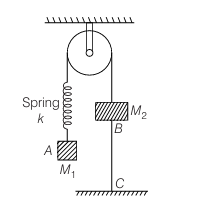
In the system shown in figure and pulley and threads are ideal. System is held at rest by thread BC. Just after thread BC is burnt.
1
Acceleration and will be upward
2
Magnitude of acceleration of both masses will be
3
Acceleration of and will be equal to zero
4
Acceleration of will be equal to zero, while that of will be upward
Official Solution
Correct Option: (2)
Step 1: After burning BC, the system is a standard Atwood machine. Step 2: Acceleration , with moving down and moving up.
17
PYQ 2017
medium
physicsID: met-2017
When an equilateral prism of refractive index produces minimum deviation the angle of incidence at the first face must be
1
30
2
42
3
60
4
75
Official Solution
Correct Option: (3)
Step 1: Understanding the Concept:
At minimum deviation, angle of refraction inside prism . Step 2: Detailed Explanation:
For equilateral prism: ,
Snell's law at first face:
Step 3: Final Answer:
Angle of incidence .
18
PYQ 2017
medium
physicsID: met-2017
For a colour of light the wavelength for air is 6000 \AA\ and in water the wavelength is 4500 \AA. Then the speed of light in water will be
1
m/s
2
m/s
3
m/s
4
zero
Official Solution
Correct Option: (2)
Step 1: Understanding the Concept:
and . Step 2: Detailed Explanation:
Step 3: Final Answer:
Speed of light in water m/s.
19
PYQ 2017
medium
physicsID: met-2017
The angle of minimum deviation for a prism of angle is . The refractive index is
1
2
3
4
Official Solution
Correct Option: (4)
Step 1: Understanding the Concept:
. Step 2: Detailed Explanation:
Step 3: Final Answer:
Refractive index .
20
PYQ 2017
medium
physicsID: met-2017
A thin rod of length is placed along the optic axis of a concave mirror of focal length such that its image is real and elongated and just touches the rod, the magnification is
1
1.5
2
2.5
3
3.5
4
4.5
Official Solution
Correct Option: (1)
Step 1: Understanding the Concept:
The image just touches the rod, so one end of the image coincides with one end of the rod. Using the mirror equation for both ends. Step 2: Detailed Explanation:
Let the rod extend from to . Since image is real and elongated and just touches the rod, one image end coincides with object end. Using for both ends gives magnification . Step 3: Final Answer:
Magnification .
21
PYQ 2017
easy
physicsID: met-2017
The plane faces of two identical plano-convex lenses each having a focal length of 50 cm are placed against each other to form a usual biconvex lens. The distance from this lens combination at which an object must be placed to obtain a real, inverted image which has the same size as the object is
Official Solution
Correct Option: (1)
22
PYQ 2017
easy
physicsID: met-2017
The angle of a prism is 60 and its refractive index is . The angle of minimum deviation suffered by a ray of light in passing through it is
Official Solution
Correct Option: (1)
23
PYQ 2018
medium
physicsID: met-2018
If refractive index of a material of equilateral prism is , then angle of minimum deviation of the prism is}
1
2
3
4
Official Solution
Correct Option: (3)
Step 1: Understanding the Concept:
For minimum deviation, . Step 2: Detailed Explanation:
Here , . So . Thus , so , giving . Step 3: Final Answer:
The angle of minimum deviation is .
24
PYQ 2018
medium
physicsID: met-2018
The light ray is incident at angle of on a prism of angle . When the light rays falls on the other surface at , the refractive index of the material of prism and the angle of deviation are given by
1
2
3
4
Official Solution
Correct Option: (4)
Step 1: Understanding the Concept:
When a ray emerges normally, and . Step 2: Detailed Explanation:
At the second surface, the ray falls at , so angle of incidence at second surface (since it emerges normally). Then . Using Snell's law at first surface: . Deviation . Step 3: Final Answer:
and .
25
PYQ 2018
medium
physicsID: met-2018
A plano-convex lens is made of refractive index of 1.6. The radius of curvature of the curved surface is . The focal length of the lens is
1
2
3
4
Official Solution
Correct Option: (3)
Step 1: Understanding the Concept:
For plano-convex lens, . Lens maker's formula: . Step 2: Detailed Explanation:
cm, . . So cm. Step 3: Final Answer:
The focal length is cm.
26
PYQ 2018
medium
physicsID: met-2018
A thin convex lens of refractive index 1.5 has focal length in air. If the lens is completely immersed in a liquid of refractive index 1.6, its focal length will be}
1
2
3
4
Official Solution
Correct Option: (1)
Step 1: Understanding the Concept:
Lens maker's formula: . Step 2: Detailed Explanation:
In air, , .
In liquid, . So, .
Dividing the two equations, , so cm. Step 3: Final Answer:
The focal length becomes cm.
27
PYQ 2019
medium
physicsID: met-2019
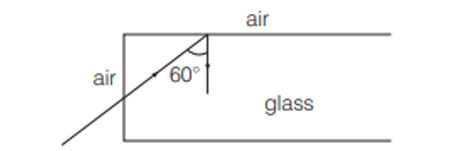
A light ray from air is incident (as shown in figure) at one end of a glass fiber (refractive index ) making an incidence angle of 60Β° on the lateral surface, so that it undergoes a total internal reflection. How much time would it take to traverse the straight fiber of length 1 km?
1
3.33 s
2
6.67 s
3
5.77 s
4
3.85 s
Official Solution
Correct Option: (4)
Step 1: Understanding the Concept:
Light travels zigzag path; actual path length = . Step 2: Detailed Explanation:
Path length =
?
Given answer is 3.85 s. Step 3: Final Answer:
Time is 3.85 s.
28
PYQ 2019
medium
physicsID: met-2019
Light travelling from a transparent medium to air undergoes total internal reflection at an angle of incidence of 45Β°. Then refractive index of the medium may be
1
1.5
2
1.3
3
1.1
4
Official Solution
Correct Option: (1)
Step 1: Understanding the Concept:
Critical angle C satisfies . Step 2: Detailed Explanation:
Step 3: Final Answer:
Refractive index is about 1.5.
29
PYQ 2019
medium
physicsID: met-2019
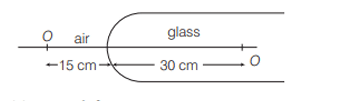
A point object O is placed in front of a glass rod having spherical end of radius of curvature 30 cm. The image would be formed at
1
30 cm left
2
infinity
3
1 cm to the right
4
18 cm to the left
Official Solution
Correct Option: (1)
Step 1: Understanding the Concept:
Refraction at spherical surface: . Step 2: Detailed Explanation:
,
(left) Step 3: Final Answer:
Image is 30 cm left.
30
PYQ 2019
medium
physicsID: met-2019
In the formation of a rainbow light from the sun on water droplets undergoes
1
dispersion only
2
only total internal reflection
3
dispersion and total internal reflection
4
None of the above
Official Solution
Correct Option: (3)
Step 1: Understanding the Concept:
Rainbow involves multiple optical phenomena. Step 2: Detailed Explanation:
Rainbow formation involves dispersion, refraction, and total internal reflection in water droplets. Step 3: Final Answer:
Dispersion and total internal reflection.
31
PYQ 2020
medium
physicsID: met-2020
When a glass prism of refracting angle is immersed in a liquid its angle of minimum deviation is . The critical angle of glass with respect to the liquid medium is:
1
2
3
4
Official Solution
Correct Option: (1)
Concept:
Refractive index of prism in a medium:
Step 1: Substitute values.
Step 2: Find critical angle.
32
PYQ 2020
medium
physicsID: met-2020
The critical angle for glass-water interface (if ) is:
1
2
3
4
None of these
Official Solution
Correct Option: (1)
Concept: Step 1: Glass is optically denser than water. Step 2:
33
PYQ 2020
medium
physicsID: met-2020
A concave lens is kept in contact with a convex lens of focal length . The combination works as a convex lens of focal length . The power of concave lens is:
1
2
3
4
Official Solution
Correct Option: (1)
Concept: Step 1: Convert to meters.
Step 2: Substitute.
Step 3: Power.
34
PYQ 2020
medium
physicsID: met-2020
A convex lens of focal length produces an image which is three times the size of the object. The distance between the object and the lens for a real image is:
1
2
3
4
Official Solution
Correct Option: (1)
Concept:
Magnification:
Lens formula:
Step 1: Given magnification.
Step 2: Substitute in lens formula.
35
PYQ 2021
medium
physicsID: met-2021
If are the unit vectors along the incident ray, reflected ray and outward normal to the reflecting surface, then:
1
2
3
4
Official Solution
Correct Option: (4)
Concept:
Reflection of vector:
Step 1: Interpretation.
is unit normal. Step 2: Apply formula.
36
PYQ 2021
medium
physicsID: met-2021
The rays of sun are focussed on a piece of ice through a lens of diameter 5 cm, as a result of which 10 g ice melts in 10 min. The amount of heat received from sun, per unit area per minute is :
1
2
3
4
Official Solution
Correct Option: (1)
Concept:
Heat required to melt ice:
where Step 1: Heat required.
Step 2: Area of lens.
Step 3: Heat per unit area per minute.
37
PYQ 2022
medium
physicsID: met-2022
The angle of a prism is . One of its refracting surface is silvered. If light rays falling at an angle of incidence on the first surface returns back through the same path after reflection from silvered surface. The refractive index of the prism is
1
2
3
4
Official Solution
Correct Option: (2)
Concept:
For ray to retrace path after reflection it must strike second face normally. Step 1: Condition at second face.
Angle of incidence at second face = Thus, inside prism:
Step 2: Apply Snell's law at first surface.
Step 3: Simplify.
38
PYQ 2023
medium
physicsID: met-2023
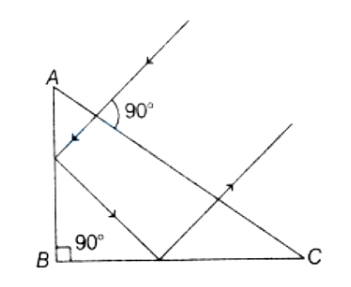
A ray falls on a prism (AB = BC) and travels as shown in the figure. The minimum refractive index of the prism material should be:
1
2
3
4
Official Solution
Correct Option: (2)
Concept:
For total internal reflection:
Step 1: Geometry of prism
Given and angle at , the prism is an isosceles right triangle. Step 2: Condition for minimum refractive index
For minimum , the ray should undergo just TIR:
From geometry, the angle of incidence at the reflecting face is:
Step 3: Apply critical angle conditionConclusion
39
PYQ 2024
medium
physicsID: met-2024
When a lens is cut into two halves along , then focal length of each half lens:
1
increases
2
decreases
3
remains same
4
None of the above
Official Solution
Correct Option: (3)
Concept:
Lens maker formula:
Step 1:Focal length depends only on:
β’Refractive index
β’Radii of curvature Step 2:When lens is cut along (i.e., along principal axis):
β’Curvature of surfaces remains unchanged
β’Only aperture (size) reduces Step 3:Since curvature is unchanged:
Final: