Arrhenius Equation
High-Yield Trend
Questions 10 MCQs
The rate constants k1 and k2 for two different reactions are 1016. e-2000/T and 1015. e-1000/T, respectively. The temperature at which k1= k2 is:
1.
2.
3.
4.
For an endothermic reaction, the energy of activation is Ea, and the enthalpy of reaction is ΔH (both of these in kJ/mol). The minimum value of Ea will be:
1. Less than H
2. Equal to H
3. More than H
4. Equal to zero
| 1. | 269 kJ mol–1 | 2. | 34.7 kJ mol–1 |
| 3. | 15.1 kJ mol–1 | 4. | 342 kJ mol–1 |
A reaction having equal energies of activation for forward and reverse reaction has:
1. ΔG = 0
2. ΔH = 0
3. ΔH = ΔG = ΔS = 0
4. ΔS = 0
What does ZAB represent in the collision theory of chemical reactions?
| 1. | The fraction of molecules with energies greater than Ea |
| 2. | The collision frequency of reactants, A and B |
| 3. | Steric factor |
| 4. | The fraction of molecules with energies equal to Ea |
The slope of Arrhenius Plot (ln k v/s ) of the first-order reaction is . The value of Ea of the reaction is:
[Given R = 8.314 JK–1 mol–1]
| 1. | 166 kJ mol–1 | 2. | –83 kJ mol–1 |
| 3. | 41.5 kJ mol–1 | 4. | 83.0 kJ mol–1 |
| Assertion (A): | A reaction can have zero activation energy. |
| Reason (R): | The minimum amount of energy required by reactant molecules so that their energy becomes equal to threshold value, is called activation energy. |
| 1. | (A) is False but (R) is True. |
| 2. | Both (A) and (R) are True and (R) is the correct explanation of (A) |
| 3. | Both (A) and (R) are True but (R) is not the correct explanation of (A). |
| 4. | (A) is True but (R) is False. |
| 1. | Probability of collision. |
| 2. | Orientation of reactant molecules during collision. |
| 3. | Rate constant at two different temperatures. |
| 4. | Rate constant at standard temperature. |
| 1. | 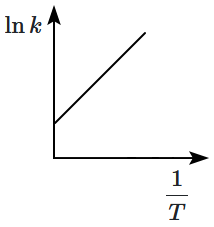 |
2. | 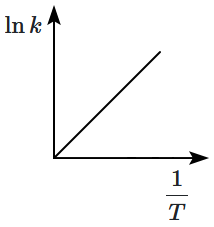 |
| 3. | 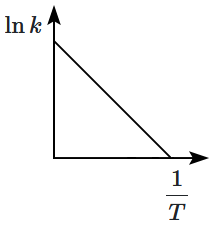 |
4. | 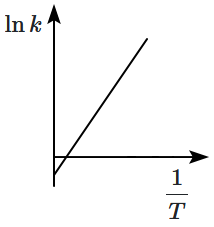 |
Given R = 8.314 J K–1 mol–1, log 4 = 0.6021
| 1. | 380.4 kJ/mol | 2. | 3.80 kJ/mol |
| 3. | 3804 kJ/mol | 4. | 38.04 kJ/mol |
Preparing Arrhenius Equation for NEET
Arrhenius Equation is a specific sub-topic that frequently appears in the NEET examination. Understanding the underlying principles and practicing targeted questions is key to mastering this concept.
The questions compiled above are previous year questions (PYQs) directly related to Arrhenius Equation. Practicing these specific questions helps you understand the difficulty level and the examiner's approach to this topic.
Topic Frequently Asked Questions
Is Arrhenius Equation a high-weightage topic?
You can refer to the priority and consistency badges at the top of this page. High priority topics should be thoroughly revised multiple times before the exam.
Should I memorize the solutions?
No, it is highly recommended to understand the core concept and methodology behind each solution rather than memorizing them, as exact questions are rarely repeated, but the concepts definitely are.