Cell Cycle Meiosis I
High-Yield Trend
Questions 15 MCQs
Synapsis occurs between:
| 1. | a male and a female gamete |
| 2. | mRNA and ribosomes |
| 3. | spindle fibres and centromere |
| 4. | two homologous chromosomes |
During gamete formation, the enzyme recombinase participates during:
1. Metaphase-I
2. Anaphase-II
3. Prophase-I
4. Prophase-II
Given below is the representation of a certain event at a particular stage of a type of cell division. Which is this stage? 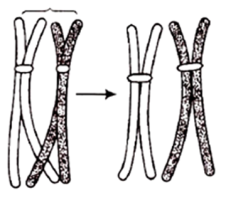
1. Prophase-I during meiosis
2. Prophase-II during meiosis
3. Prophase of mitosis
4. Both prophase and metaphase of mitosis
The complex formed by a pair of synapsed homologous chromosomes is called:
1. Kinetochore
2. Bivalent
3. Axoneme
4. Equatorial plate
Arrange the following events of meiosis in a correct sequence:
I. Crossing over
II. Synapsis
III. Terminalisation of chiasmata
IV. Disappearance of nucleolus
| 1. | II, I, IV, III | 2. | II, I, III, IV |
| 3. | I, II, III, IV | 4. | II, III, IV, I |
| Column I | Column II | ||
| (a) | pachytene | (1) | pairing of homologous chromosomes |
| (b) | metaphase I | (2) | terminalisation of chiasmata |
| (c) | diakinesis | (3) | crossing-over takes place |
| (d) | zygotene | (4) | chromosomes align at equatorial plate |
| 1. | Pachytene | 2. | Diplotene |
| 3. | Diakinesis | 4. | Zygotene |
During Meiosis 1, in which stage synapsis takes place?
| 1. | Pachytene | 2. | Zygotene |
| 3. | Diplotene | 4. | Leptotene |
Which stage of meiotic prophase shows terminalisation of chiasmata as its distincitve feature?
1. Diakinesis
2. Pachytene
3. Leptotene
4. Zygotene
1. Terminalization
2. Synaptonemal complex
3. Bivalent
4. Sites at which crossing over occurs
| 1. | Four haploid cells are formed at the end of Meiosis-II. |
| 2. | There are two stages in Meiosis, Meiosis-I and II. |
| 3. | DNA replication occurs in S phase of Meiosis-II. |
| 4. | Pairing of homologous chromosomes and recombination occurs in Meiosis-I. |
| 1. | Diakinesis | 2. | Zygotene |
| 3. | Pachytene | 4. | Diplotene |
| A. | Tetrad formation is seen during Leptotene. |
| B. | During Anaphase, the centromeres split and chromatids separate. |
| C. | Terminalization takes place during Pachytene. |
| D. | Nucleolus, Golgi complex and ER are reformed during Telophase. |
| E. | Crossing over takes place between sister chromatids of homologous chromosome. |
| 1. | B and E only | 2. | A and C only |
| 3. | B and D only | 4. | A, C and E only |
| Statement I: | Chromosomes become gradually visible under light microscope during leptotene stage. |
| Statement II: | The begining of diplotene stage is recognized by dissolution of synaptonemal complex. |
In the light of the above statements, choose the correct answer from the option given below:
1. Both Statement I and Statement II are False
2. Statement I is True but Statement II is False
3. Statement I is False but Statement II is True
4. Both Statement I and Statement II are True
| List-I (Sub Phase of Prophase I) | List-II (Specific characters) | ||
| A. | Diakinesis | I. | Synaptonemal complex formation |
| B. | Pachytene | II. | Completion of terminalisation of chiasmata |
| C. | Zygotene | III. | Chromosomes look like thin threads |
| D. | Leptotene | IV. | Appearance of recombination nodules |
Choose the correct answer from the options given below:
1. A-I, B-II, C-IV, D-III
2. A-II, B-IV, C-I, D-III
3. A-IV, B-III, C-II, D-I
4. A-IV, B-II, C-III, D-I
Preparing Cell Cycle Meiosis I for NEET
Cell Cycle Meiosis I is a specific sub-topic that frequently appears in the NEET examination. Understanding the underlying principles and practicing targeted questions is key to mastering this concept.
The questions compiled above are previous year questions (PYQs) directly related to Cell Cycle Meiosis I. Practicing these specific questions helps you understand the difficulty level and the examiner's approach to this topic.
Topic Frequently Asked Questions
Is Cell Cycle Meiosis I a high-weightage topic?
You can refer to the priority and consistency badges at the top of this page. High priority topics should be thoroughly revised multiple times before the exam.
Should I memorize the solutions?
No, it is highly recommended to understand the core concept and methodology behind each solution rather than memorizing them, as exact questions are rarely repeated, but the concepts definitely are.