Aerobic Respiration
High-Yield Trend
Questions 6 MCQs
How many ATP molecules could maximally be generated from one molecule of glucose if the complete oxidation of one mole of glucose to CO2 and H2O yields 686 kcal and the useful chemical energy available in the high energy phosphate bond of one mole of ATP is 12 kcal?
| 1. | Two | 2. | Thirty |
| 3. | One | 4. | Fifty-seven |
Aerobic respiratory pathway is appropriately termed:
1. catabolic
2. parabolic
3. amphibolic
4. anabolic
The three boxes in this diagram represent the three major biosynthetic pathways in aerobic respiration. Arrows represent net reactants or products.
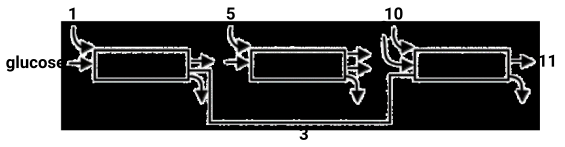
Arrows numbered 4, 8, and 12 can all be:
| 1. | ATP | 2. | A2O |
| 3. | FAD+ or FADH2 | 4. | NADH |
| 1. | It functions as an enzyme |
| 2. | It functions as an electron carrier |
| 3. | It is a nucleotide source for ATP synthesis |
| 4. | It is the final electron acceptor for anaerobic respiration |
Pyruvate dehydrogenase activity during aerobic respiration requires:
| 1. | Calcium | 2. | Iron |
| 3. | Cobalt | 4. | Magnesium |
| List-I | List-II | ||
| A. | Oxidative decarboxylation | I. | Citrate synthase |
| B. | Glycolysis | II. | Pyruvate dehydrogenase |
| C. | Oxidative phosphorylation | III. | Electron transport system |
| D. | Tricarboxylic acid cycle | IV. | EMP pathway |
| Options: | A | B | C | D |
| 1. | II | IV | III | I |
| 2. | III | IV | II | I |
| 3. | II | IV | I | III |
| 4. | III | I | II | IV |
Preparing Aerobic Respiration for NEET
Aerobic Respiration is a specific sub-topic that frequently appears in the NEET examination. Understanding the underlying principles and practicing targeted questions is key to mastering this concept.
The questions compiled above are previous year questions (PYQs) directly related to Aerobic Respiration. Practicing these specific questions helps you understand the difficulty level and the examiner's approach to this topic.
Topic Frequently Asked Questions
Is Aerobic Respiration a high-weightage topic?
You can refer to the priority and consistency badges at the top of this page. High priority topics should be thoroughly revised multiple times before the exam.
Should I memorize the solutions?
No, it is highly recommended to understand the core concept and methodology behind each solution rather than memorizing them, as exact questions are rarely repeated, but the concepts definitely are.