Seed
High-Yield Trend
Questions 11 MCQs
The scutellum observed in a grain of wheat or maize is comparable to which part of the seed in other monocotyledons?
1. Cotyledon
2. Endosperm
3. Aleurone layer
4. Plumule
What would be the number of chromosomes of the aleurone cells of a plant with 42 chromosomes in its root tip cells?
| 1. | 63 | 2. | 84 |
| 3. | 21 | 4. | 42 |
| 1. | having no reserve food |
| 2. | being a diploid tissue |
| 3. | its formation by fusion of secondary nucleus with several sperms |
| 4. | being a haploid tissue |
The wheat grain has an embryo with one large, shield-shaped cotyledon known as?
1. epiblast
2. coleorrhiza
3. scutellum
4. coleoptile
Persistent nucellus in the seed is known as:
| 1. | Tegmen | 2. | Chalaza |
| 3. | Perisperm | 4. | Hilum |
In some plants, the female gamete develops into an embryo without fertilization. This phenomenon is known as:
| 1. | Parthenogenesis | 2. | Autogamy |
| 3. | Parthenocarpy | 4. | Syngamy |
In some plants, the thalamus contributes to fruit formation. Such fruits are termed as:
1. False fruits
2. Aggregate fruits
3. True fruits
4. Parthenocarpic fruits
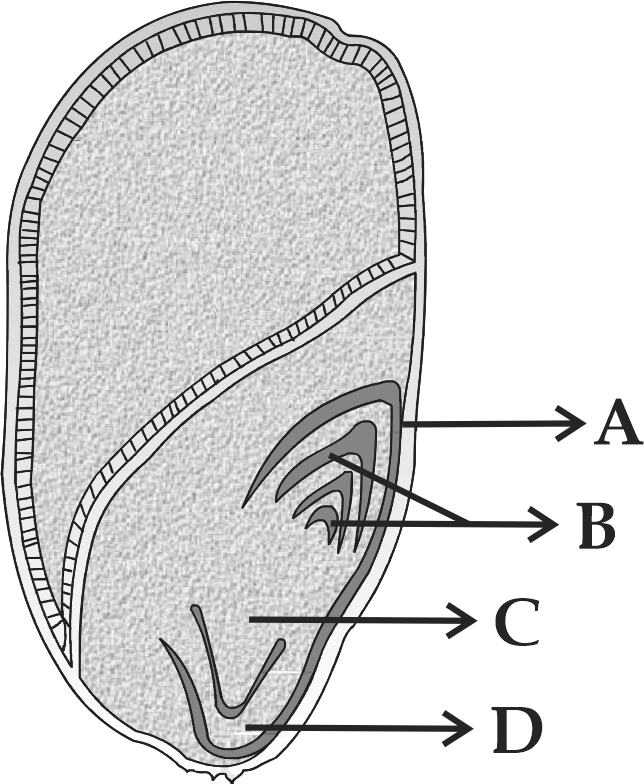
1. B
2. C
3. D
4. A
| 1. | Integument | 2. | Aleurone layer |
| 3. | Coleoptile | 4. | Coleorhiza |
| List-I | List-II | ||
| A. | Scutellum | I. | Persistent nucellus |
| B. | Non-albuminous | II. | Cotyledon of monocot seed |
| C. | Epiblast | III. | Groundnut |
| D. | Perisperm | IV. | Rudimentary cotyledon |
1. A-IV, B-III, C-I, D-II
2. A-II, B-IV, C-III, D-I
3. A-II, B-III, C-IV, D-I
4. A-IV, B-III, C-II, D-I
Preparing Seed for NEET
Seed is a specific sub-topic that frequently appears in the NEET examination. Understanding the underlying principles and practicing targeted questions is key to mastering this concept.
The questions compiled above are previous year questions (PYQs) directly related to Seed. Practicing these specific questions helps you understand the difficulty level and the examiner's approach to this topic.
Topic Frequently Asked Questions
Is Seed a high-weightage topic?
You can refer to the priority and consistency badges at the top of this page. High priority topics should be thoroughly revised multiple times before the exam.
Should I memorize the solutions?
No, it is highly recommended to understand the core concept and methodology behind each solution rather than memorizing them, as exact questions are rarely repeated, but the concepts definitely are.