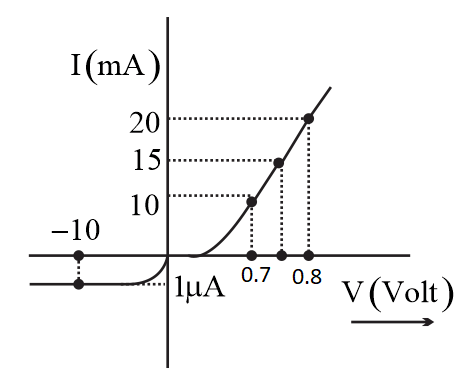
The V-I characteristic of a diode is shown in the figure. The ratio of forward to reverse bias resistance is:
1
10
2
10-6
3
106
4
100
Official Solution
Correct Option:
(2)
The forward I-V characteristic is when the diode is forward-biased, and the anodewith respect to the cathode is positive. On the other hand, the reverse I-V characteristics are observed when the cathode is positive with respect to the anode.
Formula Used:
Forward bias resistance Rf is given as -
where, is the difference between forward bias voltages,
is the difference between currents.
Reverse bias resistance is given as -
where, is the difference between reverse bias voltages,
is the difference between currents.
Complete step-by-step answer:
The forward resistance offered by a diode in forward bias is very small. On the other hand, a diode offers very high reverse resistancewhen it is in reverse bias.
The formula for forward bias resistance is given as →................(1)
where, denotes the difference between forward bias voltages.
is the difference between currents approximating particular voltages.
From the given diagram, the current ranges from 10 to 20 milli-Amperes. Therefore,
and the voltage ranges from 0.7 to 0.8 V.
Substituting the values in equation (1)
The formula for reverse bias resistance is given as:
→................(2)
where, is the difference between reverse bias voltages
is the difference between currents corresponding to particular voltages.
Also according to the diagram, the reverse bias current will be
Then, the ratio of forward bias to reverse bias resistance can be written as:
Hence, option B is the correct answer.
Note: The formula for reverse bias resistance and forward bias resistance can be written with the help of Ohm’s Law. Ohm’s law is given by V = IR.
where V is the voltage,
I is the current
R is the resistance.
Thus, resistance can be written as R = VI
Independently in terms of forward and reverse bias resistance, this equation becomes
And respectively.
About Applications Of Diode - VITEEE
Applications Of Diode is a vital chapter for VITEEE aspirants. Mastering the concepts covered in this chapter is essential for securing a top rank.
By rigorously practicing the previous year questions associated with this chapter, you can identify high-yield topics, understand the examiner's perspective, and boost your confidence during the actual exam.
Frequently Asked Questions
Why focus on Applications Of Diode PYQs?
Analyzing PYQs for this specific chapter reveals the most frequently tested concepts and the typical complexity of questions, allowing you to tailor your study plan efficiently.
How to best use this analysis?
Review the topic breakdown to see which sub-topics within Applications Of Diode carry the most weight. Then, tackle the questions iteratively to solidify your understanding.