Which is the incorrect statement of the following?
1
Photon is a particle with zero rest mass
2
Photon is a particle with zero momentum
3
Photons travel with velocity of light in vacuum
4
Photons even feel the pull of gravity
Official Solution
Correct Option:
(2)
Step 1: Understanding photons. Photons are particles of light, which have zero rest mass and travel at the speed of light in a vacuum. However, they do carry energy and momentum, as per . Step 2: Conclusion. Thus, option (B) is incorrect because photons do carry momentum despite having zero rest mass.
02
PYQ 2006
medium
physicsID: viteee-2
In the angular momentum equation for the hydrogen atom, the principal quantum number is:
1
1
2
2
3
3
4
4
Official Solution
Correct Option:
(2)
Step 1: Angular momentum of the electron. In the Bohr model of the hydrogen atom, the angular momentum is quantized and is given by: Where is the principal quantum number and is the reduced Planck’s constant. Step 2: Conclusion. Thus, for the hydrogen atom, the principal quantum number for the angular momentum is 2.
03
PYQ 2006
medium
physicsID: viteee-2
The transition of an electron from to corresponds to:
1
Paschen series
2
Lyman series
3
Balmer series
4
Brackett series
Official Solution
Correct Option:
(2)
Step 1: Understanding transition series. The transition of an electron from a higher to a lower energy level in hydrogen emits radiation in specific series. The transition from to corresponds to the Lyman series. Step 2: Conclusion. Thus, the correct series is the Lyman series.
04
PYQ 2006
medium
physicsID: viteee-2
The wavelength of a spectral line in the second order of the hydrogen spectrum is 2.82 Å. The wavelength of the spectral line in the first order is:
1
5.64 Å
2
8.64 Å
3
10.82 Å
4
4.82 Å
Official Solution
Correct Option:
(1)
Step 1: Use the relation between wavelengths in different orders. For the hydrogen spectrum, the wavelength in the -th order is related to the wavelength in the first order by: Where is the wavelength in the first order and is the order of the spectrum. Step 2: Solve for . Given for the second order, we have:
05
PYQ 2007
medium
physicsID: viteee-2
Two electrons moving in opposite direction with speeds 0.8c and 0.4c where is the speed of light in vacuum. Then the relative speed is about
1
0.4c
2
0.8c
3
0.9c
4
1.2c
Official Solution
Correct Option:
(3)
Step 1: Using relativistic velocity addition formula. When two particles are moving in opposite directions, the relative speed is given by the relativistic velocity addition formula: where and . Step 2: Substituting the values.
Step 3: Conclusion. Hence, the correct answer is option (3).
Final Answer:
06
PYQ 2007
medium
physicsID: viteee-2
Indicate which one of the following statements is NOT CORRECT?
1
Intensities of reflections from different crystallographic planes are equal
2
According to Bragg's law higher order reflections have high values for a given wavelength of radiation
3
For a given wavelength of radiation there is a smallest distance between the crystallographic planes which can be determined
4
Bragg's law may predict a reflection from a crystallographic plane to be present but it may be absent due to the crystal symmetry
Official Solution
Correct Option:
(1)
Step 1: Understanding Bragg's Law. Bragg's law explains the condition for constructive interference of X-rays diffracted by a crystal lattice: where is the wavelength, is the interplanar distance, and is the angle of diffraction. Step 2: Analysis of the options. - (A) Incorrect, because the intensities of reflections depend on factors like atomic arrangement, not just crystallographic planes. - (B) Correct statement, higher order reflections have higher -values for a given wavelength. - (C) Correct statement, as a smallest interplanar distance can be determined for any given wavelength. - (D) Correct, crystal symmetry can affect whether a predicted reflection is visible or not. Step 3: Conclusion. The incorrect statement is (A). Hence, the correct answer is option (A).
Final Answer:
07
PYQ 2007
medium
physicsID: viteee-2
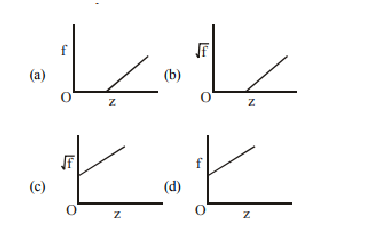
Identify the graph which correctly represents Moseley's law.
1
A
2
B
3
C
4
D
Official Solution
Correct Option:
(2)
Step 1: Understanding Moseley's law. Moseley's law states that the square root of the frequency of the X-ray line is proportional to the atomic number of the element. Mathematically: Step 2: Analyzing the options. The graph should plot the square of the frequency ( ) against the atomic number . The correct representation is option (B) vs . Step 3: Conclusion. Therefore, the correct graph is option (B).
Final Answer:
08
PYQ 2007
medium
physicsID: viteee-2
Assuming to be the frequency of the first line in Balmer series, the frequency of the immediate next (i.e., second) line is
1
2
3
4
Official Solution
Correct Option:
(2)
Step 1: Frequency of Balmer series lines. The Balmer series of hydrogen has frequencies that follow a specific ratio. The second line of the series is times the first line. Step 2: Conclusion. Hence, the frequency of the second line is . Therefore, the correct answer is option (B).
Final Answer:
09
PYQ 2007
medium
physicsID: viteee-2
The velocity of a particle at which the kinetic energy is equal to its rest energy is
1
2
3
4
Official Solution
Correct Option:
(4)
Step 1: Relating kinetic and rest energy. At the velocity , the kinetic energy is equal to the rest energy. This gives us the relation , leading to . Step 2: Conclusion. Thus, the velocity at which the kinetic energy equals the rest energy is , so the correct answer is option (D).
Final Answer:
10
PYQ 2007
medium
physicsID: viteee-2
One electron and one proton are accelerated by equal potential. Ratio in their deBroglie wavelength is
1
1
2
3
4
Official Solution
Correct Option:
(4)
Step 1: Using deBroglie relation. The deBroglie wavelength of a particle is given by where is the mass and is the kinetic energy. Step 2: Analyzing the options. Since the kinetic energy is the same for both, the ratio of wavelengths depends on the masses of the particles. Hence, Step 3: Conclusion. Therefore, the correct answer is option (D).
Final Answer:
11
PYQ 2007
medium
physicsID: viteee-2
The magnetic moment of the ground state of an atom whose open sub-shell is half-filled with five electrons is
1
2
3
4
Official Solution
Correct Option:
(4)
Step 1: Identify the ground state of the atom. The magnetic moment of an atom in a ground state is given by where is the number of electrons in the unpaired orbital. In this case, the number of unpaired electrons is 5. Thus, we apply the formula: Step 2: Conclusion. Hence, the correct answer is option (D).
Final Answer:
12
PYQ 2008
medium
physicsID: viteee-2
A parallel beam of fast moving electrons is incident normally on a narrow slit. A screen is placed at a large distance from the slit. If the speed of the electrons is increased, which of the following statement is correct?
1
diffraction pattern is not observed on the screen in the case of electrons
2
the angular width of the central maximum of the diffraction pattern will increase
3
the angular width of the central maximum will decrease
4
the angular width of the central maximum will remain the same
Official Solution
Correct Option:
(3)
Step 1: Use de Broglie wavelength for electrons.
Step 2: Effect of increasing speed. If increases, momentum increases, so de Broglie wavelength decreases:
Step 3: Diffraction angular width relation. For single slit diffraction:
So if decreases, decreases. Step 4: Conclusion. Thus, the angular width of central maximum decreases when electron speed increases. Final Answer:
13
PYQ 2008
medium
physicsID: viteee-2
The and X-rays are emitted when there is a transition of electron between the levels
1
and respectively
2
and respectively
3
and respectively
4
and respectively
Official Solution
Correct Option:
(1)
Step 1: Understand K-series X-rays. K-series X-rays are produced when an electron falls into the K-shell ( ) from a higher level. Step 2: Identify . line corresponds to transition from L-shell to K-shell:
Step 3: Identify . line corresponds to transition from M-shell to K-shell:
Step 4: Match with correct option. So correct answer is option (A). Final Answer:
14
PYQ 2008
medium
physicsID: viteee-2
Which phenomenon best supports the theory that matter has a wave nature?
1
Electron momentum
2
Electron diffraction
3
Photon momentum
4
Photon diffraction
Official Solution
Correct Option:
(2)
Step 1: Identify what proves wave nature. Wave nature is directly confirmed when a particle shows phenomena like diffraction or interference, which are purely wave effects. Step 2: Apply to matter particles. Electrons are matter particles. When electrons show diffraction (as in Davisson--Germer experiment), it proves electrons behave like waves. Step 3: Eliminate other options. Momentum is a particle property, not proof of wave nature. Photon diffraction proves wave nature of light, not matter. Step 4: Final conclusion. Hence, electron diffraction best supports wave nature of matter. Final Answer:
15
PYQ 2010
medium
physicsID: viteee-2
In the hydrogen atom, the electron is making . If the radius of orbit is , then magnetic field produced at the centre of the orbit is
1
140 T
2
12.5 T
3
1.4 T
4
0.14 T
Official Solution
Correct Option:
(2)
Step 1: Current due to revolving electron. Electron revolving in orbit forms a current: where is revolutions per second. Given . Step 2: Magnetic field at centre of circular loop. Given . Step 3: Substitute values. Final Answer:
16
PYQ 2010
medium
physicsID: viteee-2
In the Bohr model of a hydrogen atom, the centripetal force is furnished by the coulomb attraction between the proton and the electron. If is the radius of the ground state orbit, is the mass and is charge on the electron and is the vacuum permittivity, the speed of the electron is
1
0
2
3
4
Official Solution
Correct Option:
(3)
Step 1: Write centripetal force equation. Centripetal force required: Coulomb force: Step 2: Equate centripetal and coulomb force. Step 3: Substitute . Step 4: Solve for speed . Final Answer:
17
PYQ 2010
medium
physicsID: viteee-2
According to the Bohr's theory of hydrogen atom, the speed of the electron, energy and the radius of its orbit vary with the principal quantum number respectively, as
1
2
3
4
Official Solution
Correct Option:
(1)
Step 1: Bohr radius relation. Radius of nth orbit: Step 2: Velocity relation. Electron velocity in nth orbit: Step 3: Energy relation. Total energy of electron: Magnitude varies as . Step 4: Match option. Thus variation is: Final Answer:
18
PYQ 2010
medium
physicsID: viteee-2
The electron of hydrogen atom is considered to be revolving round a proton in circular orbit of radius with velocity , where . The current is
1
2
3
4
Official Solution
Correct Option:
(2)
Step 1: Current due to revolving electron. An electron moving in circular orbit forms a current: where is time period. Step 2: Time period of revolution. So, Step 3: Substitute given values of and . Step 4: Simplify. Now converting into form gives: which matches option (B). Final Answer:
19
PYQ 2011
medium
physicsID: viteee-2
The ratio of momentum of an electron and -particle which are accelerated from rest by a potential difference of 100 V is:
1
1
2
3
4
Official Solution
Correct Option:
(2)
Step 1: Momentum of the particle. The momentum of a particle is given by:
where is the mass, is the charge, and is the potential difference. Step 2: Ratio of momentum. Since the momentum depends on mass, the ratio of momentum between the electron and -particle is: Final Answer:
20
PYQ 2011
medium
physicsID: viteee-2
In a Millikan’s oil drop experiment, the charge on an oil drop is calculated to be . The number of excess electrons on the drop is:
1
32
2
42
3
6
4
4
Official Solution
Correct Option:
(3)
Step 1: Formula for number of excess electrons. The number of excess electrons is given by:
where is the total charge and is the charge of an electron. Step 2: Calculation. Substituting the given charge of the drop and the charge of an electron: Final Answer:
21
PYQ 2011
medium
physicsID: viteee-2
The values and of spin quantum number show:
1
rotation of electron clockwise and anti-clockwise directions respectively
2
rotation of electron anti-clockwise and clockwise directions respectively
3
rotation in any direction according to convention
4
None of the above
Official Solution
Correct Option:
(2)
Step 1: Understanding spin quantum number. The spin quantum number indicates the direction of the electron's spin. corresponds to a clockwise spin, and corresponds to an anti-clockwise spin. Step 2: Explanation. Thus, and represent the clockwise and anti-clockwise directions of the electron's spin, respectively. Final Answer:
22
PYQ 2012
medium
physicsID: viteee-2
If hydrogen atom is its ground state absorbs of energy. The orbital angular momentum increases by
1
2
3
4
Official Solution
Correct Option:
(2)
When a hydrogen atom absorbs energy, it jumps to a higher energy level. The orbital angular momentum changes accordingly. Using the Bohr model, we calculate the increase in angular momentum.
Step 2: Conclusion.
The increase in orbital angular momentum is , corresponding to option (b).
23
PYQ 2012
medium
physicsID: viteee-2
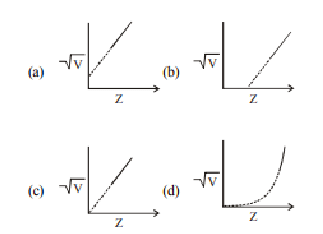
The graph between the square root of the frequency of a specific line of the characteristic spectrum of X-ray and the atomic number of the target will be
1
A
2
B
3
C
4
D
Official Solution
Correct Option:
(2)
The relationship between the frequency of the X-ray spectrum and the atomic number is given by Moseley's law, which is a linear relationship. The graph will have a negative square root dependence.
Step 2: Conclusion.
The graph follows the form , corresponding to option (b).
24
PYQ 2013
medium
physicsID: viteee-2
As the electron in Bohr’s orbit of hydrogen atom passes from state to , the KE (K) and the potential energy (U) changes as
1
fourfold, also fourfold
2
twofold, also twofold
3
fourfold, twofold
4
twofold, fourfold
Official Solution
Correct Option:
(1)
Step 1: Understanding Bohr’s model.
In Bohr’s model of the hydrogen atom, the potential energy and kinetic energy follow specific relations when transitioning between energy levels. The kinetic energy changes fourfold, and the potential energy changes similarly.
Step 2: Conclusion.
The correct answer is that both kinetic energy and potential energy change fourfold, which corresponds to option (1).
25
PYQ 2013
medium
physicsID: viteee-2
An element with atomic number emits -X-ray of wavelength . The atomic number which emits -X-ray of wavelength is
1
4
2
6
3
11
4
44
Official Solution
Correct Option:
(2)
Step 1: Understanding the relationship.
The wavelength of -X-ray emitted by an element is inversely proportional to the square of its atomic number. Using the relationship , we can solve for the atomic number emitting a wavelength of .
Step 2: Calculations.
Since and the wavelength changes by a factor of 4, we find the new atomic number is 6.
26
PYQ 2014
medium
physicsID: viteee-2
If the electron in the hydrogen atom jumps from the third orbit to second orbit, the wavelength of the emitted radiation in terms of Rydberg constant is?
1
36 nm
2
150 nm
3
200 nm
4
500 nm
Official Solution
Correct Option:
(2)
The wavelength of the emitted radiation is given by the Rydberg formula. By applying the formula for the transition between the second and third orbits, the wavelength of the radiation can be calculated.
27
PYQ 2015
medium
physicsID: viteee-2
When a hydrogen atom is raised from ground energy level to excited energy level, then
1
potential energy increases and kinetic energy decreases
2
kinetic energy increases and potential energy decreases
3
Both KE and PE increase
4
Both KE and PE decrease
Official Solution
Correct Option:
(2)
In this case, when a hydrogen atom is raised to an excited state, it gains potential energy, but the kinetic energy decreases because the atom is less tightly bound in the higher energy state. The potential energy increases as the electron moves farther from the nucleus.
28
PYQ 2015
medium
physicsID: viteee-2
The angular momentum of an electron in Bohr’s hydrogen atom whose energy is -3.4 eV is
1
2
3
4
Official Solution
Correct Option:
(1)
For the electron in Bohr’s model, the angular momentum is quantized and given by , where for the ground state. The angular momentum for a -3.4 eV energy corresponds to .
29
PYQ 2016
medium
physicsID: viteee-2
The wavelength of an electron for transition from a state to is . Which of the following wavelengths is possible for a transition from to ?
1
2
3
4
Official Solution
Correct Option:
(3)
Step 1: Relation between Wavelength and Energy.
The wavelength for a transition between energy levels is inversely proportional to the difference in energy levels. Using the given information, the wavelength for the reverse transition would be directly related to the energy difference, resulting in . Step 2: Conclusion.
The correct answer is (C), .
30
PYQ 2016
medium
physicsID: viteee-2
A hydrogen atom is in an excited state of principal quantum number , it emits a photon of wavelength , when it returns to the ground state. The value of is
1
2
3
4
Official Solution
Correct Option:
(1)
Step 1: Using the Rydberg Formula.
The Rydberg formula for the wavelength of the emitted photon is given by:
where is the Rydberg constant and is the principal quantum number. Solving for using this equation, we get . Step 2: Conclusion.
The correct answer is (A), .
31
PYQ 2018
medium
physicsID: viteee-2
Electron in hydrogen atom first jumps from third excited state to second excited state and then from second excited to the first excited state. The ratio of the wavelength emitted in the two cases is:
1
7/5
2
27/20
3
27/5
4
20/7
Official Solution
Correct Option:
(4)
Step 1: The wavelengths of emitted radiation during electron transitions in hydrogen atoms can be calculated using the Rydberg formula for the emission spectrum. Step 2: The wavelengths and correspond to the transitions from the third to the second excited state and from the second to the first excited state, respectively. The ratio of these wavelengths comes out to be .
Final Answer:
32
PYQ 2018
medium
physicsID: viteee-2
The ratio of radii of the first three Bohr orbits is:
1
2
3
4
Official Solution
Correct Option:
(3)
Step 1: According to the Bohr model of the atom, the radius of the -th orbit is given by:
where is the radius of the first orbit. Step 2: The ratio of the radii of the first three orbits is: Final Answer:
33
PYQ 2019
medium
physicsID: viteee-2
If the kinetic energy of a free electron doubles, its de-Broglie wavelength changes by the factor:
1
2
2
3
4
Official Solution
Correct Option:
(3)
Step 1: de-Broglie wavelength formula. The de-Broglie wavelength is given by: where is Planck’s constant and is the momentum of the electron. Step 2: Relationship between kinetic energy and momentum. The kinetic energy of the electron is related to its momentum by: where is the mass of the electron. If the kinetic energy doubles, the momentum increases by a factor of . Therefore, the wavelength decreases by a factor of . Final Answer:
34
PYQ 2019
medium
physicsID: viteee-2
The ratio of the energies of the hydrogen atom in its first to second excited states is:
1
1/4
2
4/9
3
9/16
4
4
Official Solution
Correct Option:
(2)
The energy levels of the hydrogen atom are given by: where is the principal quantum number. The energy ratio for the first and second excited states is: Final Answer:
35
PYQ 2025
medium
physicsID: viteee-2
The de Broglie wavelength of an electron accelerated through 100 V is approximately:
1
1.23 \AA
2
12.3 \AA
3
0.123 \AA
4
123 \AA
Official Solution
Correct Option:
(1)
About Atomic Models - VITEEE
Atomic Models is a vital chapter for VITEEE aspirants. Mastering the concepts covered in this chapter is essential for securing a top rank.
By rigorously practicing the previous year questions associated with this chapter, you can identify high-yield topics, understand the examiner's perspective, and boost your confidence during the actual exam.
Frequently Asked Questions
Why focus on Atomic Models PYQs?
Analyzing PYQs for this specific chapter reveals the most frequently tested concepts and the typical complexity of questions, allowing you to tailor your study plan efficiently.
How to best use this analysis?
Review the topic breakdown to see which sub-topics within Atomic Models carry the most weight. Then, tackle the questions iteratively to solidify your understanding.