A marble block of mass 2 kg lying on ice when given a velocity of 6 m/s is stopped by friction in 10 s. Then the coefficient of friction is (Take )
1
0.06
2
0.03
3
0.04
4
0.01
Official Solution
Correct Option:
(3)
Step 1: Using the Equation of Motion.
The frictional force , where is the normal force. Using the equation of motion for stopping:
Solving for acceleration . The frictional force is . The coefficient of friction is:
Step 2: Conclusion.
The correct answer is (C), 0.04.
02
PYQ 2016
medium
physicsID: viteee-2
A metal ball of mass 2 kg moving with a velocity of 36 km/h has a head on collision with a stationary ball of mass 3 kg. If after the collision, the two balls move together, the loss in kinetic energy due to collision is
1
140 J
2
100 J
3
60 J
4
40 J
Official Solution
Correct Option:
(2)
Step 1: Kinetic Energy Before Collision.
The initial kinetic energy of the moving ball is:
where and . Step 2: Kinetic Energy After Collision.
After the collision, the two balls move together with a combined mass of . Using conservation of momentum, the velocity after collision is:
The final kinetic energy is:
The loss in kinetic energy is:
Step 3: Conclusion.
The correct answer is (B), 100 J.
03
PYQ 2017
medium
physicsID: viteee-2
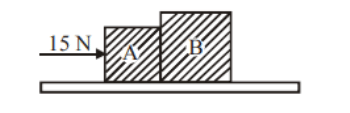
On a smooth plane surface (figure) two block A and B are accelerated by up by applying a force 15 N. If mass of B is twice that of A, the force on B is
1
30 N
2
15 N
3
10 N
4
5 N
Official Solution
Correct Option:
(3)
Step 1: Use Newton's second law.
Let the mass of block A be , and the mass of block B be . The total force applied is 15 N, and the acceleration of the system is given by:
Step 2: Calculate the force on block B.
The force on block B is . Final Answer:
04
PYQ 2025
medium
physicsID: viteee-2
A force of acts on a body of mass . What is the acceleration of the body?
1
2
3
4
Official Solution
Correct Option:
(1)
Step 1: Use Newton's Second Law of Motion
Newton's second law of motion states that:
where:
- is the force,
- is the mass,
- is the acceleration. Step 2: Rearrange the formula to solve for acceleration We are given:
- Force ,
- Mass . Rearrange the equation to solve for acceleration: Answer: Therefore, the acceleration of the body is . So, the correct answer is option (1).
05
PYQ 2025
medium
physicsID: viteee-2
A stone is dropped from a height of 45 m. What is the time taken for the stone to reach the ground?
1
3 s
2
5 s
3
6 s
4
9 s
Official Solution
Correct Option:
(1)
Step 1: Use the equation of motion For a body dropped from rest, the equation for distance traveled under uniform acceleration due to gravity is: where:
- is the distance traveled (45 m),
- is the acceleration due to gravity (approximately ),
- is the time taken (what we need to find). Step 2: Substitute the given values Substitute and into the equation: Answer: Therefore, the time taken for the stone to reach the ground is approximately 3 seconds. So, the correct answer is option (1).
06
PYQ 2025
medium
physicsID: viteee-2
A body of mass 5 kg is moving with a velocity of 15 m/s. What is its momentum?
1
2
3
4
Official Solution
Correct Option:
(1)
Step 1: Use the formula for momentum
Momentum is given by the formula: where:
- is the mass of the body,
- is the velocity of the body. Step 2: Substitute the given values
We are given:
- Mass ,
- Velocity . Substitute these values into the formula: Answer: Therefore, the momentum of the body is . So, the correct answer is option (1).
About Laws Of Motion - VITEEE
Laws Of Motion is a vital chapter for VITEEE aspirants. Mastering the concepts covered in this chapter is essential for securing a top rank.
By rigorously practicing the previous year questions associated with this chapter, you can identify high-yield topics, understand the examiner's perspective, and boost your confidence during the actual exam.
Frequently Asked Questions
Why focus on Laws Of Motion PYQs?
Analyzing PYQs for this specific chapter reveals the most frequently tested concepts and the typical complexity of questions, allowing you to tailor your study plan efficiently.
How to best use this analysis?
Review the topic breakdown to see which sub-topics within Laws Of Motion carry the most weight. Then, tackle the questions iteratively to solidify your understanding.