The de Broglie wavelength associated with a steel ball of mass 100 g moving at a speed of 1 m/s is:
1
m
2
m
3
m
4
m
Official Solution
Correct Option:
(3)
Step 1: Use de Broglie's wavelength formula. The de Broglie wavelength is given by: Where , , and . Step 2: Substitute the values:
02
PYQ 2007
medium
physicsID: viteee-2
A photo-sensitive material would emit electrons if excited by photons beyond a threshold. To overcome the threshold, one would increase
1
the voltage applied to the material
2
the intensity of the light source
3
the wavelength of light
4
the frequency of light
Official Solution
Correct Option:
(4)
Step 1: Understanding the photoelectric effect. According to the photoelectric effect, electrons are ejected from a photo-sensitive material when it absorbs photons with energy greater than or equal to a certain threshold. The energy of a photon is given by , where is Planck's constant and is the frequency of the light. Step 2: Increasing the frequency. To overcome the threshold and emit electrons, we need photons with energy greater than the threshold energy. Since energy is proportional to frequency, increasing the frequency will increase the photon energy and thus overcome the threshold. Step 3: Conclusion. Hence, the correct answer is option (4).
Final Answer:
03
PYQ 2008
medium
physicsID: viteee-2
A light whose frequency is equal to Hz is incident on a metal whose work function is 2 eV. The maximum energy of the electrons emitted will be
1
2.49 eV
2
4.49 eV
3
0.49 eV
4
5.49 eV
Official Solution
Correct Option:
(3)
Step 1: Use Einstein photoelectric equation.
Step 2: Substitute values. Given:
Energy of photon:
Step 3: Convert joule to eV.
Step 4: Subtract work function.
Final Answer:
04
PYQ 2009
medium
physicsID: viteee-2
The work function of a certain metal is . Then, the maximum kinetic energy of photoelectrons emitted by incident radiation of wavelength is (given , , )
1
2
3
4
Official Solution
Correct Option:
(2)
Step 1: Use Einstein’s photoelectric equation.
Step 2: Convert wavelength.
Step 3: Calculate photon energy.
Step 4: Subtract work function.
Step 5: Convert into eV.
Final Answer:
05
PYQ 2010
medium
physicsID: viteee-2
The collector plate in an experiment on
photoelectric effect is kept vertically above the emitter plate. Light source is put on and a saturation photo-current is recorded. An electric field is switched on which has a vertically downward direction, then
1
the photo-current will increase
2
the kinetic energy of the electrons will increase
3
the stopping potential will decrease
4
the threshold wavelength will increase
Official Solution
Correct Option:
(2)
In electric field photoelectron will experience force and accelerate opposite to the field so its increases (ie, stopping potential will increase), no change in photoelectric current, and threshold wavelength.
06
PYQ 2010
medium
physicsID: viteee-2
Silver has a work function of . When ultraviolet light of wavelength is incident upon it, potential of is required to stop photoelectrons reaching collector plate. The potential required to stop electrons when light of wavelength is incident upon silver is
1
1.5 V
2
1.85 V
3
1.95 V
4
2.37 V
Official Solution
Correct Option:
(1)
Step 1: Use stopping potential relation. Step 2: For . Given . Step 3: For . Step 4: Subtract the equations to remove . Step 5: Use energy in eV form. So, Step 6: Find stopping potential for . Final Answer:
07
PYQ 2010
medium
physicsID: viteee-2
Light of wavelength strikes a photo-sensitive surface and electrons are ejected with kinetic energy . If the kinetic energy is to be increased to , the wavelength must be changed to where
1
2
3
4
Official Solution
Correct Option:
(3)
Step 1: Use Einstein's photoelectric equation. Step 2: Write given condition. Initially, Finally, Step 3: Compare both equations. Step 4: Conclude range of . Since , Also to increase energy, must decrease compared to : Thus, Final Answer:
08
PYQ 2010
medium
physicsID: viteee-2
The maximum velocity of electrons emitted from a metal surface is , when frequency of light falling on it is . The maximum velocity when frequency becomes is
1
2
3
4
between and
Official Solution
Correct Option:
(2)
Step 1: Use relation for kinetic energy. Step 2: For frequency . Step 3: For frequency . Step 4: Compare with . Since , denominator is smaller than numerator scale, so ratio becomes greater than 4. Thus, Final Answer:
09
PYQ 2010
medium
physicsID: viteee-2
The photoelectric plate is kept vertically above the emitter plate. Light source is put on and a saturation photo-current is recorded. An electric field is switched on which has a vertically downward direction, then
1
the photo-current will increase
2
the kinetic energy of the electrons will increase
3
the stopping potential will decrease
4
the threshold wavelength will increase
Official Solution
Correct Option:
(2)
Step 1: Understand arrangement. Emitter plate is below and collector plate is above. Electrons move upward from emitter to collector. Step 2: Direction of applied electric field. Electric field is vertically downward. Force on electron is: So if is downward, electron force is upward. Step 3: Effect on electrons. Since force is upward, electrons accelerate more while moving to collector. Hence their kinetic energy increases. Step 4: Eliminate other options. Saturation current does not increase because it depends on number of emitted electrons (intensity). Stopping potential depends on maximum kinetic energy at emission, not after acceleration. Threshold wavelength depends on work function, not field. Final Answer:
10
PYQ 2011
medium
physicsID: viteee-2
The frequency of incident light falling on a photosensitive metal plate is doubled, the kinetic energy of the emitted photoelectrons is:
1
double the earlier value
2
quadrupled
3
halved
4
zero
Official Solution
Correct Option:
(1)
Step 1: Use Einstein's photoelectric equation. The kinetic energy of the emitted electrons is given by:
where is Planck’s constant, is the frequency of light, and is the work function of the material. Step 2: Explanation. Doubling the frequency of incident light doubles the kinetic energy of the emitted electrons, as is directly proportional to the frequency of the incident light. Final Answer:
11
PYQ 2011
medium
physicsID: viteee-2
Light of two different frequencies whose photons have energies 1 eV and 2.5 eV, respectively, successively illuminate a metal whose work function is 0.5 eV. The ratio of the maximum speed of the emitted electrons will be:
1
1:2
2
1:1
3
1:3
4
1:4
Official Solution
Correct Option:
(3)
Step 1: Use the photoelectric equation. The maximum kinetic energy of the emitted electrons is given by:
The speed of the emitted electrons is related to the kinetic energy. Step 2: Calculation of speed ratio. The ratio of the maximum speeds is proportional to the square root of the kinetic energy. The ratio of the speeds is therefore . Final Answer:
12
PYQ 2012
medium
physicsID: viteee-2
In photoelectric emission process from a metal of work function 1.8 eV, the kinetic energy of most energetic electrons is 0.5 eV. The corresponding stopping potential is
1
13V
2
0.5V
3
23V
4
1.8V
Official Solution
Correct Option:
(2)
The stopping potential is related to the kinetic energy of the emitted electrons. The stopping potential can be calculated using the equation , where , and is the electron charge. The stopping potential comes out to be 0.5V.
Step 2: Conclusion.
The correct stopping potential is 0.5V, corresponding to option (b).
13
PYQ 2012
medium
physicsID: viteee-2
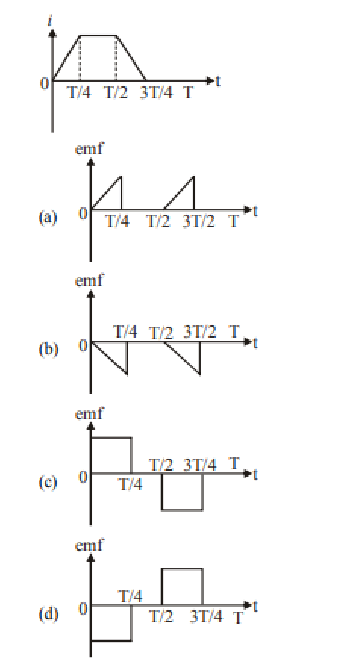
In photoelectric emission, the current varies with time as shown. The variation of induced emf with time would be
1
A
2
B
3
C
4
D
Official Solution
Correct Option:
(4)
The variation in induced emf is due to the variation in the current passing through the coil. The emf will be directly proportional to the current variation over time.
Step 2: Conclusion.
The induced emf varies with time in the same manner as the current, corresponding to option (d).
14
PYQ 2012
medium
physicsID: viteee-2
A direct X-ray photograph of the intensities is not generally taken by radiologists because
1
intensities would burst an exposure to X-rays
2
the X-rays would not pass through the intensities
3
the X-rays will pass through the intensities without causing a good shadow for any useful diagnosis
4
a very small exposure of X-rays causes cancer in the intensities
Official Solution
Correct Option:
(3)
X-rays are used to create images by passing through dense structures and casting shadows. If the intensities do not provide sufficient contrast, X-rays will pass through them without providing useful diagnostic information.
Step 2: Conclusion.
The correct answer is (c) the X-rays will pass through the intensities without causing a good shadow for any useful diagnosis.
15
PYQ 2012
medium
physicsID: viteee-2
A and B are two metals with threshold frequencies and . Two identical photons of energy each are incident on them. Then photoelectrons are emitted by (Take ):
1
A alone
2
B alone
3
Neither A nor B
4
Both A and B
Official Solution
Correct Option:
(2)
Using the photoelectric effect equation , where is the frequency, we can calculate whether photoelectrons are emitted. Only metal B has sufficient energy to emit photoelectrons.
Step 2: Conclusion.
Photoelectrons are emitted by metal B alone, corresponding to option (b).
16
PYQ 2012
medium
physicsID: viteee-2
The threshold frequency for a photo-sensitive metal is . If light of frequency is incident on this metal, the cut-off voltage for the photo-electric emission is nearly
1
2V
2
3V
3
5V
4
1V
Official Solution
Correct Option:
(2)
Using the photoelectric equation , where is the frequency, is Planck's constant, and is the work function of the metal, we can calculate the cut-off voltage. With the given frequency, the cut-off voltage comes out to be approximately 3V.
Step 2: Conclusion.
The cut-off voltage is 3V, corresponding to option (b).
17
PYQ 2012
medium
physicsID: viteee-2
and are two metals with threshold frequencies and Two identical photons of energy each are incident on them. Then photoelectrons are emitted by (Take
1
B alone
2
A alone
3
Neither A nor B
4
Both A and B
Official Solution
Correct Option:
(2)
Threshold energy of is
Similarly, As the incident photons have energy greater than but less than . So, photoelectrons will be emitted from metal only
18
PYQ 2012
medium
physicsID: viteee-2
In photoelectric emission process from a metal of work function the kinetic energy of most energetic electrons is . The corresponding stopping potential is
1
1.3V
2
0.5V
3
2.3V
4
1.8V
Official Solution
Correct Option:
(2)
Stopping potential Maximum
19
PYQ 2013
medium
physicsID: viteee-2
When a certain metallic surface is illuminated with monochromatic light of wavelength , the stopping potential for photoelectric current is . When the same surface is illuminated with a light of wavelength , the stopping potential is . The threshold wavelength for this surface to photoelectric effect is
1
2
3
4
Official Solution
Correct Option:
(1)
Step 1: Using the photoelectric equation.
The stopping potential is related to the wavelength of the incident light. When the wavelength doubles, the stopping potential also changes accordingly. We calculate the threshold wavelength for the given condition.
Step 2: Conclusion.
The threshold wavelength is , corresponding to option (1).
20
PYQ 2014
medium
physicsID: viteee-2
A metallic surface ejects electrons. When exposed to green light of intensity I but no photoelectrons are emitted, when exposed to yellow light of intensity 1 it is possible to eject electrons from the same surface by?
1
Yellow light of same intensity which is more than I
2
Green light of any intensity
3
Red light of any intensity
4
None of the above
Official Solution
Correct Option:
(1)
The photoelectric effect occurs when light of sufficient frequency strikes a metallic surface, causing the emission of electrons. Yellow light has a higher frequency than green light, which is why it can cause the ejection of electrons even at the same intensity.
21
PYQ 2014
medium
physicsID: viteee-2
Silver has a work function of 4.7 eV. When ultraviolet light of wavelength 100 nm is incident on it, a potential of 7.7 V is required to stop the photoelectrons from reaching the collector plate. How much potential will be required to stop photoelectrons when light of wavelength 200 nm is incident on it?
1
154 V
2
235 V
3
385 V
4
1.5 V
Official Solution
Correct Option:
(4)
Using the photoelectric equation , where is the kinetic energy, is Planck's constant, is the frequency of light, and is the work function, we can calculate the stopping potential for different wavelengths. For light with a longer wavelength, the stopping potential decreases.
22
PYQ 2014
medium
physicsID: viteee-2
If the distance of 100 W lamp is increased from a photocell, the saturation current in the photocell varies with the distance as?
1
2
3
4
Official Solution
Correct Option:
(2)
The saturation current in a photocell is inversely proportional to the square of the distance between the light source and the photocell, based on the inverse square law for light intensity.
23
PYQ 2015
medium
physicsID: viteee-2
Suppose a beam of electrons with each electron having energy incident on a metal surface kept in an evacuated chamber. Then,
1
electrons can be emitted with any energy less than
2
electrons can be emitted with any energy up to
3
electrons can be emitted with any energy with a maximum of
4
electrons can be emitted with any energy with a maximum of , where being work function
Official Solution
Correct Option:
(4)
When electrons strike a metal surface, they can be emitted with a maximum energy equal to the incident energy minus the work function , which is the minimum energy required to release the electron from the metal.
24
PYQ 2016
medium
physicsID: viteee-2
Let the energy of an emitted photoelectron be and the wavelength of incident light be . What will be the change in if is doubled?
1
2
3
4
Official Solution
Correct Option:
(4)
Step 1: Energy of Photoelectron.
The energy of a photoelectron is related to the frequency of the incident light:
where is Planck’s constant, is the frequency, and is the work function of the metal. Step 2: Doubling Wavelength.
Since frequency is inversely proportional to the wavelength, doubling the wavelength results in reducing the frequency by half. Therefore, the energy of the emitted electron will decrease by a factor of 4. Step 3: Conclusion.
The correct answer is (D), .
25
PYQ 2016
medium
physicsID: viteee-2
If the wavelength is brought down from 6000 Å to 4000 Å in a photoelectric experiment then what will happen?
1
The work function of the metal will increase
2
The threshold frequency will decrease
3
No change will take place
4
Cut off voltage will increase
Official Solution
Correct Option:
(4)
Step 1: Understanding the Effect of Wavelength.
According to the photoelectric equation:
where is the energy of the photons and is the frequency. Reducing the wavelength increases the frequency and thus increases the energy of the incoming photons. Step 2: Conclusion.
As energy increases, the cut-off voltage (the minimum stopping potential) required to stop the emitted electrons will increase. Step 3: Conclusion.
The correct answer is (D), Cut off voltage will increase.
26
PYQ 2016
medium
physicsID: viteee-2
Hologram is based on phenomenon of
1
diffraction
2
polarisation
3
interference
4
total internal reflection
Official Solution
Correct Option:
(3)
Hologram is based on the phenomenon of interference.
27
PYQ 2017
medium
physicsID: viteee-2
Light of wavelength 500 nm is incident on a metal with work function . The de Broglie wavelength of the emitted electron is:
1
2
3
4
Official Solution
Correct Option:
(1)
Step 1: Use the photoelectric equation. Using the photoelectric equation, the kinetic energy of the emitted electron is given by: where is the energy of the incident photon, and is the work function.
Step 2: Use the de Broglie wavelength formula. The de Broglie wavelength of the emitted electron is related to its momentum by: where .
Step 3: Calculate the de Broglie wavelength. The de Broglie wavelength can be found using the above relations, which yields: Final Answer:
28
PYQ 2018
medium
physicsID: viteee-2
In a photoelectric effect measurement, the stopping potential for a given metal is found to be volt when radiation of wavelength is used. If radiation of wavelength is used with the same metal then the stopping potential (in volt) will be:
1
2
3
4
Official Solution
Correct Option:
(4)
Step 1: The stopping potential is related to the energy of the incoming photons by the equation:
where is the frequency of the radiation. Step 2: For wavelength , the energy of the photons is half of the energy for . Therefore, the stopping potential decreases, and the new stopping potential is: Final Answer:
29
PYQ 2019
medium
physicsID: viteee-2
The surface of a metal is illuminated with the light of 400 nm. The kinetic energy of the ejected photoelectrons was found to be 1.68 eV. The work function of the metal is: (hc = 1240 eV·nm)
1
3.09 eV
2
1.42 eV
3
1.51 eV
4
1.68 eV
Official Solution
Correct Option:
(3)
The energy of the photon is given by: Substitute , to find the photon energy. Then use the photoelectric equation: Solving gives the work function as 1.51 eV. Final Answer:
30
PYQ 2025
medium
physicsID: viteee-2
Light of wavelength 600 nm is incident on a metal surface with work function 2 eV. The maximum kinetic energy of photoelectrons is:
1
0.07 eV
2
0.7 eV
3
2.07 eV
4
4.14 eV
Official Solution
Correct Option:
(1)
Photon energy:
About Photoelectric Effect - VITEEE
Photoelectric Effect is a vital chapter for VITEEE aspirants. Mastering the concepts covered in this chapter is essential for securing a top rank.
By rigorously practicing the previous year questions associated with this chapter, you can identify high-yield topics, understand the examiner's perspective, and boost your confidence during the actual exam.
Frequently Asked Questions
Why focus on Photoelectric Effect PYQs?
Analyzing PYQs for this specific chapter reveals the most frequently tested concepts and the typical complexity of questions, allowing you to tailor your study plan efficiently.
How to best use this analysis?
Review the topic breakdown to see which sub-topics within Photoelectric Effect carry the most weight. Then, tackle the questions iteratively to solidify your understanding.