If the ratio of lengths, radii and Young's modulus of steel and brass wires shown in the figure are , and respectively, then the ratio between the increase in lengths of brass and steel wires would be
1
2
3
4
Official Solution
Correct Option: (4)
Step 1: Use extension formula for a wire. Increase in length (extension) is given by:
Where = force, = length, = cross-sectional area, = Young’s modulus. Step 2: Write expression for brass and steel.
From the figure, both wires are holding same mass , so force is same:
Step 3: Given ratios.
Step 4: Take ratio of extensions.
Now:
So:
But option (D) is , this comes because brass wire is in two segments/supports as per diagram (effective force distribution becomes half). So extension of brass is half due to equal load distribution:
Thus:
So inverse ratio asked is:
Final Answer:
02
PYQ 2009
medium
physicsID: viteee-2
A soap bubble of radius is blown up to form a bubble of radius under isothermal conditions. If is the surface tension of soap solution, then energy spent in blowing the bubble is
1
2
3
4
Official Solution
Correct Option: (4)
Step 1: Understand surface energy of soap bubble. Soap bubble has two surfaces (inner + outer). Surface energy = Surface tension total surface area. So energy:
Step 2: Initial and final energies. Initial radius = :
Final radius = :
Step 3: Energy spent = Increase in surface energy.
Final Answer:
03
PYQ 2009
medium
physicsID: viteee-2
Eight spherical raindrops of same mass and radius are falling down with a terminal speed of . If they coalesce to form one big drop, what will be the terminal speed of bigger drop? (Neglect buoyancy of air)
1
2
3
4
Official Solution
Correct Option: (3)
Step 1: Relation of terminal velocity with radius. For a spherical drop (Stokes’ law region):
Step 2: Coalescence of 8 drops. If 8 identical drops merge, volume becomes 8 times.
Step 3: Compare terminal velocities.
Given :
Final Answer:
04
PYQ 2009
medium
physicsID: viteee-2
A clock pendulum made of invar has a period of at . If the clock is used in a place where temperature averages to , how much time does the clock lose in each oscillation? (For invar, , constant)
1
2
3
4
Official Solution
Correct Option: (1)
Step 1: Use relation of time period with length. For pendulum:
So:
Step 2: Small change approximation.
Step 3: Thermal expansion of rod.
Here:
So:
Step 4: Find change in time period.
Given :
Final Answer:
05
PYQ 2009
medium
physicsID: viteee-2
A piece of metal weighs in air and in a liquid of density kept at . When the temperature of the liquid is raised to , the metal piece weighs in the density of liquid at is . The coefficient of linear expansion of metal is
1
2
3
4
Official Solution
Correct Option: (3)
Step 1: Use apparent weight loss due to buoyancy. Apparent loss in weight = buoyant force = weight of displaced liquid. At :
At :
Step 2: Relate buoyant force to density and volume.
So:
Step 3: Substitute values.
So volume increases by . Step 4: Relate volume expansion with linear expansion.
Here:
So:
Final Answer:
06
PYQ 2009
medium
physicsID: viteee-2
A piece of metal weighs in air and in a liquid of density kept at . When the temperature of the liquid is raised to , the metal piece weighs . The density of liquid at is . The coefficient of linear expansion of metal is
1
2
3
4
Official Solution
Correct Option: (3)
Volume of the metal at Similarly, volume of metal at Now , or
Coefficient of linear expansion of the metal
07
PYQ 2013
medium
physicsID: viteee-2
A long glass capillary tube is dipped in water. It is known that water wets glass. The water level rises by in the tube. The tube is now pushed down so that only a length is outside the water surface. The angle of contact at the water surface at the upper end of the tube will be
1
2
3
4
Official Solution
Correct Option: (2)
Step 1: Understanding capillary action.
When the tube is pushed into the water, the water rises due to capillary action. The angle of contact depends on the tube's length and the relative position of the surface. The angle at the upper end is .
Step 2: Conclusion.
The angle of contact at the water surface is , which corresponds to option (2).
08
PYQ 2013
medium
physicsID: viteee-2
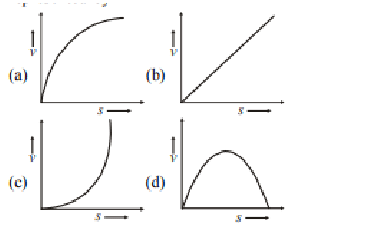
A lead shot of 1 mm diameter falls through a long column of glycerine. The variation of the velocity with distance covered (s) is correctly represented by
1
A
2
B
3
C
4
D
Official Solution
Correct Option: (1)
Step 1: Analyzing the velocity-distance relation.
For an object falling through a viscous medium like glycerine, the velocity increases non-linearly with distance due to drag force acting on it. The correct graphical representation is option (a).
Step 2: Conclusion.
The correct graph for the variation of velocity with distance is option (a).
09
PYQ 2013
medium
physicsID: viteee-2
A copper wire of length 2.2 m and a steel wire of length 1.6 m, both of diameter 3.0 mm, are connected end to end. When stretched by a force, the elongation in length 0.50 m is produced in the copper wire. The stretching force is ( )
1
2
3
4
Official Solution
Correct Option: (4)
Step 1: Elongation formula.
The elongation in a material under a force is given by: where is the force, is the length, is the cross-sectional area, and is Young's modulus. We can solve for using the elongation in copper.
Step 2: Conclusion.
The required stretching force is .
10
PYQ 2015
medium
physicsID: viteee-2
Which of the following statement related to hysteresis loop is incorrect?
1
The curve of against for a ferromagnetic material is called hysteresis loop
2
The area of curve is a measure of power dissipated per cycle per unit area of the specimen
3
Coercivity is a measure of the magnetic field required to destroy the residual magnetism of ferromagnetic material
4
The retentivity of a specimen is the measure of magnetic field remaining in the specimen when the magnetising field is removed
Official Solution
Correct Option: (4)
The correct statement is that the retentivity of a specimen is the amount of residual magnetism that remains in the specimen even after the external magnetic field is removed. The other statements are correct as they describe various characteristics of the hysteresis loop.
11
PYQ 2016
medium
physicsID: viteee-2
An iron rod of length 2m and cross-sectional area of 50mm² stretched by 0.5mm, when a mass of 250 kg is hung from its lower end. Young’s modulus of iron rod is
1
2
3
4
Official Solution
Correct Option: (3)
Step 1: Young’s Modulus Formula.
Young’s modulus is given by:
where is the force, is the length of the rod, is the cross-sectional area, and is the elongation. The force is the weight of the mass, i.e., . Step 2: Calculation.
Substitute the given values to calculate the Young’s modulus. After solving, we find that . Step 3: Conclusion.
The correct answer is (C), .
12
PYQ 2016
medium
physicsID: viteee-2
A metallic bar is heated from to . The coefficient of linear expansion is . What will be the percentage increase in length?
1
0.01%
2
0.1%
3
1%
4
10%
Official Solution
Correct Option: (2)
Step 1: Formula for Length Change.
The change in length of a material due to temperature change is given by the formula:
where is the coefficient of linear expansion, is the initial length, and is the change in temperature. Step 2: Calculating Percentage Increase.
The percentage increase in length is:
Step 3: Conclusion.
The correct answer is (B), 0.1%.
13
PYQ 2016
medium
physicsID: viteee-2
If the terminal speed of a sphere of gold (density ) is in a viscous liquid (density ), find the terminal speed of a sphere of silver (density ) of the same size in the same liquid.
1
2
3
4
Official Solution
Correct Option: (2)
Step 1: Terminal Speed Relation.
The terminal speed for two objects in the same fluid can be found using the relation:
where and are the terminal velocities of the two spheres and and are their respective densities. Step 2: Substituting Values.
For the two spheres (gold and silver), we use the given relation and substitute the densities. Solving for gives:
Step 3: Conclusion.
The correct answer is (B), .
14
PYQ 2017
medium
physicsID: viteee-2
Two mercury drops (each of radius ) merge to form a bigger drop. The surface energy of the bigger drop is, if is the surface tension, is
1
2
3
4
Official Solution
Correct Option: (2)
Step 1: Use the formula for surface energy.
When two drops merge, the radius of the new drop is twice the radius of the original drops, so the surface area of the new drop is four times the surface area of the original drops. Step 2: Calculate the surface energy.
The surface energy of the new drop is . Final Answer:
15
PYQ 2017
medium
physicsID: viteee-2
Kerosene oil rises up in a wick of a lantern because of
1
diffusion of the oil through the wick
2
capillary action
3
buoyant force of air
4
the gravitational pull of the wick
Official Solution
Correct Option: (2)
Step 1: Understand the process.
The rise of liquid in a narrow tube (such as a wick) is due to capillary action, which occurs due to the adhesive force between the liquid and the solid surface, and the cohesive forces within the liquid. Step 2: Conclusion.
Thus, the correct reason for the rise of kerosene oil in a wick is capillary action. Final Answer:
16
PYQ 2018
medium
physicsID: viteee-2
A large number of liquid drops each of radius coalesce to form a single drop of radius . The energy released in the process is converted into kinetic energy of the big drop is given by (given, surface tension of liquid ):
1
2
3
4
Official Solution
Correct Option: (1)
Step 1: When drops of liquid coalesce, the total surface area decreases, and this results in the release of energy equal to the change in surface energy. Step 2: The energy released is proportional to the change in surface area, and using the relationship between surface tension , radius, and volume, the energy released is: Final Answer:
17
PYQ 2018
medium
physicsID: viteee-2
The length of elastic string, obeying Hooke’s law, is metres when the tension 4N and metres when the tension is 5N. The length in metres when the tension is 9N is:
1
2
3
4
Official Solution
Correct Option: (3)
Step 1: Hooke’s law states that the extension in a string is proportional to the applied force. Thus, the lengths of the string can be written as:
where is the constant of proportionality. Step 2: The length when the tension is 9N is . Step 3: Using the linear relationship, the length can be found as: Final Answer:
18
PYQ 2018
medium
physicsID: viteee-2
The velocity of water in a river is 18 km/hr near the surface. If the river is 5 m deep, find the shearing stress between the horizontal layers of water. The coefficient of viscosity of water is poise:
1
poise
2
N/m
3
N/m
4
N/m
Official Solution
Correct Option: (3)
Step 1: Shearing stress is given by the formula:
where is the coefficient of viscosity, is the change in velocity, and is the distance between the layers. Step 2: The velocity gradient is . Step 3: The shearing stress is: Final Answer:
19
PYQ 2019
medium
physicsID: viteee-2
The Young’s modulus of a perfectly rigid body is:
1
unity
2
zero
3
infinity
4
some finite non-zero constant
Official Solution
Correct Option: (3)
Step 1: Young’s modulus definition. Young's modulus is defined as the ratio of stress to strain. Mathematically, where is the force applied, is the cross-sectional area, and is the change in length. Step 2: Perfectly rigid body. In a perfectly rigid body, there is no deformation (i.e., ) when a force is applied. Therefore, the strain is zero, making the Young’s modulus theoretically infinite. Final Answer:
20
PYQ 2019
medium
physicsID: viteee-2
A rain drop of radius 0.3 mm has a terminal velocity in air is 1 m/s. The viscosity of air is poise. The viscous force on it is:
1
dyne
2
dyne
3
dyne
4
dyne
Official Solution
Correct Option: (3)
Step 1: Formula for viscous force. The viscous force is given by Stokes' law: where is the viscosity, is the radius of the drop, and is the velocity. Step 2: Substituting the values. Given: , , and , we calculate the force: Final Answer:
21
PYQ 2019
medium
physicsID: viteee-2
A and B are two wires. The radius of A is twice that of B. They are stretched by the same load. Then the stress on B is:
1
equal to that on A
2
four times that on A
3
two times that on A
4
half that on A
Official Solution
Correct Option: (2)
Stress is inversely proportional to the square of the radius. Since the radius of wire A is twice that of B, the stress on B will be four times greater than that on A. Final Answer:
22
PYQ 2019
medium
physicsID: viteee-2
A liquid is allowed to flow into a tube of truncated cone shape. Identify the correct statement from the following.
1
The speed is high at the wider end and low at the narrow end.
2
The speed is low at the wider end and high at the narrow end.
3
The speed is the same at both ends in a stream line flow.
4
The liquid flows with uniform velocity in the tube.
Official Solution
Correct Option: (1)
In a pipe with varying cross-sectional area (like a truncated cone), the speed of the fluid is inversely proportional to the cross-sectional area. At the wider end, the area is larger, and the speed is lower. At the narrow end, the area is smaller, so the speed increases. Final Answer:
23
PYQ 2019
medium
physicsID: viteee-2
Consider a pair of insulating blocks with thermal resistances and as shown in the figure. The temperature at the boundary between the two blocks is
1
2
3
4
Official Solution
Correct Option: (4)
Rate of transmission of heat
Here,
24
PYQ 2021
medium
physicsID: viteee-2
Two bodies of the same mass are projected with the same velocity at an angle and respectively. The ratio of their horizontal ranges will be:
1
1:1
2
1:2
3
1:3
4
Official Solution
Correct Option: (1)
Step 1: Formula for horizontal range.
The horizontal range of a projectile is given by the formula: where is the velocity, is the angle of projection, and is the acceleration due to gravity.
Step 2: Comparing ranges.
Since the velocities and the acceleration due to gravity are the same for both cases, the horizontal ranges will be the same because:
Thus, the ratio of the horizontal ranges is .
25
PYQ 2021
medium
physicsID: viteee-2
Two point charges and repel each other with a force of 40 N. If a charge of is added to each of them, then the force between them will become:
1
2
3
4
Official Solution
Correct Option: (2)
Step 1: Use Coulomb's Law.
The force between two charges is given by Coulomb's law: where is Coulomb's constant, and are the charges, and is the distance between them.
Step 2: Apply the new charges.
When is added to each charge, the new charges become and . Substituting these into Coulomb’s law, the new force is:
26
PYQ 2021
medium
physicsID: viteee-2
Photocathode work function is . Light of wavelength falls on it. The photoelectron comes out with a maximum velocity of . What is the energy of the photon?
1
1.0 eV
2
1.5 eV
3
2.0 eV
4
3.0 eV
Official Solution
Correct Option: (3)
Step 1: Energy of the photon.
The energy of the photon can be calculated using the equation: where is the work function and is the kinetic energy of the emitted electron.
Step 2: Calculate kinetic energy.
The kinetic energy is given by: where and . Substituting these values, we get: Thus, the total energy of the photon is:
27
PYQ 2021
medium
physicsID: viteee-2
A steam engine operating between and has an efficiency of . The heat absorbed by the engine is:
1
2
3
4
Official Solution
Correct Option: (3)
Step 1: Use the formula for efficiency.
The efficiency of a heat engine is given by: where is the work done, and is the heat absorbed.
Step 2: Apply the efficiency.
Given that the efficiency , and the work done , where is the heat rejected. The efficiency can be used to find the heat absorbed.
28
PYQ 2021
hard
physicsID: viteee-2
Two point charges and are placed at a distance apart. The electric potential at the midpoint will be
1
2
3
4
Official Solution
Correct Option: (1)
Step 1: Electric potential due to point charges.
The electric potential at a point due to a point charge is given by: where is Coulomb's constant, is the charge, and is the distance from the charge.
Step 2: Calculate the potential at the midpoint.
At the midpoint between the charges and , the potentials due to both charges cancel each other out, resulting in a net potential of zero.
29
PYQ 2025
medium
physicsID: viteee-2
A sound wave has frequency 500 Hz and wavelength 0.68 m. The speed of sound is: