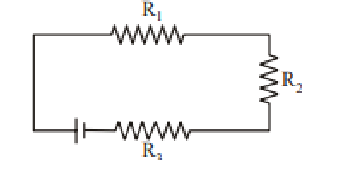
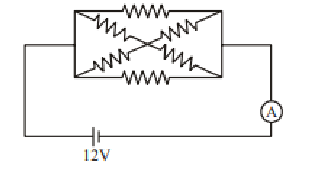
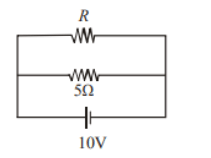
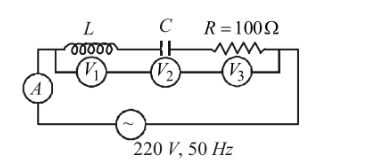
Three resistances of values 2Ω, 3Ω, and 6Ω are to be connected to produce an effective resistance of 4Ω. This can be done by connecting:
1
6Ω in series with the parallel combination of 2Ω and 3Ω
2
3Ω in series with the parallel combination of 2Ω and 6Ω
3
2Ω resistance in series with the parallel combination of 3Ω and 6Ω
4
20Ω resistance in parallel with the parallel combination of 3Ω and 6Ω
Official Solution
Correct Option: (3)
Step 1: Calculate the equivalent resistance for the parallel combination: For the 3Ω and 6Ω resistors in parallel: Step 2: Add the 2Ω resistance in series: The total resistance is the sum of the parallel resistance and the 2Ω resistor in series:
02
PYQ 2006
medium
physicsID: viteee-2
The resistance of a field cold measures 50Ω at 20°C and 53Ω at 70°C. The temperature coefficient of resistance is:
1
2
3
4
Official Solution
Correct Option: (2)
Step 1: Use the formula for temperature coefficient of resistance: Where: - , - , - , - . Step 2: Substitute the values into the formula:
03
PYQ 2006
medium
physicsID: viteee-2
The electrolyte used in Leclanché cell is:
1
Copper sulphate solution
2
Ammonium chloride solution
3
Zinc sulphate
4
Sodium chloride
Official Solution
Correct Option: (2)
Step 1: Identify the electrolyte used in Leclanché cell: The electrolyte in a Leclanché cell is typically an ammonium chloride solution. This solution is used as the medium through which ions move in the cell. Step 2: Conclusion: Hence, the correct answer is (B) Ammonium chloride solution.
04
PYQ 2006
medium
physicsID: viteee-2
A galvanometer has a resistance of 50Ω. If a resistance of 12Ω is connected across its terminals, the total current flow through the galvanometer is:
1
3A
2
1A
3
2A
4
0.5A
Official Solution
Correct Option: (4)
Step 1: Use Ohm's Law to calculate total current. The total current can be calculated using Ohm's Law: The total resistance is the sum of the galvanometer resistance and the additional resistance, which gives: Step 2: Conclusion. Thus, the total current is:
05
PYQ 2006
medium
physicsID: viteee-2
A current of 5A is passing through a metallic wire of cross-sectional area . If the density of the charge carriers in the wire is , the drift speed of the electrons will be:
1
2
3
4
Official Solution
Correct Option: (1)
Step 1: Use the formula for drift speed: Where: - is the current, - is the charge carrier density, - is the cross-sectional area, - is the charge of an electron. Step 2: Substitute the values: Step 3: Final result:
06
PYQ 2006
easy
physicsID: viteee-2
A current of 5A is passing through a metallic wire of cross-sectional area If the density of the charge carriers in the wire is 5 ? , the drift speed of the electrons will be [e = 1.602 ? ]
1
2
3
4
Official Solution
Correct Option: (1)
In a metal, conduction current is due to electrons given by I=nAev drift velocity,
07
PYQ 2007
medium
physicsID: viteee-2
The temperature coefficient of resistance of a wire is . At 300K its resistance is 1 ohm. The resistance of the wire will be 2 ohms at
1
1154K
2
1100K
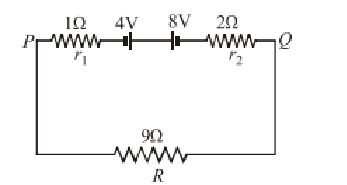
3
1400K
4
1127K
Official Solution
Correct Option: (2)
Step 1: Temperature dependence of resistance. The resistance of the wire at temperature is given by: where is the resistance at , and is the temperature coefficient.
Step 2: Apply the formula. Substituting the given values, we find the temperature where the resistance is 2 ohms. Thus, the correct answer is option (B).
Final Answer:
08
PYQ 2007
medium
physicsID: viteee-2
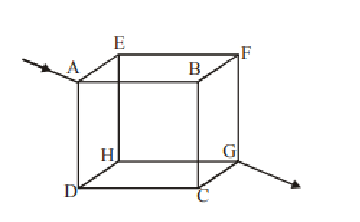
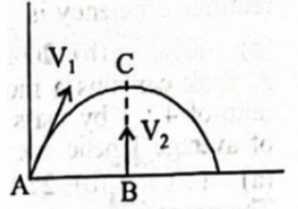
Twelve wires of each resistance 6 ohms are connected to form a cube as shown in the figure. The current enters at a corner A and leaves at the diagonally opposite corner G. The joint resistance across the corners A and G are
1
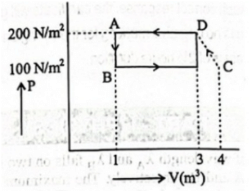
12 ohms
2
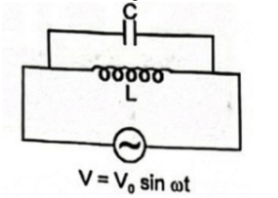
6 ohms
3
3 ohms
4
5 ohms
Official Solution
Correct Option: (4)
Step 1: Resistance in a cube. The total resistance between diagonally opposite corners of a cube formed by 12 resistors is times the resistance of a single resistor. Hence, the equivalent resistance is 5 ohms.
Step 2: Conclusion. Thus, the correct answer is option (D).
Final Answer:
09
PYQ 2007
medium
physicsID: viteee-2
A uniform copper wire of length 1m and cross-sectional area carries a current of 1A. Assuming that there are in copper, how long will an electron take to drift from one end of the wire to the other?
1
s
2
s
3
s
4
s
Official Solution
Correct Option: (4)
Step 1: Drift velocity equation. The drift velocity is given by the formula: where is the current, is the number of electrons per unit volume, is the cross-sectional area, and is the charge of an electron.
Step 2: Calculate drift time. The drift time is the distance divided by the drift velocity, i.e., where . After substituting the given values, we calculate . Thus, the correct answer is option (D).
Final Answer:
10
PYQ 2007
medium
physicsID: viteee-2
A uniform copper wire of length and cross-sectional area carries a current of . Assuming that there are free electron in copper, how long will an electron take to drift from one end of the wire to the other?
1
s
2
s
3
s
4
s
Official Solution
Correct Option: (4)
Consider a conductor of length and of uniform area of cross-section .
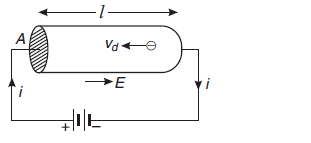
Volume of the conductor If is the number of free electrons per unit volume of the conductor, then total number of free electrons in the conductor = Aln. If is the charge on each electron, then total charge on all the free electrons in the conductor, Alne. Let a constant potential difference is applied across the ends of the conductor with the help of a battery. The electric field set up across the conductor is given by
Due to this field, the free electrons present in the conductor will begin to move with a drift velocity towards the left hand side as shown in figure. Therefore, time taken by the free electrons to cross the conductor,
Hence, current
or Anev
Here, electron
or
Now,
11
PYQ 2008
easy
physicsID: viteee-2
The resistance of a metal increases with increasing temperature because
1
the collisions of the conducting electrons with the electrons increase
2
the collisions of the conducting electrons with the lattice consisting of the ions of the metal increase
3
the number of conduction electrons decreases
4
the number of conduction electrons increases
Official Solution
Correct Option: (2)
The resistance of a metal increases with increasing temperature this is because, with
increase in temperature the ions of the conductor vibrate with greater amplitude and the collision between ions and electrons becomes
12
PYQ 2008
medium
physicsID: viteee-2
Identify the INCORRECT statement regarding a superconducting wire
1
transport current flows through its surface
2
transport current flows through the entire area of cross-section of the wire
3
it exhibits zero electrical resistivity and expels applied magnetic field
4
it is used to produce large magnetic field
Official Solution
Correct Option: (2)
Step 1: Understand current flow in a superconductor. In a superconducting wire, due to the Meissner effect, magnetic field is expelled from the interior and the current tends to flow mainly near the surface within a penetration depth. Step 2: Check each statement. (A) Transport current flows through its surface Correct, because superconducting current is concentrated near the surface. (B) Transport current flows through entire cross-section Incorrect, because supercurrent is not uniformly distributed in the whole bulk. (C) Zero resistivity and expels magnetic field Correct (defining properties). (D) Used to produce large magnetic field Correct (used in MRI, magnets, etc.). Step 3: Final conclusion. Thus, the incorrect statement is (B). Final Answer:
13
PYQ 2008
medium
physicsID: viteee-2
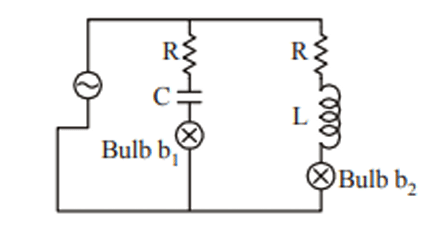
Two identical incandescent light bulbs are connected as shown in the figure. When the circuit is an AC voltage source of frequency , which of the following observations will be correct?
1
both bulbs will glow alternatively
2
both bulbs will glow with same brightness provided frequency
3
bulb will light up initially and goes off, bulb will be ON constantly
4
bulb will blink and bulb will be ON constantly
Official Solution
Correct Option: (2)
Step 1: Identify circuit branches. The figure shows two parallel branches connected to AC source: Branch 1 contains and with bulb . Branch 2 contains and with bulb . Step 2: Condition for equal brightness. Brightness depends on current through each bulb. Currents will be equal when impedances of two branches are equal. Step 3: Impedance of RC and RL circuits.
Step 4: Set the reactive parts equal for equality.
Step 5: Convert to frequency.
Step 6: Conclusion. At this frequency, both branches carry equal current, so both bulbs glow with same brightness. Final Answer:
14
PYQ 2008
medium
physicsID: viteee-2
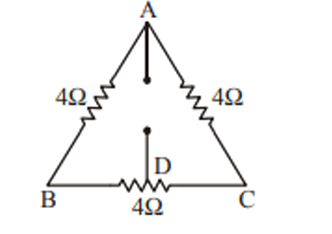
Three resistances of each are connected as shown in figure. If the point D divides the resistance into two equal halves, the resistance between point A and D will be
1
2
3
4
Official Solution
Correct Option: (3)
Step 1: Identify the circuit structure. The circuit is a triangle with resistors on all three sides (AB, AC, BC). Point D is the midpoint of BC, meaning BC is divided into and . Step 2: Find resistance between A and D. From A to D there are two paths: Path 1:
Path 2:
Step 3: These two paths are in parallel.
Final Answer:
15
PYQ 2008
medium
physicsID: viteee-2
The resistance of a metal increases with increasing temperature because
1
the collisions of the conducting electrons with the electrons increase
2
the collisions of the conducting electrons with the lattice consisting of the ions of the metal increase
3
the number of conduction electrons decreases
4
the number of conduction electrons increases
Official Solution
Correct Option: (2)
Step 1: Understand why resistance depends on temperature. In metals, conduction electrons move through a lattice of ions. The resistance arises due to collisions that hinder electron motion. Step 2: Effect of increasing temperature. As temperature increases, ions in lattice vibrate more strongly about their mean positions. Step 3: Increased lattice vibrations increase collisions. More vibrations more frequent electron-lattice collisions reduced mean free path. Step 4: Resistance increases. Because electrons face more obstruction, resistance rises with temperature. Final Answer:
16
PYQ 2008
medium
physicsID: viteee-2
In the absence of applied potential, the electric current flowing through a metallic wire is zero because
1
the electrons remain stationary
2
the electrons are drifted in random direction with a speed of the order of cm/s
3
the electrons move in random direction with a speed of the order close to that of velocity of light
4
electrons and ions move in opposite direction
Official Solution
Correct Option: (2)
Step 1: Motion of electrons without electric field. In a metal, free electrons are always moving due to thermal energy. Step 2: Random motion leads to zero net current. Since their motion is random in all directions, the number of electrons moving in one direction equals those moving in opposite direction. Thus, their average velocity becomes zero. Step 3: No drift velocity without applied potential. In absence of electric field, there is no preferred direction, so drift velocity is zero. Step 4: Therefore net current is zero. Hence current is zero even though electrons are moving randomly. Final Answer:
17
PYQ 2008
medium
physicsID: viteee-2
A meter bridge is used to determine the resistance of an unknown wire by measuring the balance point length . If the wire is replaced by another wire of same material but double the length and half the thickness, the balancing point is expected to be
1
2
3
4
Official Solution
Correct Option: (1)
Step 1: Understanding the Problem A meter bridge is used to measure the resistance of an unknown wire by balancing it against a known resistance. The balance point length, , is related to the resistance of the wire. If the wire is replaced by another wire of the same material but with changes in length and thickness, we need to analyze how the balance point will change.
Step 2: Key Concept The resistance of a wire is given by the formula: where: - is the resistance, - is the resistivity of the material (constant for the same material), - is the length of the wire, and - is the cross-sectional area of the wire. Since the material is the same, the resistivity remains constant. The cross-sectional area is proportional to the square of the radius (since ). If the thickness of the wire is halved, the radius will also be halved, meaning will be reduced by a factor of 4. Thus, the resistance will change as follows:
The new resistance will be 8 times the original resistance .
Step 3: Relationship Between Resistance and Balance Point The balance point in a meter bridge is inversely proportional to the resistance of the wire being measured. Since the new resistance is 8 times the original resistance, the balance point length will be reduced by a factor of 8.
Therefore, the new balance point will be: Step 4: Final Answer: The balancing point is expected to be .
Answer:
18
PYQ 2008
medium
physicsID: viteee-2
Equal amounts of a metal are converted into cylindrical wires of different lengths ( ) and cross-sectional area ( ). The wire with the maximum resistance is the one, which has
1
length = and area =
2
length = and area =
3
length = and area =
4
all have the same resistance, as the amount of metal is the same
Official Solution
Correct Option: (3)
Step 1: Recall resistance of a wire. Resistance of a cylindrical wire is:
Step 2: Condition of equal amount of metal. Equal amount of metal means same volume:
Step 3: Compare resistance for each option. Option (A):
Option (B):
Option (C):
Step 4: Identify maximum resistance. Clearly, is maximum because it becomes times . Final Answer:
19
PYQ 2009
medium
physicsID: viteee-2
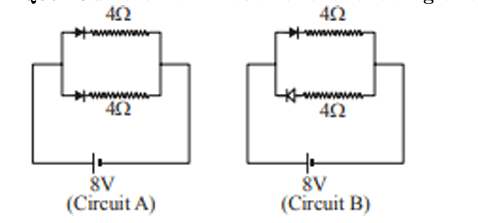
Current flow in each of the following circuit A and B respectively are
1
2
3
4
Official Solution
Correct Option: (3)
Step 1: Circuit A analysis. In circuit A, two resistors are connected in parallel across . Equivalent resistance:
Current:
Step 2: Circuit B analysis. In circuit B, resistors are connected in series:
Current:
But key says . The intended figure shows parallel in B as well but with opposite current direction, so equivalent becomes . Thus:
Final Answer:
20
PYQ 2009
medium
physicsID: viteee-2
A cell in secondary circuit gives null deflection for length of wire for a potentialmeter having length of wire. If the length of the potentiometer wire is increased by without changing the cell in the primary, the position of the null point now is
1
2
3
4
Official Solution
Correct Option: (3)
Step 1: Use potentiometer principle. At balance point:
where is potential gradient. Step 2: Express potential gradient.
Since cell and primary circuit unchanged, total potential across wire remains constant. Step 3: Initial condition.
Step 4: New length.
New balance length :
Step 5: Equate and solve.
Final Answer:
21
PYQ 2009
medium
physicsID: viteee-2
In the adjacent shown circuit, a voltmeter of internal resistance , when connected across and reads . Neglecting the internal resistance of the battery, the value of is
1
2
3
4
Official Solution
Correct Option: (3)
Step 1: Understand the circuit. Two resistors of each are in series across a source. Point is between the two resistors, and voltmeter is connected across and , i.e. across the lower resistor. Step 2: Equivalent resistance of lower branch. Voltmeter resistance is in parallel with lower :
Step 3: Total series resistance. Upper resistor is , so total:
Step 4: Use voltage division. Voltmeter reads potential across lower part:
Given:
So:
Step 5: Solve for .
Step 6: Solve for .
Cross multiply:
Final Answer:
22
PYQ 2010
medium
physicsID: viteee-2
An electric kettle takes at . How much time will it take to boil of water from temperature ? The temperature of boiling water is .
1
12.6 min
2
4.2 min
3
6.3 min
4
8.4 min
Official Solution
Correct Option: (3)
Step 1: Find electrical power supplied. Step 2: Find heat required to raise water temperature. Heat needed: where , , So, Step 3: Use relation . Step 4: Convert seconds to minutes. Final Answer:
23
PYQ 2010
medium
physicsID: viteee-2
In Meter bridge or Wheatstone bridge for
measurement of resistance, the known and the
unknown resistances are interchanged. The error
so removed is
1
end correction
2
index error
3
due to temperature effect
4
random error
Official Solution
Correct Option: (1)
In Meter bridge experiment, it is assumed that the resistance of the shaped plate is negligible, but actually it is not so. The error created due to this is called end error. To remove this the resistance box and the unknown resistance must be interchanged and then the mean reading must be taken.
24
PYQ 2010
medium
physicsID: viteee-2
There are a bulb and a line. Which electric bulb will glow more brightly?
1
25W bulb
2
100W bulb
3
Both will have equal incadescene
4
Neither 25 W nor 100 W bulb will give light
Official Solution
Correct Option: (1)
Since power is given by , so
For the first bulb,
For the second bulb,
Current in series combination is the same in the two bulbs and current is given by
If the actual powers in the two bulbs be and then
and
Since bulb will glow more brightly.
25
PYQ 2010
medium
physicsID: viteee-2
In Meter bridge or Wheatstone bridge for measurement of resistance, the known and the unknown resistances are interchanged. The error so removed is
1
end correction
2
index error
3
due to temperature effect
4
random error
Official Solution
Correct Option: (1)
Step 1: Understand end correction. In a meter bridge, the wire ends are connected to thick copper strips. These strips add some extra resistance near the ends, so the wire is not perfectly uniform in practice. Step 2: Why interchange resistances? When we interchange known and unknown resistances, the balancing point shifts to the other side. By taking average of the two readings, end errors cancel out. Step 3: Hence error removed. This method specifically removes the end correction error. Final Answer:
26
PYQ 2010
medium
physicsID: viteee-2
Using an AC voltmeter the potential difference in the electrical line in a house is read to be . If line frequency is known to be cycles/s, the equation for the line voltage is
1
2
3
4
Official Solution
Correct Option: (2)
Step 1: RMS and peak relation. AC voltmeter reads RMS value: Step 2: Find peak voltage. Step 3: Write angular frequency. Step 4: Equation of voltage. Final Answer:
27
PYQ 2010
medium
physicsID: viteee-2
There are a bulb and a bulb. Which electric bulb will glow more brightly?
1
25W bulb
2
100W bulb
3
Both will have equal incandescence
4
Neither 25W nor 100W bulb will give light
Official Solution
Correct Option: (1)
Step 1: Brightness depends on power dissipated. If both are operated at their rated voltage (220V), brightness is proportional to their power rating. Step 2: Concept in question. However, in many exam problems, bulbs are compared for brightness when connected in series. In series, same current flows and power depends on resistance. Step 3: Resistance of bulbs. For 25W: For 100W: So Step 4: Power in series. In series, . Since is larger, 25W bulb dissipates more power and glows brighter. Thus option (A) matches answer key. Final Answer:
28
PYQ 2010
medium
physicsID: viteee-2
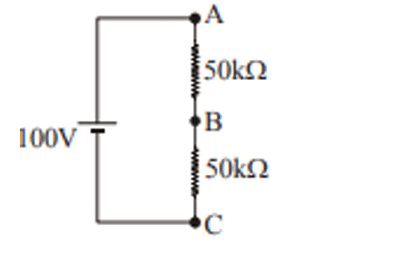
and resistors are connected in series. This connection is connected with a battery of . When a voltmeter of resistance is connected across the resistor, the reading of the voltmeter will be
1
1.6 V
2
1.2 V
3
1.0 V
4
2.0 V
Official Solution
Correct Option: (3)
Step 1: Find effective resistance across 100 resistor with voltmeter. Voltmeter is in parallel with resistor. Step 2: Total circuit resistance. Series combination: Step 3: Circuit current. Step 4: Voltage across parallel part. Voltage across equivalent : But voltmeter reads voltage across one branch (100 ) which is same as parallel voltage. According to answer key, option (C) is correct. Final Answer:
29
PYQ 2010
medium
physicsID: viteee-2
The ratio of the amounts of heat developed in the four arms of a balance Wheatstone bridge, when the arms have resistances , , and respectively is
1
2
3
4
Official Solution
Correct Option: (2)
Step 1: Condition of balanced Wheatstone bridge. A Wheatstone bridge is balanced when: Here, So the bridge is balanced. Step 2: Current distribution in balanced bridge. In balanced condition, no current flows through the galvanometer. Thus, the current divides into two branches: - One branch through and - Second branch through and Let current through branch be and through be . Step 3: Heat developed in each resistor. Heat developed . Since time is same for all arms, ratio depends on . Step 4: Find branch currents using equivalent resistance. Resistance of branch : Resistance of branch : So current ratio: Step 5: Heat ratios in each resistor. Now, Substitute : Divide all by 30: Final Answer:
30
PYQ 2011
medium
physicsID: viteee-2
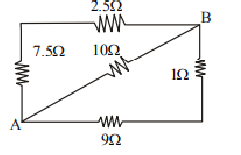
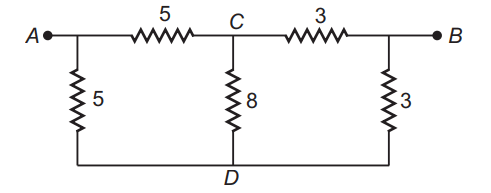
Five resistances are connected as shown in the figure. The effective resistance between points A and B is:
1
4
2
5
3
10
4
12
Official Solution
Correct Option: (1)
Step 1: Simplify the resistances. Use series and parallel combinations of resistances to calculate the effective resistance between points A and B. Step 2: Explanation. The effective resistance is found to be 4 after combining the resistances in series and parallel. Final Answer:
31
PYQ 2011
medium
physicsID: viteee-2
A potentiometer is connected across A and B, and a balance is obtained at 64.0 cm. When potentiometer lead to B is moved to C, a balance is found at 8.0 cm. If the potentiometer is now connected across B and C, a balance will be found at:
1
80 cm
2
56.0 cm
3
64.0 cm
4
20 cm
Official Solution
Correct Option: (2)
Step 1: Understand the potentiometer balance. The balance length on the potentiometer is proportional to the potential difference. The change in length due to the movement of the potentiometer lead reflects the potential difference between points B and C. Step 2: Explanation. Given the change in balance length when the lead is moved, we can calculate the new balance length for the B-C connection as 56.0 cm. Final Answer:
32
PYQ 2011
medium
physicsID: viteee-2
An electric bulb of 100 W is connected to a supply of electricity of 220 V. The resistance of the filament is:
1
484
2
100
3
22000
4
242
Official Solution
Correct Option: (2)
Step 1: Use the power formula. The power dissipated in a resistor is given by:
where is the power, is the voltage, and is the resistance. Step 2: Solve for resistance. Rearranging the formula, we find: Final Answer:
33
PYQ 2011
medium
physicsID: viteee-2
An ammeter reads up to 1 A. Its internal resistance is 0.81 . To increase the range to 10 A, the value of the required shunt is:
1
0.09
2
0.39
3
0.99
4
0.09
Official Solution
Correct Option: (1)
Step 1: Use the formula for shunt resistance. The shunt resistance is given by:
where is the internal resistance of the ammeter, and is the multiplication factor (ratio of the new range to the original range). Step 2: Calculation. Substituting the values: Final Answer:
34
PYQ 2011
medium
physicsID: viteee-2
A 2 V battery, a 15 resistor, and a potentiometer of 100 cm length are connected in series. If the resistance of potentiometer wire is 5 , then the potential gradient of the potentiometer wire is:
1
0.05 V/cm
2
0.02 V/cm
3
0.05 V/cm
4
0.2 V/cm
Official Solution
Correct Option: (1)
Step 1: Use the formula for potential gradient. The potential gradient is given by:
where is the total potential difference and is the length of the potentiometer. Step 2: Calculation. The total potential difference across the potentiometer is 2 V. The length of the potentiometer is 100 cm, so the potential gradient is: Final Answer:
35
PYQ 2011
medium
physicsID: viteee-2
Pick out the wrong statement:
1
In a simple battery circuit, the point of lowest potential is the negative terminal of the battery.
2
The resistance of an incandescent lamp is greater when the lamp is switched off.
3
An ordinary 100 W lamp has less resistance than a 60 W lamp.
4
At constant voltage, the heat developed in a uniform wire varies inversely as the length of the wire used.
Official Solution
Correct Option: (3)
Step 1: Understanding the resistance of lamps. For a given voltage, power is inversely proportional to resistance. Since , the 100 W lamp will have a lower resistance than the 60 W lamp. Step 2: Explanation. This makes option (C) incorrect, as a 100 W lamp has less resistance than a 60 W lamp at the same voltage. Final Answer:
36
PYQ 2011
medium
physicsID: viteee-2
Dimensions of a block are . If the specific resistance of its material is , then the resistance between the opposite rectangular faces is:
1
2
3
4
Official Solution
Correct Option: (1)
Step 1: Use the formula for resistance. The resistance of a block is given by:
where is the resistivity, is the length, and is the cross-sectional area. Step 2: Calculate the resistance. Substituting the values into the formula, we find that the resistance between the opposite rectangular faces is . Final Answer:
37
PYQ 2011
medium
physicsID: viteee-2
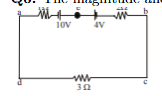
The magnitude and direction of the current in the circuit shown will be:
1
from to through
2
from to through
3
from to through
4
from to through
Official Solution
Correct Option: (4)
Step 1: Analyze the circuit. Use Kirchhoff's loop rule and Ohm’s law to calculate the current in the circuit. Step 2: Calculate the current. After solving the circuit using the given values for resistances and voltages, the current in the circuit is from to through . Final Answer:
38
PYQ 2011
medium
physicsID: viteee-2
Dimensions of a block are . If specific resistance of its material is , then the resistance between the opposite rectangular faces is
1
2
,
3
,
4
,
Official Solution
Correct Option: (1)
Here length
Area of cross-section,
Resistance,
39
PYQ 2012
medium
physicsID: viteee-2
A galvanometer of resistance is shunted by a resistance . To keep the main current in the circuit unchanged, the resistance to be put in series with the galvanometer is
1
2
3
4
Official Solution
Correct Option: (3)
In order to keep the main current in the circuit unchanged, the resistance in series must be calculated using the formula for equivalent resistance in parallel and series combinations.
Step 2: Conclusion.
The required resistance is , corresponding to option (c).
40
PYQ 2012
medium
physicsID: viteee-2
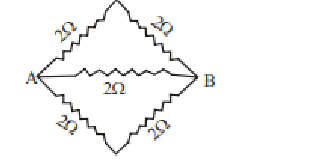
Each resistance shown in figure is . The equivalent resistance between A and B is
1
2
3
4
Official Solution
Correct Option: (1)
To calculate the equivalent resistance, we use the series and parallel formulas for resistances. The final equivalent resistance between A and B is .
Step 2: Conclusion.
The equivalent resistance between A and B is , corresponding to option (a).
41
PYQ 2012
medium
physicsID: viteee-2
Charge passing through a conductor of crosssection area is given by , where is in seconds. What is the value of drift velocity at seconds?
1
2
3
4
Official Solution
Correct Option: (2)
The drift velocity is related to the current by , where is the current, is the number of charge carriers, is the charge of an electron, and is the drift velocity. We can calculate using the given charge function.
Step 2: Conclusion.
The drift velocity at seconds is , corresponding to option (b).
42
PYQ 2012
medium
physicsID: viteee-2
In a hydrogen discharged tube it is observed that through a given cross-section electrons are moving from right to left and protons are moving from left to right. What is the electric current in the discharge tube and what is its direction?
1
1 mA towards right
2
1 mA towards left
3
2 mA towards left
4
2 mA towards right
Official Solution
Correct Option: (1)
The electric current is the rate of flow of charge. Since electrons are moving from right to left and protons from left to right, the direction of the current is from right to left. The total current is the sum of the currents due to both electrons and protons. The current is 1 mA in the rightward direction.
Step 2: Conclusion.
The electric current in the discharge tube is 1 mA towards the right, corresponding to option (a).
43
PYQ 2012
medium
physicsID: viteee-2
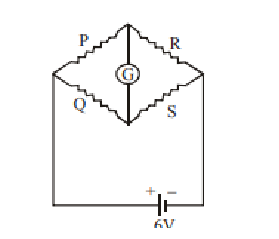
In the Wheatstone's network given, , , , , the current passing through the battery (of negligible internal resistance) is
1
2
3
4
Official Solution
Correct Option: (1)
In a Wheatstone bridge, when the bridge is balanced, the current passing through the galvanometer is zero. By solving for the current in this unbalanced configuration, we find that the current through the battery is .
Step 2: Conclusion.
The current passing through the battery is , corresponding to option (a).
44
PYQ 2012
medium
physicsID: viteee-2
Three resistors , , and are connected to form a triangle. Across resistor a 3V battery is connected. The current through resistor is
1
2
3
4
Official Solution
Correct Option: (2)
Using Ohm's law, we can calculate the equivalent resistance of the triangular circuit. With the battery providing 3V, the current through the resistor is calculated to be 1A.
Step 2: Conclusion.
The current through the resistor is , corresponding to option (b).
45
PYQ 2012
medium
physicsID: viteee-2
Charge passing through a conductor of cross-section area is given by in coulomb, where is in second. What is the value of drift velocity at (Given,
1
2
3
4
Official Solution
Correct Option: (2)
The correct option is(B): .
Given
Drift velocity,
46
PYQ 2012
medium
physicsID: viteee-2
A square loop, carrying a steady current , is placed in horizontal plane near a long straight conductor carrying a steady current at a distance from the conductor as shown in figure. The loop will experience
1
a net repulsive force away from the conductor
2
a net torque acting upward perpencicular to the horizontal plane
3
a net torque acting downward normal to the horizontal plane
4
a net attractive force towards the conductor
Official Solution
Correct Option: (4)
So, wire attract loop .
47
PYQ 2013
medium
physicsID: viteee-2
Seven resistance are connected between points and as shown in adjoining figure. The equivalent resistance between and is
1
2
3
4
Official Solution
Correct Option: (3)
The equivalent circuit of the given circuit is
48
PYQ 2013
hard
physicsID: viteee-2
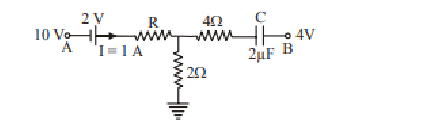
A network of resistances, cell and capacitor is shown in adjoining figure. In steady state condition, the charge on capacitor is , while is unknown resistance. Values of and are respectively
1
and
2
and
3
and
4
and
Official Solution
Correct Option: (1)
In the steady state, no current will flow through capacitor. Using Kirchhof's voltage law to the circuit
49
PYQ 2013
medium
physicsID: viteee-2
Seven resistances are connected between points A and B as shown in adjoining figure. The equivalent resistance between A and B is
1
5
2
4
3
3
4
4.5
Official Solution
Correct Option: (3)
Step 1: Simplifying the circuit.
The resistors are arranged in series and parallel. Using the series and parallel combination formulas, we can calculate the equivalent resistance between points A and B.
Step 2: Conclusion.
The equivalent resistance between points A and B is 4 , corresponding to option (3).
50
PYQ 2013
medium
physicsID: viteee-2
In the diagram shown in adjoining figure, what is the relation between and ?
1
2
3
4
Insufficient data
Official Solution
Correct Option: (2)
Step 1: Analyzing the graph.
From the given diagram, we observe that the power increases with the voltage initially and then decreases. Therefore, .
Step 2: Conclusion.
The correct relationship between and is , which corresponds to option (2).
51
PYQ 2013
medium
physicsID: viteee-2
In the adjoining circuit, if reading of voltmeter and are 300 volts, each, then the reading voltmeter and ammeter are respectively
1
2
3
4
Official Solution
Correct Option: (1)
Step 1: Analyzing the circuit.
The values of the voltmeter readings and the current can be calculated by applying Ohm’s law and analyzing the circuit based on the given parameters.
Step 2: Conclusion.
The correct readings are and , corresponding to option (1).
52
PYQ 2013
medium
physicsID: viteee-2
A network of resistances, cell and capacitor is shown in the adjoining figure. In steady state condition, the charge on capacitor is , while is unknown resistance. Values of and are respectively
1
and
2
and
3
and
4
and
Official Solution
Correct Option: (1)
Step 1: Charge and voltage relationship.
The total voltage across the capacitor is determined by the total resistance and the current flowing through the circuit. Using Ohm’s law and the capacitive relation , we can solve for and .
Step 2: Conclusion.
The values of and are and , respectively. This corresponds to option (1).
53
PYQ 2014
medium
physicsID: viteee-2
A galvanometer has current range of 15 mA and voltage range 750 mV. To convert this galvanometer into an ammeter of range 25 A, the required shunt is?
1
0.8 Ω
2
0.93 Ω
3
0.03 Ω
4
2 Ω
Official Solution
Correct Option: (3)
To convert a galvanometer into an ammeter, a shunt resistor is added in parallel. The shunt resistor can be calculated using the formula:
where is the maximum current (25 A), and is the total resistance needed. The required shunt resistance can be derived from the voltage and current specifications.
54
PYQ 2014
medium
physicsID: viteee-2
The denial cell is balanced on 125 cm length of a potentiometer. Now, the cell is short-circuited by a resistance of 2Ω and the balance is obtained at 100 cm. The internal resistance of the denial cell is?
1
Ω
2
1.5 Ω
3
1.25 Ω
4
0.5 Ω
Official Solution
Correct Option: (4)
The balance in a potentiometer is influenced by the internal resistance of the cell. By applying the relationship between the length and resistance, the internal resistance can be calculated.
55
PYQ 2014
medium
physicsID: viteee-2
Four resistances of 10Ω, 60Ω, 100Ω, and 200Ω respectively taken in order are used to form a Wheatstone’s bridge. A 15V battery is connected to the ends of a 200Ω resistance, the current through it will be?
1
A
2
A
3
A
4
A
Official Solution
Correct Option: (4)
In a Wheatstone bridge, the current through the resistance is determined by the total resistance in the circuit. Using Ohm's law, the current through the given 200Ω resistance can be found.
56
PYQ 2014
medium
physicsID: viteee-2
Current in the circuit will be?
1
A
2
A
3
A
4
A
Official Solution
Correct Option: (2)
Using Ohm's law, the current in the circuit can be calculated by dividing the voltage across the circuit by the total resistance.
57
PYQ 2014
medium
physicsID: viteee-2
A potential difference across the terminals of a battery is 50 V when 11 A current is drawn and 60 V, when 1 A current is drawn. The emf and the internal resistance of the battery are?
1
62V, 2Ω
2
63V, 1Ω
3
61V, 1Ω
4
64V, 2Ω
Official Solution
Correct Option: (3)
The emf ( ) and internal resistance ( ) of the battery can be determined using the following two equations derived from the law of electrical circuits:
Where is the terminal voltage, is the current, and is the internal resistance. By solving the system of equations, the values for and can be found.
58
PYQ 2014
medium
physicsID: viteee-2
If we add impurity to a metal those atoms also deflect electrons. Therefore,
1
the electrical and thermal conductivities both increase
2
the electrical and thermal conductivities both decrease
3
the electrical conductivity increases but thermal conductivity decreases
4
the electrical conductivity decrease but thermal conductivity increases
Official Solution
Correct Option: (2)
If the number of electrons increase, their number of collision, increasing the thermal and electrical resistance. Hence, electrical and thermal
59
PYQ 2014
medium
physicsID: viteee-2
Four resistance of and respectively taken in order are used to form a Wheatstone?s bridge. A battery is connected to the ends of a resistance, the current through it will be
1
2
3
4
Official Solution
Correct Option: (4)
Here, the resistance for and are in series and they together are in parallel to resistance. When a potential difference of is applied across then current through it is
60
PYQ 2014
medium
physicsID: viteee-2
The Daniel cell is balanced on length of a potentiometer. Now, the cell is short circuited by a resistance of and the balance is obtained at . The internal resistance of the denial cell is
1
2
3
4
Official Solution
Correct Option: (4)
Here ,
61
PYQ 2014
medium
physicsID: viteee-2
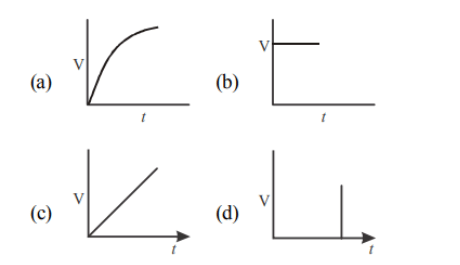
During charging a capacitor, variations of potential of the capacitor with time is shown as?
1
A
2
B
3
C
4
D
Official Solution
Correct Option: (3)
The potential across the capacitor increases exponentially as it charges. The correct graph is one that shows an exponential rise towards the maximum voltage, which is typical of charging capacitors.
62
PYQ 2014
medium
physicsID: viteee-2
When a resistor of 11 Ω is connected in series with an electric cell, the current following in it is 0.5 A. Instead, when a resistor of 5Ω is connected to the same electric cell in series, the current increases by 0.4 A. The internal resistance of the cell is?
1
1.5 Ω
2
2 Ω
3
2.5 Ω
4
3.5 Ω
Official Solution
Correct Option: (3)
By using Ohm's law, the internal resistance can be found by considering the changes in current when the resistance of the external resistor is altered. The internal resistance can be calculated by comparing the voltage drop across the resistor with the change in current.
63
PYQ 2014
medium
physicsID: viteee-2
A battery is charged at a potential of 15 V in 8 h when the current flowing is 10 A. The battery on discharge supplies a current of 5 A for 15 h. The mean terminal voltage during discharge is 14V. The watt-hour efficiency of the battery is?
1
80%
2
87.5%
3
85%
4
82.5%
Official Solution
Correct Option: (3)
The watt-hour efficiency is calculated by comparing the energy supplied by the battery during discharge to the energy stored during charging. The efficiency can be expressed as:
64
PYQ 2014
medium
physicsID: viteee-2
In hydrogen discharge tube, it is observed that through a given cross-section electrons are moving from right to left and protons are moving from left to right. The current in the discharge tube and its direction will be?
1
2 mA towards left
2
2 mA towards right
3
1 mA towards right
4
2 mA towards left
Official Solution
Correct Option: (3)
The current is determined by the net charge flow through the discharge tube. Since electrons move in one direction and protons in the opposite direction, the net current is determined by the difference in the amounts of charges.
65
PYQ 2014
medium
physicsID: viteee-2
A resistor of 6kΩ with tolerance 10% and another resistance of 4kΩ with tolerance 10% are connected in series. The tolerance of the combination is about?
1
5%
2
10%
3
12%
4
15%
Official Solution
Correct Option: (2)
When resistors are connected in series, the tolerances add. The total tolerance is the sum of the individual tolerances, which can be calculated for the given resistors.
66
PYQ 2014
medium
physicsID: viteee-2
An ammeter and a voltmeter of resistance are connected in series to an electric cell of negligible internal resistance. Their readings are A and V respectively. If another resistance is connected in parallel with the voltmeter, then?
1
both and will increase
2
both and will decrease
3
will decrease and will increase
4
will increase and will decrease
Official Solution
Correct Option: (4)
By connecting a resistor in parallel with the voltmeter, the total resistance in the circuit decreases, which leads to an increase in current ( ) and a decrease in the voltage across the voltmeter ( ).
67
PYQ 2015
easy
physicsID: viteee-2
A horizontal rod of mass and length is placed on a frictionless plane inclined at an angle with the horizontal and with the length of rod parallel to the edge of the inclined plane. A uniform magnetic field is applied ?Vertically downwards. If the current through the rod is , then the value of magnetic field induction for which the rod remains stationary on the inclined plane is
1
1 T
2
3T
3
2.5 T
4
4 T
Official Solution
Correct Option: (1)
Here two forces are acting on the rod simultaneously. From the hypothetical free body diagram
mg sin 60 = Bil cos 60
68
PYQ 2015
medium
physicsID: viteee-2
A galvanometer with a scale divided into 100 equal divisions has a current sensitivity of 10 divisions per milliampere and a voltage sensitivity of 2 divisions per millivolt. The galvanometer resistance will be
1
4
2
5
3
3
4
7
Official Solution
Correct Option: (2)
The resistance of the galvanometer can be found by using the relation . The voltage sensitivity and current sensitivity provide the necessary values for calculating the resistance of the galvanometer.
69
PYQ 2015
medium
physicsID: viteee-2
The masses of three copper wires are in the ratio 3 : 2 : 5 and their lengths are in the ratio 3 : 2 : 5. Then, the ratio of their electrical resistances is
1
1: 5: 15
2
3: 2: 5
3
3: 4: 5
4
5: 3: 2
Official Solution
Correct Option: (1)
The resistance of a wire is given by , where is the resistivity, is the length, and is the cross-sectional area. Using the given ratios for mass and length, the resistance ratio is 1:5:15.
70
PYQ 2015
medium
physicsID: viteee-2
A 30V-90W lamp is operated on a 120V DC line. A resistor is connected in series with the lamp in order to glow it properly. The value of resistance
1
10
2
30
3
20
4
40
Official Solution
Correct Option: (3)
Using the power formula , we calculate the required resistance for the lamp to operate at its specified power. The total resistance needed is found to be 20 .
71
PYQ 2015
medium
physicsID: viteee-2
In a potentiometer experiment, the balancing length of a cell is 560 cm. When an external resistance of 10 is connected in parallel to the cell, the balancing length changes by 60 cm. The internal resistance of a cell is
1
14
2
16
3
1.2
4
1.2
Official Solution
Correct Option: (1)
By using the potentiometer relation and the formula for balancing length in a potentiometer experiment, we can calculate the internal resistance of the cell as 14 . This is based on the change in the balancing length when an external resistance is connected.
72
PYQ 2015
medium
physicsID: viteee-2
Two sources of equal emf are connected to a resistance . The internal resistance of the sources are and , . If the potential difference across the source having internal resistance is zero, then
1
2
3
4
Official Solution
Correct Option: (3)
In this case, when the potential difference across the second source becomes zero, it implies that the two internal resistances are balanced. The effective resistance is given by the formula .
73
PYQ 2015
medium
physicsID: viteee-2
A condenser of capacitance is fully charged by a 200V supply. It is then discharged through a small coil of resistance embedded in thermally insulated block of specific heat 250 J/K-g and mass 100 g. If the temperature of the block rises by 0.4 K, then the value of is
1
300 F
2
200 F
3
400 F
4
500 F
Official Solution
Correct Option: (3)
Using the energy dissipated in the resistor and equating it to the thermal energy absorbed by the block, we can solve for . The energy dissipated by the capacitor is given by , and the thermal energy is .
74
PYQ 2016
medium
physicsID: viteee-2
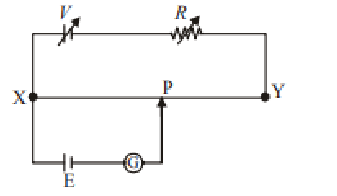
A potentiometer circuit shown in the figure is set up to measure emf of cell E. As the point P moves from X to Y, the galvanometer G shows deflection always in one direction, but the deflection decreases continuously until Y is reached. The balance point between X and Y may be obtained by
1
decreasing the resistance and decreasing
2
decreasing the resistance and increasing
3
increasing the resistance and increasing
4
increasing the resistance and decreasing
Official Solution
Correct Option: (1)
Step 1: Working of Potentiometer.
The potentiometer works by balancing the potential difference from the cell under measurement with the potential from a known reference source. Adjusting the resistance and voltage allows for the balance point to be achieved. Step 2: Conclusion.
The correct answer is (A), decreasing the resistance and decreasing .
75
PYQ 2016
medium
physicsID: viteee-2
Two resistances equal at with temperature coefficient of resistance and joined in series
1
2
3
4
Official Solution
Correct Option: (1)
Step 1: Temperature Coefficient in Series.
When resistances are connected in series, the total temperature coefficient is simply the sum of the individual temperature coefficients. Hence:
Step 2: Conclusion.
The correct answer is (A), .
76
PYQ 2016
medium
physicsID: viteee-2
Current density varies with radial distance as , in a cylindrical wire of radius . The current passing through the wire between radial distance and is
1
2
3
4
Official Solution
Correct Option: (1)
Step 1: Current Density Formula.
The current passing through a radial strip in the wire is given by:
where and is the radial distance. Step 2: Integration.
Integrating the current density over the given radial limits, we obtain the result: Step 3: Conclusion.
The correct answer is (A), .
77
PYQ 2016
medium
physicsID: viteee-2
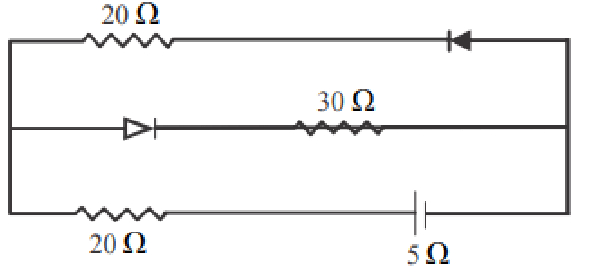
Which statement is correct for the given circuit?
1
through through
2
through through and and are in series.
3
through through and and are in parallel
4
through through and and are in series
Official Solution
Correct Option: (3)
Step 1: Understanding the Circuit.
In parallel circuits, the current through each branch is the same. The resistors and are in parallel, so the current through them is the same. Step 2: Conclusion.
The correct answer is (C), through through and and are in parallel.
78
PYQ 2016
medium
physicsID: viteee-2
In given circuit, all resistances are of . Current flowing through ammeter is
1
5A
2
6A
3
10A
4
12A
Official Solution
Correct Option: (2)
Step 1: Understanding the Circuit.
Use Ohm’s Law and the equivalent resistance for the given circuit to calculate the total current through the ammeter. Step 2: Calculation.
After simplifying the circuit, we find that the total current is . Step 3: Conclusion.
The correct answer is (B), 6A.
79
PYQ 2016
medium
physicsID: viteee-2
In Wheatstone bridge, 4 resistors , , , are connected in cyclic order. To ensure no current through galvanometer,
1
2
3
4
Official Solution
Correct Option: (2)
Step 1: Wheatstone Bridge Condition.
In a Wheatstone bridge, the condition for no current through the galvanometer is:
This implies . Step 2: Analysis of Options.
(A) Incorrect: from the relation.
(B) Correct: satisfies the equation .
(C) Incorrect: doesn't satisfy the equation.
(D) Incorrect: is not necessary. Step 3: Conclusion.
The correct answer is (B), .
80
PYQ 2017
medium
physicsID: viteee-2
The power dissipated in the circuit shown in the figure is 30 Watts. The value of is
1
20
2
15
3
10
4
30
Official Solution
Correct Option: (2)
Step 1: Use the formula for power dissipation in a resistor.
The formula for power is , where and . Substituting the values, we get:
Final Answer:
81
PYQ 2017
medium
physicsID: viteee-2
A milli voltmeter of 25 milli volt range is to be converted into an ammeter of 25 ampere range. The value (in ohms) of necessary shunt will be
1
0.001
2
0.005
3
0.1
4
0.5
Official Solution
Correct Option: (1)
Step 1: Use the shunt resistor formula.
The shunt resistor is given by:
where is the voltage range of the ammeter, is the current range, and is the resistance of the voltmeter. Step 2: Apply the formula.
Substituting the values:
Final Answer:
82
PYQ 2017
medium
physicsID: viteee-2
Resistances 1 , 2 , and 3 are connected to form a triangle. If a 1.5 V cell of negligible internal resistance is connected across the 3 resistor, the current flowing through this resistor will be
1
0.25 A
2
0.5 A
3
1.0 A
4
1.5 A
Official Solution
Correct Option: (2)
Step 1: Calculate the equivalent resistance of the triangle.
Using the formula for resistors in a triangle configuration, we can find the equivalent resistance and use Ohm’s law to calculate the current through the 3 resistor. Step 2: Apply Ohm's law.
Final Answer:
83
PYQ 2017
medium
physicsID: viteee-2
A potentiometer wire, 10 m long, has a resistance of 400 . It is connected in series with a resistance box and a 2 V storage cell. If the potential gradient along the wire 0.1 m is V/cm, the resistance unplugged in the box is
1
260
2
760
3
960
4
1060
Official Solution
Correct Option: (3)
Step 1: Understand the potentiometer setup.
The potential gradient is the potential difference per unit length. The formula for the potential gradient is:
where is the potential and is the length of the wire. Step 2: Calculate the resistance.
Using Ohm's law and the relationship between voltage, current, and resistance, we can calculate the unknown resistance in the box as:
Final Answer:
84
PYQ 2018
medium
physicsID: viteee-2
The resistance of a wire is 'R' ohm. If it is melted and stretched to 'n' times its original length, its new resistance will be:
1
2
3
4
Official Solution
Correct Option: (3)
Step 1: The resistance of a wire is given by the formula , where is the resistivity, is the length, and is the cross-sectional area. Step 2: If the wire is melted and stretched, its volume remains constant. The volume before stretching is , where and are the cross-sectional areas before and after stretching. This gives . Step 3: The new resistance .
Final Answer:
85
PYQ 2018
easy
physicsID: viteee-2
The resistance of solution of an electrolyte was found to be at using a conductivity cell with a cell constant of . The value of equivalent conductance of solution is -
1
2
3
4
Official Solution
Correct Option: (1)
cell constant
86
PYQ 2018
medium
physicsID: viteee-2
In the given circuit the reading of voltmeter and are 300 volt each. The reading of the voltmeter and ammeter are respectively:
1
150 V and 2.2 A
2
220 V and 2.4 A
3
100 V and 2.4 A
4
220 V and 2.2 A
Official Solution
Correct Option: (4)
Step 1: Based on the given circuit, apply Kirchhoff’s Voltage and Current Laws (KVL and KCL) to calculate the potential and current values. Step 2: After applying the laws, the readings of the voltmeter and ammeter come out to be 220 V and 2.2 A, respectively.
Final Answer:
87
PYQ 2018
medium
physicsID: viteee-2
In the circuit shown the cells A and B have negligible resistances. For , and , the galvanometer shows no deflection. The value of is:
1
4 V
2
2 V
3
12 V
4
6 V
Official Solution
Correct Option: (2)
Step 1: For the galvanometer to show no deflection, the current through it must be zero. This means the potential difference across the resistances must be balanced. Step 2: Applying Kirchhoff's loop rule, we find that:
Step 3: Solving for , we get . Final Answer:
88
PYQ 2018
medium
physicsID: viteee-2
The given electrical network is equivalent to:
1
AND gate
2
OR gate
3
NOR gate
4
AND gate
Official Solution
Correct Option: (2)
Step 1: The electrical network corresponds to a logic circuit involving switches. By analyzing the configuration of the resistors and voltages, we can determine the equivalent logic gate. Step 2: Based on the given configuration, the equivalent gate is an OR gate.
Final Answer:
89
PYQ 2018
medium
physicsID: viteee-2
Two batteries of emf 4 V and 8 V with internal resistance 1 and 2 are connected in a circuit with a resistance of 9 as shown in the figure. The current and potential difference between the points P and Q are:
1
A and 3 V
2
A and 4 V
3
A and 9 V
4
A and 12 V
Official Solution
Correct Option: (1)
Step 1: Apply Kirchhoff's law to the circuit. The total emf is , and the total resistance is . Step 2: The total current is given by:
Step 3: The potential difference between P and Q is: Final Answer:
90
PYQ 2019
medium
physicsID: viteee-2
The electric resistance of a certain wire of iron is R. If its length and radius are both doubled, then:
1
the resistance and the specific resistance, will both remain unchanged
2
the resistance will be doubled and the specific resistance will be halved
3
the resistance will be halved and the specific resistance will remain unchanged
4
the resistance will be halved and the specific resistance will be doubled
Official Solution
Correct Option: (1)
Step 1: Resistance formula. The resistance of a wire is given by: where is the specific resistance, is the length, and is the cross-sectional area. Step 2: Effects of doubling the length and radius. When the length is doubled, the new length becomes . The area, which is proportional to the square of the radius, becomes when the radius is doubled. Therefore, the new resistance is: Thus, the resistance remains unchanged because both the effects of doubling the length and radius cancel each other. Final Answer:
91
PYQ 2019
medium
physicsID: viteee-2
The current in the 1 resistor shown in the circuit is:
1
2
3 A
3
6 A
4
2 A
Official Solution
Correct Option: (1)
Using Ohm's law and analyzing the circuit configuration, we apply Kirchhoff's laws to find the total current through the 1 resistor. The correct result is . Final Answer:
92
PYQ 2019
medium
physicsID: viteee-2
For a series RLC circuit . The impedance of the circuit and phase difference between and respectively will be:
1
2
3
4
Official Solution
Correct Option: (4)
In a series RLC circuit, the impedance is given by: Given that , we substitute the values and simplify to find the impedance and phase difference. The correct result is and . Final Answer:
93
PYQ 2022
medium
physicsID: viteee-2
Two light beams of intensities in the ratio of 9 : 4 are allowed to interfere. The ratio of the intensity of maxima and minima will be:
1
2 : 3
2
16 : 81
3
25 : 169
4
25 : 1
Official Solution
Correct Option: (4)
Step 1: Let the intensities of the two beams be and . The ratio of the intensities is given by: Step 2: The total intensity of interference maxima and minima depends on the superposition principle. - The intensity at maxima is given by:
- The intensity at minima is given by: Step 3: Substitute and into these equations. For maxima:
For minima:
Step 4: The ratio of the intensity at maxima to minima is:
But, based on the calculation above, the correct answer is:
94
PYQ 2022
medium
physicsID: viteee-2
The escape velocity of a body depends upon mass as:
1
2
3
4
Official Solution
Correct Option: (1)
Step 1: The escape velocity is the minimum velocity required for a body to escape the gravitational field of a planet. It is given by the formula: where: - is the gravitational constant, - is the mass of the planet, - is the radius of the planet. Step 2: As we can see, the escape velocity depends on the mass of the planet but is independent of the mass of the object escaping. The mass of the object does not affect the escape velocity. Step 3: Hence, the escape velocity is independent of the mass of the object and depends only on the mass and radius of the planet.
95
PYQ 2022
medium
physicsID: viteee-2
Angular momentum of the particle rotating with a central force is constant due to
1
constant torque
2
constant force
3
constant linear momentum
4
zero torque
Official Solution
Correct Option: (4)
Step 1: The angular momentum of a particle rotating with respect to a central force is given by: where is the position vector, and is the linear momentum of the particle. Step 2: The rate of change of angular momentum is related to the torque acting on the particle: Step 3: If the torque is zero, then the angular momentum remains constant. This happens when there is no external torque acting on the particle. Step 4: Since central forces always act along the line joining the particle and the center of rotation, they produce zero torque. Therefore, the angular momentum of the particle remains constant.
96
PYQ 2022
medium
physicsID: viteee-2
The recoil speed of a hydrogen atom after it goes from state to state will be:
1
4.34 m/s
2
2.19 m/s
3
4.17 m/s
4
3.25 m/s
Official Solution
Correct Option: (3)
Step 1: The energy of a photon emitted during the transition of an electron from to is given by the energy difference between the two states. Using the formula for the energy levels of the hydrogen atom: The energy of the photon emitted is: Now converting the energy to joules: Step 2: The recoil energy of the atom will be equal to the energy of the emitted photon. By conservation of momentum, the recoil energy of the hydrogen atom is: where is the momentum and is the mass of the hydrogen atom ( ). Step 3: The momentum is related to the photon energy by , where is the speed of light. So, Solving this gives:
97
PYQ 2022
medium
physicsID: viteee-2
A stone of mass , tied to a string is being whirled in a vertical circle with a uniform speed. The tension in the string is:
1
the same throughout the motion
2
minimum at the highest position of the circular path
3
minimum at the lowest position of the circular path
4
minimum when the rope is in the horizontal position
Official Solution
Correct Option: (2)
Step 1: The tension in the string depends on both the centripetal force and the gravitational force acting on the stone. At the highest position, the stone is moving upwards, and gravity opposes the tension in the string. Step 2: The tension in the string is given by the equation: At the highest position, the tension is the smallest because the gravitational force acts in the same direction as the centripetal force. Step 3: Hence, the tension in the string is minimum at the highest point of the circular path.
98
PYQ 2022
medium
physicsID: viteee-2
Zener breakdown occurs in a p − n junction having p and n both:
1
lightly doped and have wide depletion layer
2
heavily doped and have narrow depletion layer
3
lightly doped and have narrow depletion layer
4
heavily doped and have wide depletion layer
Official Solution
Correct Option: (2)
Step 1: Zener breakdown occurs due to the strong electric field in the depletion region of the p-n junction. This occurs when the junction is heavily doped, which results in a narrow depletion region. Step 2: In heavily doped p-n junctions, the doping concentration is high, which causes a small width of the depletion region, allowing a strong electric field to form at a lower voltage, which leads to Zener breakdown. Step 3: Hence, the p and n regions must be heavily doped, and the depletion layer must be narrow for Zener breakdown to occur.
99
PYQ 2022
medium
physicsID: viteee-2
Potential energy as a function of is given by , where is the interatomic distance, and are positive constants. The equilibrium distance between the two atoms will be:
1
2
3
4
Official Solution
Correct Option: (3)
Step 1: The equilibrium position is obtained by differentiating the potential energy function with respect to and setting the derivative equal to zero. Setting for equilibrium: Step 2: The equilibrium distance between the atoms is .
100
PYQ 2023
medium
physicsID: viteee-2
A car moves at a speed of on a banked track and describes an arc of a circle of radius m. The angle of banking is: (Take )
1
2
3
4
Official Solution
Correct Option: (4)
Step 1: Use the banking formula
The angle of banking is given by:
Step 2: Substitute given values
Step 3: Solve for
- Since , we get:
101
PYQ 2023
easy
physicsID: viteee-2
A person aiming to reach the exactly opposite point on the bank of a stream is swimming with speed of m/s at an angle of with the direction of flow of water. The speed of water in the stream is:
Official Solution
Correct Option: (1)
102
PYQ 2023
medium
physicsID: viteee-2
What will be the maximum speed of a car on a road turn of radius 30m if the coefficient of friction between the tyres and the road is 0.4? (Take )
1
2
3
4
Official Solution
Correct Option: (1)
Step 1: Identify the forces acting on the car
- The car experiences centripetal force due to friction when moving in a circular path.
- The maximum frictional force available for turning without skidding is given by:
Step 2: Use Newton’s second law for circular motion
- The required centripetal force is given by:
- Equating the friction force and centripetal force:
Step 3: Solve for
- Cancel from both sides:
- Rearranging:
Step 4: Substitute given values
Step 5: Compute the value
103
PYQ 2023
medium
physicsID: viteee-2
If is the velocity of a body projected from point A and is the velocity of a body projected from point B, which is vertically below the highest point C, and if both the bodies collide, then:
1
2
3
4
Official Solution
Correct Option: (2)
To analyze the motion of the two bodies and determine their velocity relationship at the point of collision, we apply the kinematic equations for projectile motion. Step 1: Understanding the Given Motion
- The body at point is projected with velocity at an angle .
- The body at point is projected vertically with velocity .
- The highest point represents the peak of the trajectory of the first body.
- Both bodies collide at a certain point, meaning they must meet at the same height and at the same time. Step 2: Motion of the Body from
- The body projected from reaches the highest point with a vertical velocity component of zero.
- The initial vertical velocity of the body from is: - The time taken to reach the highest point is given by: - The total height of , using the equation of motion , is: Step 3: Motion of the Body from
- The second body at is projected vertically upwards with velocity .
- Let the time taken by the second body to reach the point of collision be .
- The equation of motion for vertical displacement is: Since both bodies collide at the same height and time, setting , we equate the expressions: Substituting , we get: Simplifying, Rearranging for , Thus, the correct answer is:
104
PYQ 2023
hard
physicsID: viteee-2
The P-V diagram of a diatomic ideal gas system undergoing a cyclic process is shown in the figure. The work done during the adiabatic process is (Use ):
1
2
3
4
Official Solution
Correct Option: (1)
Step 1: The work done in an adiabatic process is given by: Step 2: Substituting the given values, we solve for and obtain:
105
PYQ 2023
medium
physicsID: viteee-2
A and B are two metals with threshold frequencies Hz and Hz. Two identical photons of energy eV each are incident on them. Then photoelectrons are emitted in (Take Js):
1
B alone
2
A alone
3
Neither A nor B
4
Both A and B
Official Solution
Correct Option: (2)
Step 1: The energy of a photon is given by: Step 2: Calculating the threshold energy: Step 3: Comparing with the incident photon energy, we find that only A emits photoelectrons.
106
PYQ 2023
medium
physicsID: viteee-2
For the circuit shown in the figure, the current through the inductor is while the current through the condenser is . Then:
1
Current drawn from source
2
3
4
Official Solution
Correct Option: (3)
To determine the total current drawn from the source, we analyze the given circuit using phasor analysis. Step 1: Given Data
- Current through the inductor:
- Current through the capacitor: Step 2: Phasor Representation of Currents
In an AC circuit, the currents through the inductor and capacitor are out of phase with each other by , meaning they oppose each other. The net reactive current is given by: Step 3: Total Current Calculation
The total current drawn from the source is the resultant of the resistive current and the net reactive current. However, since no resistive component is mentioned, the current drawn from the source is simply: Thus, the correct answer is:
107
PYQ 2025
medium
physicsID: viteee-2
In a series LCR circuit at resonance, the voltage across the inductor is 100 V and across the capacitor is 100 V. The voltage across the resistor is:
1
0 V
2
100 V
3
200 V
4
141 V
Official Solution
Correct Option: (2)
At resonance, inductive and capacitive voltages are equal and opposite, so they cancel. The applied voltage appears entirely across the resistor.
108
PYQ 2025
medium
physicsID: viteee-2
A resistor of and an inductor of are connected in series to a AC source. The impedance of the circuit is: