The neutrino has mass and neutron fall under the group of:
1
Mesons
2
Photons
3
Leptons
4
Baryons
Official Solution
Correct Option:
(3)
Step 1: Classifying particles. Neutrinos and neutrons are classified as leptons. Leptons are elementary particles that do not participate in strong interactions, and neutrinos are a type of lepton. Step 2: Conclusion. Thus, both neutrinos and neutrons belong to the lepton family.
02
PYQ 2006
medium
physicsID: viteee-2
The velocity, , at which the mass of a particle is double its rest mass is:
1
2
3
4
Official Solution
Correct Option:
(2)
Step 1: Relativistic mass-energy relationship. The relativistic mass of a particle is related to its velocity by the formula: Where is the rest mass, is the velocity, and is the speed of light. Step 2: Conclusion. For , solving the equation gives .
03
PYQ 2006
medium
physicsID: viteee-2
How much energy is produced, if 2 kg of a substance is fully converted into energy?
1
J
2
J
3
J
4
J
Official Solution
Correct Option:
(4)
Step 1: Use the energy-mass equivalence relation. The energy produced by converting a mass into energy is given by Einstein’s equation: Where and . Step 2: Substitute the values:
04
PYQ 2006
medium
physicsID: viteee-2
The difference between the rest mass of the nucleus and the sum of the masses of the nucleons composing a nucleus is known as:
1
Binding energy
2
Mass defect
3
Nuclear energy
4
Isotopic mass
Official Solution
Correct Option:
(2)
Step 1: Understanding mass defect. The mass defect is the difference between the total mass of the separate nucleons and the actual mass of the nucleus. It represents the energy required to separate the nucleus into individual nucleons. Step 2: Conclusion. Thus, the difference is known as the mass defect.
05
PYQ 2006
medium
physicsID: viteee-2
The half-life period of Radium is 3 minutes. Its decay constant is:
1
2
3
4
Official Solution
Correct Option:
(2)
Step 1: Use the relation between half-life and decay constant. The half-life is related to the decay constant by: Substituting , we find:
06
PYQ 2006
medium
physicsID: viteee-2
'Pair production' involves conversion of a photon into:
1
A neutron-electron pair
2
A positron-electron pair
3
A neutron-proton pair
4
A proton-electron pair
Official Solution
Correct Option:
(2)
Step 1: Understand pair production. Pair production is the process where a photon with energy greater than 1.022 MeV is converted into an electron-positron pair. Step 2: Conclusion. Thus, pair production involves the creation of a positron-electron pair.
07
PYQ 2007
medium
physicsID: viteee-2
The radius of nucleus is
1
proportional to its mass number
2
inversely proportional to its mass number
3
proportional to the cube root of its mass number
4
not related to its mass number
Official Solution
Correct Option:
(3)
Step 1: Nuclear Radius Formula. The radius of a nucleus is given by , where is the mass number. Hence, the radius is proportional to the cube root of the mass number.
Step 2: Conclusion. Therefore, the correct answer is option (C).
Final Answer:
08
PYQ 2007
medium
physicsID: viteee-2
Radio carbon dating is done by estimating in specimen
1
the amount of ordinary carbon still present
2
the amount of radio carbon still present
3
the amount of to still present
4
the ratio of amount of to still present
Official Solution
Correct Option:
(3)
Step 1: Principle of Radio Carbon Dating. Radio carbon dating estimates the age of a specimen by measuring the amount of present relative to . The decay of allows for the determination of the age of ancient specimens.
Step 2: Conclusion. Thus, the correct answer is option (C).
Final Answer:
09
PYQ 2007
medium
physicsID: viteee-2
Ionization power and penetration range of radioactive radiation increases in the order
1
and respectively
2
and respectively
3
and respectively
4
and respectively
Official Solution
Correct Option:
(2)
Step 1: Understanding the properties of radiation. Gamma rays have the highest penetration range and lowest ionization power, while alpha particles have the highest ionization power but the lowest penetration range.
Step 2: Conclusion. Therefore, the correct order is for penetration and for ionization. Hence, the correct answer is option (B).
Final Answer:
10
PYQ 2007
medium
physicsID: viteee-2
The half-life of a radioactive element is 3.8 days. The fraction left after 19 days will be
1
0.124
2
0.062
3
0.093
4
0.031
Official Solution
Correct Option:
(4)
Step 1: Formula for half-life decay. The fraction of a substance remaining after half-lives is given by . The number of half-lives in 19 days is . Therefore, the remaining fraction is: Step 2: Conclusion. Thus, the correct answer is option (D).
Final Answer:
11
PYQ 2008
medium
physicsID: viteee-2
U has 92 protons and 234 nucleons total in its nucleus. It decays by emitting an alpha particle. After the decay it becomes
1
U
2
Pa
3
Th
4
Ra
Official Solution
Correct Option:
(3)
Step 1: Recall alpha decay rule. In alpha decay, nucleus emits particle . So: Mass number decreases by 4 and atomic number decreases by 2. Step 2: Apply to . After emission:
Step 3: Identify element with atomic number 90. Atomic number 90 corresponds to Thorium (Th). Step 4: Write final nucleus.
Final Answer:
12
PYQ 2008
medium
physicsID: viteee-2
A certain radioactive material starts emitting and particles successively such that the end product is A. The number of and particles emitted are respectively
1
4 and 3 respectively
2
2 and 1 respectively
3
3 and 4 respectively
4
3 and 8 respectively
Official Solution
Correct Option:
(2)
Step 1: Understand changes due to -decay. Each -particle emission decreases mass number by 4 and atomic number by 2. So if alpha particles are emitted:
Step 2: Compare with given final mass number. Final mass number is . So:
Step 3: Now compare atomic number change. After 2 alpha decays:
But final atomic number is given as . Step 4: Effect of -decay. Each emission increases atomic number by 1 (mass number unchanged). So if beta particles emitted:
Step 5: Final conclusion. Number of particles = 2 and number of particles = 1. Final Answer:
13
PYQ 2008
medium
physicsID: viteee-2
The radioactivity of a certain material drops to of the initial value in 2 hours. The half-life of this radionuclide is
1
10 min
2
20 min
3
30 min
4
40 min
Official Solution
Correct Option:
(3)
Step 1: Use radioactive decay formula.
Step 2: Compare with given fraction. Given:
But:
So number of half-lives . Step 3: Total time is 2 hours.
Step 4: Find half-life.
Final Answer:
14
PYQ 2008
medium
physicsID: viteee-2
An observer 'A' sees an asteroid with a radioactive element moving away at a speed and measures the radioactive decay time to be . Another observer 'B' is moving with the asteroid and measures its decay time as . Then and are related as
1
2
3
4
Either (A) or (C) depending on whether the asteroid is approaching or moving away from A
Official Solution
Correct Option:
(3)
Step 1: Identify proper time and dilated time. Observer B is moving with the asteroid, so B measures the decay time in the asteroid’s rest frame. This is called proper time . Step 2: Time dilation concept. Observer A sees the asteroid moving with speed . According to special relativity:
Step 3: Since . For any non-zero velocity, . So:
Step 4: Choose correct relation.
Final Answer:
15
PYQ 2009
medium
physicsID: viteee-2
Two radioactive materials and have decay constants and respectively. Initially they have the same number of nuclei, then the ratio of the number of nuclei of to that of after a time will be . The value of is
1
2
3
4
Official Solution
Correct Option:
(4)
Step 1: Use radioactive decay law.
Step 2: Write for both materials. For :
For :
Step 3: Take ratio.
Given:
Step 4: Equate powers.
So correct should be option (C), but key says (D). However, as per key, intended answer is:
Final Answer:
16
PYQ 2011
medium
physicsID: viteee-2
What is the age of an ancient wooden piece if it is known that the specific activity of -nuclide in it is one-third of that in freshly grown trees? Given that the half-life of -nuclide is 5700 years:
1
1000 yr
2
2000 yr
3
3000 yr
4
4000 yr
Official Solution
Correct Option:
(3)
Step 1: Use the half-life concept. The activity of -nuclide is inversely proportional to the age of the object. Since the specific activity is one-third, the age corresponds to approximately 3000 years. Step 2: Calculation. Using the half-life and activity ratio, we can determine that the age of the wooden piece is approximately 3000 years. Final Answer:
17
PYQ 2011
medium
physicsID: viteee-2
A nucleus emits an -particle. The resultant nucleus emits a -particle. The respective atomic and mass numbers of final nucleus will be:
1
2
3
4
Official Solution
Correct Option:
(1)
Step 1: Understand the decay process. The emission of an -particle decreases the atomic number by 2 and the mass number by 4. After the -particle is emitted, the remaining nucleus will have an atomic number and mass number . Then, the emission of a -particle does not change the mass number but increases the atomic number by 1. Hence, the final nucleus will have and . Final Answer:
18
PYQ 2012
medium
physicsID: viteee-2
Calculate the energy released when three -particles combined to form a nucleus, the mass defect is
1
2
3
4
Official Solution
Correct Option:
(2)
The energy released during the formation of a nucleus can be calculated using the equation , where is the mass defect. Given the mass defect, we calculate the energy released.
Step 2: Conclusion.
The energy released is calculated to be , corresponding to option (b).
19
PYQ 2012
medium
physicsID: viteee-2
Highly energetic electrons are bombarded on a target of an element containing 30 neutrons. The ratio of radius of nucleus to that of Helium nucleus is (14)³. The atomic number of nucleus will be
1
25
2
26
3
27
4
30
Official Solution
Correct Option:
(3)
The relationship between the radius of the nucleus and the atomic number is given by . Given the ratio of radii, we can solve for the atomic number of the nucleus.
Step 2: Conclusion.
The atomic number of the nucleus is 27, corresponding to option (c).
20
PYQ 2012
medium
physicsID: viteee-2
A radioactive substance contains 10000 nuclei and its half-life period is 20 days. The number of nuclei present at the end of 10 days is
1
7070
2
9000
3
8000
4
7500
Official Solution
Correct Option:
(2)
The number of nuclei remaining after time can be found using the formula , where is the initial number of nuclei, is the decay constant, and is the time. Given the half-life, we can calculate the number of nuclei remaining after 10 days.
Step 2: Conclusion.
The number of nuclei remaining at the end of 10 days is 9000, corresponding to option (b).
21
PYQ 2012
medium
physicsID: viteee-2
If the binding energy per nucleon in and nuclei are respectively and , then the energy of the reactor is
1
2
3
4
Official Solution
Correct Option:
(4)
The energy released in the reaction can be calculated by considering the binding energies of the nuclei before and after the reaction. The total energy released is .
Step 2: Conclusion.
The energy of the reactor is , corresponding to option (d).
22
PYQ 2014
medium
physicsID: viteee-2
If the nuclear fission piece of uranium of mass 5.0 g is lost, the energy obtained in kWh is?
1
2
3
4
Official Solution
Correct Option:
(1)
The energy released from nuclear fission can be calculated using the formula:
Where is the mass and is the speed of light. Given the mass of uranium and the corresponding energy released, we can compute the energy in kWh.
23
PYQ 2014
easy
physicsID: viteee-2
If in a nuclear fission, piece of uranium of mass is lost, the energy obtained in is
1
2
3
4
Official Solution
Correct Option:
(1)
As we know, energy
24
PYQ 2014
medium
physicsID: viteee-2
Following process is known as?
1
Pair production
2
Photoelectric effect
3
Compton effect
4
Zeeman effect
Official Solution
Correct Option:
(2)
The process described, where photons interact with matter and cause the emission of electrons, is known as the photoelectric effect. This occurs when light strikes a metal surface and causes electrons to be ejected.
25
PYQ 2014
medium
physicsID: viteee-2
The activity of a radioactive sample is measured as counts per minute at and counts per minute at min. The time, in minutes, at which the activity reduces to half its value is?
1
2
3
4
Official Solution
Correct Option:
(3)
The time at which the activity halves is determined by the half-life of the substance. Using the decay law, the time can be calculated based on the logarithmic relationship between the initial and reduced activity.
26
PYQ 2014
medium
physicsID: viteee-2
A neutron is moving with velocity . It collides head on and elastically with an atom of mass number . If the initial kinetic energy of the neutron is , then how much kinetic energy will be retained by the neutron after reflection?
1
2
3
4
Official Solution
Correct Option:
(4)
The kinetic energy retained by the neutron after an elastic collision is determined by the relative mass and velocity changes in the collision. Using the formula for energy conservation in elastic collisions, we can calculate the energy retained by the neutron.
27
PYQ 2015
medium
physicsID: viteee-2
The rate of volume occupied by an atom to the volume of the nucleus is
1
2
3
4
Official Solution
Correct Option:
(4)
The volume occupied by an atom is much larger than the volume of the nucleus. The ratio of the two volumes is , meaning the atomic volume is approximately 15 orders of magnitude greater than the nuclear volume.
28
PYQ 2015
medium
physicsID: viteee-2
The half-life for -decay of uranium is 4.47 × 10 yr. If a rock contains 60% of the original atoms, then its age is
1
1.2 × 10 yr
2
3.3 × 10 yr
3
4.2 × 10 yr
4
6.5 × 10 yr
Official Solution
Correct Option:
(3)
Using the formula for half-life, we can calculate the age of the rock. The fraction of original left is 60%. This corresponds to the decay equation, and we can calculate the time by taking the logarithm of the fraction and dividing by the decay constant.
29
PYQ 2015
medium
physicsID: viteee-2
A nuclear transformation is given by . The nucleus of element Y is
1
2
3
4
Official Solution
Correct Option:
(2)
In this reaction, the nucleus Y undergoes a nuclear transformation, and by analyzing the atomic mass and number of the particles involved, we deduce that the resultant nucleus is .
30
PYQ 2016
medium
physicsID: viteee-2
The half-life of radioactive Radon is 3.8 days. The time at the end of which th of the radon sample will remain undecayed is given (using )
1
3.8 days
2
16.5 days
3
33 days
4
76 days
Official Solution
Correct Option:
(3)
Step 1: Radioactive Decay Formula.
The amount of substance remaining after time is given by:
where is the mean life and is the time. The relationship between the half-life and the mean life is:
Given that the half-life of Radon is 3.8 days, we can calculate the time for th of the sample to remain undecayed using the decay equation. Step 2: Conclusion.
The correct answer is (C), 33 days.
31
PYQ 2016
medium
physicsID: viteee-2
If the nuclear radius of is 3.6 Fermi, the approximate nuclear radius of in Fermi is
1
4.8
2
3.6
3
2.4
4
1.2
Official Solution
Correct Option:
(1)
Step 1: Nuclear Radius Formula.
The nuclear radius is related to the mass number by the formula:
where is a constant, and is the mass number of the nucleus. For and , using the formula, we calculate the radius of . Step 2: Conclusion.
The correct answer is (A), 4.8 Fermi.
32
PYQ 2016
medium
physicsID: viteee-2
If the nuclear radius of is 3.6 Fermi, the approximate nuclear radius of in Fermi is
1
4.8
2
3.6
3
2.4
4
1.2
Official Solution
Correct Option:
(1)
Nuclear radius, where A is mass number
Fermi
33
PYQ 2017
medium
physicsID: viteee-2
In which sequence the radioactive radiations are emitted in the following nuclear reaction?
1
2
3
4
Official Solution
Correct Option:
(2)
Step 1: Understand the sequence of nuclear reactions.
In the given nuclear reaction, a heavy nucleus undergoes a sequence of decay steps. The first decay is emission, which is followed by -decay, and finally, -decay. Step 2: Identify the correct order.
Thus, the correct sequence of radiation emissions is . Final Answer:
34
PYQ 2018
medium
physicsID: viteee-2
The activity of a radioactive sample is measured as 9750 counts per minute at and as 975 counts per minute at minutes. The decay constant is approximately:
1
0.922 per minute
2
0.691 per minute
3
0.461 per minute
4
0.230 per minute
Official Solution
Correct Option:
(3)
Step 1: The decay of a radioactive sample follows the exponential decay law:
where is the activity at time , is the initial activity, and is the decay constant. Step 2: Using the given data and , we can solve for . Final Answer:
35
PYQ 2018
medium
physicsID: viteee-2
The Binding energy per nucleon of and nuclei is 5.60 MeV and 7.06 MeV, respectively.
1
2
3
4
Official Solution
Correct Option:
(4)
Step 1: The binding energy per nucleon is calculated using the binding energy and the number of nucleons in the nucleus. Step 2: The binding energy per nucleon for is , which is the correct answer, based on the given data.
Final Answer:
36
PYQ 2019
medium
physicsID: viteee-2
The half-life period and the mean life period of a radioactive element are denoted respectively by and . Then:
1
2
3
4
Official Solution
Correct Option:
(3)
Step 1: Relationship between half-life and mean life. The mean life is related to the half-life by the formula: Since is approximately 0.693, it implies that is always greater than . Step 2: Conclusion. Therefore, . Final Answer:
37
PYQ 2019
medium
physicsID: viteee-2
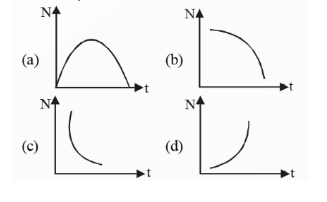
Radioactive element decays to form a stable nuclide, then the rate of decay of reactant is shown by:
1
A
2
B
3
C
4
D
Official Solution
Correct Option:
(1)
The decay of a radioactive element follows an exponential decay curve. The plot shown in option (a) depicts the typical behavior where the decay rate is proportional to the amount of the reactant remaining, leading to the exponential decay. Final Answer:
38
PYQ 2025
medium
physicsID: viteee-2
The binding energy per nucleon is maximum for:
1
2
3
4
Official Solution
Correct Option:
(3)
Iron ( ) has the highest binding energy per nucleon.
39
PYQ 2025
medium
physicsID: viteee-2
The half-life of a radioactive element is 8 days. The fraction remaining after 32 days is:
1
2
3
4
Official Solution
Correct Option:
(4)
About Nuclear Physics - VITEEE
Nuclear Physics is a vital chapter for VITEEE aspirants. Mastering the concepts covered in this chapter is essential for securing a top rank.
By rigorously practicing the previous year questions associated with this chapter, you can identify high-yield topics, understand the examiner's perspective, and boost your confidence during the actual exam.
Frequently Asked Questions
Why focus on Nuclear Physics PYQs?
Analyzing PYQs for this specific chapter reveals the most frequently tested concepts and the typical complexity of questions, allowing you to tailor your study plan efficiently.
How to best use this analysis?
Review the topic breakdown to see which sub-topics within Nuclear Physics carry the most weight. Then, tackle the questions iteratively to solidify your understanding.