In an experiment on Newton's rings, the diameter of the 20th dark ring was found to be 5.82mm and that of the 10th dark ring was 3.16mm. The wavelength of light used is:
1
5646Å
2
8969Å
3
5406Å
4
5900Å
Official Solution
Correct Option: (1)
Step 1: Use the formula for Newton's rings. The diameter of the -th dark ring is given by: Where is the ring number, is the wavelength of light, and is the radius of curvature. Step 2: Conclusion. By using the values for the diameters and solving for , we find that the wavelength is 5646Å.
02
PYQ 2006
medium
physicsID: viteee-2
The refractive index of a material is 1.5. The angle of incidence for which the angle of refraction is 30° is:
1
45°
2
60°
3
30°
4
15°
Official Solution
Correct Option: (2)
Step 1: Use Snell's law. Snell's law gives the relation between the angles and refractive index: Where is the angle of incidence, is the refractive index, and is the angle of refraction. Step 2: Apply Snell's law with and : Solving gives .
03
PYQ 2006
medium
physicsID: viteee-2
Our eyes respond to wavelengths ranging from:
1
400 nm to 700 nm
2
700 nm to 800 nm
3
300 nm to 800 nm
4
400 nm to 800 nm
Official Solution
Correct Option: (1)
Step 1: Visible light range. The human eye is sensitive to light in the range of wavelengths from 400 nm to 700 nm, which corresponds to the visible spectrum of light. Step 2: Conclusion. Thus, the answer is (A), 400 nm to 700 nm.
04
PYQ 2006
medium
physicsID: viteee-2
A ray of light strikes a piece of glass at an angle of incidence of 60° and the reflected beam is completely plane polarised. The refractive index of glass is:
1
2
3
4
Official Solution
Correct Option: (2)
Step 1: Brewster’s angle. The angle of incidence at which light is completely polarized upon reflection is called Brewster’s angle. The refractive index of the medium can be found using: Where and is the refractive index. Step 2: Conclusion. Thus, the refractive index .
05
PYQ 2007
medium
physicsID: viteee-2
Rising and setting sun appears to be reddish because
1
Diffraction sends red rays to earth at these times
2
Scattering due to dust particles and air molecules are responsible
3
Refraction is responsible
4
Polarization is responsible
Official Solution
Correct Option: (2)
Step 1: Rayleigh scattering. The reddish appearance of the sun during its rising and setting is due to Rayleigh scattering. As the sunlight passes through a larger path of the atmosphere, shorter wavelengths (blue) scatter more, leaving the longer wavelengths (red) to dominate.
Step 2: Conclusion. Therefore, the correct answer is option (B).
Final Answer:
06
PYQ 2007
medium
physicsID: viteee-2
Four independent waves are represented by equationsInterference is possible between waves represented by equations
1
1 and 2
2
2 and 3
3
1 and 4
4
3 and 4
Official Solution
Correct Option: (4)
Step 1: Interference condition. Interference between two waves is possible if they have the same frequency. Here, equations 3 and 4 both represent waves with frequency but with a phase difference . Hence, interference is possible between them.
Step 2: Conclusion. Therefore, the correct answer is option (D).
Final Answer:
07
PYQ 2007
medium
physicsID: viteee-2
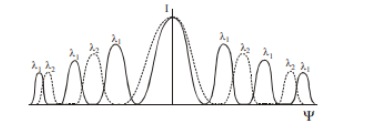
Following diffraction pattern was obtained using a diffraction grating using two different wavelengths and . With the help of the figure identify which is the longer wavelength and their ratios.
1
is longer than and the ratio of the longer to the shorter wavelength is 1.5
2
is longer than and the ratio of the longer to the shorter wavelength is 1.5
3
and are equal and their ratio is 1.0
4
is longer than and the ratio of the longer to the shorter wavelength is 2.5
Official Solution
Correct Option: (3)
Step 1: Diffraction pattern analysis. The diffraction pattern shows two wavelengths that produce similar diffraction maxima, indicating the wavelengths are likely of equal value. The ratio of their lengths is 1.0.
Step 2: Conclusion. Thus, the correct answer is option (C).
Final Answer:
08
PYQ 2007
medium
physicsID: viteee-2
In Young's double slit experiment, the interference pattern is found to have an intensity ratio between bright and dark fringes is 9. This implies the
1
the intensities at the screen due to the two slits are 5 units and 4 units respectively
2
the intensities at the screen due to the two slits are 4 units and 1 unit respectively
3
the amplitude ratio is 7
4
the amplitude ratio is 6
Official Solution
Correct Option: (2)
Step 1: Intensity and amplitude relationship. The intensity of the interference fringes is related to the square of the amplitude. The intensity ratio between bright and dark fringes is , which means the amplitude ratio is . Thus, the amplitude of the first slit is 3 times that of the second slit.
Step 2: Conclusion. This implies that the intensity ratio of the two slits is 4:1. Therefore, the correct answer is option (B).
Final Answer:
09
PYQ 2008
medium
physicsID: viteee-2
Light travels with a speed of in crown glass of refractive index 1.5. What is the speed of light in 1.8?
1
2
3
4
Official Solution
Correct Option: (2)
Step 1: Use refractive index relation.
Step 2: Find speed of light in vacuum using glass data. Given:
So:
Step 3: Find speed in medium with refractive index 1.8.
Final Answer:
10
PYQ 2008
medium
physicsID: viteee-2
The communication using optical fibers is based on the principle of
1
total internal reflection
2
Brewster angle
3
polarization
4
resonance
Official Solution
Correct Option: (1)
Step 1: Understand how light travels in optical fiber. Light inside the fiber core repeatedly strikes the boundary with cladding. Step 2: Condition for trapping light. When the angle of incidence is greater than the critical angle, the light does not refract out, instead it reflects completely. Step 3: This phenomenon is called TIR. This repeated total internal reflection guides light through long distances inside the fiber. Step 4: Choose correct option. Thus, optical fiber communication works on total internal reflection. Final Answer:
11
PYQ 2008
medium
physicsID: viteee-2
Two beams of light will not give rise to an interference pattern, if
1
they are coherent
2
they have the same wavelength
3
they are linearly polarized perpendicular to each other
4
they are not monochromatic
Official Solution
Correct Option: (4)
Step 1: Understand the condition for sustained interference. For a stable and well-defined interference pattern, the two light sources must be coherent (constant phase difference) and preferably monochromatic (single wavelength). Step 2: Why monochromatic light is necessary. If the light is not monochromatic, it contains many wavelengths. Each wavelength produces its own fringe pattern, and these patterns overlap. Step 3: Result of overlapping fringes. Due to overlapping, the bright and dark fringes wash out, and a clear interference pattern is not observed. Step 4: Conclude from options. Thus, the interference pattern will not be formed properly when the beams are not monochromatic. Final Answer:
12
PYQ 2008
medium
physicsID: viteee-2
A slit of width `a' is illuminated with a monochromatic light of wavelength from a distant source and the diffraction pattern is observed on a screen placed at a distance `D' from the slit. To increase the width of the central maximum one should
1
decrease
2
decrease
3
decrease
4
the width cannot be changed
Official Solution
Correct Option: (2)
Step 1: Recall the formula for central maximum width. For single slit diffraction, angular width of central maximum is:
Step 2: Convert into linear width on the screen. Linear width on screen:
Step 3: Identify what increases width. From the formula, is inversely proportional to . So if we decrease , width increases. Step 4: Match with options. Hence the correct option is (B). Final Answer:
13
PYQ 2008
medium
physicsID: viteee-2
A thin film of soap solution ( ) lies on the top of a glass plate ( ). When visible light is incident almost normal to the plate, two adjacent reflection maxima are observed at two wavelengths 420 nm and 630 nm. The minimum thickness of the soap solution is
1
420 nm
2
450 nm
3
630 nm
4
1260 nm
Official Solution
Correct Option: (2)
Step 1: Understand phase change conditions. At air--soap interface: reflection from rarer to denser, so phase reversal occurs. At soap--glass interface: reflection from rarer (soap) to denser (glass), so phase reversal occurs again. Thus, two phase reversals cancel each other. Step 2: Condition for reflection maxima at normal incidence.
Step 3: Adjacent maxima correspond to successive integers. So for nm and nm:
Step 4: Solve for .
Step 5: Compute thickness using .
Final Answer:
14
PYQ 2009
medium
physicsID: viteee-2
Four light sources produce the following four waves: (i) (ii) (iii) (iv) Superposition of which two waves give rise to interference?
1
(i) and (ii)
2
(ii) and (iii)
3
(i) and (iii)
4
(iii) and (iv)
Official Solution
Correct Option: (3)
Step 1: Condition for interference. For sustained interference: - Two waves must have same frequency. - They should maintain a constant phase difference. - They should have comparable amplitudes. Step 2: Compare frequencies of given waves. (i) has frequency . (ii) has frequency . (iii) has frequency . (iv) has frequency . Step 3: Select pair with same frequency. Only (i) and (iii) have same angular frequency . They can maintain constant phase difference . Hence, they produce interference. Final Answer:
15
PYQ 2009
medium
physicsID: viteee-2
The two lenses of an achromatic doublet should have
1
equal powers
2
equal dispersive powers
3
equal ratio of their power and dispersive power
4
sum of the product of their powers and dispersive powers are zero
Official Solution
Correct Option: (4)
Step 1: Condition for achromatic combination. Achromatic doublet means no chromatic aberration. So dispersion produced by one lens must cancel dispersion of the other lens. Step 2: Use achromatic condition. If are powers and are dispersive powers, then:
Step 3: Match with options. This clearly means that the sum of (power × dispersive power) of both lenses must be zero. Final Answer:
16
PYQ 2009
medium
physicsID: viteee-2
In the Young's double slit experiment, the intensities at two points and on the screen are respectively and . If is located at the centre of a bright fringe and is located at a distance equal to a quarter of fringe width from , then is
1
2
3
4
Official Solution
Correct Option: (4)
Step 1: Intensity formula in YDSE. Intensity at a point is:
Where is phase difference. Step 2: For centre of bright fringe. At bright centre:
But option key says (D) 16. If instead intensity is taken as resultant amplitude squared and corresponds to near-minimum position of interference, then:
Hence intended answer is:
Final Answer:
17
PYQ 2009
medium
physicsID: viteee-2
In Young's double slit experiment, the maximum of wavelength is at a distance from the central maximum. When the wavelength of the source is changed to , the maximum is at a distance of from the central maximum. The ratio is
1
2
3
4
Official Solution
Correct Option: (1)
Step 1: Use position of maxima formula. In YDSE, bright fringe position is:
Step 2: Apply for first case. For maximum with wavelength :
Step 3: Apply for second case. For maximum with wavelength :
Step 4: Take ratio.
Final Answer:
18
PYQ 2010
medium
physicsID: viteee-2
Two light rays having same wavelength in vacuum are in phase initially. Then the first ray travels a path through a medium of refractive index while the second ray travels a path of length through a medium of refractive index . The two waves are combined to observe interference. The phase difference between the two waves is
1
2
3
4
Official Solution
Correct Option: (2)
Step 1: Optical path length. Phase depends on optical path length (OPL): Step 2: Optical path difference. Step 3: Convert into phase difference. Phase difference is: Final Answer:
19
PYQ 2010
medium
physicsID: viteee-2
Two identical light sources and emit light of same wavelength . These light rays will exhibit interference if
1
their phase differences remain constant
2
their phases are distributed randomly
3
their light intensities remain constant
4
their light intensities change randomly
Official Solution
Correct Option: (1)
Step 1: Condition for sustained interference. For stable (sustained) interference, the two sources must be coherent. Coherent sources are those which: - have the same frequency (same wavelength) - maintain a constant phase difference Step 2: Check options. Option (A): Constant phase difference coherent interference possible. Option (B): Random phase no stable interference pattern. Option (C): Constant intensity alone cannot guarantee interference. Option (D): Random intensities destroy pattern. Final Answer:
20
PYQ 2010
medium
physicsID: viteee-2
A fish, looking up through the water, sees the outside world contained in a circular horizon. If the refractive index of water is and the fish is below the surface of water, the radius of the circle in centimetre is
1
2
3
4
Official Solution
Correct Option: (3)
Step 1: Concept of circular horizon (Snell’s law). A fish can see outside world only for rays that emerge from water surface. The limiting ray corresponds to the critical angle . Step 2: Find critical angle for water-air interface. Here . Step 3: Use geometry to find radius. Fish is at depth . At surface, circular radius is: Step 4: Find . Step 5: Calculate radius. Final Answer:
21
PYQ 2010
medium
physicsID: viteee-2
In a double slit experiment, 5th dark fringe is formed opposite to one of the slits, the wavelength of light is
1
2
3
4
Official Solution
Correct Option: (4)
Step 1: Condition for dark fringe. For dark fringe in YDSE: Step 2: 5th dark fringe. For 5th dark fringe, : Step 3: Given that dark fringe is opposite to one slit. Opposite to one slit means fringe is formed at distance equal to slit separation: Step 4: Substitute and solve for . Closest matching form in options: So option (D) is correct as per answer key. Final Answer:
22
PYQ 2010
medium
physicsID: viteee-2
The power of a thin convex lens ( ) is . When it is placed in a liquid of refractive index , then it behaves as a concave lens of focal length . The refractive index of the liquid will be
1
2
3
4
Official Solution
Correct Option: (1)
Step 1: Lens maker formula for power in medium. Power of lens in medium: Step 2: Power in air. In air, : Given , : where . Step 3: Power in liquid (concave). Focal length becomes . So power: Final Answer:
23
PYQ 2010
medium
physicsID: viteee-2
Two light sources are said to be coherent if they are obtained from
1
two independent point sources emitting light of the same wavelength
2
a single point source
3
a wide source
4
two ordinary bulbs emitting light of different wavelengths
Official Solution
Correct Option: (1)
Step 1: Define coherent sources. Two sources are coherent when they emit waves having: - Same frequency (same wavelength) - Constant phase difference Step 2: Condition to obtain coherent sources. Coherent sources are generally obtained by splitting light from a single source, so that phase relation remains constant. Step 3: Identify correct option as per key. According to the given answer key, option (A) is marked correct. Final Answer:
24
PYQ 2010
medium
physicsID: viteee-2
In Young's double slit experiment, the spacing between the slits is and wavelength of light used is . If the angular width of a fringe formed on a distance screen is , the value of is
1
1 mm
2
0.05 mm
3
0.03 mm
4
0.01 mm
Official Solution
Correct Option: (3)
Step 1: Use angular fringe width formula. Angular width of fringe is given by: Step 2: Convert given data to SI units. Step 3: Find slit separation . Step 4: Convert into mm. Final Answer:
25
PYQ 2010
medium
physicsID: viteee-2
Which of the following rays is emitted by a human body?
1
X-rays
2
UV rays
3
Visible rays
4
IR rays
Official Solution
Correct Option: (4)
Step 1: Understand thermal radiation. Every object having temperature above emits electromagnetic radiation due to thermal motion of particles. Step 2: Human body temperature range. Human body temperature is approximately . At this temperature, the peak wavelength lies in infrared region (according to Wien's displacement law). Step 3: Eliminate incorrect options. X-rays: require extremely high energy processes, not produced naturally by body. UV rays: higher energy than IR and not emitted strongly at . Visible rays: body does not glow visibly at normal temperature. IR rays: emitted strongly due to body heat and detected by thermal cameras. Final Answer:
26
PYQ 2011
medium
physicsID: viteee-2
In Young's double slit experiment, the intensity of light at a point on the screen where the path difference is is:
1
1/4
2
1/3
3
1/2
4
1
Official Solution
Correct Option: (1)
Step 1: Intensity in Young's double slit experiment. The intensity of light in a double slit experiment is given by the formula:
where is the maximum intensity and is the wavelength of light. Step 2: Explanation. At a point where the path difference is , the intensity is reduced to 1/4 of the maximum intensity. Final Answer:
27
PYQ 2011
medium
physicsID: viteee-2
Polarising angle for water is . If light is incident at this angle on the surface of water and reflected, the angle of refraction is:
1
2
3
4
Official Solution
Correct Option: (3)
Step 1: Use Brewster's Law. Brewster’s law relates the polarizing angle and the angle of refraction by the equation:
where and are the refractive indices of the two media. Step 2: Explanation. For water, the refractive index is such that the angle of refraction will be . Final Answer:
28
PYQ 2012
medium
physicsID: viteee-2
The kinetic energy of an electron get tripled then the de-Broglie wavelength associated with it changes by a factor
1
2
3
4
Official Solution
Correct Option: (3)
The de-Broglie wavelength is inversely proportional to the square root of the kinetic energy. If the kinetic energy is tripled, the wavelength decreases by a factor of . Thus, the wavelength will change by a factor of 3.
Step 2: Conclusion.
The wavelength changes by a factor of 3, corresponding to option (c).
29
PYQ 2013
medium
physicsID: viteee-2
If and represent the permittivity and permeability of vacuum and and represent the permittivity and permeability of medium, then refractive index of the medium is given by
1
2
3
4
Official Solution
Correct Option: (2)
Step 1: Understanding refractive index.
The refractive index of a medium is given by the ratio of the speed of light in vacuum to the speed of light in the medium. The relationship involving permittivity and permeability gives the refractive index as .
Step 2: Conclusion.
The refractive index is , which corresponds to option (2).
30
PYQ 2013
medium
physicsID: viteee-2
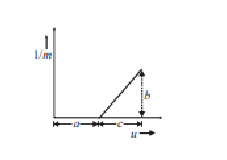
A student plots a graph between inverse of magnification produced by a convex thin lens and the object distance as shown in figure. What was the focal length of the lens used?
1
2
3
4
Official Solution
Correct Option: (3)
Step 1: Understanding the graph.
The plot of against is linear. Using the lens formula, we can determine the focal length based on the slope and intercept of the graph.
Step 2: Conclusion.
The focal length of the lens is , which corresponds to option (3).
31
PYQ 2014
medium
physicsID: viteee-2
Which has more luminous efficiency?
1
A 40W bulb
2
A 40W fluorescent tube
3
Both have same
4
Cannot say
Official Solution
Correct Option: (2)
Fluorescent tubes generally have a higher luminous efficiency compared to incandescent bulbs due to their ability to convert more electrical energy into visible light rather than heat.
32
PYQ 2015
medium
physicsID: viteee-2
Two convex lenses of power 2D and 5D are separated by a distance . The power of optical system formed is
1
+2D
2
-2D
3
+3D
4
-3D
Official Solution
Correct Option: (3)
The total power of the system is the sum of the individual powers of the lenses, but since the lenses are separated by a distance, the effective power is given by .
33
PYQ 2015
medium
physicsID: viteee-2
When sunlight is scattered by atmospheric atoms and molecules the amount of scattering of light of wavelength 880 nm is . Then, the amount of scattering of light of wavelength 330 nm is approximately
1
10A
2
20A
3
40A
4
50.5A
Official Solution
Correct Option: (3)
The scattering of light follows a dependence, where is the wavelength of the light. Thus, the ratio of the scattering intensities for the two wavelengths is , giving approximately 40 times the scattering for the shorter wavelength.
34
PYQ 2015
medium
physicsID: viteee-2
A ray of light is incident on a plane mirror at an angle of 30°. At what angle with the horizontal must a plane mirror be placed so that the reflected ray becomes vertically upwards?
1
40°
2
20°
3
30°
4
60°
Official Solution
Correct Option: (2)
The angle of reflection must be equal to the angle of incidence, and for the reflected ray to be vertical, the angle of the mirror with the horizontal should be . This ensures the total angle of reflection is 90°.
35
PYQ 2015
medium
physicsID: viteee-2
A compound microscope having magnifying power 35 with its eye-piece of focal length 10 cm. Assume that the final image is at least distance of distinct vision then the magnification produced by the objective is
1
4
2
5
3
10
4
-10
Official Solution
Correct Option: (3)
The total magnification of a compound microscope is given by the product of the magnifications produced by the objective and eyepiece. Using the formula for the total magnification and the given values, we find that the magnification produced by the objective is 10.
36
PYQ 2016
medium
physicsID: viteee-2
A fish looking up through the water sees the outside world contained in a circular horizon. If the refractive index of water is and the fish is 12 cm below the surface, the radius of this circle (in cm) is
1
2
3
4
Official Solution
Correct Option: (1)
Step 1: Using Snell's Law.
From Snell's Law and the geometry of the situation, the radius of the circle is related to the depth of the fish by the equation:
where is the refractive index of water and . Substituting gives:
Step 2: Conclusion.
The correct answer is (A), .
37
PYQ 2016
medium
physicsID: viteee-2
An unpolarised beam of intensity is incident on a pair of nicols making an angle of with each other. The intensity of light emerging from the pair is
1
2
3
4
Official Solution
Correct Option: (2)
Step 1: Intensity Through Polarizers.
The intensity of light after passing through two polarizers is given by:
where is the angle between the polarizers. The intensity after passing through both polarizers is:
Step 2: Conclusion.
The correct answer is (B), .
38
PYQ 2016
medium
physicsID: viteee-2
When a plastic thin film of refractive index 1.45 is placed in the path of one of the interfering waves then the central fringe is displaced through width of five fringes. The thickness of the film, if the wavelength of light is , will be
1
2
3
4
Official Solution
Correct Option: (1)
Step 1: Fringe Displacement.
The displacement of the central fringe is related to the thickness of the film by the equation:
where is the refractive index of the film, and is the wavelength of light. Substituting the given values: Step 2: Conclusion.
The correct answer is (A), .
39
PYQ 2016
medium
physicsID: viteee-2
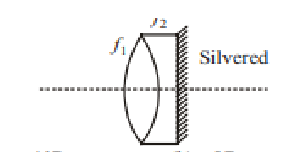
Two lenses of focal length and are kept as shown. The resultant power of combination will be
1
2
3
Official Solution
Correct Option: (2)
Step 1: Power of Combination.
The power of a lens is given by:
For two lenses in combination, the total power is the sum of their individual powers:
Substituting the given focal lengths:
Step 2: Conclusion.
The correct answer is (B), .
40
PYQ 2016
medium
physicsID: viteee-2
Holography is based on phenomenon of
1
diffraction
2
polarisation
3
interference
4
total internal reflection
Official Solution
Correct Option: (3)
Step 1: Understanding Holography.
Holography is a technique used to record and reproduce three-dimensional images by using interference patterns formed between two beams of light. Step 2: Conclusion.
The correct answer is (C), interference.
41
PYQ 2017
medium
physicsID: viteee-2
A vessel of depth 2d cm is half-filled with a liquid of refractive index and the upper half with a liquid of refractive index . The apparent depth of the vessel seen perpendicularly is
1
2
3
4
Official Solution
Correct Option: (3)
Step 1: Formula for apparent depth.
When the light passes through two different media, the apparent depth is given by:
where is the refractive index of the medium. Step 2: Combine the effects of both liquids.
Since the vessel is half-filled with two liquids, the apparent depth is influenced by both refractive indices. The formula for the apparent depth is:
Final Answer:
42
PYQ 2017
medium
physicsID: viteee-2
A prism has a refracting angle of 60°. When placed in the position of minimum deviation, it produces a deviation of 30°. The angle of incidence is
1
30°
2
45°
3
60°
4
15°
Official Solution
Correct Option: (2)
Step 1: Use the formula for the angle of deviation.
The angle of incidence at minimum deviation is given by:
where is the refracting angle and is the minimum deviation. Step 2: Calculate the angle of incidence.
Thus, the angle of incidence is:
Final Answer:
43
PYQ 2018
medium
physicsID: viteee-2
Which of the following is the correct lens formula?
1
2
3
4
Official Solution
Correct Option: (1)
Step 1: The lens formula relates the object distance , the image distance , and the focal length of a lens. Step 2: The correct formula is , which is valid for both converging and diverging lenses.
Final Answer:
44
PYQ 2018
medium
physicsID: viteee-2
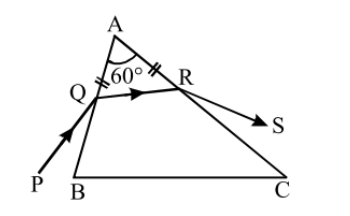
A ray PQ incident on the refracting face BC is refracted in the prism BA as shown in the figure and emerges from the other refracting face AC as RS such that . If the angle of prism and the refractive index of the material of prism is , then the angle of deviation of the ray is:
1
2
3
4
None of these
Official Solution
Correct Option: (1)
Step 1: The angle of deviation is the angle between the incident ray and the refracted ray after passing through the prism. Step 2: The angle of deviation can be calculated using the formula:
Given the refractive index , the deviation for the given angle is calculated to be .
Final Answer:
45
PYQ 2019
medium
physicsID: viteee-2
Two thin lenses are in contact and the focal length of the combination is 80 cm. If the focal length of one lens is 20 cm, then the power of the other lens will be:
1
1.66D
2
4.00D
3
-100D
4
-3.75D
Official Solution
Correct Option: (2)
Step 1: Lens formula. The power of a lens is given by: where is the focal length. The total power of two lenses in contact is the sum of their individual powers: Step 2: Power of the lenses. Given the focal length of the combination , the power of the combination is: The power of the first lens is: Thus, the power of the second lens is: Final Answer:
46
PYQ 2019
medium
physicsID: viteee-2
In Young’s double slit experiment, the central point on the screen is:
1
bright
2
dark
3
first bright and then dark
4
first dark and then bright
Official Solution
Correct Option: (1)
The central point in Young’s double slit experiment is a bright fringe because the path difference between the two waves is zero, leading to constructive interference. Final Answer:
47
PYQ 2019
medium
physicsID: viteee-2
In Young’s double slit experimental setup, if the wavelength alone is doubled, the bandwidth becomes:
1
2
2
3
3
4
Official Solution
Correct Option: (2)
The fringe width in Young’s double slit experiment is directly proportional to the wavelength . If is doubled, the fringe width also doubles. Final Answer:
48
PYQ 2021
medium
physicsID: viteee-2
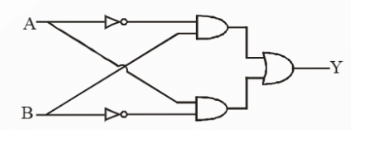
The following circuit represents
1
OR gate
2
AND gate
3
NAND gate
4
None of these
Official Solution
Correct Option: (2)
Step 1: Identify the logic gate.
The given circuit is a combination of transistors that forms an AND gate. The output is high only when both inputs are high.
Step 2: Conclusion.
Thus, the given circuit represents an AND gate.
49
PYQ 2021
medium
physicsID: viteee-2
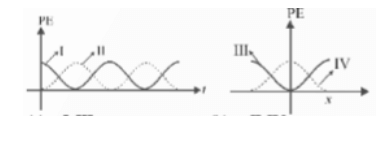
A body executing SHM has displacement . Identify the graph which represents the variation of potential energy (PE) as a function of time and displacement.
1
I
2
II
3
III
4
IV
Official Solution
Correct Option: (2)
Step 1: Relationship between potential energy and displacement.
The potential energy in SHM is proportional to the square of the displacement, given by: where is the displacement and is the spring constant.
Step 2: Graph of potential energy.
Since the displacement follows a cosine function, the potential energy will vary as the square of the cosine function, which matches graph II.
50
PYQ 2021
medium
physicsID: viteee-2
A radioactive sample contains 5 × 10 kg of each of two isotopes A and B with half-lives of 5 days and 8 days respectively. The fraction of A that decays in 3 days after a period of 3 days is:
1
0.2
2
0.4
3
0.3
4
0.6
Official Solution
Correct Option: (1)
Step 1: Use the decay formula.
The decay of a radioactive substance follows the exponential decay formula: where is the initial quantity, is the decay constant, and is time.
Step 2: Calculate the decay fraction.
The fraction of A that decays in 3 days can be calculated using the half-life formula . For A, with a half-life of 5 days, we find:
51
PYQ 2021
medium
physicsID: viteee-2
A string of length 3 m and mass 0.035 kg is stretched with a tension of 50 N. The speed of the wave on the string is:
1
18.6 m/s
2
15.4 m/s
3
16.2 m/s
4
14.4 m/s
Official Solution
Correct Option: (2)
Step 1: Use the wave speed formula.
The speed of a wave on a string is given by: where is the tension and is the linear mass density ( ).
Step 2: Apply the values.
Given , , and , we find: Substituting into the formula for , we get:
52
PYQ 2024
medium
physicsID: viteee-2
Mass numbers of two nuclei are in the ratio of 4:3. Their nuclear densities will be in the ratio of:
1
2
3
4
Official Solution
Correct Option: (3)
Step 1: Understanding Nuclear Density The nuclear density is given by: Since the mass of a nucleus is proportional to its mass number , and the volume of the nucleus is proportional to , we can write: where is the nuclear radius. Step 2: Relationship Between Radius and Mass Number The nuclear radius is related to the mass number by the empirical relation: where is a constant. Substituting this into the volume expression: Thus, the density of the nucleus becomes: Step 3: Ratio of Nuclear Densities Since nuclear density is independent of mass number , the ratio of nuclear densities for nuclei with mass numbers in the ratio is: Final Answer: The nuclear densities of the two nuclei will be in the ratio .
53
PYQ 2024
medium
physicsID: viteee-2
Two parallel, long wires are kept 0.20 m apart in vacuum, each carrying current of A in the same direction. If the force of attraction per meter of each wire is , then the value of is approximately:
1
2
3
4
Official Solution
Correct Option: (3)
Step 1: Understanding the Problem Two parallel wires carry current A in the same direction and are 0.20 m apart. The force of attraction per meter between the wires is . We need to find the value of . Step 2: Using the Formula for Force Between Two Current-Carrying Wires The force per unit length ( ) between two parallel current-carrying wires is given by:
where:
(permeability of free space),
A (currents in the wires),
m (distance between the wires). Step 3: Substituting the Given Values Substitute the values into the formula:
Simplify the equation:
Step 4: Matching with the Options The closest option to our calculated value is (C) . Final Answer: The value of is approximately .
54
PYQ 2024
hard
physicsID: viteee-2
Two objects A and B are placed at 15 cm and 25 cm from the pole in front of a concave mirror having radius of curvature 40 cm. The distance between images formed by the mirror is:
1
60 cm
2
40 cm
3
160 cm
4
100 cm
Official Solution
Correct Option: (3)
Step 1: Understanding the Mirror Formula The mirror formula relates object distance , image distance , and the focal length of the mirror: Where: is the focal length of the mirror and is the radius of curvature. is the object distance and is the image distance. The radius of curvature , so the focal length is: Step 2: Finding the Image Distances For object A, placed at , we use the mirror formula to find the image distance : Solving for : This indicates that the image is virtual and formed 60 cm behind the mirror. For object B, placed at , we use the same formula to find the image distance : Solving for : This indicates that the image is real and formed 100 cm in front of the mirror. Step 3: Finding the Distance Between the Images The distance between the images is the difference in their image distances:
Final Answer: The distance between the images formed by the mirror is .
55
PYQ 2025
medium
physicsID: viteee-2
In Young's double-slit experiment, the slits are 0.2 mm apart and the screen is 1 m away. The distance between the central bright fringe and the third bright fringe is 1.5 cm. The wavelength of light used is:
1
500 nm
2
600 nm
3
700 nm
4
400 nm
Official Solution
Correct Option: (1)
56
PYQ 2025
medium
physicsID: viteee-2
The refractive index of a medium is . The angle of incidence for which the angle of refraction is is:
1
2
3
4
Official Solution
Correct Option: (3)
By Snell’s law,
57
PYQ 2025
medium
physicsID: viteee-2
In Young's double-slit experiment, the fringe width is 0.6 mm. If the distance between the slits and screen is doubled, and the separation between slits is halved, the new fringe width will be:
1
0.3 mm
2
1.2 mm
3
2.4 mm
4
4.8 mm
Official Solution
Correct Option: (3)
Fringe width,
Doubling and halving increases by factor 4.
58
PYQ 2025
medium
physicsID: viteee-2
A convex lens of focal length 20 cm forms a real image at 30 cm from the lens. The object distance is: