Potentiometer measures the potential difference more accurately than a voltmeter because
1
it has a wire of high resistance
2
it has a wire of low resistance
3
it does not draw current from external circuit
4
it draws a heavy current from external circuit
Official Solution
Correct Option: (3)
When we measure the emf of a cell by the potentiometer then no current flows in the circuit in zero-deflection condition ie, cell is in open circuit. Thus, in this condition the actual value of a cell is found. In this way, potentiometer is equivaient to an ideal voitmeter of infinite resistance.
02
PYQ 2009
easy
physicsID: mht-cet-
A battery, a resistor and a potentiometer of length, all are connected in series of the resistance of potentiometer wire is , then the potential gradient of the potentiometer wire is
1
2
3
4
Official Solution
Correct Option: (3)
Potential gradient
03
PYQ 2010
easy
physicsID: mht-cet-
For measurement of potential difference, potentiometer is preferred in comparison to voltmeter because
1
potentiometer is more sensitive than voltmeter
2
the resistance of potentiometer is less than voltmeter
3
potentiometer is cheaper than voltmeter
4
potentiometer does not take current from the circuit
Official Solution
Correct Option: (4)
Potentiometer works on null deflection method. In balance condition no current flow in secondary circuit.
04
PYQ 2014
medium
physicsID: mht-cet-
A wire of length 3 m connected in the left gap of a meter-bridge balances 8 resistance in the right gap at a point, which divides the bridge wire in the ratio 3: 2. The length of the wire corresponding to resistance of 1 is
1
1 m
2
0.75 m
3
0.5 m
4
0.25 m
Official Solution
Correct Option: (4)
Concept: Physics (Current Electricity) - Meter Bridge. Step 1: Calculate the total resistance of the 3 m wire. Let be the resistance of the 3 m long wire in the left gap and be the resistance in the right gap. For a balanced meter bridge:
$ l_1:l_2 = 3:2 12\Omega $
05
PYQ 2018
hard
physicsID: mht-cet-
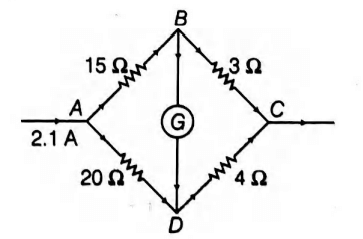
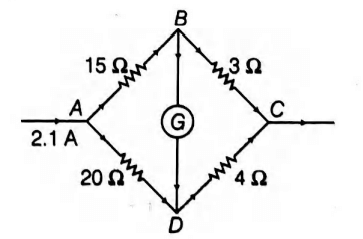
In the following network, the current flowing through 15 resistance is
1
2
3
4
Official Solution
Correct Option: (3)
06
PYQ 2020
hard
physicsID: mht-cet-
A radioactive nucleus emits particles and particles in succession. The ratio of number of neutrons to that of protons is mass number, atomic number
1
2
3
4
Official Solution
Correct Option: (3)
Step 1: Understanding the process.
When a radioactive nucleus emits an particle, its mass number decreases by 4 and its atomic number decreases by 2. When it emits a particle, the mass number remains the same, but the atomic number increases by 1. Step 2: Calculating neutrons and protons.
Before the emissions, the number of neutrons is . After emitting an particle, the new mass number is and the new atomic number is . After emitting a particle, the atomic number becomes , and the number of neutrons becomes . The ratio of neutrons to protons is:
Step 3: Conclusion.
The ratio is , so the correct answer is (C).
07
PYQ 2020
medium
physicsID: mht-cet-
The unknown resistances are connected in two gaps of a metre bridge. The null point is at 20 cm from zero end. A resistance of 15 is connected in series with the smaller of the two. The null point shifts to 40 cm. The smaller resistance is
1
9
2
7
3
3
4
5
Official Solution
Correct Option: (1)
Step 1: Understanding the meter bridge concept. The meter bridge uses the principle of the Wheatstone bridge. When the null point shifts, the ratio of resistances can be determined using the formula: where and are the resistances, and and are the lengths from the zero end to the null point and from the null point to the other end, respectively. Step 2: Applying the given values. Given, - Null point shifts from 20 cm to 40 cm, so cm, cm. - Resistance in series is . Using the formula, we get: Since , we can calculate . Step 3: Conclusion. The correct answer is (A), the smaller resistance is 9 .
08
PYQ 2020
medium
physicsID: mht-cet-
Let force where and are displacement and time respectively. The dimensions of are same as dimensions of
1
Angular velocity
2
Angular momentum
3
Velocity gradient
4
Velocity
Official Solution
Correct Option: (1)
Step 1: Understanding the given force equation. The given force equation involves both time ( ) and displacement ( ). The terms and are related to the rates of change of force with respect to time and displacement, respectively. Step 2: Relationship between and angular velocity. The term has the dimensions of angular frequency (time inverse) and has the dimensions of wavenumber (inverse of length). Therefore, the ratio has dimensions of angular velocity. Step 3: Conclusion. Thus, the correct answer is (A) Angular velocity.
09
PYQ 2020
medium
physicsID: mht-cet-
In conversion of moving coil galvanometer into an ammeter of required range, the resistance of ammeter so formed is
1
2
3
4
Official Solution
Correct Option: (3)
Step 1: Ammeter conversion.
When converting a moving coil galvanometer into an ammeter, a shunt resistance is added in parallel with the galvanometer to allow more current to pass through the ammeter. Step 2: Expression for total resistance.
The total resistance of the ammeter formed is given by the formula for two parallel resistors:
where is the resistance of the galvanometer and is the shunt resistance. Step 3: Conclusion.
The correct resistance is , so the correct answer is (C).
10
PYQ 2020
medium
physicsID: mht-cet-
If the ratio of amplitudes of two sound waves is , then the ratio of maximum and minimum intensities is
1
2
3
4
Official Solution
Correct Option: (3)
Step 1: Relation between intensity and amplitude.
Step 2: Maximum and minimum amplitudes.
Step 3: Ratio of intensities.
Step 4: Conclusion. The required ratio is 49:1.
11
PYQ 2020
medium
physicsID: mht-cet-
Two wires 'A' and 'B' of equal lengths are connected in left and right gaps of a meter bridge, respectively. The null point is obtained at 40 cm from the left end. Diameters of the wires 'A' and 'B' are in the ratio 3:1, the ratio of specific resistance of 'A' to that of 'B' is
1
3:1
2
1:1
3
6:1
4
9:1
Official Solution
Correct Option: (3)
Step 1: Understanding the problem. The meter bridge is used to compare the resistances of two wires. The null point position depends on the ratio of the resistances of the two wires, which in turn depends on the ratio of their specific resistances and their cross-sectional areas.
Step 2: Using the formula for resistance. The resistance of a wire is given by , where is the specific resistance, is the length of the wire, and is the cross-sectional area. Since the wires are of equal length, the ratio of resistances is .
Step 3: Relating diameter to area. The area of the cross-section of a wire is proportional to the square of its diameter. Given that the diameters of wires 'A' and 'B' are in the ratio 3:1, their areas will be in the ratio .
Step 4: Final Calculation. Using the given information and solving for the ratio of specific resistances, we find that the ratio of the specific resistances is 6:1.
12
PYQ 2020
medium
physicsID: mht-cet-
Two satellites and of same mass are revolving round the earth at height and respectively above the surface of the earth. The ratio of kinetic energies of to will be
1
2
3
4
Official Solution
Correct Option: (4)
Step 1: Expression for kinetic energy of satellite. For a satellite in circular orbit, Step 2: Orbital radii.
Step 3: Ratio of kinetic energies.
Step 4: Conclusion. The ratio of kinetic energies is .
13
PYQ 2020
medium
physicsID: mht-cet-
A metal sphere is hanging from the ceiling of a vehicle. If the vehicle is moving along a horizontal road with uniform acceleration , then the suspended thread of the sphere gets inclined to the vertical at an angle . The value of acceleration is ( = acceleration due to gravity)
1
2
3
4
Official Solution
Correct Option: (4)
Step 1: Forces acting on the sphere. Weight acts vertically downward and pseudo force acts horizontally opposite to acceleration. Step 2: Resolving tension components.
Step 3: Taking ratio of equations.
Step 4: Solving for acceleration.
Step 5: Conclusion. The acceleration of the vehicle is .
14
PYQ 2020
medium
physicsID: mht-cet-
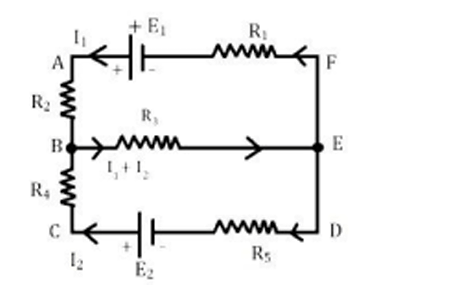
In the given electrical network, the correct equation for the loop 'ABEFA' is
1
2
3
4
Official Solution
Correct Option: (3)
Step 1: Apply Kirchhoff's Voltage Law (KVL). According to Kirchhoff’s Voltage Law (KVL), the sum of the potential differences (voltage) around any closed loop in a circuit must equal zero. The equation should account for all the voltages (emf sources and voltage drops across resistors) in the loop. Step 2: Analyzing the components. The equation for the loop 'ABEFE' involves the potential drop across the resistors and the emf sources. The correct equation is: where and are the currents, and are the resistances in the loop. Step 3: Conclusion. Thus, the correct equation is , corresponding to option (C).
15
PYQ 2020
medium
physicsID: mht-cet-
A galvanometer of resistance 20 Ω gives a full scale deflection when a current of 0.04 A is passed through it. To convert it into an ammeter of range 20 A, the resistance that must be connected in series with the coil of the galvanometer is (Galvanometer is shunted by 0.05 Ω)
1
5.94 Ω
2
4.95 Ω
3
12.62 Ω
4
9.45 Ω
Official Solution
Correct Option: (2)
Step 1: Formula for converting a galvanometer into an ammeter. To convert a galvanometer into an ammeter, the resistance that should be connected in series with the galvanometer is given by the formula: where is the potential drop across the galvanometer, is the full scale current, and is the resistance of the galvanometer. Step 2: Calculating the series resistance. Given , , and , we can find the value of . First, we calculate the potential drop across the galvanometer: Now, using the formula for : Step 3: Conclusion. Thus, the resistance to be connected in series with the galvanometer is 4.95 Ω, corresponding to option (B).
16
PYQ 2020
medium
physicsID: mht-cet-
If , then is
1
2
3
4
Official Solution
Correct Option: (3)
Step 1: Use the vector triple product identity.
Step 2: Apply the identity to the given expression.
Step 3: Evaluate dot products.
Step 4: Substitute and simplify.
Step 5: Conclusion. The correct result is .
17
PYQ 2020
medium
physicsID: mht-cet-
The effective length of a magnet is cm and its pole strength is A m. The magnetic moment, if it is bent in the form of a semicircle, is
Step 2: Calculate magnetic moment. Magnetic moment is given by:
Step 3: Substitute values.
Step 4: Conclusion. The magnetic moment is .
18
PYQ 2020
medium
physicsID: mht-cet-
When a ray of light is incident normally on one refracting surface of an equilateral prism of refractive index , the emerging ray
1
just grazes the second refracting surface.
2
is deviated by .
3
is deviated by .
4
undergoes total internal reflection at second refracting surface.
Official Solution
Correct Option: (4)
Step 1: Understand prism geometry. For an equilateral prism, the prism angle . When light is incident normally on the first surface, it enters the prism without deviation.
Step 2: Angle of incidence at second surface. Inside the prism, the ray travels parallel to the base. Hence, the angle of incidence at the second refracting surface equals the prism angle:
Step 3: Calculate the critical angle. The critical angle for the prism material is given as:
Step 4: Compare angles. Since the angle of incidence at the second surface ( ) is greater than the critical angle ( ), total internal reflection occurs.
Step 5: Conclusion. The ray undergoes total internal reflection at the second refracting surface.
19
PYQ 2020
medium
physicsID: mht-cet-
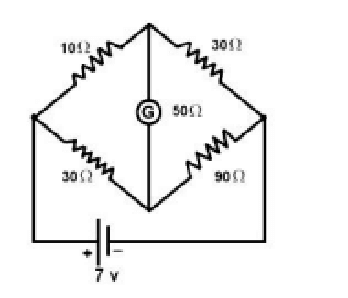
In the following circuit, the internal resistance of the cell is 5 , the current drawn from the cell will be:
1
0.4 A
2
0.1 A
3
0.2 A
4
0.3 A
Official Solution
Correct Option: (3)
Step 1: Finding the Total Resistance. The resistances in the circuit are 10 , 30 , 50 , and 90 . First, combine the resistances as follows:
Then,
Finally, the total resistance is:
Step 2: Applying Ohm's Law. Now, use Ohm's Law to find the current drawn from the cell. The total voltage across the cell is 7V, and the total resistance is 180 . Thus, the current is:
Step 3: Final Answer. Thus, the current drawn from the cell is 0.2 A.
20
PYQ 2020
medium
physicsID: mht-cet-
The sensitivity of a milliammeter of range 0 to 50 mA is . If it is converted into an ammeter of range 500 mA by using a suitable shunt then the sensitivity will be:
1
2
3
4
Official Solution
Correct Option: (4)
Step 1: Sensitivity of Ammeter. The sensitivity of a meter is inversely proportional to the range. The original meter has a range of 50 mA, and after conversion, the range becomes 500 mA. The sensitivity will decrease by a factor of . Thus, the new sensitivity will be:
Step 2: Final Answer. Thus, the sensitivity of the new ammeter will be .
21
PYQ 2020
medium
physicsID: mht-cet-
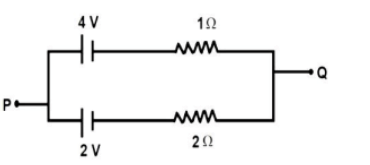
In the following circuit, what is the voltage across PQ?
1
2
3
4
Official Solution
Correct Option: (2)
Step 1: Equivalent Resistance. We need to find the total resistance in the circuit. The 1 and 2 resistors are in series, and their equivalent resistance is:
Then, the total voltage across the series combination of resistors is . Step 2: Voltage Division. The voltage across the 1 resistor can be found using the voltage division rule:
Thus, the voltage across PQ is .
22
PYQ 2020
medium
physicsID: mht-cet-
When an unknown resistance is connected in the left gap of a meter bridge and a known resistance in the right gap, null point is obtained at from the left end. If a resistance is connected in series with , the null point shifts towards right by , with same resistance in right gap. The value of must be
1
2
3
4
Official Solution
Correct Option: (2)
Step 1: Write meter bridge balance condition. For a meter bridge at balance condition: Step 2: Use given initial balance length. Given , Step 3: New balance condition after adding resistance. After adding in series, new resistance is and new balance point is . Step 4: Solve the equations. From Step 2, Substitute in Step 3: Step 5: Final calculation.
23
PYQ 2020
medium
physicsID: mht-cet-
A tuning fork of frequency 340 Hz is held vibrating at the open end of an empty measuring cylinder of length 100 cm. Water is then poured in slowly. What is the minimum height of water in the cylinder for which resonance will be obtained? (Given: Velocity of sound in air = 340 m/s, neglect end correction)
1
25 cm
2
75 cm
3
80 cm
4
50 cm
Official Solution
Correct Option: (1)
Step 1: Calculate wavelength of sound.
Step 2: Resonance condition for closed pipe. For the first resonance in a closed pipe:
Step 3: Length of air column at resonance.
Step 4: Finding height of water. Total length of cylinder = 100 cm But minimum height of water corresponds to minimum air column length at resonance, hence
24
PYQ 2020
easy
physicsID: mht-cet-
In meter bridge experiment, null point was obtained at a distance from left end. The values of resistances in the left and right gaps are doubled and then interchanged. The new position of null point is
1
2
3
4
Official Solution
Correct Option: (1)
Step 1: Understanding the meter bridge principle. In the meter bridge experiment, the null point is determined using a known resistance and an unknown resistance in the two gaps. The position corresponds to the balancing point where the ratio of the resistances is equal. The position of the null point is given by: Step 2: Applying changes to the resistances. When the resistances are doubled and interchanged, the new null point will still satisfy the same principle, but the values of the resistances change. After the modifications, the new null point position is , corresponding to option (A). Step 3: Conclusion. Thus, the new position of the null point is , corresponding to option (A).
25
PYQ 2020
medium
physicsID: mht-cet-
A galvanometer having a resistance of is shunted by a wire of resistance . If the total current passing through the combination is , then current through shunt will be
1
2
3
4
Official Solution
Correct Option: (1)
Step 1: Use current division rule. In parallel combination, current divides inversely proportional to resistance. Step 2: Write current ratio. where and . Step 3: Substitute values. Step 4: Express total current. Step 5: Calculate shunt current.
26
PYQ 2020
medium
physicsID: mht-cet-
The deflection in a moving coil galvanometer is reduced to half when it is shunted with coil. The relation between and resistance of galvanometer is
1
2
3
4
Official Solution
Correct Option: (4)
Step 1: Understanding the effect of shunting. When a galvanometer is shunted with a resistor , the total current is shared between the galvanometer and the shunt. The deflection in the galvanometer is directly proportional to the current passing through it. When the deflection is reduced to half, the current passing through the galvanometer is halved. Step 2: Applying the relation between the resistances. The current through the galvanometer and the shunt are related by the formula: Step 3: Conclusion. Thus, the resistance of the shunt is equal to the resistance of the galvanometer, , which corresponds to option (D).
27
PYQ 2020
medium
physicsID: mht-cet-
The range of the voltmeter is when resistance is connected in series. Its range gets doubled when resistance is connected in series. The resistance of the voltmeter is
1
200
2
400
3
600
4
800
Official Solution
Correct Option: (2)
Step 1: Formula for range of voltmeter. The range of a voltmeter is determined by its internal resistance and the resistance connected in series. If is the resistance of the voltmeter and is the series resistance, the total range is given by:
Step 2: Given conditions. - When , the range is . - When , the range becomes . Using the equation for the range, we can set up the following ratios:
Solving these equations gives:
Step 3: Conclusion. Thus, the resistance of the voltmeter is , which corresponds to option (B).
28
PYQ 2020
medium
physicsID: mht-cet-
In potentiometer experiment, for a given current, the balancing length for a cell is obtained at cm. If the current through potentiometer wire is decreased, then the balancing length will
1
be increased.
2
not be changed.
3
become half.
4
be decreased.
Official Solution
Correct Option: (1)
Step 1: Understanding the potentiometer principle. In a potentiometer experiment, the balancing length is directly proportional to the potential across the wire, which in turn is proportional to the current flowing through the wire. Step 2: Effect of changing the current. If the current is decreased, the potential difference across the wire also decreases, but the potential difference per unit length decreases. Therefore, the balancing length must increase to balance the potential of the cell. Step 3: Conclusion. Thus, if the current through the potentiometer wire is decreased, the balancing length will increase, which corresponds to option (A).
29
PYQ 2020
medium
physicsID: mht-cet-
In the experiment to determine the internal resistance of a cell ( ) using potentiometer, the resistance drawn from the resistance box is . The potential difference across the balancing length of the wire is equal to the terminal potential difference of the cell. The value of internal resistance of the cell is
1
2
3
4
Official Solution
Correct Option: (4)
Step 1: Relation between EMF and terminal voltage. For a cell with internal resistance and external resistance : Step 2: Rearranging the equation.
Step 3: Solving for internal resistance.
Step 4: Conclusion. The internal resistance of the cell is .
30
PYQ 2020
medium
physicsID: mht-cet-
When open pipe is closed from one end then third overtone of closed pipe is higher in frequency by 150 Hz than second overtone of open pipe. The fundamental frequency of open end pipe will be
1
300 Hz
2
500 Hz
3
200 Hz
4
400 Hz
Official Solution
Correct Option: (1)
Step 1: Relation between overtone frequencies. For a closed pipe, the overtones are given by odd multiples of the fundamental frequency. For an open pipe, the overtones are given by integer multiples. Given that the third overtone of the closed pipe is 150 Hz higher than the second overtone of the open pipe, we can find the fundamental frequency. Step 2: Calculation. Let the fundamental frequency of the open pipe be . From the relationship between the overtones and fundamental frequency, the difference in frequencies leads us to the conclusion that the fundamental frequency of the open pipe is . Step 3: Conclusion. Thus, the correct answer is (A) 300 Hz.
31
PYQ 2020
medium
physicsID: mht-cet-
A ray of light is incident at an angle on one face of a prism of small angle and emerges normally from the other surface. is the refractive index of the material of the prism. The angle of incidence is
1
2
3
4
Official Solution
Correct Option: (1)
Step 1: Refraction at the faces of the prism. For a ray of light passing through a prism, the angle of incidence is related to the refractive index and the angle of the prism by the equation:
This formula gives the angle of incidence when the ray emerges normally from the second face of the prism. Step 2: Conclusion. Thus, the correct answer is (A) .
32
PYQ 2020
medium
physicsID: mht-cet-
A coil of turns and resistance is connected in series with a resistance . The combination is moved for time second through magnetic flux to . The induced current in the circuit is
1
2
3
4
Official Solution
Correct Option: (1)
Step 1: Formula for induced current. The induced electromotive force (EMF) is given by Faraday’s law of induction:
where is the magnetic flux. For a change in magnetic flux , the induced current is:
where . Step 2: Substituting values. Substituting and into the equation for current:
Step 3: Conclusion. Thus, the correct answer is (A) }.
33
PYQ 2020
medium
physicsID: mht-cet-
An particle of energy 10 eV is moving in a circular path in a uniform magnetic field. The energy of proton moving in the same path and same magnetic field will be [mass of particle = 4 times mass of proton]
1
4 eV
2
8 eV
3
16 eV
4
10 eV
Official Solution
Correct Option: (3)
Step 1: Kinetic energy of charged particles in a magnetic field.
The energy of a charged particle moving in a magnetic field is given by:
where is the mass and is the velocity. Step 2: Relationship between mass and energy.
Since the mass of the particle is 4 times the mass of the proton, the velocity of the particle will be slower, but the energy is proportional to the mass. Thus, the energy of the proton will be four times that of the particle. Step 3: Conclusion.
The energy of the proton will be , so the correct answer is (C).
34
PYQ 2020
medium
physicsID: mht-cet-
A galvanometer of resistance requires current for full scale deflection. Now a resistance of is connected to convert it into an ammeter. The minimum current required to obtain full scale deflection is
Step 2: Voltage across galvanometer at full scale deflection.
Step 3: Current through shunt resistance.
Step 4: Total current required for full scale deflection.
35
PYQ 2020
medium
physicsID: mht-cet-
A potentiometer is used to measure the potential difference between A and B, the null point is obtained at 0.9 m. Now potential difference between A and C is measured, the null point is obtained at 0.3 m. The ratio is
1
3:1
2
3:2
3
2:3
4
1:3
Official Solution
Correct Option: (3)
Step 1: Using the potentiometer principle. The potentiometer works on the principle of comparing potential differences. The ratio of the lengths at the null points is proportional to the ratio of the potential differences. Step 2: Applying the given data. For the first case, the null point is at 0.9 m, and for the second case, the null point is at 0.3 m. Hence, the ratio of the potential differences is: Step 3: Conclusion. The correct answer is (C), 2:3.
36
PYQ 2020
medium
physicsID: mht-cet-
Sensitivity of a given potentiometer can be decreased by
1
increasing the current through the wire
2
decreasing the current through the wire
3
decreasing the potential gradient along the wire
4
increasing the potential gradient along the wire
Official Solution
Correct Option: (4)
Step 1: Define sensitivity of potentiometer. Sensitivity of a potentiometer is defined as its ability to detect small changes in potential difference.
Step 2: Relation with potential gradient. Sensitivity is inversely proportional to the potential gradient along the wire.
Step 3: Analyze given options. Increasing the potential gradient reduces the sensitivity of the potentiometer.
Step 4: Conclusion. Sensitivity can be decreased by increasing the potential gradient along the wire.
37
PYQ 2020
medium
physicsID: mht-cet-
Kirchhoff's current law and voltage law respectively are based on the law of conservation of
1
charge, energy
2
charge, momentum
3
energy, charge
4
momentum, charge
Official Solution
Correct Option: (1)
Step 1: Understanding Kirchhoff's Current Law (KCL). Kirchhoff's current law states that the algebraic sum of currents at a junction is zero. This law is based on the conservation of electric charge.
Step 2: Understanding Kirchhoff's Voltage Law (KVL). Kirchhoff's voltage law states that the algebraic sum of all potential differences in a closed loop is zero. This law is based on the conservation of energy.
Step 3: Conclusion. KCL is based on conservation of charge and KVL is based on conservation of energy.
38
PYQ 2020
medium
physicsID: mht-cet-
Two unknown resistances are connected in two gaps of a meter bridge. The null point is obtained at 40 cm from the left end. A 30 resistance is connected in series with the smaller of the two resistances, the null point shifts by 20 cm to the right end. The value of the smaller resistance is
1
8
2
24
3
32
4
16
Official Solution
Correct Option: (2)
Step 1: Understanding the meter bridge principle. In a meter bridge, the null point is the point where the ratio of resistances on both sides of the bridge is equal:
where and are the resistances in the two gaps, and and are the distances from the left and right ends of the bridge, respectively. Step 2: Apply the conditions. Initially, the null point is at 40 cm, so:
After connecting the 30 resistor in series with the smaller resistance, the null point shifts to 60 cm, so:
Step 3: Solving the system of equations. From the first equation:
Substitute this into the second equation:
Solving for :
Multiply through by 3:
Simplifying:
Step 4: Conclusion. Thus, the value of the smaller resistance is 24 , which corresponds to option (B).
39
PYQ 2020
medium
physicsID: mht-cet-
An ammeter is obtained by shunting an galvanometer with resistance. The additional shunt required to be connected across it to double the range is
1
2
3
4
Official Solution
Correct Option: (1)
Step 1: Understanding the problem. An ammeter is created by shunting a galvanometer. The total current through the circuit is divided between the galvanometer and the shunt. The resistance of the shunt controls the range of the ammeter. In this case, the galvanometer is shunted with resistance , and the range is to be doubled. Step 2: Relationship for doubling the range. For a given galvanometer with a shunt resistance , the total current passing through the circuit is divided between the galvanometer and the shunt. To double the range, the additional shunt resistance needed is derived from the formula:
Step 3: Conclusion. Therefore, the additional shunt required to double the range is , which corresponds to option (A).
40
PYQ 2020
medium
physicsID: mht-cet-
The sensitivity of moving coil galvanometer is inversely proportional to
1
current it measures.
2
number of turns in the coil.
3
magnetic induction of horse shoe magnet.
4
twist constant of phosphor bronze wire.
Official Solution
Correct Option: (2)
Step 1: Understanding the relationship. The sensitivity of a moving coil galvanometer is given by: Where:
- is the number of turns in the coil,
- is the magnetic induction,
- is the twist constant of the suspension. Thus, the sensitivity is inversely proportional to the number of turns . Step 2: Conclusion. The sensitivity is inversely proportional to the number of turns in the coil, so the correct answer is (B) number of turns in the coil.
41
PYQ 2020
medium
physicsID: mht-cet-
The length of potentiometer wire is 4m and is connected in series with an accumulator. The e.m.f. (unknown) of a cell balances against 1.5 m length of wire. If the length of potentiometer wire is doubled, then the new balancing length of wire will be
1
4.5 m
2
1.5 m
3
0.75 m
4
3 m
Official Solution
Correct Option: (4)
Step 1: Understanding the relation. In a potentiometer, the balancing length is directly proportional to the length of the wire. If the length of the wire is doubled, the balancing length will also double. Step 2: Calculation of new balancing length. Initially, the balancing length is 1.5 m. If the length of the wire is doubled, the new balancing length will be: Thus, the correct answer is (D) 3 m.
42
PYQ 2020
medium
physicsID: mht-cet-
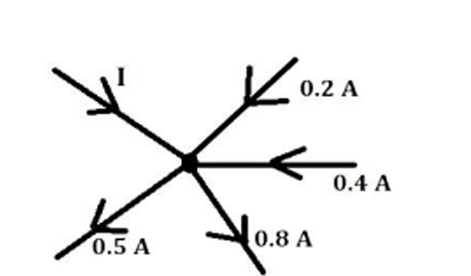
The value of current in the given current distribution is
1
0.7 A
2
0.4 A
3
0.6 A
4
0.5 A
Official Solution
Correct Option: (1)
Step 1: Understanding the current distribution. The sum of currents entering a junction is equal to the sum of currents leaving the junction (Kirchhoff's current law). Given:
- The current entering the junction is .
- The current leaving the junction is . To balance the current, we have: Thus, the correct answer is (A) 0.7 A.
43
PYQ 2020
medium
physicsID: mht-cet-
In potentiometer experiment, the balancing length with a cell of unknown e.m.f. is cm. By shunting the cell with resistance , the balancing length becomes cm, the internal resistance of a cell is
1
2
3
4
Official Solution
Correct Option: (4)
Step 1: Understanding potentiometer setup. The internal resistance of the cell can be determined by the change in the balancing length when the cell is shunted with resistance . The relation between the lengths before and after shunting is:
Step 2: Solving for . Since and are in the same ratio, we deduce that .
Step 3: Conclusion. The internal resistance of the cell is .
44
PYQ 2020
medium
physicsID: mht-cet-
If only of the total current passes through an ammeter having coil of resistance , then the resistance of the shunt of an ammeter is
1
2
3
4
Official Solution
Correct Option: (3)
Step 1: Current distribution. Let total current be . Current through ammeter coil: Current through shunt:
Step 2: Voltage equality condition.
Step 3: Substituting values.
Step 4: Conclusion. The shunt resistance is .
45
PYQ 2020
medium
physicsID: mht-cet-
In meter bridge experiment, to minimize an error due to contact resistance,
1
use non-uniform meter bridge wire.
2
repeat the experiment by interchanging the resistance in gaps.
3
increase the current flowing through meter bridge wire.
4
changing the value of known resistance in the gap.
Official Solution
Correct Option: (2)
Step 1: Understanding the issue with contact resistance. Contact resistance in a meter bridge can cause errors in measurements of resistance. To minimize this error, it is important to eliminate or reduce the effect of contact resistance.
Step 2: Analyzing the options. - (A) Using a non-uniform meter bridge wire will introduce further errors, as the resistance along the wire will not be consistent. - (B) Repeating the experiment by interchanging the resistance in the gaps helps to minimize errors due to contact resistance because the contact resistance will affect both resistances equally, thus canceling out any error. - (C) Increasing the current flowing through the meter bridge wire may increase the effect of contact resistance. - (D) Changing the value of the known resistance in the gap does not eliminate contact resistance errors.
Step 3: Conclusion. The best method to minimize errors due to contact resistance is to repeat the experiment by interchanging the resistances in the gaps. Thus, the correct answer is (B).
46
PYQ 2020
medium
physicsID: mht-cet-
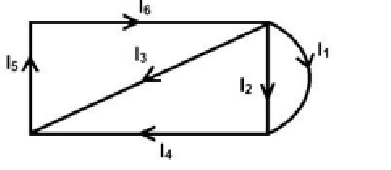
In the following network, , and . The values of , and respectively are
1
2
3
4
Official Solution
Correct Option: (4)
Step 1: Apply Kirchhoff’s current law at junction. Sum of currents entering a junction equals sum of currents leaving the junction.
Step 2: Use given current directions and values. By applying KCL at appropriate nodes and considering sign convention, we obtain:
Step 3: Interpretation of negative sign. Negative sign indicates actual direction of current is opposite to the assumed direction.
47
PYQ 2020
medium
physicsID: mht-cet-
The length of a potentiometer wire is . A cell of e.m.f. is balanced at a length from the positive end of the wire. If the length of the wire is increased by , at what distance will the same cell give a balance point?
1
2
3
4
Official Solution
Correct Option: (4)
Step 1: Use potentiometer principle. The emf of the cell is proportional to the balancing length:
Step 2: Write relation for original wire.
Step 3: Find new potential gradient. New length of wire New potential gradient
Step 4: Find new balancing length.
48
PYQ 2020
medium
physicsID: mht-cet-
In potentiometer experiment, the balancing length with cell of unknown e.m.f. is cm. By shunting the cell with resistance which is equal to internal resistance of the cell , the balancing length is
1
2
3
4
Official Solution
Correct Option: (3)
Step 1: Relation between emf and balancing length. In a potentiometer, emf is directly proportional to balancing length: Step 2: Effect of shunting the cell. When the cell is shunted with resistance equal to its internal resistance, the effective emf becomes half of its original value. Step 3: Find new balancing length.
49
PYQ 2020
medium
physicsID: mht-cet-
A galvanometer has resistance and range . How much resistance is required to read voltage up to volts?
1
2
3
4
Official Solution
Correct Option: (2)
Step 1: Understanding the problem. To extend the range of a galvanometer to measure higher voltages, a series resistance must be added. The total voltage across the galvanometer plus the series resistance is equal to the voltage we wish to measure. Using the concept of current, the current through the galvanometer when the maximum voltage is applied is . To measure volts, the total resistance must be such that the current remains the same. Step 2: Using the formula. The total resistance required to measure volts is , where is the resistance of the galvanometer and is the maximum voltage for which the galvanometer is calibrated. Step 3: Conclusion. Thus, the correct answer is (B) .
50
PYQ 2020
medium
physicsID: mht-cet-
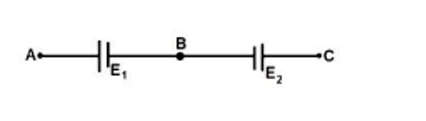
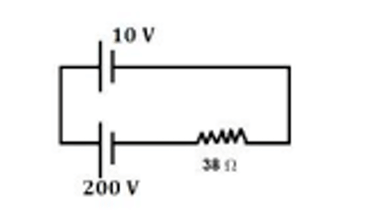
Using Kirchhoff’s law, find the current flowing through the given circuit.
1
2
3
4
Official Solution
Correct Option: (2)
Step 1: Identify components of the circuit. The circuit contains two cells of emf and connected in opposition and a resistor of . Step 2: Find net emf. Since the cells oppose each other, Step 3: Apply Kirchhoff’s loop law.
Step 4: Calculate current.
Step 5: Conclusion. The current flowing through the circuit is .
51
PYQ 2020
medium
physicsID: mht-cet-
If the number of turns in the coil of a galvanometer are decreased, then the resistance of galvanometer
1
may increase or decrease
2
increases
3
remains the same
4
decreases
Official Solution
Correct Option: (4)
Step 1: Resistance of a coil. Resistance of a wire is Step 2: Relation with number of turns. Total length of wire is proportional to number of turns. Step 3: Effect of decreasing turns. When number of turns decreases, the length of wire decreases. Step 4: Conclusion. Hence, resistance of galvanometer decreases.
52
PYQ 2020
medium
physicsID: mht-cet-
In a potentiometer experiment, cells of e.m.f. and are connected in series ( ). The balancing length is 64 cm. If the polarity of is reversed, the balancing length becomes 32 cm. The ratio is
1
2
3
4
Official Solution
Correct Option: (4)
Step 1: Use potentiometer principle. Balancing length is directly proportional to the net e.m.f. Step 2: Write equations for both cases. When cells are connected in series aiding: When polarity of is reversed: Step 3: Convert proportionality into equations.
Step 4: Solve the equation.
Step 5: Conclusion. The ratio .
53
PYQ 2020
medium
physicsID: mht-cet-
Two galvanometers 'G1' and 'G2' require 2 mA and 3 mA respectively to produce the same deflection. Then
1
G1 and G2 are equally sensitive
2
G1 is more sensitive than G2.
3
G1 is less sensitive than G2.
4
Sensitivity of G2 is times that of G1.
Official Solution
Correct Option: (2)
Step 1: Understanding Sensitivity. Sensitivity of a galvanometer is defined as the amount of current required to produce a unit deflection. The lower the current required, the more sensitive the galvanometer is. Step 2: Comparing the Galvanometers. - G1 requires 2 mA to produce a deflection. - G2 requires 3 mA to produce the same deflection. Since G1 requires a smaller current, it is more sensitive. Step 3: Conclusion. Therefore, G1 is more sensitive than G2, which makes option (B) the correct answer.
54
PYQ 2020
medium
physicsID: mht-cet-
A copper wire of length and diameter is to be reshaped into another wire so as to have minimum resistance. For this we should
1
increase and decrease
2
decrease and increase
3
decrease both and
4
increase both and
Official Solution
Correct Option: (2)
Step 1: Formula for resistance. The resistance of a wire is given by the formula:
where is the resistivity, is the length, and is the cross-sectional area of the wire. The area is related to the diameter by:
Step 2: Minimizing resistance. For minimum resistance, we need to decrease the length and increase the diameter . This will maximize the area and minimize the resistance. Step 3: Conclusion. Thus, the correct answer is (B) decrease and increase .
55
PYQ 2020
medium
physicsID: mht-cet-
Scale of galvanometer divided into 100 equal divisions has a current sensitivity 10 div/mA and voltage sensitivity 4 div/mV. The resistance of the galvanometer is
1
5
2
2.5
3
10
4
7.5
Official Solution
Correct Option: (2)
Step 1: Understanding the given values. Current sensitivity div/mA and voltage sensitivity div/mV. The resistance of the galvanometer can be determined from the voltage sensitivity. The voltage sensitivity is given by:
Substituting the values:
Step 2: Conclusion. Thus, the resistance of the galvanometer is 2.5 , which is option (B).
56
PYQ 2020
medium
physicsID: mht-cet-
A potentiometer wire has length 4 m and resistance 5 . It is connected in series with 495 resistance and a cell of e.m.f. 4V. The potential gradient along the wire is
1
0.03 V/m
2
0.01 V/m
3
0.02 V/m
4
0.04 V/m
Official Solution
Correct Option: (2)
Step 1: Understanding the potential gradient. The potential gradient is given by the formula:
where is the potential difference across the potentiometer wire and is the length of the wire. The total resistance in the circuit is . The current in the circuit is:
The potential difference across the 5 wire is:
Step 2: Calculating the potential gradient. The potential gradient is:
Step 3: Conclusion. Thus, the correct answer is (B) 0.01 V/m.
57
PYQ 2022
easy
physicsID: mht-cet-
In metre bridge experiment, null point is obtained at 20 cm from left end of the wire, when resistance X is balanced against another resistance Y (X < Y). To balance a resistance 4 X against Y, the new position of the null point from the same end will be
1
80 cm
2
60 cm
3
40 cm
4
50 cm
Official Solution
Correct Option: (4)
According to the meter bridge principle = = Y = 4X Now = Put Y = 4X = 1 = 100-l = l 2l = 100 l = l = 50 cm Therefore the correct option is (D) 50 cm.
58
PYQ 2022
easy
physicsID: mht-cet-
Find resistance in a delta shape terminal.
Official Solution
Correct Option: (1)
Concept: A delta (Δ) network of resistors is a closed-loop configuration where three resistors are connected end-to-end in a triangle-like shape. Each vertex of the triangle represents a terminal. This type of resistor network is common in electrical circuits, especially in balanced 3-phase systems.
The resistance between any two terminals of a delta network depends on the values of the resistors connected between those terminals.
Let the resistors be: • RAB between terminals A and B, • RBC between terminals B and C, • RCA between terminals C and A.
If you want to find the total resistance between any two terminals, say A and B, then the effective resistance is calculated as:
RAB (total) =
This formula is derived from the concept of converting a delta (Δ) network into an equivalent star (Y) network, which simplifies the computation of equivalent resistances.
Common Misconception: The expression: is not applicable directly for a delta connection. That formula is used for parallel resistors. In a delta configuration, resistors are not simply in parallel.
Correct Approach: Use the formula: Similar formulas apply for other pairs of terminals.
Conclusion: In a delta (Δ) configuration, to find resistance between any two terminals, always use the delta resistance formula involving all three resistors. This helps you accurately determine the total resistance seen across any terminal pair in the network.
59
PYQ 2024
medium
physicsID: mht-cet-
From current electricity, to convert a galvanometer into an ammeter, a shunt is given. Find the resistance of the galvanometer.
1
2
3
4
Official Solution
Correct Option: (3)
To convert a galvanometer into an ammeter, a shunt resistance is placed in parallel with the galvanometer. This allows the ammeter to measure large currents without damaging the galvanometer. The total current through the circuit is shared between the galvanometer and the shunt, with the galvanometer current determined by its resistance. Using the relation for parallel resistances:
where is the resistance of the galvanometer, and is the shunt resistance. Thus, the total resistance of the system is the sum .
60
PYQ 2024
hard
physicsID: mht-cet-
In a meter bridge experiment, a resistance of is balanced by a resistance with a balance point at . What is the value of ?
1
2
3
4
Official Solution
Correct Option: (1)
The meter bridge experiment is based on the principle of the **Wheatstone bridge**. In a Wheatstone bridge, the ratio of two resistances is balanced by the ratio of the lengths of the bridge wire. The relationship is given by the equation:
where: is the known resistance (in this case, it is the fixed resistance), is the unknown resistance (which we need to find), is the distance on the bridge wire where the balance point is obtained, is the remaining length of the wire on the other side of the bridge. Step 1: Use the balanced condition.
We know that the ratio of the resistances is equal to the ratio of the lengths at the balance point:
Step 2: Rearrange for .
Rearranging the equation to solve for the unknown resistance :
Step 3: Substitute the known values.
Substitute the values for , , and :
Simplify the equation:
Conclusion:
Thus, the value of the unknown resistance is . Therefore, the correct answer is .
61
PYQ 2025
medium
physicsID: mht-cet-
When a big drop of water is formed from ' ' small drops of water, the energy loss is ' ' where ' ' is the energy of the bigger drop. The radius of the bigger drop is ' R ' and that of smaller drop is ' ' then the value of ' ' is
In Young's double slit interference experiment, using two coherent sources of different amplitudes, the intensity ratio between bright to dark fringes is . The value of the ratio of resultant amplitudes of bright fringe to dark fringe is
1
2
3
4
Official Solution
Correct Option: (1)
Concept: Step 1: Given ratio. Step 2: Amplitude ratio. For unequal amplitudes:
Step 3: Conclusion. Required ratio =
63
PYQ 2025
medium
physicsID: mht-cet-
A string of mass has length . It is fixed at both ends and stretched such that it has a tension of . The string vibrates in three segments with amplitude . The amplitude (maximum) of the particle velocity is (in )
1
2
3
4
Official Solution
Correct Option: (2)
Concept:
Maximum particle velocity in SHM:
For string:
Step 1: Wave velocity. Step 2: Frequency. Three segments Step 3: Angular frequency. Step 4: Amplitude. Step 5: Maximum velocity. Step 6: Conclusion.
64
PYQ 2025
medium
physicsID: mht-cet-
Two conducting circular loops of radii and are placed in the same plane with their centres coinciding. If , the mutual inductance between them will be directly proportional to
1
2
3
4
Official Solution
Correct Option: (4)
Concept:
Mutual inductance depends on magnetic flux linkage:
Step 1: Magnetic field of larger loop. Magnetic field at centre of loop of radius :
Step 2: Flux through smaller loop. Area of smaller loop:
Step 3: Find M. Step 4: Conclusion.
65
PYQ 2025
medium
physicsID: mht-cet-
A charge is placed at the centre of a cube. The flux through two opposite faces of the cube is ( permittivity of free space)}
1
2
3
4
Official Solution
Correct Option: (2)
Step 1: Concept
According to Gauss's Law, the total electric flux through a closed surface is . Step 2: Analysis
For a cube with a charge at its center, the total flux is . Since a cube has 6 identical faces, the flux through one face is . Step 3: Calculation
The question asks for the flux through two opposite faces.
. Step 4: Conclusion
Hence, the correct answer is . Final Answer: (B)
66
PYQ 2025
medium
physicsID: mht-cet-
In a single slit diffraction pattern, the distance between the plane of the slit and screen is 1.3 m . The width of the slit is 0.65 mm and the second maximum is formed at the distance of 2.6 mm from the centre of the screen. The wavelength of light used is
1
2
3
4
Official Solution
Correct Option: (3)
Step 1: Formula for Secondary Maxima
Position of secondary maximum: .
For 2nd maximum, . Step 2: Substitution
.
. Step 3: Calculation
.
. Final Answer: (C)
67
PYQ 2025
medium
physicsID: mht-cet-
The two ends of a rod of length ' ' and uniform cross-sectional area ' ' are kept at temperatures ' ' and ' ' respectively ( ). If the rate of heat transfer is ' ', through the rod in steady state, then the coefficient of thermal conductivity ' ' is
1
2
3
4
Official Solution
Correct Option: (2)
Step 1: Fundamental Formula
The rate of heat flow is . Step 2: Rearrange for K
. Step 3: Formatting
. Final Answer: (B)
68
PYQ 2025
medium
physicsID: mht-cet-
Photoelectric emission takes place from a certain metal at threshold frequency . If the radiation of frequency is incident on the metal plate, the maximum velocity of the emitted photoelectrons will be ( mass of photoelectron, Planck's constant)}
1
2
3
4
Official Solution
Correct Option: (1)
Step 1: Einstein's Equation
.
Threshold frequency is , so Work function . Step 2: Substitute Values
Incident frequency .
. Step 3: Solve for v
. Final Answer: (A)
69
PYQ 2025
hard
physicsID: mht-cet-
A wire of length 2 m and resistance 8 is stretched to double its original length, keeping the volume constant. What is the new resistance of the wire?
1
2
3
4
Official Solution
Correct Option: (2)
The resistance of a wire is given by the formula:
Where:
- is the resistivity of the material,
- is the length of the wire,
- is the cross-sectional area. Initially, the wire has:
- Length ,
- Resistance . When the wire is stretched to double its original length, the new length is:
Since the volume of the wire remains constant during stretching, the volume before and after stretching is equal:
The new cross-sectional area is half the original area. The new resistance is given by:
Substitute and :
Since the original resistance is , we can express the new resistance in terms of the original resistance:
Alternatively, since resistance is proportional to , and doubles while halves, the resistance changes by:
Thus, the new resistance of the wire is .
70
PYQ 2025
hard
physicsID: mht-cet-
A wire has a resistance of at . If the temperature coefficient of resistance of the material is , what is the resistance of the wire at ?
1
2
3
4
Official Solution
Correct Option: (1)
Step 1: Use the formula for resistance at a new temperature Where: - is the resistance at the new temperature - is the resistance at the reference temperature - is the temperature coefficient of resistance - is the new temperature - is the reference temperature Given: - - - - Substitute the values into the formula: Answer: Therefore, the resistance of the wire at is . So, the correct answer is option (1).
71
PYQ 2025
easy
physicsID: mht-cet-
The resistance of a wire is and the current passing through it is . What is the potential difference across the wire?
1
2
3
4
Official Solution
Correct Option: (1)
Step 1: Use Ohm's law Where: - is the potential difference - is the current - is the resistance Given: - - Substitute the values into the formula: Answer: Therefore, the potential difference across the wire is . So, the correct answer is option (1).
72
PYQ 2025
easy
physicsID: mht-cet-
A 5-ohm resistor is connected to a 10 V battery. Calculate the current flowing through the resistor.
1
1.0 A
2
2.0 A
3
0.5 A
4
0.2 A
Official Solution
Correct Option: (2)
Using Ohm's Law: Where: - is the voltage (10 V), - is the current (which we need to find), - is the resistance (5 ohms). Rearranging the formula to solve for : Substituting the values: Thus, the current flowing through the resistor is .
73
PYQ 2026
easy
physicsID: mht-cet-
What is the shunt resistance needed if the galvanometer current is of the total current ?
1
2
3
4
Official Solution
Correct Option: (1)
Concept:
A galvanometer can be converted into an ammeter by connecting a low resistance called a shunt in parallel with the galvanometer. The shunt allows most of the current to bypass the galvanometer so that only a small fraction of the total current flows through it. If
= resistance of the galvanometer,
= shunt resistance,
= current through the galvanometer,
= total current. Since the galvanometer and shunt are connected in parallel, the potential difference across them is the same. where is the current through the shunt. Step 1: Express galvanometer current as a fraction of total current.
Step 2: Determine the current through the shunt.
Step 3: Use the parallel branch relation. Substitute the values: Step 4: Solve for shunt resistance. Cancel from both sides: Step 5: Final result.