A particle of mass collides with another stationary particle of mass . The particle of mass stops just after collision. The coefficient of restitution is
1
2
3
4
Official Solution
Correct Option: (2)
Step 1: Definition of coefficient of restitution.
Step 2: Using conservation of momentum. Initial momentum:
Step 3: Calculating coefficient of restitution. Since particle of mass stops after collision:
Step 4: Substituting value of .
Step 5: Conclusion. The coefficient of restitution is .
02
PYQ 2020
medium
physicsID: mht-cet-
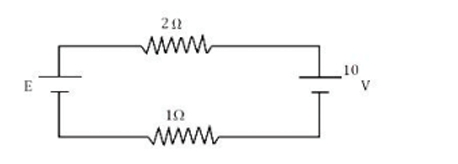
A current of flows through the following circuit in anticlockwise direction as well as in clockwise direction. The value of respectively is
1
2
3
4
Official Solution
Correct Option: (4)
Step 1: Identify total resistance. The resistances and are in series.
Step 2: Case I — Current in anticlockwise direction. Applying Kirchhoff’s loop law: Magnitude of .
Step 3: Case II — Current in clockwise direction. Now the sources oppose each other:
Step 4: Conclusion. The value of is for anticlockwise current and for clockwise current.
03
PYQ 2020
medium
physicsID: mht-cet-
To what depth must a rubber ball be taken in deep sea so that its volume is decreased by 0.2%? The bulk modulus of rubber is and the density of sea water is (g = 9.8 m/s )
1
200 m
2
100 m
3
50 m
4
25 m
Official Solution
Correct Option: (1)
Step 1: Formula for Volume Change. The change in volume due to pressure is related to the bulk modulus by the formula:
where is the bulk modulus and is the change in pressure. The pressure change at a depth is . Substituting, we get:
Step 2: Solving for Depth. We are given that the volume change is 0.2%, or . Solving for , we get:
Substituting the known values:
Step 3: Final Answer. Thus, the depth at which the volume will decrease by 0.2% is 200 m.
04
PYQ 2020
medium
physicsID: mht-cet-
A particle is moving along a circular path of radius with velocity . The magnitude of average acceleration after half revolution is
1
2
3
4
Official Solution
Correct Option: (2)
Step 1: Definition of average acceleration.
Step 2: Change in velocity after half revolution. After half revolution, velocity reverses direction. Hence,
Step 3: Time taken for half revolution.
Step 4: Calculating average acceleration.
Step 5: Conclusion. The magnitude of average acceleration is .
05
PYQ 2020
medium
physicsID: mht-cet-
If a capillary tube is immersed vertically in water, rise of water in capillary is . When the whole arrangement is taken to a depth in a mine, the water level rises to . The ratio is
1
2
3
4
Official Solution
Correct Option: (4)
Step 1: Expression for capillary rise. Capillary rise is given by: Hence, . Step 2: Value of acceleration due to gravity at depth . Acceleration due to gravity at depth is: Step 3: Relation between and . Step 4: Substitute value of .
06
PYQ 2020
medium
physicsID: mht-cet-
Which one of the following statements about the angle of contact is wrong?
1
is not constant for particular solid–liquid pair.
2
for pure water–glass pair.
3
for mercury–glass pair.
4
for kerosene–glass pair.
Official Solution
Correct Option: (1)
Step 1: Define angle of contact. Angle of contact is the angle between the tangent to the liquid surface at the point of contact and the solid surface, measured inside the liquid. Step 2: Nature of angle of contact. For a given solid–liquid pair and given surrounding medium, the angle of contact remains constant. Step 3: Check each option. - Pure water wets glass, so is small but greater than . - Mercury does not wet glass, hence . - Kerosene wets glass, so . Step 4: Identify the incorrect statement. Statement (A) is wrong because angle of contact is constant for a particular solid–liquid pair.