A bullet of mass moving with a velocity of strikes a target and is brought to rest in of a second. The impulse and average force of impact are respectively
1
2
3
4
Official Solution
Correct Option:
(4)
Step 1: Convert mass into SI units.
Step 2: Calculate impulse. Impulse Magnitude of impulse .
Step 3: Calculate average force.
Step 4: Conclusion. Impulse and average force .
02
PYQ 2020
medium
physicsID: mht-cet-
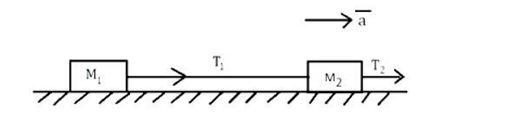
Two masses and are accelerated uniformly on a frictionless surface as shown in figure. The ratio of the tensions is
1
2
3
4
Official Solution
Correct Option:
(3)
Step 1: Understanding the scenario. The two masses and are connected and subjected to uniform acceleration on a frictionless surface. The tension in the string connecting them is and , respectively. We need to find the ratio . Step 2: Applying Newton’s second law. For mass , the tension causes an acceleration , so: For mass , the tension causes an acceleration , so: Step 3: Finding the ratio of tensions. From equations (1) and (2), we can write: But since both masses are moving together, the total mass being accelerated is . So, the ratio of the tensions becomes: Step 4: Conclusion. Therefore, the correct ratio of the tensions is , which corresponds to option (C).
03
PYQ 2020
medium
physicsID: mht-cet-
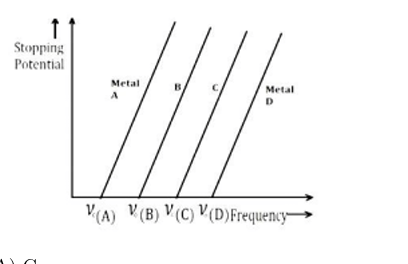
The variation of stopping potential for metals A, B, C and D with frequency of incident radiation is as shown in the figure. For which metal, stopping potential is higher for lower values of threshold frequency ( )? [The frequency of incident radiation is same.]
1
C
2
D
3
A
4
B
Official Solution
Correct Option:
(3)
Step 1: Photoelectric equation. Stopping potential is given by Step 2: Effect of threshold frequency. For a fixed incident frequency , a lower threshold frequency gives a larger value of , and hence a larger stopping potential. Step 3: Interpreting the graph. From the graph, metal A has the lowest threshold frequency among A, B, C and D. Step 4: Conclusion. Therefore, metal A has the highest stopping potential for the given frequency.
04
PYQ 2020
medium
physicsID: mht-cet-
The motion of a rocket in upward direction with high speed is based on the principle of conservation of
1
kinetic energy
2
mass
3
angular momentum
4
linear momentum
Official Solution
Correct Option:
(4)
Step 1: Understand rocket propulsion. A rocket moves upward by ejecting gases downward at high speed. Step 2: Apply conservation law. In absence of external forces, total linear momentum of rocket and exhaust gases remains conserved. Step 3: Explain motion. Downward momentum of gases produces equal upward momentum of the rocket. Step 4: Conclusion. Rocket propulsion is based on conservation of linear momentum.
05
PYQ 2020
medium
physicsID: mht-cet-
A ball at rest falls vertically on ground from a height of 5m. The coefficient of restitution is 0.4. The maximum height of the ball after the first rebound is
1
0.8 m
2
0.6 m
3
0.2 m
4
0.4 m
Official Solution
Correct Option:
(1)
Step 1: Understanding the coefficient of restitution. The coefficient of restitution ( ) is the ratio of the speed of separation to the speed of approach. When the ball hits the ground, the velocity of the ball just before the impact is given by , where is the height and is the acceleration due to gravity. After the collision, the velocity is reduced by the coefficient of restitution. Therefore, the rebound height will be related to the square of . Step 2: Calculating the rebound height. The velocity just before the rebound is: The rebound velocity is reduced by the factor , so the rebound velocity is: Now, the maximum height after the rebound is given by: Step 3: Conclusion. Thus, the maximum height of the ball after the first rebound is 0.8 m, corresponding to option (A).
06
PYQ 2020
medium
physicsID: mht-cet-
A block of mass is placed on a horizontal surface having coefficients of static and kinetic friction as and respectively. If a force parallel to the horizontal surface of is applied to the body, then the force of friction acting on the body will be
1
2
3
4
Official Solution
Correct Option:
(4)
Step 1: Calculate normal reaction.
Step 2: Calculate maximum static friction.
Step 3: Compare applied force with limiting friction. Applied force So the block does not move.
Step 4: Frictional force. For static condition, friction equals the applied force.
Step 5: Conclusion. The force of friction acting on the block is .
07
PYQ 2020
easy
physicsID: mht-cet-
A metal ball of mass 2 kg moving with a speed of 10 m/s had a head-on collision with a stationary ball of mass 3 kg. If after collision, both the balls move together, then the loss in kinetic energy due to collision is
Official Solution
Correct Option:
(1)
08
PYQ 2020
medium
physicsID: mht-cet-
A vehicle moving with 15 km/hr comes to rest by covering 5 m distance by applying brakes. If the same vehicle moves at 45 km/hr, then by applying brakes, it will come to rest by covering a distance of
1
15 m
2
45 m
3
60 m
4
30 m
Official Solution
Correct Option:
(2)
Step 1: Using the relation for stopping distance. The stopping distance is proportional to the square of the speed. Hence, if the stopping distance for a speed is , then for a speed , the stopping distance is given by: Substituting the given values: Step 2: Conclusion. The correct answer is (B), 45 m.
09
PYQ 2020
medium
physicsID: mht-cet-
A large open tank containing water has two holes to its wall. A square hole of side is made at a depth and a circular hole of radius is made at a depth from the surface of water. If equal amount of water comes out through both the holes per second, then the relation between and will be
1
2
3
4
Official Solution
Correct Option:
(4)
Step 1: Flow rate from holes.
The flow rate through an orifice is given by Torricelli's law:
where is the discharge coefficient, is the area of the hole, is the acceleration due to gravity, and is the height of the fluid above the hole. Step 2: Apply to both holes.
For the square hole, the area is , and the depth is . For the circular hole, the area is , and the depth is . The flow rates should be equal, so:
Simplifying:
Thus:
Step 3: Conclusion.
The correct relation between and is , so the correct answer is (D).
10
PYQ 2020
medium
physicsID: mht-cet-
A body initially at rest is acted upon by a constant force for time . The kinetic energy at time is
1
2
3
4
Official Solution
Correct Option:
(4)
Step 1: Use Newton’s second law. A constant force acting on a mass produces acceleration Step 2: Find velocity after time . Since the body starts from rest, Step 3: Write expression for kinetic energy.
Step 4: Substitute the value of velocity.
Step 5: Conclusion. The kinetic energy of the body at time is .
11
PYQ 2020
medium
physicsID: mht-cet-
A block of mass is moving on a rough horizontal surface. The coefficient of kinetic friction between block and surface is . The net force exerted by the surface on the block is
1
2
3
4
Official Solution
Correct Option:
(4)
Step 1: Understanding the forces. The net force exerted by the surface is the resultant of the frictional force and the force due to gravity. The frictional force , where is the normal force. Step 2: Finding the net force. The net force can be expressed as the square root of the sum of the squared forces, i.e., Step 3: Conclusion. The correct answer is (D), .
12
PYQ 2020
medium
physicsID: mht-cet-
A body of mass 5 kg is moving in a straight line. The relation between its displacement and time is m. What is the force acting on it at the end of 5 seconds?
1
150 N
2
120 N
3
80 N
4
100 N
Official Solution
Correct Option:
(1)
Step 1: Finding velocity. Velocity is the derivative of displacement with respect to time. The displacement is given by: Taking the derivative with respect to time : Step 2: Finding acceleration. Acceleration is the derivative of velocity with respect to time. Taking the derivative of : Step 3: Finding force. Force is given by . Substituting the values for mass and acceleration at : Thus, the force is: Thus, the correct answer is (A) 150 N.
13
PYQ 2025
easy
physicsID: mht-cet-
An object of mass is moving with a velocity of . What is the momentum of the object?
1
2
3
4
Official Solution
Correct Option:
(1)
Step 1: Formula for momentum Momentum is given by the product of mass and velocity: Step 2: Substitute the given values Given: - Mass - Velocity Answer: Therefore, the momentum of the object is . So, the correct answer is option (1).
14
PYQ 2025
easy
physicsID: mht-cet-
A car travels a distance of 200 meters in 20 seconds. What is the average speed of the car?
1
2
3
4
Official Solution
Correct Option:
(1)
Step 1: Use the formula for average speed Given: - Total distance = 200 m - Total time = 20 s Substitute the values into the formula: Answer: Therefore, the average speed of the car is . So, the correct answer is option (1).
15
PYQ 2025
easy
physicsID: mht-cet-
A block of mass 2 kg is acted upon by a net force of 10 N. What is its acceleration?
1
2 m/s\textsuperscript{2}
2
5 m/s\textsuperscript{2}
3
10 m/s\textsuperscript{2}
4
20 m/s\textsuperscript{2}
Official Solution
Correct Option:
(2)
According to Newton’s Second Law: Given: Force , Mass Rearranging to solve for acceleration: Option (b) is correct.
16
PYQ 2025
medium
physicsID: mht-cet-
A 0.2 kg ball is thrown vertically upwards with an initial velocity of . What is the maximum height reached by the ball?(Acceleration due to gravity )
1
2
3
4
Official Solution
Correct Option:
(1)
Step 1: Use the kinematic equation to find the maximum height At the maximum height, the final velocity . The equation for vertical motion is: Where: - is the final velocity - is the initial velocity - is the acceleration due to gravity - is the maximum height Given: - - - Rearrange the formula to solve for height : Answer: Therefore, the maximum height reached by the ball is . So, the correct answer is option (1).
17
PYQ 2025
medium
physicsID: mht-cet-
A block of mass is placed on a frictionless surface. If a force of is applied to the block, what will be the acceleration of the block?
1
2
3
4
Official Solution
Correct Option:
(1)
Step 1: Use Newton's second law of motion Where: - is the applied force - is the mass of the block - is the acceleration Given: - - Rearranging the formula to solve for acceleration : Answer: Therefore, the acceleration of the block is . So, the correct answer is option (1).
18
PYQ 2026
medium
physicsID: mht-cet-
Find the acceleration of a kg block acted upon by a net force of N.
1
2
3
4
Official Solution
Correct Option:
(2)
Concept: According to Newton's Second Law of Motion, where
= net force acting on the body
= mass of the body
= acceleration produced
Thus, Step 1: {Write the given values.} Step 2: {Substitute into the formula.} Step 3: {State the final result.} Hence, the acceleration of the block is
About Newtons Laws Of Motion - MHT-CET
Newtons Laws Of Motion is a vital chapter for MHT-CET aspirants. Mastering the concepts covered in this chapter is essential for securing a top rank.
By rigorously practicing the previous year questions associated with this chapter, you can identify high-yield topics, understand the examiner's perspective, and boost your confidence during the actual exam.
Frequently Asked Questions
Why focus on Newtons Laws Of Motion PYQs?
Analyzing PYQs for this specific chapter reveals the most frequently tested concepts and the typical complexity of questions, allowing you to tailor your study plan efficiently.
How to best use this analysis?
Review the topic breakdown to see which sub-topics within Newtons Laws Of Motion carry the most weight. Then, tackle the questions iteratively to solidify your understanding.