The time period of a particle in simple harmonic motion is 8 second. At t = 0 it is at the mean position. The ratio of the distances travelled by it in the first and second seconds is:
1
2
3
4
Official Solution
Correct Option:
(3)
Time period of particle is given by So, Equation of SHM is ?(i) ( At mean position t = 0) Hence, For t = 1 s E (i) becomes ?(ii) For t = 2 s E (i) becomes ?(iii) Now, the distance covered in 2 s is given by Again the ratio of the distance covered in first and second seconds is
02
PYQ 2006
medium
physicsID: mht-cet-
Two particles execute SHM of the same amplitude and frequency along the same straight line. If they pass one another when going in opposite directions, each time their displacement is half their amplitude, the phase difference between them is
1
2
3
4
Official Solution
Correct Option:
(4)
Equation of simple harmonic wave is
Here,
So, So, the phase difference of the two particles when they are crossing each other at y in opposite directions are
03
PYQ 2008
medium
physicsID: mht-cet-
The graph between the time period and the length of a simple pendulum is
1
straight line
2
curve
3
ellipse
4
parabola
Official Solution
Correct Option:
(4)
The time period of a simple pendulum is
Here, is the length of the pendulum. On squaring both sides
So, the graph between time period and length of the pendulum is a parabola.
04
PYQ 2010
medium
physicsID: mht-cet-
The equation of a simple harmonic progressive wave is given by . Find the distance between particles having a phase difference of .
1
2
3
4
Official Solution
Correct Option:
(1)
Given, The general equation,
and or
Phase difference,
or
Distance,
05
PYQ 2011
hard
physicsID: mht-cet-
A particle executes a simple harmonic motion of time period . Find the time taken by the particle to go directly from its mean position to half the amplitude
1
2
3
4
Official Solution
Correct Option:
(4)
At the mean position
06
PYQ 2018
medium
physicsID: mht-cet-
The path length of oscillation of simple pendulum of length 1 metre is 16 cm. Its maximum velocity is
1
2
3
4
Official Solution
Correct Option:
(3)
Given, Length of the pendulum Amplitude
Acceleration due to gravity We know that, time period
Maximum velocity
07
PYQ 2020
medium
physicsID: mht-cet-
Moving coil galvanometers and have resistance, number of turns, area of coil and magnetic field as follows: . (Spring constants are same for both materials.) The ratio of (i) current sensitivity and (ii) voltage sensitivity for galvanometer to is respectively
1
2
3
4
Official Solution
Correct Option:
(4)
Step 1: Current sensitivity. Current sensitivity of a moving coil galvanometer is Thus, Substituting values, Hence, current sensitivity ratio . Step 2: Voltage sensitivity. Voltage sensitivity is given by So, Step 3: Conclusion. The ratios are for current sensitivity and for voltage sensitivity.
08
PYQ 2020
medium
physicsID: mht-cet-
A cube of mass and side is fixed on the horizontal surface. Modulus of rigidity of the material of the cube is . A force is applied perpendicular to one of the side faces. When the force is removed, the cube executes small oscillations. The time period is
1
2
3
4
Official Solution
Correct Option:
(3)
Step 1: Understanding the time period of oscillation. The time period of small oscillations of a body can be given by the formula for oscillations due to restoring force: where is the moment of inertia and is the restoring force constant. For this system, is related to the modulus of rigidity . Step 2: Moment of inertia and restoring force. For a cube fixed on a surface, the moment of inertia about an axis perpendicular to one side is given by: The restoring force constant is related to the modulus of rigidity and the length of the cube. The time period is then: Step 3: Conclusion. Thus, the time period of oscillation is , corresponding to option (C).
09
PYQ 2020
medium
physicsID: mht-cet-
A body attached to a spring oscillates in horizontal plane with frequency . Its total energy is . If the velocity in the mean position is , then the spring constant is
1
2
3
4
Official Solution
Correct Option:
(3)
Step 1: Energy in simple harmonic motion (S.H.M.). In simple harmonic motion, the total energy is given by: where is the mass of the body, is the angular frequency, and is the amplitude of oscillation. Also, the velocity at the mean position is given by: Step 2: Relating total energy and velocity. We know that the angular frequency , so the total energy can be rewritten as: Substituting , we get: Step 3: Solving for spring constant. The spring constant is related to the angular frequency by: Substituting , we get: Step 4: Conclusion. Thus, the spring constant is , corresponding to option (C).
10
PYQ 2020
medium
physicsID: mht-cet-
The frequency of a particle performing linear S.H.M. is Hz. The differential equation of S.H.M. is
1
2
3
4
Official Solution
Correct Option:
(3)
Step 1: Understanding the formula. The frequency of simple harmonic motion is related to the angular frequency by:
Given that the frequency is , we can find the angular frequency as: Step 2: Relating angular frequency to the equation of motion. The equation of motion for S.H.M. is: Substituting , we get: Step 3: Conclusion. Thus, the differential equation for the given frequency is , corresponding to option (C).
11
PYQ 2020
medium
physicsID: mht-cet-
What should be the length of a closed pipe to produce resonance with sound wave of wavelength 62 cm, in fundamental mode? (Neglect end correction)
1
2
3
4
Official Solution
Correct Option:
(2)
Step 1: Condition for fundamental mode in closed pipe. For a closed pipe, the fundamental mode occurs when Step 2: Substituting wavelength. Given , Step 3: Conclusion. The required length of the closed pipe is .
12
PYQ 2020
medium
physicsID: mht-cet-
When a mass is suspended from a spring of length , the length of the spring becomes . The mass is pulled down by a distance and released. If the equation of motion of the mass is , then is equal to ( = acceleration due to gravity )
1
2
3
4
Official Solution
Correct Option:
(3)
Step 1: Extension of the spring. The extension produced in the spring is Step 2: Using equilibrium condition. At equilibrium, where is the spring constant. Hence, Step 3: Equation of motion. For simple harmonic motion, Comparing with the given equation, Step 4: Conclusion. Thus, the value of is .
13
PYQ 2020
medium
physicsID: mht-cet-
A body performs linear simple harmonic motion of amplitude . At what displacement from the mean position, the potential energy of the body is one fourth of its total energy?
1
2
3
4
Official Solution
Correct Option:
(2)
Step 1: Energy in SHM. Total energy in simple harmonic motion is constant and given by:
Step 2: Potential energy in SHM. Potential energy is given by:
Step 3: Condition for potential energy. At the required displacement, potential energy is one fourth of total energy:
Step 4: Solving for displacement.
Step 5: Conclusion. The displacement is .
14
PYQ 2020
medium
physicsID: mht-cet-
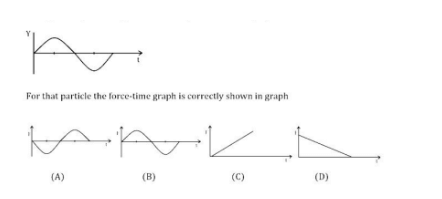
For a particle performing S.H.M., the displacement–time graph is as shown.
1
(B)
2
(C)
3
(A)
4
(D)
Official Solution
Correct Option:
(3)
Step 1: Force–displacement relation in SHM. For simple harmonic motion: Force is always proportional to displacement and opposite in direction.
Step 2: Relation between force and time. Since displacement varies sinusoidally with time, force will also vary sinusoidally with time but will be opposite in phase to displacement.
Step 3: Phase relation. When displacement is maximum positive, force is maximum negative and vice versa.
Step 4: Matching with given graphs. Among the given options, graph (A) correctly represents a sinusoidal force–time graph that is opposite in phase to the displacement–time graph.
Step 5: Conclusion. The correct force–time graph is option (A).
15
PYQ 2020
medium
physicsID: mht-cet-
A mass attached to a horizontal spring executes S.H.M. of amplitude . When the mass passes through its mean position, a smaller mass is placed over it and both move together with amplitude . The ratio is
1
2
3
4
Official Solution
Correct Option:
(3)
Step 1: Velocity at mean position. At mean position, the velocity of the mass is maximum and given by where
Step 2: Apply conservation of momentum. When mass is placed on , total mass becomes . Using conservation of momentum at mean position,
Step 3: Relate new velocity and amplitude. New angular frequency and
Step 4: Solve for amplitude ratio.
16
PYQ 2020
medium
physicsID: mht-cet-
A particle performs S.H.M. with amplitude . Its speed is tripled at the instant when it is at a distance of from the mean position. The new amplitude of the motion is
1
2
3
4
Official Solution
Correct Option:
(2)
Step 1: Write the expression for speed in S.H.M. The speed of a particle performing S.H.M. at displacement is given by:
Step 2: Apply the given condition. At displacement , the initial speed is:
Step 3: Use the condition of tripled speed. When the speed is tripled, the new speed becomes: Let the new amplitude be . Then,
Step 4: Solve for the new amplitude.
Step 5: Final conclusion. The new amplitude of the motion is .
17
PYQ 2020
medium
physicsID: mht-cet-
The displacement of a particle executing linear S.H.M. is m. If , the period of S.H.M. is
1
2
3
4
Official Solution
Correct Option:
(2)
Step 1: Compare with standard SHM equation. Standard equation of SHM is Step 2: Identify angular frequency. Comparing, Step 3: Write formula for time period.
Step 4: Substitute values.
Step 5: Conclusion. The time period of the SHM is .
18
PYQ 2023
medium
physicsID: mht-cet-
Find the height of a conical pendulum if the time period is given.
Official Solution
Correct Option:
(1)
If we have the length of the string and the time period, we can calculate the height using the following steps:
1. Identify the length of the string in meters.
2. Calculate the time period of the conical pendulum in seconds.
3. Determine the value of gravitational acceleration, typically taken as 9.8 m/s².
4. Use the formula for the time period of a conical pendulum:
Where T is the time period, h is the height, and g is the gravitational acceleration.
5. Rearrange the formula to solve for the height:
6. Substitute the known values of T and g into the formula and calculate the height.
Please note that this calculation assumes a perfectly ideal conical pendulum and neglects factors like air resistance and the mass of the string.
19
PYQ 2024
medium
physicsID: mht-cet-
A particle performs SHM, having a speed of 6 cm/sec at the mean position and an amplitude of 4 cm. Find the position of the particle from the mean position when its velocity is 2 cm/sec.
1
2
3
4
Official Solution
Correct Option:
(3)
To determine the position of the particle from the mean position when its velocity is , we can use the principles of Simple Harmonic Motion (SHM). Given: Maximum speed at mean position, Amplitude of SHM, Velocity at position , Step 1: Relate Maximum Speed to Angular Frequency In SHM, the maximum speed is related to the angular frequency and amplitude by the equation:
Solving for :
Step 2: Use the Velocity-Position Relationship in SHM The velocity of a particle in SHM at position is given by:
Solving for :
Step 3: Substitute the Known Values Substitute , , and into the equation:
Rounding to the nearest whole number:
Conclusion: The position of the particle from the mean position when its velocity is is:
20
PYQ 2024
medium
physicsID: mht-cet-
The time period of SHM is with mass . If an additional mass of is added, the time period increases by . What is (in grams)?
1
2
3
4
Official Solution
Correct Option:
(1)
The time period of a simple harmonic motion (SHM) is given by: where: is the time period, is the mass, is the spring constant.
Step 1: Initial time period. The time period with mass is: Squaring both sides: Rearranging for :
Step 2: New time period with added mass. The new time period is , and the total mass becomes : Rearranging:
Step 3: Subtract initial from new equation. From the two equations: Factorize: Substitute and : Simplify: Solve for :
Step 4: Substitute back to find . Using the expression for : Substitute : Simplify: Convert to grams: Thus, the mass is .
21
PYQ 2024
medium
physicsID: mht-cet-
Which of the following is a logic gate that gives an output of 1 when the inputs are different?
Official Solution
Correct Option:
(1)
The XOR (exclusive OR) gate produces an output of 1 when the inputs are different (i.e., one is 0 and the other is 1). If the inputs are the same, the output is 0. - AND Gate: Output is 1 only when both inputs are 1.
- OR Gate: Output is 1 if at least one input is 1.
- XOR Gate: Output is 1 if the inputs are different.
- NOT Gate: It only inverts one input. Therefore, the correct answer is XOR Gate.
22
PYQ 2024
medium
physicsID: mht-cet-
What is the overtone of a vibrating string?
Official Solution
Correct Option:
(1)
In the context of a vibrating string, the fundamental frequency is the first harmonic. The overtones are higher frequency modes of vibration that occur at integer multiples of the fundamental frequency. - The first harmonic is the fundamental frequency.
- The second harmonic is the first overtone, which has twice the frequency of the fundamental.
- The third harmonic is the second overtone, which has three times the frequency of the fundamental. Thus, the overtone refers to the second harmonic.
23
PYQ 2024
medium
physicsID: mht-cet-
How do you find the amplitude of a simple harmonic oscillator?
Official Solution
Correct Option:
(1)
The amplitude of a simple harmonic oscillator can be found using the total mechanical energy of the system. The total energy is the sum of potential and kinetic energy:
Solving for , we get:
Thus, the amplitude is related to the total energy and the spring constant .
24
PYQ 2024
medium
physicsID: mht-cet-
The root mean square velocity ( ) of a gas is given by:
Official Solution
Correct Option:
(1)
The root mean square (rms) velocity of a gas is given by the formula:
where:
- is the Boltzmann constant,
- is the temperature in Kelvin,
- is the mass of one molecule of the gas. This formula gives the square root of the average of the squared velocities of gas molecules. It is derived from the kinetic theory of gases.
25
PYQ 2024
easy
physicsID: mht-cet-
The potential energy of a particle performing linear S.H.M is joules. If the mass of the particle is , find the frequency of S.H.M:
1
2
3
4
Official Solution
Correct Option:
(3)
Step 1: Start with the formula for potential energy in S.H.M.
The potential energy is given by:
where: is the mass of the particle, is the angular frequency, is the displacement. From the question, the potential energy is given as:
Equating:
Cancel from both sides:
Substitute :
Simplify:
Step 2: Solve for angular frequency and frequency.
Take the square root:
The frequency is given by:
Substitute :
Using :
Thus, the frequency of S.H.M is .
26
PYQ 2024
medium
physicsID: mht-cet-
A particle performs simple harmonic motion with amplitude . Its speed is tripled at the instant that it is at a distance from the equilibrium position. The new amplitude of the motion is:
1
2
3
4
Official Solution
Correct Option:
(2)
In this problem, we are tasked with determining the new amplitude when the velocity of a particle performing simple harmonic motion triples. The velocity of a particle in simple harmonic motion is given by the equation:
where:
Step 1: Initial velocity at displacement The initial velocity is given by:
Simplify:
Step 2: Velocity when speed is tripled The final velocity is three times the initial velocity, so:
Substitute the expression for :
Simplify:
Step 3: Solve for Square both sides to eliminate the square roots:
Rearrange the equation:
Simplify:
Now, take the square root of both sides:
Final Answer:
27
PYQ 2025
easy
physicsID: mht-cet-
A simple pendulum of length 1 m is oscillating with a small amplitude. If the acceleration due to gravity is , what is the time period of the pendulum?
1
2
3
4
Official Solution
Correct Option:
(2)
The time period of a simple pendulum oscillating with small amplitude is given by the formula:
Where:
- (length of the pendulum),
- (acceleration due to gravity). Substitute the values into the formula:
Rounding to one decimal place, the time period is approximately . Thus, the time period of the pendulum is .
28
PYQ 2025
hard
physicsID: mht-cet-
A 1.5 kg block is placed on a frictionless surface and attached to a spring with a spring constant of 100 N/m. If the block is displaced by 0.2 m from its equilibrium position, what is the potential energy stored in the spring?
1
2
3
4
Official Solution
Correct Option:
(1)
Given:
Mass of the block:
Spring constant:
Displacement from equilibrium:
Step 1: Use the formula for the potential energy stored in a spring
The potential energy stored in a spring is given by Hooke's law: where: - is the potential energy stored in the spring, - is the spring constant, - is the displacement from the equilibrium position.
Step 2: Substitute the given values into the formula
✅ Final Answer:
The potential energy stored in the spring is .
29
PYQ 2026
medium
physicsID: mht-cet-
A particle performs SHM with an amplitude of 5 cm. Find its acceleration when it is 3 cm from the mean position (assume ).
1
2
3
4
Official Solution
Correct Option:
(3)
Concept: In Simple Harmonic Motion (SHM), acceleration is directly proportional to displacement from the mean position and always directed toward the mean position. The relation is where = acceleration, = angular frequency, = displacement from mean position. Step 1: {Substitute the given values.} Step 2: {Interpret the result.} The negative sign indicates the acceleration is directed toward the mean position. Thus the magnitude of acceleration is
About Simple Harmonic Motion - MHT-CET
Simple Harmonic Motion is a vital chapter for MHT-CET aspirants. Mastering the concepts covered in this chapter is essential for securing a top rank.
By rigorously practicing the previous year questions associated with this chapter, you can identify high-yield topics, understand the examiner's perspective, and boost your confidence during the actual exam.
Frequently Asked Questions
Why focus on Simple Harmonic Motion PYQs?
Analyzing PYQs for this specific chapter reveals the most frequently tested concepts and the typical complexity of questions, allowing you to tailor your study plan efficiently.
How to best use this analysis?
Review the topic breakdown to see which sub-topics within Simple Harmonic Motion carry the most weight. Then, tackle the questions iteratively to solidify your understanding.