A ball of mass attached to the end of a string of length is moving in a horizontal circle. The string will break if the tension is more than . What is the maximum speed with which ball can be moved?
1
2
3
4
Official Solution
Correct Option: (1)
The correct option is(A): 14m/s. Tension of string
02
PYQ 2020
medium
physicsID: mht-cet-
A bullet of mass is fired from a gun of mass with a speed of . The magnitude of recoil velocity of the gun is
1
2
3
4
Official Solution
Correct Option: (3)
Step 1: Apply law of conservation of momentum. Initially, the system is at rest, so total momentum is zero. Step 2: Write momentum balance equation. Step 3: Substitute given values. Step 4: Calculate recoil velocity.
03
PYQ 2020
medium
physicsID: mht-cet-
A cricket ball of mass moving with a velocity of is turned back with a velocity of on hitting the bat. The force of the blow lasts for . The force exerted on the ball by the bat is
1
2
3
4
Official Solution
Correct Option: (1)
Step 1: Converting mass into kg.
Step 2: Calculating change in velocity. Initial velocity Final velocity
Step 3: Change in momentum.
Step 4: Force exerted.
Step 5: Conclusion. The force exerted on the ball is .
04
PYQ 2020
medium
physicsID: mht-cet-
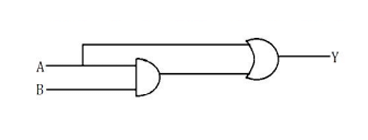
The output in the following logic circuit will be ONE only if
1
B is β1β
2
A is β1β
3
B is β0β
4
A is β0β
Official Solution
Correct Option: (2)
Step 1: Identifying the gates. The first gate is an AND gate taking inputs A and B. The output of this AND gate and input A go into an OR gate. Step 2: Writing the Boolean expression.
Step 3: Simplifying the expression.
Step 4: Conclusion. The output will be ONE only when A is β1β.
05
PYQ 2020
medium
physicsID: mht-cet-
Pascalβs law is not applied in
1
a hydraulic jack.
2
hydraulic brakes.
3
a hydraulic press.
4
an automiser.
Official Solution
Correct Option: (4)
Step 1: State Pascalβs law. Pascalβs law states that pressure applied to an enclosed fluid is transmitted equally in all directions throughout the fluid.
Step 2: Analyze the given options. (A) Hydraulic jack: Works on Pascalβs law to lift heavy loads using pressure transmission. (B) Hydraulic brakes: Pressure applied at one point is transmitted equally to brake pistons. (C) Hydraulic press: Uses Pascalβs law to multiply force. (D) Automiser: Works on Bernoulliβs principle, not Pascalβs law.
Step 3: Conclusion. Pascalβs law is not applied in an automiser.
06
PYQ 2020
medium
physicsID: mht-cet-
A positively charged particle travelling at with respect to the direction of a magnetic field of strength experiences a force of . The speed of the charged particle will be
1
2
3
4
Official Solution
Correct Option: (2)
Step 1: Write the formula for magnetic force. The magnetic force on a charged particle is given by:
Step 2: Substitute given values.
Step 3: Simplify the expression.
Step 4: Solve for velocity.
Step 5: Conclusion. The speed of the charged particle is .
07
PYQ 2020
medium
physicsID: mht-cet-
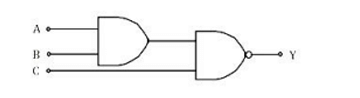
For the following combination of logic gates, when all the three inputs are first high and then low, the output will respectively be
1
2
3
4
Official Solution
Correct Option: (4)
Step 1: Identify the logic gates. From the diagram, the first gate is an OR gate taking inputs . The output of this OR gate is then fed into a NAND gate (AND gate followed by NOT).
Step 2: Case 1 β All inputs are HIGH (A = B = C = 1). OR gate output = . This output is applied to the NAND gate input. NAND gate output = .
Step 3: Case 2 β All inputs are LOW (A = B = C = 0). OR gate output = . This output is applied to the NAND gate input. NAND gate output = .
Step 4: Conclusion. When inputs are first HIGH, output is , and when inputs are LOW, output is .
08
PYQ 2020
medium
physicsID: mht-cet-
A block of mass moving on a frictionless surface at speed collides elastically with a block of same mass, initially at rest. Now the first block moves at an angle with its initial direction and has speed . The speed of the second block after collision is:
1
2
3
4
Official Solution
Correct Option: (3)
Step 1: Conservation of Momentum. In elastic collisions, the total momentum before and after the collision is conserved. Since both blocks have the same mass, the velocities are related by the following equation:
where is the velocity of the second block after the collision. Step 2: Final Answer. Thus, the speed of the second block is given by .
09
PYQ 2020
medium
physicsID: mht-cet-
A block of mass collides with another stationary block of mass . The lighter block comes to rest after collision. If the velocity of the first block is , then the value of the coefficient of restitution is:
1
0.4
2
0.8
3
0.5
4
0.6
Official Solution
Correct Option: (3)
Step 1: Coefficient of Restitution Formula. The coefficient of restitution is defined as:
For this problem, the relative velocity before the collision is , and the relative velocity after the collision is , where is the velocity of the second block after collision. Since the lighter block comes to rest, . Hence:
Step 2: Final Answer. Thus, the coefficient of restitution is 0.5.
10
PYQ 2020
medium
physicsID: mht-cet-
A wooden block is placed on a rough horizontal surface. It is given a velocity m/s and the coefficient of friction between the block and the surface is . The distance covered by the block before coming to rest is: (g = acceleration due to gravity)
1
2
3
4
Official Solution
Correct Option: (2)
Step 1: Work-Energy Principle. The block moves under the influence of friction, and the work done by the frictional force brings the block to rest. The frictional force is given by:
where is the mass of the block and is the acceleration due to gravity. The work done by the frictional force is equal to the change in kinetic energy:
where is the distance covered by the block and is the initial velocity. Solving for , we get:
Step 2: Final Answer. Thus, the distance covered by the block before coming to rest is .
11
PYQ 2020
medium
physicsID: mht-cet-
A galvanometer of resistance has a current sensitivity of 5 div/mA. The instrument has 50 divisions. It can be converted into a voltmeter reading up to 25 V by connecting a resistance of
Step 4: Conclusion. A resistance of in series is required.
12
PYQ 2020
medium
physicsID: mht-cet-
What is the least radius of curve on a horizontal road, at which a vehicle can travel with a speed of at an angle of inclination ?
1
2
3
4
Official Solution
Correct Option: (1)
Step 1: Convert speed into m/s. Step 2: Use formula for banking of roads. Step 3: Substitute given values. Step 4: Solve for radius .
13
PYQ 2020
medium
physicsID: mht-cet-
A block of mass is kept on an ice surface. When a velocity of is given to it, it stops by friction in . The coefficient of friction is
1
2
3
4
Official Solution
Correct Option: (4)
Step 1: Calculate acceleration. Initial velocity , final velocity , time . Step 2: Relation between acceleration and friction. Step 3: Calculate coefficient of friction.
14
PYQ 2020
medium
physicsID: mht-cet-
In phase modulation, according to the information signal, a parameter of the carrier wave which is varied, is
1
Phase shift
2
Phase shift as well as amplitude
3
Amplitude
4
Amplitude as well as frequency
Official Solution
Correct Option: (1)
Step 1: Understanding phase modulation. In phase modulation (PM), the phase of the carrier signal is varied in accordance with the information signal. The amplitude and frequency of the carrier wave remain constant, while the phase changes with the information signal. Step 2: Conclusion. Thus, the parameter that is varied in phase modulation is the phase shift, which corresponds to option (A).
15
PYQ 2020
medium
physicsID: mht-cet-
A bomb at rest explodes into three parts of same mass. The momentum of two parts is and respectively. The magnitude of the momentum of third part is
1
2
3
4
Official Solution
Correct Option: (2)
Step 1: Understanding the problem. Since the bomb is initially at rest, the total momentum of the system is zero. After the explosion, the vector sum of the momenta of the three parts must still be zero. Step 2: Apply the given momentum values. The momentum of the first two parts is given as and . Let the momentum of the third part be . Step 3: Apply the Pythagorean theorem. Since the total momentum is zero, we can use the Pythagorean theorem to find the magnitude of the third momentum . We have:
Substituting the given values:
Step 4: Conclusion. Thus, the magnitude of the momentum of the third part is , which corresponds to option (B).
16
PYQ 2020
medium
physicsID: mht-cet-
A particle is performing vertical circular motion. The difference in tension at lowest and highest point is
1
2
3
4
Official Solution
Correct Option: (2)
Step 1: Tension at lowest point. At the lowest point: Step 2: Tension at highest point. At the highest point: Step 3: Difference in tension. Step 4: Simplification.
17
PYQ 2022
easy
physicsID: mht-cet-
A van is moving with a speed of 108 km/hr on a level road where the coefficient of friction between the tyres and the road is 0.5. For the safe driving of the van, the minimum radius of curvature of the road shall be (Acceleration due to gravity, g=10 m/s2)
1
180 m
2
120 m
3
80 m
4
40 m
Official Solution
Correct Option: (1)
The centripetal force required to keep the van moving in a curved path is given by: Fc = The maximum frictional force that can be provided by the tires is given by: Ffriction = ΞΌmg For safe driving, the maximum centripetal force must be less than or equal to the maximum frictional force. Therefore, we can equate the two expressions: = ΞΌmg = ΞΌg r = Now we can substitute the given values: v = 108 km/hr v = = v = 30 m/s ΞΌ = 0.5 g = 10 m/s2 r = r = m r = 180 m Therefore, the minimum radius of curvature of the road for safe driving is 180 meters. So, the correct option is (A) 180 m.
18
PYQ 2024
easy
physicsID: mht-cet-
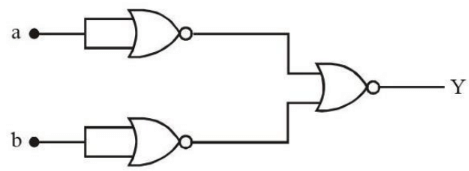
The logic performed by the circuit shown in the figure is equivalent to:
1
2
3
4
Official Solution
Correct Option: (1)
The circuit performs the following logical operations:
The first two NOT gates take inputs and , producing the complements and respectively.
The OR gate then combines the complements:
The result from the OR gate is then complemented by another NOT gate, yielding the final output:
Using De Morgan's law, we simplify:
Thus, the circuit implements the logic of an AND gate.
Truth Table:
The output matches the truth table of an AND gate.
Final Answer:
19
PYQ 2024
easy
physicsID: mht-cet-
A rocket of initial mass 6000 kg ejects gases at a constant rate of 16 kg/s with a constant relative speed of 11 km/s. What is the acceleration of the rocket one minute after the blast?
Official Solution
Correct Option: (1)
Step 1: Identify the variables. \begin{itemize} Initial mass of the rocket ( ) = 6000 kg. Rate of mass ejection ( ) = 16 kg/s. Relative speed of ejected gases ( ) = 11 km/s = 11000 m/s. Time ( ) = 1 minute = 60 seconds.
\end{itemize} Step 2: Calculate the mass of the rocket after 1 minute. The mass decreases at a constant rate:
Substitute the values:
Step 3: Use the rocket equation to find acceleration. The acceleration of the rocket is given by:
Substitute the known values:
Simplify:
Thus, the acceleration of the rocket after 1 minute is .
20
PYQ 2024
medium
physicsID: mht-cet-
Light emerges out of a convex lens when a source of light is kept at its focus. The shape of the wavefront of the light is:
1
Both spherical and cylindrical
2
Cylindrical
3
Spherical
4
Plane
Official Solution
Correct Option: (4)
A wavefront is defined as the locus of points that oscillate in phase. When a point source of light is placed at the focal point of a convex lens, the rays of light emerging from the lens become parallel to each other. These parallel rays form a plane wavefront, as all points on the wavefront lie at the same distance from the source and propagate in the same direction. The convex lens transforms the initially spherical wavefront into a plane wavefront due to its focusing properties. Final Answer:
21
PYQ 2024
medium
physicsID: mht-cet-
Correct Bernoulliβs equation is (symbols have their usual meaning):
1
2
3
4
Official Solution
Correct Option: (2)
Bernoulliβs theorem describes the conservation of energy in a flowing fluid and can be derived by analyzing the work done by pressure forces, gravity, and changes in velocity along a streamline. It is mathematically expressed as:
where: : Pressure energy per unit volume, : Density of the fluid, : Gravitational acceleration, : Height above a reference level, : Velocity of the fluid. To analyze the given options: Option (a): The use of (mass) instead of (density) is incorrect because Bernoulliβs equation is based on energy per unit volume, not mass. Option (c): Modifying the potential energy term as instead of is dimensionally inconsistent. Option (d): Changing the kinetic energy term from to is incorrect for fluid dynamics, as it does not conform to energy per unit volume. Only option (b) correctly preserves the balance of energy terms per unit volume:
Final Answer:
22
PYQ 2024
medium
physicsID: mht-cet-
An electric field is given by . The electric flux through a surface area lying in the YZ-plane (in SI units) is:
1
2
3
4
Official Solution
Correct Option: (1)
An electric field is given by . The electric flux through a surface area lying in the YZ-plane (in SI units) is:
Solution:
The electric flux ( ) through a surface is calculated using the dot product of the electric field vector ( ) and the area vector ( ):
Given:
Electric field:
Area vector:
The area vector indicates that the surface lies in the YZ-plane, and the vector is directed along the X-axis (perpendicular to the YZ-plane).
Now, calculate the dot product:
Recall that:
Therefore:
Thus, the electric flux through the surface is 180 N m2/C.
Final Answer:
23
PYQ 2024
medium
physicsID: mht-cet-
A magnetic needle is kept in a non-uniform magnetic field. It experiences:
1
neither a force nor a torque
2
a torque but not a force
3
a force but not a torque
4
a force and a torque
Official Solution
Correct Option: (4)
When a magnetic needle is placed in a non-uniform magnetic field, it experiences both a net force and a torque. The non-uniform magnetic field applies forces of different magnitudes on the north and south poles of the needle, causing an imbalance. This imbalance results in a net force acting on the needle. Simultaneously, these unequal forces produce a torque that aligns the needle along the magnetic field lines. Final Answer:
24
PYQ 2024
medium
physicsID: mht-cet-
Point charge of is placed at the origin. At what location on the X-axis should a point charge of be placed so that the net electric field is zero at on the X-axis?
1
2
3
4
Official Solution
Correct Option: (1)
To find the position where the second charge ( ) should be located so that the net electric field is zero at : Step 1: Balance the Electric Fields The net electric field at is zero when the contributions from both charges cancel out: Step 2: Simplify the Equation Divide out and simplify the terms: Step 3: Solve for Rearrange the equation: Take the square root of both sides: Thus: Step 4: Choose the Correct Value of Since the second charge is positioned to the right of , the correct location is: Final Answer:
25
PYQ 2024
medium
physicsID: mht-cet-
A light-emitting diode (LED) is fabricated using GaAs semiconductor material whose band gap is . The wavelength of light emitted from the LED is:
1
2
3
4
Official Solution
Correct Option: (3)
The wavelength of emitted light is determined using the relationship between the band gap energy and wavelength : Rearranging for : Step 1: Substitute the Given Values Given:
Substitute into the equation: Perform the calculation: Final Answer:
26
PYQ 2024
medium
physicsID: mht-cet-
The mass of proton, neutron, and helium nucleus are respectively . The binding energy of the helium nucleus is:
1
2
3
4
Official Solution
Correct Option: (3)
To find the binding energy ( ) of a nucleus, we use the equation:
where is the mass defect and is the speed of light. For the helium nucleus, the mass defect is:
where:
- is the mass of a proton,
- is the mass of a neutron,
- is the mass of the helium nucleus. Substitute the values for the protons and neutrons:
Now, to convert the mass defect into energy, we use the conversion factor :
Final Answer:
27
PYQ 2024
medium
physicsID: mht-cet-
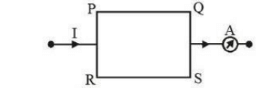
A current-carrying rectangular loop PQRS is made of uniform wire. The length PR = QS = and PQ = RS = . If the ammeter current reading changes from to , the ratio of magnetic forces per unit length on the wire PQ due to wire RS in the two cases respectively is:
1
2
3
4
Official Solution
Correct Option: (2)
The magnetic force per unit length between two parallel current-carrying wires is expressed as: where: - is the permeability of free space, - and are the currents in the two wires, - is the separation between the wires. Step 1: Analyze Proportionality for The magnetic force is proportional to the product of the currents: When the current is increased to : Step 2: Calculate the Ratio of Forces The ratio of the magnetic forces is: Therefore, the ratio of the forces is: Final Answer:
28
PYQ 2025
medium
physicsID: mht-cet-
A car of mass 1000 kg is moving with a velocity of 20 m/s. The driver applies the brakes, and the car comes to rest in 10 seconds. Find the average force exerted by the brakes to stop the car.
1
2
3
4
Official Solution
Correct Option: (1)
To find the average force exerted by the brakes, we can use Newton's second law of motion, which states that the force is the product of mass and acceleration: .
Initially, we need to determine the acceleration. Since the car comes to rest, the final velocity ( ) is 0 m/s, and the initial velocity ( ) is 20 m/s. The time taken ( ) is 10 seconds.
The formula for acceleration ( ) is given by:
Substituting the values, we get:
This negative sign indicates that the car is decelerating.
Now, apply the formula for force:
Substitute the known values (mass , acceleration ):
The negative sign denotes that the force is acting in the opposite direction of motion, which corresponds to the braking force. Therefore, the magnitude of the average braking force is:
29
PYQ 2025
easy
physicsID: mht-cet-
A 5 kg block is placed on a horizontal surface. A force of 10 N is applied to the block. The coefficient of friction between the block and the surface is 0.2. Find the acceleration of the block.
1
2
3
4
Official Solution
Correct Option: (1)
Given:
Mass of the block:
Applied force:
Coefficient of friction:
Acceleration due to gravity:
Step 1: Calculate the frictional force
The frictional force is given by: where is the normal force. Since the block is on a horizontal surface, the normal force is equal to the weight of the block: Thus, the frictional force is:
Step 2: Calculate the net force
The net force acting on the block is the applied force minus the frictional force:
Step 3: Calculate the acceleration using Newton's Second Law
Newton's Second Law states: Solving for acceleration :
β Final Answer:
The acceleration of the block is .
30
PYQ 2025
easy
physicsID: mht-cet-
A ball is thrown vertically upwards with an initial velocity of 20 m/s. If the acceleration due to gravity is , what is the maximum height reached by the ball?
1
2
3
4
Official Solution
Correct Option: (2)
To find the maximum height reached by the ball, we use the kinematic equation:
Where:
- (final velocity at the maximum height, where the ball momentarily stops),
- (initial velocity),
- (acceleration due to gravity, negative as it opposes the upward motion),
- is the maximum height (displacement). Substitute the values:
Alternatively, we can use the formula for maximum height in projectile motion:
Thus, the maximum height reached by the ball is .
31
PYQ 2025
easy
physicsID: mht-cet-
A ball is thrown vertically upwards with an initial velocity of 20 m/s. Calculate the time it takes for the ball to reach the highest point. (Assume )
1
2
3
4
Official Solution
Correct Option: (1)
At the highest point, the velocity of the ball becomes zero. Using the equation of motion:
Where:
- (velocity at the highest point),
- (initial velocity),
- (acceleration due to gravity, acting downward). Rearranging the equation to solve for time :
Thus, the time taken for the ball to reach the highest point is .
32
PYQ 2025
easy
physicsID: mht-cet-
A 0.2 kg ball is dropped from a height of 10 meters. What is the velocity of the ball just before it hits the ground? (Assume and neglect air resistance.)
1
2
3
4
Official Solution
Correct Option: (1)
Using the equation of motion for an object in free fall:
Where:
- (initial velocity, as the ball is dropped),
- is the acceleration due to gravity,
- is the height from which the ball is dropped. Substitute the values:
Thus, the velocity of the ball just before it hits the ground is .
33
PYQ 2025
easy
physicsID: mht-cet-
A car accelerates uniformly from rest to a speed of 20 m/s in 10 seconds. What is the car's acceleration?
1
2
3
4
Official Solution
Correct Option: (1)
To determine the car's acceleration, we will use the formula for uniform acceleration:
Where:
= final velocity =
= initial velocity = (since the car starts from rest)
= time =
Substituting the values:
Therefore, the car's acceleration is . However, based on the provided options, none of the given choices matches our calculated answer.
34
PYQ 2025
hard
physicsID: mht-cet-
A 2 kg object is hanging vertically from a rope. The tension in the rope is 15 N. What is the acceleration of the object? (Assume )
1
2
3
4
Official Solution
Correct Option: (1)
Given:
Mass of the object:
Tension in the rope:
Acceleration due to gravity:
Step 1: Use Newton's Second Law of Motion
The net force acting on the object is the difference between the tension in the rope and the gravitational force: where: - is the tension in the rope, - is the gravitational force acting on the object. The net force causes the object to accelerate, so according to Newtonβs second law: where: - is the acceleration of the object, - is the mass of the object.
Step 2: Set up the equation for acceleration
Combining the equations for and : Substituting the known values:
Step 3: Solve for acceleration
The negative sign indicates that the object is accelerating downward, but the magnitude of the acceleration is:
35
PYQ 2026
medium
physicsID: mht-cet-
A block of mass is on a frictionless surface; find its acceleration when a force of is applied.
1
2
3
4
Official Solution
Correct Option: (2)
Concept:
According to Newtonβs Second Law of Motion, where
= applied force,
= mass of the object,
= acceleration. Step 1: Write the given values. Step 2: Apply Newtonβs second law. Step 3: Calculate the acceleration. Thus, the acceleration of the block is