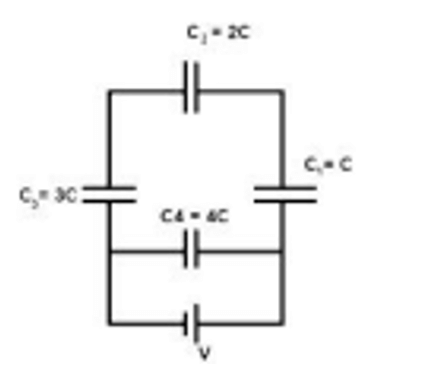
A network of four capacitors is connected to a battery as shown. The ratio of the charges on capacitors and is
1
2
3
4
Official Solution
Correct Option: (4)
Step 1: Identify capacitor values and connections. From the figure, the capacitances are: The circuit is a bridge-type network connected across a battery of voltage . Step 2: Note symmetry and equivalent combinations. The left and right vertical branches form parallel paths between the same two nodes. The top and middle capacitors are connected between these branches. Step 3: Apply charge–voltage relation. For any capacitor, Hence, the ratio of charges depends on the effective potential difference across each capacitor. Step 4: Use node potential method. Let the potential difference across the network be . On solving the node equations for this capacitor bridge (using charge conservation at junctions), the effective potential drops across and are obtained in the ratio: Step 5: Calculate ratio of charges.
Step 6: Conclusion. The ratio of charges on capacitors and is .
02
PYQ 2020
medium
physicsID: mht-cet-
Two identical parallel plate air capacitors are connected in series to a battery of e.m.f. . If one of the capacitors is inserted in liquid of dielectric constant , then potential difference of the other capacitor will become
1
2
3
4
Official Solution
Correct Option: (2)
Step 1: Understanding the capacitor's behavior. For capacitors in series, the total capacitance is given by . When a dielectric is inserted, the capacitance increases by a factor of , so the capacitance of the dielectric-inserted capacitor becomes . Step 2: Applying the formula. For the two capacitors, the total potential difference is , and we have the relation: Using the capacitance formula and the fact that , we can solve for (the potential across the capacitor without the dielectric). After simplification, we get: Step 3: Conclusion. The correct answer is (B), .
03
PYQ 2020
medium
physicsID: mht-cet-
A capacitor is charged by a battery and energy stored is . Now the battery is removed and the distance between plates is increased to four times. The energy stored becomes
1
2
3
4
Official Solution
Correct Option: (1)
Step 1: Condition after removing battery. When the battery is removed, charge on the capacitor remains constant.
Step 2: Relation between capacitance and plate separation. Capacitance of a parallel plate capacitor is: If distance is increased to , new capacitance becomes:
Step 3: Energy stored in a capacitor.
Step 4: New energy after increasing distance.
Step 5: Conclusion. Energy stored becomes .
04
PYQ 2020
medium
physicsID: mht-cet-
Seven capacitors each of capacitance are to be connected to obtain equivalent capacitance of . Which of the following combination is possible?}
1
3 in parallel and 4 in series
2
2 in parallel and 5 in series
3
5 in parallel and 2 in series
4
4 in parallel and 3 in series
Official Solution
Correct Option: (3)
Step 1: Capacitance of 5 capacitors in parallel. Capacitance in parallel adds directly.
Step 2: Capacitance of 2 capacitors in series. For two identical capacitors in series:
Step 3: Equivalent capacitance of series combination of and .
Step 4: Conclusion. Required equivalent capacitance is obtained when 5 capacitors are in parallel and 2 are in series.
05
PYQ 2020
medium
physicsID: mht-cet-
Three condensers of capacities are connected in series with a source of e.m.f. . The potentials across the three condensers are in the ratio of
1
2
3
4
Official Solution
Correct Option: (4)
Step 1: Property of capacitors in series. When capacitors are connected in series, the charge on each capacitor is the same.
Step 2: Relation between potential and capacitance.
Step 3: Ratio of potentials.
06
PYQ 2020
medium
physicsID: mht-cet-
Choose the correct statement. In conductors
1
valence band and conduction band overlap each other.
2
valence band and conduction band are separated by a large energy gap.
3
very small number of electrons are available for electrical conduction.
4
valence band and conduction band are separated by a small energy gap.
Official Solution
Correct Option: (1)
Step 1: Understanding conductors. In conductors, the valence band and conduction band overlap, meaning that electrons in the valence band can easily move into the conduction band when an external electric field is applied, allowing electrical conduction.
Step 2: Analyzing the options. - (A) Valence band and conduction band overlap each other. This is correct for conductors. - (B) In conductors, the valence and conduction bands do not have a large energy gap, as this would prevent easy conduction of electrons. - (C) In conductors, a large number of electrons are available for electrical conduction, not a very small number. - (D) In conductors, the gap between the valence and conduction bands is either very small or nonexistent.
Step 3: Conclusion. The correct answer is (A), as conductors have overlapping valence and conduction bands.
07
PYQ 2020
medium
physicsID: mht-cet-
Four capacitors of equal capacity have an equivalent capacitance when connected in series and an equivalent capacitance when connected in parallel. The ratio is
1
2
3
4
Official Solution
Correct Option: (3)
Step 1: Assume capacitance of each capacitor. Let each capacitor have capacitance .
Step 2: Equivalent capacitance in series. For four capacitors in series,
Step 3: Equivalent capacitance in parallel. For four capacitors in parallel,
Step 4: Find the ratio.
08
PYQ 2020
medium
physicsID: mht-cet-
Choose the correct statement. In case of insulators,
1
conduction band is partially filled and valence band is partially empty
2
conduction band and valence band overlap each other
3
conduction band is empty
4
there is no gap between conduction and valence band
Official Solution
Correct Option: (3)
Step 1: Band structure of solids. In solids, electrical conductivity depends on the distribution of electrons in the valence band and conduction band. Step 2: Behaviour of insulators. In insulators, the valence band is completely filled and the conduction band is completely empty due to a large energy gap between them. Step 3: Elimination of incorrect options. Options (A) and (B) correspond to conductors, while option (D) is incorrect because insulators have a large forbidden energy gap. Step 4: Conclusion. Hence, in insulators, the conduction band is empty.
09
PYQ 2020
medium
physicsID: mht-cet-
The fundamental frequency of a string stretched with a weight kg is hertz. Keeping the vibrating length constant, the weight required to produce its octave is
1
2
3
4
Official Solution
Correct Option: (4)
Step 1: Write the formula for fundamental frequency of a stretched string. The fundamental frequency of a stretched string is given by: where is the tension and is the linear density.
Step 2: Relation between tension and frequency. Keeping the length and linear density constant,
Step 3: Condition for octave. An octave means the frequency is doubled:
Step 4: Find new tension.
Step 5: Relation between tension and weight. Since tension is proportional to the weight suspended,
Step 6: Conclusion. The weight required to produce an octave is .
10
PYQ 2020
medium
physicsID: mht-cet-
The surface density of charge on the surface of a charged conductor in air is . The outward force per unit area of charged conductor is:
1
2
3
4
Official Solution
Correct Option: (2)
Step 1: Formula for Surface Charge. The outward force per unit area on a charged conductor is given by:
where is the surface charge density and is the permittivity of free space. Substituting the given values:
Step 2: Final Answer. Thus, the outward force per unit area is .
11
PYQ 2020
medium
physicsID: mht-cet-
In parallel plate capacitor, electric field between the plates is . If the charge on the plates is , then the force on each plate is
1
2
3
4
Official Solution
Correct Option: (2)
Step 1: Understanding the relationship. The force on each plate of a parallel plate capacitor is given by the formula: where is the area of the plates and is the permittivity of free space. The electric field between the plates is . By substituting this expression for into the force equation, we get: Step 2: Conclusion. Thus, the force on each plate is , corresponding to option (B).
12
PYQ 2020
medium
physicsID: mht-cet-
If the radius of the spherical Gaussian surface is increased then the electric flux due to a point charge enclosed by the surface
1
decreases
2
remains unchanged
3
increases
4
is zero
Official Solution
Correct Option: (2)
Step 1: Gauss’s law. According to Gauss’s law, electric flux through a closed surface is Step 2: Dependence on radius. The flux depends only on the charge enclosed by the surface and not on the size or shape of the Gaussian surface. Step 3: Conclusion. Since the enclosed charge remains the same, the electric flux remains unchanged even if the radius increases.
13
PYQ 2020
medium
physicsID: mht-cet-
A plane surface of area is kept in a uniform electric field of intensity . If the angle between the normal to the surface and the field is , then the electric flux through the surface is
1
2
3
4
Official Solution
Correct Option: (3)
Step 1: Write the formula for electric flux. Step 2: Convert area into SI units. Step 3: Substitute given values. Step 4: Calculate electric flux.
14
PYQ 2020
medium
physicsID: mht-cet-
Two parallel plates separated by a distance are kept at potential difference volt. A charge of mass enters in parallel plates with some velocity. The acceleration of the charged particle will be
1
2
3
4
Official Solution
Correct Option: (3)
Step 1: Understand the force on the charged particle. When the charge enters the electric field between the parallel plates, the force acting on it is given by:
where is the electric field between the plates. The electric field is related to the potential difference and the distance between the plates by:
Step 2: Apply Newton's second law. The acceleration of the charged particle is given by Newton's second law:
Step 3: Conclusion. Thus, the acceleration of the charged particle is , which corresponds to option (C).
15
PYQ 2020
medium
physicsID: mht-cet-
A small metal sphere of mass and density , when dropped in a jar filled with liquid moves with terminal velocity after some time. The viscous force acting on the sphere is
\textit{(where is the density of liquid, is the gravitational acceleration)}
1
2
3
4
Official Solution
Correct Option: (1)
Step 1: Terminal velocity condition. At terminal velocity, the net force acting on the sphere is zero. The forces involved are the buoyant force, the gravitational force, and the viscous drag force. The viscous force is given by:
where is the density of the sphere, is the density of the liquid, and is the gravitational acceleration. Step 2: Conclusion. Thus, the correct answer is (A) .
16
PYQ 2020
medium
physicsID: mht-cet-
A metal sphere of radius cm is charged with C situated in air. If is surface density of charge, is electric intensity at a distance from the centre of sphere, then is
( = permittivity of free space)
1
2
3
4
Official Solution
Correct Option: (2)
Step 1: Surface charge density of the sphere. Total charge on the sphere is . Surface charge density:
Step 2: Electric field at distance from centre. For , electric field due to a charged sphere is:
Step 3: Substitute .
Step 4: Solve for .
Step 5: Conclusion. The distance from the centre is .
17
PYQ 2020
medium
physicsID: mht-cet-
Two capacitors of same capacity are first joined in series and then in parallel. The ratio of resultant capacity in series to that in parallel combination will be
1
2
3
4
Official Solution
Correct Option: (2)
Step 1: Capacitance in series. For two identical capacitors each of capacitance :
Step 2: Capacitance in parallel.
Step 3: Ratio of capacitances.
Step 4: Conclusion. The required ratio is .
18
PYQ 2020
medium
physicsID: mht-cet-
There are four convex lenses , , , and of focal length 2, 4, 6, and 8 cm respectively. Two of these lenses form a telescope of length 10 cm and magnifying power 4. The objective and eye lenses are respectively
1
2
3
4
Official Solution
Correct Option: (4)
Step 1: Understanding the telescope setup.
For a telescope, the focal length of the objective lens and eye lens are related to the length of the telescope and magnifying power. The length of the telescope is the difference between the focal lengths of the objective and eye lenses:
The magnifying power of the telescope is given by:
Step 2: Given values.
We are given that and . Using the magnifying power formula:
This gives the relationship between the focal lengths of the objective and eye lenses. Step 3: Solve for the correct combination.
By trial and error, the correct combination of objective and eye lenses that satisfies the equation is (objective) and (eye lens). Thus, the correct answer is (D).
19
PYQ 2020
medium
physicsID: mht-cet-
Two condensers of capacities and are connected in parallel and then in series with 3rd condenser of capacity . The combination is charged to volt. The charge on the condenser of capacity is
1
2
3
4
Official Solution
Correct Option: (2)
Step 1: Understanding the combination of capacitors. When capacitors are connected in parallel, the total capacity is the sum of the individual capacitances. When the combination is then connected in series with a third capacitor, the total capacitance is found by: where , , and . Step 2: Finding the charge on the first capacitor. The charge on the capacitor is given by . After finding , the charge on the capacitor of capacity is . Step 3: Conclusion. The correct answer is (B), .
20
PYQ 2020
medium
physicsID: mht-cet-
A parallel plate capacitor has uniform electric field in the space between the plates. If the distance between plates is and area of each plate is , the energy stored in the capacitor is = permittivity of free space
1
2
3
4
Official Solution
Correct Option: (2)
Step 1: Understanding the formula for energy stored in a capacitor. The energy stored in a parallel plate capacitor is given by: Where:
- is the electric field,
- is the area of each plate,
- is the distance between the plates,
- is the permittivity of free space. Thus, the correct answer is (B) .
21
PYQ 2020
medium
physicsID: mht-cet-
In a parallel plate capacitor, the capacity can be increased by decreasing
1
permeability of the medium.
2
value of dielectric constant.
3
area of the plates.
4
the distance between plates.
Official Solution
Correct Option: (4)
Step 1: Understanding the formula for capacitance. The capacitance of a parallel plate capacitor is given by the formula: where is the permittivity of the dielectric material between the plates, is the area of the plates, and is the distance between the plates. Step 2: Effect of distance between plates. To increase the capacitance, we need to reduce the distance between the plates. As decreases, the capacitance increases. Step 3: Conclusion. Thus, the capacitance can be increased by decreasing the distance between the plates, which corresponds to option (D).
22
PYQ 2020
medium
physicsID: mht-cet-
The potential differences that must be applied across the parallel and series combination of 3 identical capacitors is such that the energy stored in them becomes the same. The ratio of potential difference in parallel to series combination is
1
2
3
4
Official Solution
Correct Option: (3)
Step 1: Understanding the question. We are given that the energy stored in both the parallel and series combinations of capacitors is the same. The energy stored in a capacitor is given by . Since the energy is the same, we can equate the energies for both combinations.
Step 2: Analyzing the parallel and series combinations. - In the parallel combination, the total capacitance is . - In the series combination, the total capacitance is . Step 3: Deriving the ratio. The potential difference across each combination must satisfy the energy condition. By equating the energies, we find that the ratio of potential differences . This gives the correct answer as .
23
PYQ 2020
medium
physicsID: mht-cet-
A body of mass 2 kg is acted upon by two forces, each of magnitude 1 N and inclined at with each other. The acceleration of the body in is
1
2
3
4
Official Solution
Correct Option: (3)
Step 1: Resolve the forces. The two forces act at an angle . The resultant force is given by:
Substitute the values:
Step 2: Calculate the acceleration. Using Newton's second law, the acceleration is:
Step 3: Conclusion. Thus, the correct answer is (C) .
24
PYQ 2020
medium
physicsID: mht-cet-
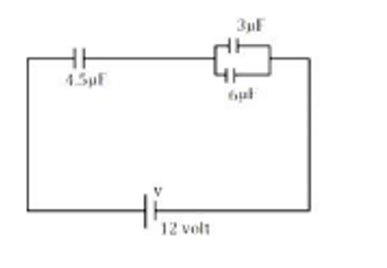
In the circuit shown, the potential difference across the 4.5 capacitor is
1
volt
2
8 volt
3
6 volt
4
4 volt
Official Solution
Correct Option: (2)
Step 1: Analyzing the circuit. The circuit consists of capacitors in series and parallel. The total potential difference of 12 volts is applied across the series combination of the capacitors. To find the potential difference across the 4.5 capacitor, we need to use the equivalent capacitance of the series combination. For two capacitors in series, the formula for the total capacitance is:
where and . Solving for , we get:
Step 2: Finding the potential difference. The total voltage volts is distributed across the capacitors. The potential difference across each capacitor in series is inversely proportional to its capacitance. The potential difference across the 4.5 capacitor is 8 volts, as obtained from the voltage divider rule. Step 3: Conclusion. Thus, the correct answer is (B) 8 volt.
25
PYQ 2020
medium
physicsID: mht-cet-
An air-filled parallel plate capacitor has a uniform electric field in the space between the plates. If the distance between the plates is and area of each plate is , the energy stored in the capacitor is ( = permittivity of free space)
1
2
3
4
Official Solution
Correct Option: (1)
Step 1: Write energy density of electric field. Energy density in an electric field is Step 2: Find volume between capacitor plates.
Step 3: Calculate total energy stored.
Step 4: Conclusion. The energy stored in the capacitor is .
26
PYQ 2020
medium
physicsID: mht-cet-
A capacitor of unknown capacitance is connected across a battery of volt. The charge stored in it becomes coulomb. When potential across the capacitor is reduced by volt, the charge stored in it becomes coulomb. The capacitance is
1
2
3
4
Official Solution
Correct Option: (4)
Step 1: Understanding the capacitor's equation. The capacitance of a capacitor is given by: Where is the charge stored and is the potential across the capacitor. The change in charge is proportional to the change in voltage, thus: Therefore, the capacitance is given by , and the correct answer is (D).
27
PYQ 2025
medium
physicsID: mht-cet-
In an isobaric process of an ideal gas, the ratio of heat supplied and work done by the system is .
1
1
2
3
4
Official Solution
Correct Option: (3)
Step 1: Concept
For an isobaric process: and . Step 2: Analysis
Ratio . Step 3: Calculation
We know .
.
Divide numerator and denominator by :
. Step 4: Conclusion
Hence, the ratio is . Final Answer: (C)
28
PYQ 2025
medium
physicsID: mht-cet-
The scale of a galvanometer is divided into 160 equal divisions. The galvanometer shows full scale deflection of and maximum voltage is . Now the range is changed so that galvanometer reads . The required resistance to be connected is
1
in series.
2
in series.
3
in parallel.
4
in parallel.
Official Solution
Correct Option: (1)
Concept:
To convert galvanometer to voltmeter:
Step 1: Find galvanometer resistance. Step 2: Required total resistance. Step 3: Series resistance. Step 4: Conclusion. Required resistance = (series)
29
PYQ 2025
medium
physicsID: mht-cet-
A capacitor has a capacitance of and a potential difference of is applied across it. What is the charge on the capacitor?
1
2
3
4
Official Solution
Correct Option: (2)
Calculate the Charge on the Capacitor
We are given the following data:
Capacitance
Potential difference
Step 1: Recall the formula for the charge on the capacitor
The formula is:
Step 2: Substitute the given values
Conclusion:
The charge on the capacitor is .
The correct answer is:
Option 2:
30
PYQ 2025
easy
physicsID: mht-cet-
A 10 charge is placed in an electric field of . What is the force experienced by the charge?
1
2
3
4
Official Solution
Correct Option: (1)
Step 1: Use the formula for force in an electric field The force experienced by a charge in an electric field is given by: Step 2: Substitute the given values Given: - Charge - Electric field Answer: Therefore, the force experienced by the charge is . So, the correct answer is option (1).