A string of length fixed at one end carries a body of mass at the other end. The mass is revolved in a circle in horizontal plane making angle with vertical. The angular frequency of the body is . The tension in the string is
1
2
3
4
Official Solution
Correct Option: (2)
Step 1: Recognize the motion. This is a conical pendulum. The mass moves in a horizontal circle while the string makes constant angle with vertical. Step 2: Forces acting on mass. Two forces act: • Weight downward
• Tension along string Horizontal component of tension provides centripetal force. Step 3: Radius of circular path. If string length is : $ r=L\sin\theta \sin\theta \theta $
02
PYQ 2014
medium
physicsID: mht-cet-
A particle moves around a circular path of radius 'r' with uniform speed 'V'. After moving half the circle, the average acceleration of the particle is
1
2
3
4
Official Solution
Correct Option: (3)
Concept: Physics (Circular Motion) - Average Acceleration. Step 1: Determine the change in velocity. At the end points of a half revolution, the magnitude of the velocity remains the same ( ), but its direction is exactly opposite.
Taking one direction as positive and the other as negative:
$ \pi r V a $
03
PYQ 2016
medium
physicsID: mht-cet-
A particle moves along a circle of radius ? ? with constant tangential acceleration. If the velocity of the particle is ? ? at the end of second revolution, after the revolution has started then the tangential acceleration is
1
2
3
4
Official Solution
Correct Option: (1)
Answer (a)
04
PYQ 2017
easy
physicsID: mht-cet-
A flywheel at rest is to reach an angular velocity of 24 rad/s in 8 second with constant angular acceleration. The total angle turned through during this interval is
1
24 rad
2
48 rad
3
72 rad
4
96 rad
Official Solution
Correct Option: (4)
To determine the total angle turned through by a flywheel starting from rest and reaching an angular velocity of 24 rad/s in 8 seconds with constant angular acceleration, we can use the kinematic equations for rotational motion. Given: - Initial angular velocity, rad/s (since it starts from rest) - Final angular velocity, rad/s - Time, seconds First, we need to find the angular acceleration . Using the kinematic equation for angular velocity:
Solving for :
Now, to find the total angle turned through, we use the kinematic equation for angular displacement:
Substituting the known values:
Thus, the total angle turned through by the flywheel during this interval is option (D) .
05
PYQ 2020
medium
physicsID: mht-cet-
Two small drops of mercury each of radius coalesce to form a large single drop. The ratio of the total surface energies before and after the change is
1
2
3
4
Official Solution
Correct Option: (3)
Step 1: Surface energy formula. Surface energy is directly proportional to the surface area of the drop. The surface area of a spherical drop is , and the surface energy is proportional to the surface area. Step 2: Before and after coalescence. Initially, there are two drops, each with radius , and after coalescence, the radius of the large drop becomes . The total surface energy before the change is proportional to , and after the change, it is proportional to . Step 3: Conclusion. Thus, the ratio of the total surface energies before and after the change is , so the correct answer is (C).
06
PYQ 2020
medium
physicsID: mht-cet-
The moment of inertia of a ring about an axis passing through its centre and perpendicular to its plane is . It is rotating with angular velocity . Another identical ring is gently placed on it so that their centres coincide. If both the rings rotate about the same axis, then loss in kinetic energy is
1
2
3
4
Official Solution
Correct Option: (3)
Step 1: Initial angular momentum. Initially, only one ring is rotating.
Step 2: Final angular velocity using conservation of angular momentum. After placing the second identical ring, total moment of inertia becomes .
Step 3: Initial kinetic energy.
Step 4: Final kinetic energy.
Step 5: Loss in kinetic energy.
Step 6: Conclusion. The loss in kinetic energy is .
07
PYQ 2020
medium
physicsID: mht-cet-
For a gas . This gas is made up of molecules which are
1
diatomic
2
polyatomic
3
monoatomic
4
mixture of diatomic and polyatomic
Official Solution
Correct Option: (3)
Step 1: Relation between and degrees of freedom. For an ideal gas, where is the number of degrees of freedom. Step 2: Using the given ratio. Given Step 3: Determining degrees of freedom.
Step 4: Identifying the gas. A gas with 3 degrees of freedom is monoatomic. Step 5: Conclusion. The gas is monoatomic.
08
PYQ 2020
medium
physicsID: mht-cet-
Two concentric circular coils of turns each are situated in the same plane. Their radii are and ( ) and they carry currents and respectively ( ) in opposite direction. The magnetic field at the centre is
1
2
3
4
Official Solution
Correct Option: (1)
Step 1: Magnetic field due to a circular coil. Magnetic field at the centre of a circular coil of radius carrying current is Step 2: Fields due to individual coils. For inner coil: For outer coil: Step 3: Net magnetic field. Since currents are in opposite directions, the resultant field is Step 4: Conclusion. The magnetic field at the centre is given by option (A).
09
PYQ 2020
medium
physicsID: mht-cet-
At any instant, the magnitude of the centripetal force on a particle of mass performing circular motion is given by
1
2
3
4
Official Solution
Correct Option: (4)
Step 1: Understanding centripetal force. The centripetal force on a particle moving in a circle of radius with velocity is given by: Since , where is the angular velocity, the expression for centripetal force becomes: Step 2: Conclusion. Thus, the magnitude of the centripetal force is , corresponding to option (D).
10
PYQ 2020
medium
physicsID: mht-cet-
A motorcycle racer takes a round with speed 20 m/s on a curved road of radius 40 m. The leaning angle of the motorcycle with vertical for safe turn is
1
75°
2
45°
3
60°
4
30°
Official Solution
Correct Option: (2)
Step 1: Understanding the centripetal force. The motorcycle moves along a curved path, so the centrifugal force must be balanced by the component of gravitational force. The relation for the leaning angle is: where is the speed, is the radius, and is the acceleration due to gravity. Substituting these values: Step 2: Finding the angle. Thus, . Step 3: Conclusion. Therefore, the leaning angle is 45°, corresponding to option (B).
11
PYQ 2020
medium
physicsID: mht-cet-
A plano-convex lens is made from glass of refractive index . The radius of curvature of its curved surface is . Its focal length is
1
2
3
4
Official Solution
Correct Option: (2)
Step 1: Use the lens maker’s formula. For a thin lens in air,
Step 2: Identify radii of curvature. For a plano-convex lens, one surface is plane, so
Step 3: Substitute values.
Step 4: Calculate focal length.
Step 5: Conclusion. The focal length of the plano-convex lens is .
12
PYQ 2020
medium
physicsID: mht-cet-
A particle of mass is rotating in a horizontal circle of radius with uniform velocity . The change in its momentum at two diametrically opposite points will be:
1
2
3
4
Official Solution
Correct Option: (3)
Step 1: Change in Momentum. At two diametrically opposite points, the velocity vectors of the particle will have opposite directions. Therefore, the change in momentum will be:
The negative sign indicates the reversal in direction. Step 2: Conclusion. Thus, the change in momentum at the two points is .
13
PYQ 2020
medium
physicsID: mht-cet-
A particle of mass 4 gram moves along a circle of radius cm with constant tangential acceleration. After beginning of the motion, by the end of second revolution, the kinetic energy of the particle becomes J. The magnitude of tangential acceleration is:
1
2
3
4
Official Solution
Correct Option: (3)
Step 1: Using the formula for Kinetic Energy. The kinetic energy of a particle is given by:
The relationship between the final velocity and tangential acceleration is:
where is the tangential acceleration, and is the time. From the problem, we can relate the change in kinetic energy to the tangential acceleration to solve for . After solving for , we find:
Step 2: Final Answer. Thus, the magnitude of tangential acceleration is .
14
PYQ 2020
medium
physicsID: mht-cet-
Earth revolves round the sun in a circular orbit of radius . The angular momentum of the revolving earth is directly proportional to
1
2
3
4
Official Solution
Correct Option: (3)
Step 1: Expression for angular momentum.
Step 2: Orbital speed of earth. For circular orbit:
Step 3: Substituting in angular momentum.
Step 4: Conclusion. Angular momentum is proportional to .
15
PYQ 2020
medium
physicsID: mht-cet-
Mass of is attached to a string moving in a horizontal circle with angular velocity cycle/min. Keeping radius constant, tension in the string is made times by increasing angular velocity . The value of of that mass will be
1
cycle/s
2
cycle/s
3
cycle/s
4
cycle/s
Official Solution
Correct Option: (1)
Step 1: Relation between tension and angular velocity. For uniform circular motion, tension provides centripetal force: With and constant,
Step 2: Use the given condition. Tension is made times:
Step 3: Convert initial angular speed to cycle/s. Given cycle/min:
Step 4: Find the new angular speed.
Step 5: Conclusion. The required angular velocity is cycle/s.
16
PYQ 2020
medium
physicsID: mht-cet-
In non-uniform circular motion, the ratio of tangential acceleration to radial acceleration is radius of circle, speed and angular acceleration)
1
2
3
4
Official Solution
Correct Option: (2)
Step 1: Understanding tangential and radial acceleration. In non-uniform circular motion, the total acceleration can be split into two components: tangential acceleration ( ) and radial (centripetal) acceleration ( ). - The tangential acceleration is given by:
where is the radius and is the angular acceleration. - The radial acceleration is given by:
where is the speed. Step 2: Calculate the ratio of tangential to radial acceleration. The ratio of tangential acceleration to radial acceleration is:
Step 3: Conclusion. Thus, the ratio of tangential acceleration to radial acceleration is proportional to , which corresponds to option (B).
17
PYQ 2020
medium
physicsID: mht-cet-
The maximum velocity of the photoelectron emitted by the metal surface is . Charge and mass of the photoelectron are denoted by and respectively. The stopping potential in volt is
1
2
3
4
Official Solution
Correct Option: (2)
Step 1: Relation between kinetic energy and stopping potential. The maximum kinetic energy of the photoelectron is given by:
The stopping potential is the potential that stops the photoelectron and is related to its kinetic energy:
By equating the kinetic energy and the work done by the stopping potential:
Solving for the stopping potential:
Step 2: Conclusion. Thus, the correct answer is (B) }.
18
PYQ 2020
medium
physicsID: mht-cet-
A particle is performing uniform circular motion. If , , and are its angular displacement, angular velocity, angular acceleration and centripetal acceleration respectively, then which of the following is WRONG?
( is its linear velocity)
1
2
3
4
Official Solution
Correct Option: (3)
Step 1: Nature of uniform circular motion. In uniform circular motion, angular velocity is constant in magnitude and direction. Hence, angular acceleration .
Step 2: Analyze each option. (A) : Correct, since centripetal acceleration is radial and velocity is tangential. (B) : Correct, angular velocity is along axis of rotation while linear velocity is tangential. (C) : Wrong, because in uniform circular motion, so perpendicularity has no meaning. (D) : Correct, is radial in plane of motion and is perpendicular to that plane.
Step 3: Conclusion. The incorrect statement is .
19
PYQ 2020
medium
physicsID: mht-cet-
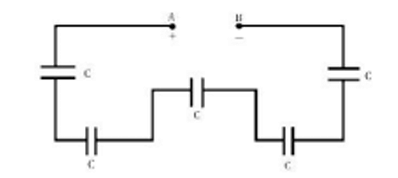
Five capacitors each of capacity are connected as shown in the figure. If their resultant capacity is 2\mu F, then the capacity of each condenser is
1
2.5 \mu F
2
2 \mu F
3
10 \mu F
4
5 \mu F
Official Solution
Correct Option: (3)
Step 1: Analyze the capacitor combination.
The five capacitors are arranged in series and parallel combinations. Let's assume the capacitors are in the following configuration: two capacitors in series and the result in parallel with the other three. Step 2: Calculate the equivalent capacitance.
For capacitors in series, the equivalent capacitance is given by:
Thus, . For capacitors in parallel, the equivalent capacitance is the sum of the individual capacitances:
Step 3: Apply the result to the given total capacitance.
Given that the total capacitance is 2 \mu F:
Thus, the correct answer is (C) 10 \mu F.
20
PYQ 2020
medium
physicsID: mht-cet-
A particle performing U.C.M. of radius makes revolutions in time . Its tangential velocity is
1
2
3
4
Official Solution
Correct Option: (4)
Step 1: Expression for tangential velocity. Tangential velocity in uniform circular motion is
Step 2: Find angular velocity. If the particle completes revolutions in time ,
Step 3: Substitute given radius.
21
PYQ 2020
medium
physicsID: mht-cet-
Two cars of masses and are moving in circles of radii and respectively. Their speeds are such that they make complete circles in the same time . The ratio of their centripetal force is
1
2
3
1 : 1
4
Official Solution
Correct Option: (4)
Step 1: Understanding centripetal force. The centripetal force acting on an object moving in a circle is given by the formula: where is the mass, is the velocity, and is the radius. Step 2: Considering the same time period. Since the two cars complete the circles in the same time , their velocities are related by: Thus, the centripetal forces for the two cars are: Simplifying, we get the ratio of the centripetal forces as: Step 3: Conclusion. Thus, the ratio of the centripetal forces is , which corresponds to option (D).
22
PYQ 2020
medium
physicsID: mht-cet-
In the case of conical pendulum, if is the tension in the string and is the semi-vertical angle of the cone, then the component of tension which balances the centrifugal force in equilibrium position is
1
2
3
4
Official Solution
Correct Option: (1)
Step 1: Understanding the forces. In a conical pendulum, the forces acting on the bob are the tension and the centrifugal force. The tension is resolved into two components: one along the string ( ) and one perpendicular to the string ( ). The centrifugal force is balanced by the horizontal component of the tension. Step 2: Conclusion. Thus, the component of the tension that balances the centrifugal force is , which corresponds to option (A).
23
PYQ 2020
medium
physicsID: mht-cet-
A particle moves along a circular path of radius with uniform speed . The angle described by the particle in one second is
1
2
3
4
Official Solution
Correct Option: (4)
Step 1: Understanding the concept of angular velocity. In uniform circular motion, the angle described by the particle per unit time is related to the angular velocity, which can be expressed as:
where is the linear velocity of the particle and is the radius of the circular path. This equation represents the angular velocity in radians per second. Step 2: Derivation of the angle. The angular velocity, , is given by the formula:
Since the angle described by the particle in one second is the angular velocity, we conclude that in one second, the angle is equal to radians. Step 3: Final Answer. Thus, the correct answer is , which corresponds to option (D).
24
PYQ 2020
medium
physicsID: mht-cet-
A train has to negotiate a curve of radius m, the distance between the rails is m and outer rail is raised above inner rail by distance of m. If the angle of banking is small, the safety speed limit on this banked road is
1
2
3
4
Official Solution
Correct Option: (1)
Step 1: Safety speed equation. The safety speed limit for a train negotiating a curve is determined by the formula: Where is the radius of curvature, is the acceleration due to gravity, is the height difference between the rails, and is the distance between the rails. Thus, the correct answer is (A) .
25
PYQ 2020
medium
physicsID: mht-cet-
A string of length fixed at one end carries a mass at the other end. The string makes revolutions / second around the vertical axis through the fixed end as shown in figure. The tension in the string is}
1
2
3
4
Official Solution
Correct Option: (1)
Step 1: Centripetal force on the mass. The mass moves in a circle and experiences centripetal force, which is provided by the tension in the string. The angular velocity is given by:
Step 2: Tension and centripetal force relation. The centripetal force on the mass is: Substitute : Since , this simplifies to:
Step 3: Conclusion. The tension is .
26
PYQ 2020
medium
physicsID: mht-cet-
A bucket containing water is revolved in a vertical circle of radius . To prevent the water from falling down, the minimum frequency of revolution required is (where = acceleration due to gravity)
1
2
3
4
Official Solution
Correct Option: (1)
Step 1: Condition for water not falling down. To prevent the water from falling, the centripetal force must be at least equal to the weight of the water. The condition for the critical velocity is:
Step 2: Relating velocity and frequency. The velocity for a body in circular motion is related to frequency by:
Step 3: Solving for minimum frequency. Equating the two expressions for :
Step 4: Conclusion. The minimum frequency required is .
27
PYQ 2020
medium
physicsID: mht-cet-
A heavy mass is attached at one end of a thin wire and whirled in a vertical circle. The chances of breaking the wire are maximum when
1
the wire is horizontal.
2
the mass is at the lowest point of the circle.
3
the wire makes an angle of 60° with the horizontal.
4
the mass is at the highest point of the circle.
Official Solution
Correct Option: (2)
Step 1: Tension in the wire. The tension in the wire when the mass is at the lowest point of the circle is the highest because, at that point, both the gravitational force and the centripetal force act in the same direction, requiring the maximum tension to hold the mass. At the highest point of the circle, the forces work against each other, so the tension is less.
Step 2: Analyzing the options. - (A) The wire is horizontal, but the tension will not be at its maximum at this point. - (B) The mass is at the lowest point of the circle, where the chances of breaking the wire are maximum because the tension is highest. - (C) The wire makes an angle of 60° with the horizontal; this is not the point of maximum tension. - (D) The mass is at the highest point of the circle, but the tension here is less than at the lowest point.
Step 3: Conclusion. The correct answer is (B), as the chances of breaking the wire are maximum when the mass is at the lowest point of the circle.
28
PYQ 2020
medium
physicsID: mht-cet-
Two cars of masses and are moving in the circles of radii and respectively. Their angular speeds and are such that they both complete one revolution in the same time . The ratio of linear speed of to the linear speed of is
1
2
3
4
Official Solution
Correct Option: (1)
Step 1: Relationship between linear and angular velocity. The linear velocity is related to the angular velocity by the formula: where is the radius of the circular path and is the angular velocity. Step 2: Applying the given conditions. Since both cars complete one revolution in the same time , their angular velocities are related by: Since the time is the same for both, the linear velocities of the cars are: Step 3: Ratio of linear speeds. The ratio of linear speeds is: Step 4: Conclusion. Thus, the ratio of the linear speeds is . Therefore, the correct answer is (A).
29
PYQ 2020
medium
physicsID: mht-cet-
A ball of mass is attached to the free end of an inextensible string of length . Let be the tension in the string. The ball is moving in a horizontal circular path about the vertical axis. The angular velocity of the ball at any particular instant will be
1
2
3
4
Official Solution
Correct Option: (1)
Step 1: Understanding the problem. The ball is moving in a horizontal circular path, and the forces acting on it are tension in the string and the centripetal force required for circular motion.
Step 2: Using the centripetal force formula. The centripetal force required to maintain circular motion is given by , where is the angular velocity and is the length of the string. The tension provides the centripetal force. Thus, .
Step 3: Solving for angular velocity. Solving for , we get: Thus, the angular velocity of the ball is .
Step 4: Conclusion. The correct answer is (A).
30
PYQ 2020
medium
physicsID: mht-cet-
A mass is tied to one end of a spring and whirled in a horizontal circle with constant angular velocity. The elongation in the spring is 1 cm. If the angular speed is doubled, the elongation in the spring is 6 cm. The original length of the spring is
1
3 cm
2
9 cm
3
6 cm
4
12 cm
Official Solution
Correct Option: (2)
Step 1: Identify the force acting on the mass. When a mass attached to a spring is whirled in a horizontal circle, the required centripetal force is provided by the spring force. Thus,
where is the spring constant, is the elongation, is the angular speed, and is the radius of the circular motion.
Step 2: Write equations for the two given conditions. Let the natural length of the spring be . For angular speed , elongation : When the angular speed is doubled, , elongation :
Step 3: Eliminate constants and solve for the natural length. Dividing the second equation by the first:
Step 4: Final conclusion. The original (natural) length of the spring is .
31
PYQ 2020
medium
physicsID: mht-cet-
Two stones of masses and are whirled in horizontal circles, the heavier one in radius and lighter one in radius . The tangential speed of lighter stone is times that of the heavier stone when both experience the same centripetal force. The value of is
1
2
2
3
3
1
4
4
Official Solution
Correct Option: (2)
Step 1: Write the formula for centripetal force.
Step 2: Write force equations for both stones. For lighter stone: For heavier stone: Step 3: Equate the forces.
Step 4: Simplify.
Step 5: Conclusion. The tangential speed of the lighter stone is 3 times that of the heavier stone.
32
PYQ 2020
medium
physicsID: mht-cet-
The angular speed of the minute hand of a clock in degrees per second is
1
2
3
4
Official Solution
Correct Option: (2)
Step 1: Determine angular displacement of minute hand. The minute hand completes one full revolution in minutes, i.e. in seconds. Step 2: Calculate angular speed.
Step 3: Conclusion. The angular speed of the minute hand is .
33
PYQ 2020
medium
physicsID: mht-cet-
A particle rotates in a horizontal circle of radius in a conical funnel, with speed . The inner surface of the funnel is smooth. The height of the plane of the circle from the vertex of the funnel is (g = acceleration due to gravity)
1
2
3
4
Official Solution
Correct Option: (3)
Step 1: Understanding the forces involved. In this problem, the particle rotates in a horizontal circle inside a conical funnel. The centripetal force is provided by the component of the gravitational force acting along the surface of the funnel. This force is balanced by the vertical component of the tension in the string. The height of the circle from the vertex of the funnel can be related to the velocity and the radius using the equation:
where is the speed of the particle and is the acceleration due to gravity. Step 2: Conclusion. Thus, the height of the circle from the vertex of the funnel is , which is option (C).
34
PYQ 2020
medium
physicsID: mht-cet-
A particle moves along a circular path with decreasing speed. Hence
1
its resultant acceleration is towards the centre.
2
its angular momentum remains constant.
3
the direction of angular momentum remains constant.
4
it moves in a spiral path with decreasing radius.
Official Solution
Correct Option: (3)
Step 1: Understanding the motion of the particle. As the particle moves along a circular path with decreasing speed, it experiences a change in velocity. The direction of the angular momentum of the particle (which is perpendicular to the plane of motion) remains unchanged. The decrease in speed implies that the particle is losing kinetic energy, but the direction of the angular momentum vector remains constant. Step 2: Conclusion. Thus, the correct answer is (C) the direction of angular momentum remains constant.
35
PYQ 2024
medium
physicsID: mht-cet-
What is the safety speed for a vehicle moving along a curved horizontal banked road?
Official Solution
Correct Option: (1)
Step 1: Forces acting on the vehicle.
For a vehicle moving on a banked curve, the forces acting are: Gravitational force ( ). Normal reaction force ( ). Frictional force ( ). The net force provides the necessary centripetal force for circular motion. Step 2: Resolving forces.
The component of the normal reaction along the radius provides the centripetal force:
where is the speed, is the radius of the curve, and is the banking angle. Step 3: Frictionless case (Safety speed).
For the safety speed, assume friction is negligible. The normal force's component balances the centripetal force:
Solve for :
Step 4: Final Answer.
The safety speed is:
36
PYQ 2024
medium
physicsID: mht-cet-
If is the magnitude of linear momentum of a particle executing a uniform circular motion, then the ratio of centripetal force acting on the particle to its linear momentum is given by:
1
.
2
.
3
.
4
.
Official Solution
Correct Option: (1)
Step 1: Relationship between centripetal force and linear momentum.
The centripetal force for a particle in uniform circular motion is given by:
where is the mass of the particle, is its velocity, and is the radius of the circular path. The magnitude of linear momentum is given by:
Step 2: Ratio of to .
The ratio of centripetal force to linear momentum is:
Step 3: Conclusion.
The ratio of centripetal force to linear momentum is .
37
PYQ 2025
hard
physicsID: mht-cet-
A car of mass 1000 kg is moving in a circular path of radius 50 m with a speed of 20 m/s. Calculate the centripetal force acting on the car.
1
2
3
4
Official Solution
Correct Option: (1)
A car of mass 1000 kg is moving in a circular path of radius 50 m with a speed of 20 m/s. We need to calculate the centripetal force acting on the car. The formula for centripetal force is:
Where:
(mass of the car)
(speed of the car)
(radius of the circular path)
Plugging in the values, we get:
Simplifying further:
The correct computation yields:
Thus, the centripetal force acting on the car is .
38
PYQ 2025
medium
physicsID: mht-cet-
An alternating voltage is connected to a capacitor through an a.c. ammeter. The ammeter reading will be
1
2
3
4
Official Solution
Correct Option: (1)
Concept:
For capacitor in AC:
Step 1: Find and . Step 2: Calculate capacitive reactance. Step 3: Find current. Step 4: Conclusion. Ammeter reading =
39
PYQ 2025
medium
physicsID: mht-cet-
The molar specific heat of an ideal gas at constant pressure and constant volume is ' ' and ' ' respectively. If ' ' is a universal gas constant and the ratio of ' ' to ' ' is , then ' ' is equal to
1
2
3
4
Official Solution
Correct Option: (3)
Concept:
For an ideal gas:
Step 1: Express in terms of . Step 2: Substitute in Mayer's relation. Step 3: Find . Step 4: Find . Step 5: Conclusion.
40
PYQ 2025
medium
physicsID: mht-cet-
A ray of light from a monochromatic point source of light is incident at a point on the screen. If a thin mica film of thickness ' ' and refractive index ' ' is introduced in its path, then the optical path}
1
is decreased by .
2
is increased by .
3
is not affected.
4
is increased by .
Official Solution
Correct Option: (4)
Step 1: Definition
Optical path . Step 2: Comparison
Without film, path length .
With film, optical path . Step 3: Difference
Increase . Final Answer: (D)
41
PYQ 2025
medium
physicsID: mht-cet-
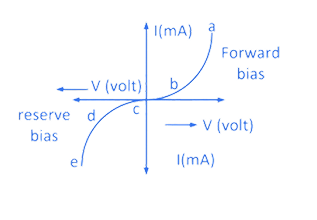
The graph given below represents I-V characteristics of zener diode. The part of the characteristics curve that is most relevant for its operation as a voltage regulator is
1
ab
2
bc
3
cd
4
de
Official Solution
Correct Option: (4)
Step 1: Zener Operation
A Zener diode works as a voltage regulator only in the **reverse breakdown region**. Step 2: Identifying Regions
- 'ab' and 'bc' are in the forward bias region.
- 'cd' is the reverse bias region before breakdown (leakage current).
- 'de' is the breakdown region where voltage remains almost constant despite large changes in current. Step 3: Conclusion
Region 'de' is the regulation region. Final Answer: (D)
42
PYQ 2025
easy
physicsID: mht-cet-
A car of mass 800 kg is moving in a circular path with a radius of 50 m at a speed of 20 m/s. Calculate the centripetal force acting on the car.
1
2
3
4
Official Solution
Correct Option: (1)
The centripetal force acting on an object moving in a circle is given by:
Where:
- is the mass of the car,
- is the speed of the car,
- is the radius of the circular path. Now, substitute the values:
Thus, the centripetal force acting on the car is .
43
PYQ 2025
medium
physicsID: mht-cet-
A particle is moving with a constant velocity of in a circular path of radius . What is the centripetal acceleration of the particle?
1
2
3
4
Official Solution
Correct Option: (2)
We are given the following data:
Velocity of the particle,
Radius of the circular path,
Step 1: Recall the formula for centripetal acceleration
The formula for centripetal acceleration is:
Step 2: Substitute the given values into the formula
Conclusion:
The centripetal acceleration of the particle is .
44
PYQ 2025
easy
physicsID: mht-cet-
A small object is tied to a string and whirled in a vertical circle of radius L. What should be the minimum speed at the topmost point of the circle so that the string just remains taut?
1
2
3
4
Zero
Official Solution
Correct Option: (2)
At the topmost point of the vertical circular motion, the only forces acting on the object are the tension in the string and the gravitational force. To ensure the string remains taut, the centripetal force must be at least equal to the weight of the object. The centripetal force is provided by the tension in the string and gravity. Let be the tension and the weight of the object. For the string to remain taut, the condition at the topmost point is: At the minimum speed, , so the equation becomes: Solving for , we get: Thus, the minimum speed required at the topmost point is .
45
PYQ 2026
medium
physicsID: mht-cet-
State the formula for the safety speed of a vehicle on a curved banked road.
1
2
3
4
Official Solution
Correct Option: (3)
Concept:
When a vehicle moves along a curved road, it requires a centripetal force directed towards the center of the circular path. On a banked road, the road is inclined at an angle with respect to the horizontal. This inclination helps provide the necessary centripetal force through the components of the normal reaction. A banked road allows vehicles to move safely around curves even without relying entirely on friction. The horizontal component of the normal reaction provides the centripetal force required for circular motion. Step 1: Forces acting on the vehicle.
Two main forces act on the vehicle:
• Weight of the vehicle acting vertically downward
• Normal reaction perpendicular to the road surface Step 2: Resolving forces.
The components of the normal reaction are:
• balancing the weight
• providing the centripetal force Step 3: Applying circular motion condition.
Centripetal force required:
Equating the horizontal component:
From vertical balance:
Dividing the two equations:
Therefore,
Thus, the safe speed of a vehicle on a banked curve is given by:
46
PYQ 2026
medium
physicsID: mht-cet-
What is the formula for the safety speed on a banked road?
1
2
3
4
Official Solution
Correct Option: (3)
Concept: When a vehicle moves along a curved banked road, the road is inclined at an angle . This inclination helps provide the necessary centripetal force required for circular motion without relying on friction. For a vehicle moving safely without slipping, the required centripetal force is provided by the horizontal component of the normal reaction. Step 1: Forces acting on the vehicle. Two main forces act on the vehicle: ⢠Weight acting vertically downward
⢠Normal reaction from the road surface Resolving the normal reaction: Step 2: Dividing the equations. Step 3: Solving for velocity. Thus, the safety speed on a banked road is given by
47
PYQ 2026
easy
physicsID: mht-cet-
Determine the minimum speed at the topmost point of a vertical circle of radius for the string to remain taut.