A thin light weight rod of diamagnetic substance such as silver is suspended in a uniform external magnetic field. It will align itself with its length
1
perpendicular to magnetic field.
2
inclined at an angle 120° to magnetic field.
3
inclined at an angle 45° to magnetic field.
4
parallel to magnetic field.
Official Solution
Correct Option:
(1)
Step 1: Diamagnetic behavior.
Diamagnetic substances create an induced magnetic field in the direction opposite to the applied magnetic field. This causes a force that tends to align the substance in a direction where it minimizes energy. Step 2: Orientation of the rod.
For a thin diamagnetic rod suspended in a uniform external magnetic field, it aligns itself perpendicular to the magnetic field. This minimizes the potential energy of the system, as the magnetic moment opposes the external field. Step 3: Conclusion.
The rod will align itself perpendicular to the magnetic field, so the correct answer is (A).
02
PYQ 2020
medium
physicsID: mht-cet-
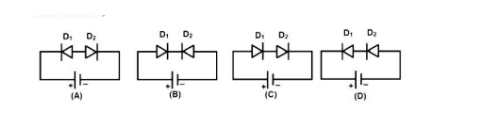
The non-zero potential difference across diode and that across diode are equal in the circuit shown in the figure (both diodes are identical in characteristics)
1
(A)
2
(B)
3
(D)
4
(C)
Official Solution
Correct Option:
(4)
Step 1: Analyze diode behavior. Identical diodes will have equal potential difference only if both are either forward biased with equal current or reverse biased identically.
Step 2: Examine circuit (C). In option (C), both diodes are forward biased symmetrically, ensuring identical current and hence equal potential difference across each diode.
Step 3: Final conclusion. Thus, the circuit in which both diodes have equal non-zero potential difference is option (C).
03
PYQ 2020
medium
physicsID: mht-cet-
A body of mass is moving along a circle of radius with linear speed . Now, to change the linear speed to and to move it along the circle of radius , required change in the centripetal force of the body is
1
decrease by
2
increase by
3
increase by
4
decrease by
Official Solution
Correct Option:
(1)
Step 1: Write initial centripetal force.
Step 2: New speed and radius.
Step 3: Write new centripetal force.
Step 4: Simplify the expression.
Step 5: Compare the two forces.
Step 6: Find the change in force. Decrease in force =
Step 7: Conclusion. The centripetal force decreases by of its original value.
04
PYQ 2020
medium
physicsID: mht-cet-
What is the stopping potential, when a metal surface with work function is illuminated with light of energy ?
1
2
3
4
Official Solution
Correct Option:
(4)
Step 1: Use Einstein’s photoelectric equation.
Step 2: Substitute given values.
Step 3: Relation with stopping potential.
Step 4: Conclusion. The stopping potential is .
05
PYQ 2020
medium
physicsID: mht-cet-
A transistor is connected in C-E mode. If collector current is and , then base current will be:
1
30
2
26
3
28
4
24
Official Solution
Correct Option:
(1)
Step 1: Relationship Between , , and . In a transistor, the relationship between collector current , base current , and is given by:
where is the emitter current. The emitter current is related to the base current by:
From this, we can calculate the base current as:
Substituting the given values:
Step 2: Final Answer. Thus, the base current is 30 .
06
PYQ 2020
medium
physicsID: mht-cet-
In a semiconductor diode, the barrier potential offers opposition to only:
1
majority carriers in both regions.
2
holes in the p-region.
3
minority carriers in both regions.
4
free electrons in the n-region.
Official Solution
Correct Option:
(4)
Step 1: Understanding Barrier Potential in Diodes. In a semiconductor diode, the barrier potential opposes the flow of current by impeding the movement of free electrons in the n-region. The majority carriers (electrons in n-region and holes in p-region) are unaffected by the barrier potential, but the minority carriers (electrons in p-region and holes in n-region) face resistance due to the potential. Step 2: Final Answer. Thus, the barrier potential offers opposition to free electrons in the n-region.
07
PYQ 2020
medium
physicsID: mht-cet-
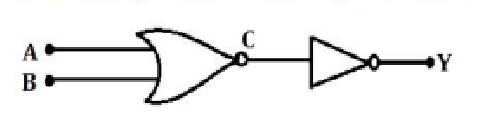
The resultant gate and its Boolean expression for the given circuit is
1
OR,
2
NOR,
3
NAND,
4
AND,
Official Solution
Correct Option:
(1)
Step 1: Analyzing the circuit. The circuit consists of an OR gate followed by a NOT gate (inverter). The OR gate gives the output , and the NOT gate inverts the output to produce . Step 2: Boolean expression. The output of the circuit is given by the expression , and the NOT gate inverts it. The final Boolean expression is . Step 3: Conclusion. The correct Boolean expression is , corresponding to option (A) OR gate.
08
PYQ 2020
medium
physicsID: mht-cet-
The region near the junction of an unbiased p-n junction diode is known as depletion layer. The layer is depleted of
1
only negative ions
2
electrons and holes
3
both positive and negative ions
4
only positive ions
Official Solution
Correct Option:
(2)
Step 1: Understanding depletion layer. In an unbiased p-n junction, electrons from the n-side and holes from the p-side diffuse across the junction and recombine.
Step 2: Charge carrier distribution. Due to recombination, mobile charge carriers (electrons and holes) are removed from the junction region. Only immobile ions remain in this region.
Step 3: Conclusion. Thus, the depletion layer is depleted of free electrons and holes.
09
PYQ 2020
medium
physicsID: mht-cet-
A spherical rubber balloon carries a charge, uniformly distributed over the surface. As the balloon is blown up and increases in size, the total electric flux coming out of the surface
1
Decreases.
2
Remains unchanged.
3
Increases.
4
Becomes zero.
Official Solution
Correct Option:
(2)
Step 1: Gauss's Law.
According to Gauss's law, the total electric flux through a closed surface is proportional to the charge enclosed inside the surface. The electric flux is given by:
where is the charge enclosed and is the permittivity of free space. Step 2: Behavior of flux with balloon size.
Since the charge is uniformly distributed over the surface and the charge itself does not change as the balloon inflates, the total electric flux remains constant. Step 3: Conclusion.
The total electric flux remains unchanged as the balloon increases in size, so the correct answer is (B).
10
PYQ 2020
medium
physicsID: mht-cet-
Photodiode is a device
1
in which photo current is dependent on the reverse bias.
2
which is always operated in forward bias.
3
in which photo current is independent of incident radiation.
4
which is always operated in reverse bias.
Official Solution
Correct Option:
(4)
Step 1: Understanding photodiodes. A photodiode is a semiconductor device that operates in reverse bias. When light hits the junction, it generates electron-hole pairs, which contribute to the photocurrent. This current is directly dependent on the incident radiation. Step 2: Conclusion. The correct answer is (D), as photodiodes are always operated in reverse bias to generate photocurrents.
11
PYQ 2020
medium
physicsID: mht-cet-
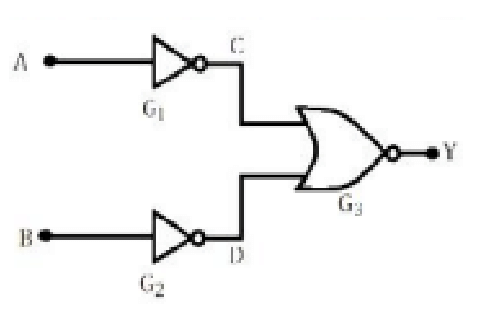
The resultant gate and its Boolean expression for the given circuit is
1
OR,
2
NAND,
3
NOR,
4
AND,
Official Solution
Correct Option:
(4)
Step 1: Identify individual gates. The first two gates and are NOT gates, so they invert inputs and .
Step 2: Analyze the final gate. The outputs of the NOT gates are fed into an OR gate with an inverted output, i.e., a NOR gate.
Step 3: Write Boolean expression.
Step 4: Apply De Morgan’s theorem.
Step 5: Conclusion. The resultant gate is AND gate with Boolean expression .
12
PYQ 2020
medium
physicsID: mht-cet-
In common emitter mode of transistor, the d.c. current gain is 20, the emitter current is 7 mA. The collector current is
1
2
3
4
Official Solution
Correct Option:
(4)
Step 1: Understanding the relation. In a common emitter configuration, the collector current is related to the emitter current by the following relation: Where is the current gain of the transistor. Given that the current gain is and the emitter current , we can find the collector current. Step 2: Calculating the collector current. Thus, the correct answer is (D) .
13
PYQ 2020
medium
physicsID: mht-cet-
The width of the depletion layer of a p-n junction diode, when it is (i) forward biased and (ii) reverse biased respectively
1
increases and increases.
2
decreases and decreases.
3
increases and decreases.
4
decreases and increases.
Official Solution
Correct Option:
(4)
Step 1: Understanding the behavior of depletion region. The width of the depletion layer in a p-n junction diode depends on the biasing conditions. - In forward bias, the width of the depletion region decreases because the external voltage reduces the barrier for charge carriers to cross the junction.
- In reverse bias, the width of the depletion region increases as the applied voltage enhances the barrier, making it harder for charge carriers to cross. Step 2: Conclusion. Thus, the width of the depletion layer decreases under forward bias and increases under reverse bias. Therefore, the correct answer is (D) decreases and increases.
14
PYQ 2020
medium
physicsID: mht-cet-
In energy band diagram of insulators, a band gap and the conduction band is respectively
1
very high, empty.
2
very low, partially filled.
3
very high, completely filled.
4
very low, empty.
Official Solution
Correct Option:
(1)
Step 1: Understanding the band gap. In insulators, the band gap between the valence band and the conduction band is very high, making it difficult for electrons to move into the conduction band. This is why insulators do not conduct electricity. Step 2: Analyzing the options. - (A) very high, empty: Correct, because in insulators, the conduction band is empty, and the band gap is large. - (B) very low, partially filled: Incorrect, this describes conductors or semiconductors. - (C) very high, completely filled: Incorrect, the conduction band remains empty in insulators. - (D) very low, empty: Incorrect, the band gap is high, not low. Step 3: Conclusion. The correct answer is (A), because insulators have a very high band gap and an empty conduction band.
About Semiconductor Devices - MHT-CET
Semiconductor Devices is a vital chapter for MHT-CET aspirants. Mastering the concepts covered in this chapter is essential for securing a top rank.
By rigorously practicing the previous year questions associated with this chapter, you can identify high-yield topics, understand the examiner's perspective, and boost your confidence during the actual exam.
Frequently Asked Questions
Why focus on Semiconductor Devices PYQs?
Analyzing PYQs for this specific chapter reveals the most frequently tested concepts and the typical complexity of questions, allowing you to tailor your study plan efficiently.
How to best use this analysis?
Review the topic breakdown to see which sub-topics within Semiconductor Devices carry the most weight. Then, tackle the questions iteratively to solidify your understanding.